BRIEFING
Structural safety—a public duty we cannot ignore
The horrific collapses of the World Trade Center towers following a terrorist attack on 11 September were a stark reminder of the potentially high human cost of structural failure. John Fenn of the UK structural safety body SCOSS reviews its latest, chillingly relevant report (page 147).

Eco-design—the need for new tools
If sustainability in the construction industry is to move beyond rhetoric, civil engineering and other construction designers need some new tools – such as life-cycle assessment software. John Dowling of Corus explains (page 148).

Avoiding the legal pitfalls of e-commerce
Most European civil engineering businesses now have some kind of web presence and many are starting to trade on-line – but probably not all are aware of the legal implications. John Warchus of law firm Shadbolt & Co highlights some of the more-likely pitfalls (page 150).

Funding European enlargement
Funding the construction of Europe in both the political and physical sense was the theme of this year's ICE annual European lecture given by Sir Brian Unwin, KCB. Diana Maxwell, formerly the ICE's European affairs manager, reports (page 151).
Quarterly reports— a fresh approach
Writing quarterly reports is an essential part of every graduate civil engineer's initial professional development. Gary Batchelor of Peter Brett Associates says it need not become a burden (page 152).

MONITOR
Proceedings
The editor's choice of recently published papers, details of forthcoming papers and a list of prize-winning papers published last year. (page 153).

Books
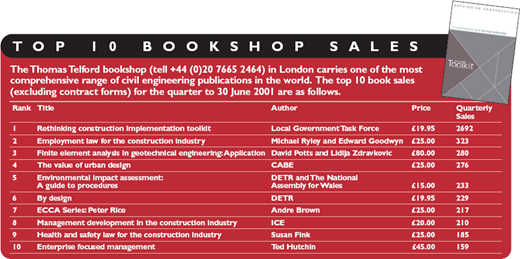
A list of civil engineering book reviews published on-line, details of recent ICE publications and the top 10 sales from the ICE book-shop (page 155).

Internet
Civil engineering website round up including the new ICE Proceedings archive, which makes all 20,000 ICE papers published since 1836 instantly available for just £5 each (page 156).

Events
Details of all forthcoming events organised by ICE headquarters staff on behalf of ICE boards and associated societies (page 159).
PAPERS
Graduate shortage: the key to civil engineering's future?
Recent years have seen a steady decline in admissions to UK civil engineering degree courses such that an intense skills shortage looms. According to Mike Byfield, civil engineering graduates will be in greater demand than ever before—but ironically this could finally trigger the increase in status which the profession has sought for so long (page 161).
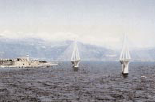
Rion-Antirion bridge, Greece— measuring a moving gap
Designing a 3·5 km bridge across an active geological fault-line in Greece is not without its difficulties – not least since the land masses on either side are constantly moving apart from each other. Nicholas Hytiris and Anastasios Kominos describe a satellite survey project to estimate what the movements are likely to be during the life of the bridge (page 166).
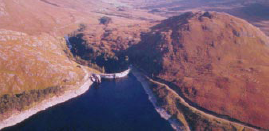
Britain's concrete dams— the final 50 years?
The second half of the 20th century saw over 60 large concrete dams built in Britain for a wide variety of water and power reservoirs. However, with increasing social and environmental concerns about such projects, the Maentwrog gravity of 10 years ago could be the UK's last. Chris Scott and Dominic Molyneux record an era that seems to be over (page 170).
Further reflections on megalith mechanics
The 4500-year-old circle of rocks at Stonehenge in England continues to fascinate today's civil engineers. Transporting and erecting the 40 t megaliths from which it is made would provide a logistical headache now let alone 45 centuries ago. John Simpson suggests our ancestors had even greater intellectual sophistication than previously imagined (page 181).

Eurocodes—failing to standardise safety
The first parts of the European Commission's suite of structural Eurocodes have been published this year and, within the next few years, will replace all national structural design codes. However, Mike Byfield and David Nethercot believe some further refinements are necessary to avoid creating weak links in structures (page 186).
Briefing: Structural safety a public duty we cannot ignore
The horrific collapses of the World Trade Center towers following a terrorist attack on 11 September were a stark reminder of the potentially high human cost of structural failure. John Fenn of the UK structural safety body SCOSS reviews its latest, chillingly relevant report.
The 13th report of the joint ICE/IStructE standing committee on structural safety (SCOSS), published earlier this year, has four themes
control of risks to structural safety
dynamic response of structures
naturally occurring environmental hazards to structures including climate change
duties to both warn and heed warnings.
The report also reviews influences on structural safety and current trends. Trends that are considered to have a potentially adverse effect on structural safety include
less time spent in reflection on design
loss of traditional systems checking
inhibition of individuals from giving or heeding warnings.
Attention is also drawn in the report to a number of trends intended to promote safety that may actually have adverse effects, for example the imposition of more severe fines and costs orders in health and safety prosecutions. There is believed to be an increasing reluctance to release technical information from experience and valuable opportunities for learning are lost. Keeping risks to structural safety—and safety more generally—acceptably low requires a learning culture throughout the industry.
Identification and control of risks
The report reviews risks to structural safety. Risks are found to arise through active errors by designers and site personnel and by latent errors introduced through inadequate procurement procedures, codes, standards and regulations. There may be gaps in codes and they may not cover recent innovation.
It is concluded that the control of risks depends primarily on the competence and integrity of individuals and organisations. Supervision and management systems should include third-party independent arrangements for checking safety-critical elements. The report also draws attention to the limitations of self-certification.
For structures, the failure of which from whatever cause (e.g. an extreme natural event, accident or malicious act) would have high consequences (e.g. a tall building), and for structures that are innovative or unfamiliar in relation to the experience of the project team, the report proposes an explicit process of risk management be used. The process should include the systematic identification of hazards and assessment of risk followed by the selection of critical situations for design.
Highlighting dynamic response dangers
An important technical area covered in the report concerns the dynamic response of structures, in particular cantilever-seating decks in sports stadia and pedestrian bridges. Cantilevered seating decks can be sensitive to changes in use as may occur when music is introduced to encourage rhythmic dancing of crowds. It is concluded that targeted research is needed to evaluate the uncertainties in the design of these structures.
The report applauds the valuable sharing of knowledge of the unexpected dynamic behaviour of the Millennium Bridge in London and draws attention to the possibility that other pedestrian bridges may suffer strong lateral vibration if subjected to large pedestrian loads in the future.
Attention is drawn to the duty of professional engineers to report previously unknown structural behaviour in the technical literature so that others may be alerted and learn. The report suggests that the behaviour of dynamically sensitive structures may not be sufficiently well covered in the education and training of civil and structural engineers.
Climate change and duties on warnings
In its penultimate theme the report discusses the implications of climate change for structural safety. It identifies approaches to maintaining safety as the climate changes and proposes assessment of the engineering implications through engineering research at national and international level based on continuous monitoring of the climate.
The last theme of the report concerns situations where there is a duty to warn or to heed warnings. The giving and heeding of warnings are essential parts of ensuring structural safety. The draft guidelines, prepared by a working group chaired by the late Edmund Hambly and published in 1991 by the Royal Academy of Engineering (included in the report as an appendix), are commended to engineers. They are particularly helpful in providing guidance on whether, when, who and how to warn in difficult situations.
SCOSS continues to see merit in proposals for a confidential reporting system relating to structural safety. The viability of such a system will depend on the level of demand and support. The committee seeks views from engineers on their perceptions of the need for such a system.
For more information please contact John Fenn at SCOSS on +44 (0)20 7201 9133 or fenn@istructe.org.uk.
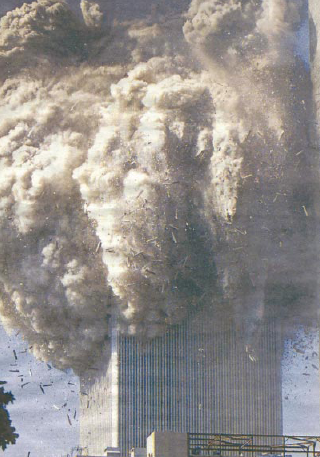
The collapse of the World Trade Center – the potentially vast human cost of structural failure means that anything that might affect structural safety cannot be ignored
The collapse of the World Trade Center – the potentially vast human cost of structural failure means that anything that might affect structural safety cannot be ignored
Briefing: Eco-design the need for new tools
If sustainability in the construction industry is to move beyond rhetoric, civil engineering and other construction designers need some new tools – such as life-cycle assessment software. John Dowling of Corus explains.
There are strong parallels between the UK Government's current drive for sustainability and the moves towards quality-driven manufacturing a generation ago.
In the face of a tide of high quality imports from the Far East in the 1980s, the Government promoted a quality agenda throughout British industry, initially against a great deal of resistance. Today, one would probably need to search long and hard to find anyone in a responsible role in manufacturing industry that regards quality as a cost rather than a benefit.
Similarly, sustainability will become the norm when it can be shown to be commercially beneficial to all involved. This is a prerequisite of UK Government environmental policy, which recognises the drive for sustainability needs to be tempered with social and economic considerations.
Life-cycle assessment software needed
But recognition alone is not enough. If sustainability is to become universal practice in, for example, the construction industry then the necessary design support tools must be put in the hands of civil engineers and other construction designers. Only then will we be able to start moving the problem along the awareness-solution continuum.
If specifiers and other decision makers are to be able to make informed decisions as to which construction forms will minimise overall environmental impacts, they must be able to calculate the major impacts of construction and use. The likely method by which this will be achieved will be through the development of robust and credible life-cycle assessment software supported with reliable data on a wide range of construction materials.
Life-cycle assessment involves evaluating the environmental impacts of a system or process involved in the production of a product across all stages of its life cycle – from cradle to grave. It has been used for many years in a number of industries such as chemical, automotive and packaging and is fundamental to the materials decision-making process in these areas. Its use is now being extended to the construction industry.
A life-cycle assessment can be used to identify environmental ‘hot-spots’ in the life cycle of a product, that is those stages which contribute most to the impacts of a process and also as the basis on which to compare the impacts of several products carrying out the same function.
However, the development of a full life-cycle assessment tool for the construction industry is still some years away. Data collection from myriad sources will almost certainly prove to be difficult and time-consuming and the end results will be no better than the quality of data received. In the meantime other, less-exhaustive, measures are being taken to improve building efficiency. The Building Research Establishment's BREEAM system is now being widely used in the UK. BREEAM provides a single-point environmental assessment score for office buildings.
Recycling or downcycling?
The construction industry must be prepared to develop information on design and construction methodologies which will minimise the requirement for repair and maintenance in buildings and maximise the potential for reusability and recyclability. Not a hopeless task, as some might argue. Even with current building materials, by using a carefully planned approach and a procurement process that emphasises recovery aspects, endof-life trials have demonstrated that it is possible to recover over 90% of building materials for reuse.
But as well as simplifying deconstruction and minimising waste, steps must also be taken to put in place the infrastructure to collect, process and redistribute products and materials with a high recycling potential.
At the same time, there needs to be a shift in the emphasis in recycling. Eco-architect Bill McDonough recently talked about the concept of ‘downcycling’ as opposed to ‘recycling’. By this he meant that so long as you are converting concrete beams into crushed aggregates or window panes into milk bottles you’re not recycling – you’re downcy-cling. It's losing quality. Truly recyclable materials are those that can be continuously converted back into the original product – such as steel and aluminium, which can be re-used or recycled ad infinitum.
Making structures more adaptable
The development of new, more environmentally effective, methods of construction along with the necessary design guidance is a further requirement. Ten years ago as the UK was coming out of recession, it was reported that almost 3 Mm2 of available office space in London was unusable because it was not fit for the purpose. Since then most of the buildings concerned have had to be removed and replaced at enormous financial and environmental cost.
Adaptability in use must become a central design plank if we are not to see the wholesale disposal of structurally sound buildings that have become unusable after extremely short functional lives.
In less than 50 years, the planet's population is expected to double with an eightfold increase in resource and environmental impact. The issue now is not whether mankind poses a threat to his environment; the issue is what practical steps we can take to temper our environmental imprint. From a construction perspective that means giving designers, as a matter of priority, the tools they need to pursue a low-risk approach to sustainable building.
For more information contact John Dowling at Corus on +44 (0)12244 05760 or john.dowling@corusgroup.com

Steel is considered to be a truly recyclable material as it can be continuously converted to its original form without loss of quality
Steel is considered to be a truly recyclable material as it can be continuously converted to its original form without loss of quality
Briefing: Avoiding the legal pitfalls of e-commerce
Most European civil engineering businesses now have some kind of web presence and many are starting to trade on-line – but probably not all are aware of the legal implications. John Warchus of law firm Shadbolt & Co highlights some of the most likely pitfalls.
The first stage of using the internet to promote or sell civil engineering products and services on-line is to chose an appropriate web address. Although domain name registration itself is relatively cheap and quick, much time and money can be lost if a favoured name has been snapped up by a third party.
The English courts have given firm judgments against ‘cyber squatting’, which is the unlawful practice whereby a party with no connection to a specific domain name registers it with the intention of selling it on to an interested party who has a connection to it. In such circumstances, a court may order the domain name to be transferred where it infringes a registered trade mark, another reason for ensuring that the marks are registered.
The clear lesson is to register all likely permutations of a domain name as soon as possible. In the absence of cyber squatting or other legal infringement, however, the law is still very much ‘first come, first served’ and the party to register a name first will be able to keep it.
Concluding contracts on-line
When trading on-line, civil engineers need to be wary when it comes to entering negotiations by e-mail. Contrary to popular opinion, there is no legal bar to entering a binding legal contract by way of e-mail.
Provided there is a clear offer and acceptance of all the vital terms, a contract will be concluded.
Accordingly, employees should be reminded of any limits on their authority to conclude contracts and consideration should be given to adding a disclaimer to e-mails stating that a particular employee cannot conclude agreements or that an e-mail order has to be confirmed in a specified way before the party is bound.
Regulations implemented by the UK government in October last year affect all on-line civil engineering suppliers in the business to consumer (‘B2C’) sector. They require an online supplier to display specified information before a contract is concluded, including
its identity and postal address
characteristics of the relevant goods/services
the price, delivery costs and any additional taxes
the existence of a right of withdrawal (for the consumer) from the contract.
Apart from limited exceptions, the regulations apply to all contracts where one party is a consumer. If an on-line supplier fails to comply, the consumer will have the seven-day period in which it can cancel the contract extended by an additional three months.
Limiting commercial liability
No prudent civil engineer trading on the Internet should do so without including a limitation-of-liability provision. Care will be needed as, under English law, the limitation of liability will only be valid to the extent that it is reasonable in the circumstances.
A long line of decisions on what constitutes ‘reasonable’ suggests that suppliers must have an objective justification for the limitation figure: as a rule of thumb, it will probably be justifiable to limit direct loss or damage to the contract value and to exclude all liability for indirect and consequential loss. This is an area where professional legal advice is recommended as loose wording can have significant legal or commercial consequences.
There is currently uncertainty in relation to disputes in consumer contracts concluded over the Internet. The European Commission has proposed that consumers should be able to sue the on-line supplier in the consumer's home state where the website has ‘targeted’ that state. This could be a real burden on the construction sector and industry pressure is forcing the Commission to consult further over this issue – watch this space.
Rules for using personal data
A website, particularly an interactive site, can be a great source for marketing information for future promotional activities. There is nothing to prevent an on-line civil engineering supplier collecting and using such information, provided that it bears in mind the impact of the Data Protection Act 1998 that came into force on 1 March 2000.
In broad terms, the Act applies to virtually all processing of personal data. In addition, manual filing systems are now covered by the rules as well as computer files. On-line suppliers should be aware of expanded rights in favour of individuals which include
the right to be informed as to whether data is held on him/her and what this data comprises
the right to object to processing of personal data for direct marketing purposes
the right to claim damages where loss is suffered as a result of any breach of the Act.
In order to comply with the new Act, it is therefore imperative that on-line suppliers publish, in a prominent place on the site, a privacy policy which explains clearly which information will be retained and how it may be used in the future. At the same time, there should be a clear and easy mechanism whereby an individual can indicate that he/she does not want personal details to be used for future marketing activities.
For further details contact the author on +44 17 3722 6277 or john_warchus@shadboltlaw.co.uk.

Look before you click - it is easier to conclude legally binding contracts on line than many people think
Look before you click - it is easier to conclude legally binding contracts on line than many people think
Briefing: Funding European enlargement
Funding the construction of Europe in both the political and physical sense was the theme of this year's ICE annual European lecture given by Sir Brian Unwin, KCB. Diana Maxwell, formerly the ICE's European affairs manager, reports.
The European Investment Bank (EIB) plays a strategic role as both the long-term financing institution of the European Union and also an autonomous financial institution. In 2000, the bank lent some €36 billion globally – at least two thirds of which is allocated to infrastructure projects that will link the single market and its neighbours in central and eastern Europe and the Mediterranean.
Through its borrowing and lending policies, the bank contributed to the establishment of economic and monetary union at the beginning of 1999 and the introduction of the Euro. Former bank chairman Sir Brian Unwin's view of the outlook for the Euro is a positive one. However, exclusion of the UK from the Euro zone could have a negative impact on the British financial services sector. The sector accounts for around 25% of gross domestic product, some 10 times more than agriculture, and is of great importance to the economy. Exclusion is also detrimental to those competing for contracts in a Europe, which still needs to develop its infrastructure, particularly as enlargement to the East takes place.
More funding needed for trans-European networks
The physical development of the EU has been assisted by large grants and loans directed by the Commission and EIB to less prosperous regions. Sir Brian considers the trans-European networks as an embodiment of the type of infrastructure projects of which the bank has long years of financing experience. Formalising the concept has given it higher political priority; the bank has advanced well over €50 billion for trans-European networks or related projects, representing a total investment of nearly €150 billion.
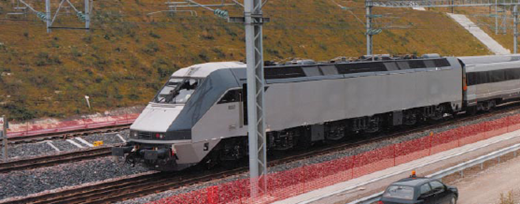
Since the mid-1990s, the trans-European networks have slipped down the political agenda. It is important they are brought back to the front line. Continuing economic growth brings congestion problems and accession will reinforce the problem, particularly in transit countries. Balance between rail freight and road traffic is still shifting too much in favour of road. There is an urgent need for added rail capacity and improved operational performance, requiring major investment effort in infrastructure and strong political will to create an integrated European transport system. Urgency is heightened by the long planning, approval and implementation time, coupled with the very long lead-time for infrastructure solutions.
The scarcity of public funds can be illustrated by the fact that the European budget line for trans-European networks is only €500 million a year against the required estimated investment of €200–300 billion over the next 20 years.
Limitations of public-private partnerships
The shortage of funds has led to increased privatisation and the encouragement of public-private partnerships in which the EIB played a pioneering role, particularly in the UK. Experience has been transferred elsewhere in the EU including the Dublin Ring road and Athens’ Spata airport.
However, Sir Brian Unwin urges caution in the use of public-private partnerships that are not a wholly proven concept and recommends they should be approached on a case-by-case basis. The partnerships can bring financial benefits in terms of risk allocation and efficiency gains through better and more cost-effective management. However, they must be paid for some time and a major public commitment will still be essential for large infrastructure projects. The lack of such commitment from British and French governments was a key factor in the difficulties of financing the Channel Tunnel.
Estimates indicate that the investment required annually to finance infrastructure in central and eastern Europe will be some 5% of gross domestic product (the combined economies of the countries of Central and Eastern Europe amount to 5–6% of EU GDP). The EIB will have the largest role to play alongside the European Commission, the London-based European Bank for Reconstruction and Development, the World Bank and other institutions. Some financing must come from the private banking sector, which contributes about a third of total foreign direct investment in the region.
The EIB is substantially the largest single source of external investment finance to EU applicant countries. Over €12 billion has been lent in 12 countries since 1990. A further €17 billion is committed between 2001–2007. But there is little prospect at present of taking forward public-private partnerships, attempts having failed in the road sector in Hungary, ‘one of the most sophisticated of the applicant countries’.
Institutional reform needed
Institutional reform is required within the EU and the Commission must be kept to a manageable size. As it is, business handled by up to 20 participants at meetings of the Council of Ministers is very difficult to conduct efficiently. In the April 2001 meeting of economic and finance ministers for example, a total of 68 ministers, central bank governors and commissioners were seated round the table. Progress is essential at the next inter-governmental conference in 2004 if the Union is to cope with enlargement.
Current enlargement targets may be excessively ambitious but Sir Brian Unwin concludes that the Union will get there and that the trans-European network will eventually reach out to more than 20 countries. ‘The history of the European Community has always been one of steadily moving forward … three paces forward and two paces back, but always making progress’.
Briefing: Quarterly reports a fresh approach
Writing quarterly reports is an essential part of every graduate civil engineer's initial professional development (IPD). Gary Batchelor of Peter Brett Associates says it need not become a burden.
Although the laws governing space and time dictate that the task of writing your quarterly report should only recur every three months, for many of us it seems to come round much quicker than that.
How can we, as busy young professionals, get this regular bit of ‘homework’ out of the way and get back to directing the great sources of power in nature, and yet still manage to have those annoying little boxes in our training agreements signed-off by either our supervising civil engineer (SCE) or delegated engineer (DE)?
Focusing on quality rather than quantity
It would seem that we are quite happy to spend hours value engineering the projects we work on, so that the client is delivered an economic end product that is fit for its intended purpose. Yet we do not apply the same ruthless techniques for eliminating activities that do not add value when it comes to writing our quarterly reports.
For instance, the commonly quoted figure of 1000 words is intended for guidance only and like all good ‘guidelines’ should be ignored as and when the situation dictates. If you can effectively record what you have learned in the last three months in 500 or even 100 words it is obviously pointless to try to pad your report with ‘waffle’ to make it up to 1000 words.
Quarterly reports are intended to be of value in helping to remind you of what you have achieved during your IPD. You may decide that it is of more value to prepare an A4 page summary of the activities in which you have been involved and what you feel you have learned from them and use this as the basis for an extended discussion with your SCE or DE.
Indeed, busy SCEs and DEs may prefer to be presented with an ‘executive summary’ and spend more time discussing what you have learnt rather than wading through a lengthy report prior to your quarterly review meeting. It is up to you to agree on an appropriate style for your reports with your SCE or DE.
Creating a personal development library
Although it is no longer a requirement to submit your quarterly reports as an appendix to your professional review application, they can be a valuable resource when you eventually come to write your experience and project reports. It is often difficult to recall the details of projects completed 12 months ago, let alone the projects you worked on at the beginning of your training agreement. Do not even be tempted to believe that you will readily be able to retrieve the relevant information from your company filing system either.
It is often a good idea to save copies of drawings, documents, photographs and so on to jog your memory. Many of us do this anyway. How often do you pin a photocopy of a document you regularly refer to on the wall? If you find yourself doing this a lot then why not make it a formal part of your training.
A ‘tongue-in-cheek’ suggestion is that an alternative ‘style’ of quarterly report is to fill up a box file of photocopies of all the useful documents you have been using and wish to keep for future reference and take this along for discussion with your SCE.
Another idea has been to change the name ‘quarterly reports’ to something more ‘touchy-feely’ like ‘personal development library’. If you develop the habit of saving copies of useful documents, this library will be an invaluable reference resource and will be an easy habit to retain until retirement, not just until your training review.
Getting in front and staying there
The whole point of writing quarterly reports is to form the basis for a discussion about your training with your SCE every three months and to provide sufficient evidence for your SCE or DE to determine how you are progressing in achieving your core and specific objectives.
Despite our best intentions, many of us find that we start getting behind with our reports and then inevitably discover we have even less enthusiasm for completing them. If you do find yourself in this situation then there is little point trying to catch up. The opportunity to meet regularly with your SCE and review your progress has been lost.
Instead, draw a line and just concentrate on getting your most recent report delivered on time. Use the current report to bridge over the gap and summarise all the activities you have been involved with in the period and discuss them with your SCE. It is certainly more valuable to do this, and a lot less frustrating, than to struggle to complete outof-date reports and find yourself falling further and further behind.
Remember, the reports are your documents. Produce only what you want to use in the future. Encourage and use your SCE's and DE's criticism. That is, after all, what they are there for and not, as is commonly believed, to be constantly on your back reminding you to write your damn quarterly reports!
Further advice on writing quarterly reports can be obtained from the ICE Membership department on +44 (0)20 7665 2200 or membership@ice.org.uk
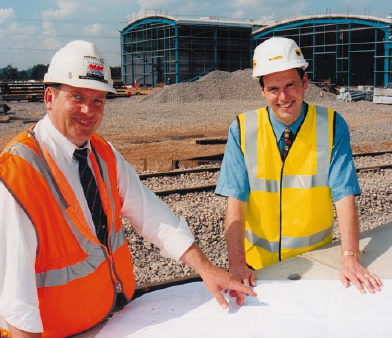
Quarterly reports are intended to make it easier to to review your progress with your supervising or delegated engineers – they should not be seen as a chore
Quarterly reports are intended to make it easier to to review your progress with your supervising or delegated engineers – they should not be seen as a chore
Monitor
Proceedings
EDITOR'S CHOICE
 | Building Bombay's giant sewage pump | |
| The complex task of rescuing and completing the massive underground Bandra sewage pumping station in Mumbai (formerly Bombay), India – one of the largest of its kind in the world – is reported by Edward Antonio and N. Adams. Designed to serve 13 million people, the World Bank-financed Mumbai sewerage scheme started in the early 1980s but two 33 m diameter by 35 m deep rock shafts at Bandra were abandoned and flooded after contracts ran into problems. Work restarted in 1996 and, to avoid the risk of siltation, the shafts had to be made 4 m wider and 12 m deeper. This in turn required a complex rock support system, particularly for the 3 m ‘neck’ between the two shafts. | ||
| (Geotechnical Engineering, Vol. 149, No. 3) | ||
 | Local authorities failing to involve the public | |
| UK local authorities are in danger of failing to involve the public properly in planning and implementing municipal engineering projects, according to this dedicated issue on community involvement and the politicians role. Honorary editor David Hodgkinson says the adoption of private-sector practices such as streamlined decision-making and best-value procurement means the public-sector risks making the common business mistake of forgetting its customers’ needs. Topics range from an analysis of the current planning process, the changing role of the politician and the ways in which society can be successfully involved on even complex and controversial issues. | ||
| (Municipal Engineer, Vol. 145, No. 2) | ||
 | Westminster station—London's deepest basement | |
| Building the new Westminster underground station on the Jubilee Line extension involved creating the deepest basement in London. The 40 m deep diaphragm-walled 'box' for the escalator hall was built in a particularly congested and historic site next to Big Ben and the Houses of Parliament. Excavation was carried out under a grillage supporting the existing District and Circle lines as well as the foundations for Portcullis House, the new parliamentary building. Paul Glass and Chris Stones of Balfour Beatty Amec joint venture also report on the associated monitoring, instrumentation and settlement control contract – one of the biggest undertaken world-wide. | ||
| (Structures and Buildings, Vol. 146, No. 3) | ||
 | North West at forefront of UK transport revolution | |
| The wide variety of integrated transport projects recently completed or underway in the North West of England —covering sea, land and air—put the region at the forefront of the UK transport revolution. According to editor Graham Harding of Lancashire County Council, the North West was the first region in the UK to publish a regional transport strategy, helping to ensure a balance between economic, social and environmental factors in future transport schemes. Transport projects covered in this dedicated issue include Manchester's Metrolink, its airport and outer ring road; Irish Sea ferry services, regional rail developments and the trans-Pennine corridor. | ||
| (Transport, Vol. 147, No. 3) | ||
 | Flood risk—the need for clarity | |
| Civil engineers should come clean on flood risk. Since no flood defences are absolutely secure, the public should be made aware of the level of residual risk in terms they can understand. ‘The concept of return period is not particularly helpful for communicating flood risk to the public at large,’ says author Rodney White of HR Wallingford. ‘It gives no measure of the likelihood of flooding in any given year, it can obscure the random nature of flooding and it can engender a false sense of security.’ Dr White recommends that civil engineers convey the flood risk in terms of an annual probability of occurrence, which people can understand more readily. | ||
| (Water and Maritime Engineering, Vol. 148, No. 2) | ||
Summaries of all papers published in ICE Proceedings journals since 1998 can be read free of charge at the ICE web site (www.ice.org.uk/jol). To subscribe to one or more journals call +44 (0)20 7665 2135 (members) or +44 (0)20 7665 2460 (non-members).
Forthcoming papers
The following papers have been accepted for publication in future issues of ICE Proceedings journals.
Civil Engineering
The replacement of UB30/398 Float Viaduct. M. Hackney
The EPC template for describing output standards in engineering. D. Muir Wood
21st Century Japanese Construction Mechatronics. M. D. Taylor, I. G. N. Smith and S. C. Wanuziri
The application of RTK-GPS in Bridge Safety Monitoring. M. McDonald, J. Guo, L. Xu, L. Dai, J. Wu and Y. Li
Energy efficiency benefits by innovation in hydraulic engineering. D. Piesold and G. Caro
Marketing—Art, Science or a branch of Engineering? J. Pratt
Geotechnical Engineering
Foundation piling steel to replace concrete. R. Dawson
Factored material properties and limit state loads—unlikely extreme or impossible pretence? R. A. Day
Rainfall-induced landslides in Singapore. D. G. Toll
Geotechnical engineering and building research. Part 2: 1935–1944. A. D. M. Penman
The Copenhagen Metro observational method at Norreport station. D. R. Beadman, R. Bailey, T. Roberts, S. Welman, P. Thurlow and M. Fauschou
Undrained analysis of earth berms as temporary supports for embedded retaining walls. W. Powrie and M. P. Daley
The status of the global positioning system for dam surface monitoring. M. Tsakiri and M. G. Stewart
Experimental investigation of air sparging to control contaminated groundwater. S. Catney and R. Lynch
Behaviour of joints containing clay infill under constant normal stiffness, with and without bolting. B. Indraratna, N. Aziz and A. Dey
Municipal Engineer
Local authorities achieve Best Value through partnering and demonstration. A. Crane Time to rethink? R. McGregor
Innovative partnership—Dorset County Council and Buro Happold. M. Winter
Partnership—a marriage made in Kent. M. Stephens and D. Thomas
Partnering in the provision of a highway management system. C. Kennedy and A. Johns
Learning networks in construction procurement. G. Thomas
Parking services—driving Best Value into your business. G. Davies
Funding and procurement proving the link—from potholes to poverty. D. R. Pigg
Structures and Buildings
Composite construction for columns in high-rise buildings in China. C. D. Goode and S. Zhong
Parametric study of the residual strength of deteriorating simply-supported post-tensioned concrete bridges. D. G. Cavell and P. Waldron
Arching station in high strength concrete slabs. S. E. Taylor, G. I. B. Rankin and D. J. Cleland
Flexural strength enhancement of confined reinforced concrete columns. H. J. Pam and J. C. M. Ho
Holistic design: key to sustainability in concrete construction. R. N. Swamy
Flexural strength and ductility of reinforced normal and high-strength concrete beams. A. K. H. Kwan, H. J. Pam and M. S. Islam
Isolation of floor mechanics by lever-type inertial vibration corrector. M. K. Savovich and V. A. Ivovich
The effect of traffic vibration on adhesive curing during installation of bonded external reinforcement. R. A. Barnes and G. C. Mays
Assessment loading criteria for bridge decks, piers and parapets. P. C. Das
Transport
Assessment of historical railway retaining walls. A. Hough
New trackbed investigation techniques. P. Grainger
Vulnerability analysis of highway networks, methodology and case study. M. Sánchez-Silva and G. Lieras-Echeverri
Traffic congestion and the fundamental relationships of traffic flow. C. C. Wright and K. Lupton
The nine year plan for transport: what next? P. B. Goodwin
The use of weigh-in-motion data in pavement design. A. C. Collop, B. Al-Hakim and N. H. Thom
Forecasting daily traffic volumes—the concept of capacity. C. P. K. Sherwood
Water and Maritime Engineering
Jacob Leupold's analysis of the overshot water wheel. W. G. Lockett
Regression and dimensional analysis in coastal engineering: some pitfalls. T. S. Hedges
Some water resources issues of Central Kazakhstan. S. Heaven, T. W. Tanton and M. A. Ilyushchenko
The free overfall as a flow measuring device in a circular channel. M. Sterling and D. W. Knight
Salinity modelling for the Sabine-Neches Estuary, Southeast Texas. P. A. Mantz
Estimating transverse mixing coefficients. J. B. Boxall and I. Guymer
PRIZE-WINNING PAPERS
The following papers published in ICE Proceedings journals during 2000 have been selected for ICE awards. Most are presented at the annual awards ceremony at the ICE in London on 6 November 2001 at 11.30 am.
Civil Engineering
Design and construction of London Bridge station on the Jubilee Line Extension by Field, Gamble and Karakashian, February issue (John Henry Garrood King Medal)
Newport Transporter Bridge - an historical perspective by Mawson and Lark, February issue (Webb Prize)
Engineering design of the Millennium Dome by Liddell, McLaughlin, Ross and Phillips, May special issue (Bill Curtin Medal)
Regeneration of the Forth & Clyde and Union canals, Scotland by Paxton, Stirling and Fleming, May issue (Robert Alfred Carr Prize)
Design and construction of the Øresund tunnel by Busby and Marshall, November issue (Halcrow Prize – tunnels)
Geotechnical Engineering
Modelling tunnelling-induced settlement of masonry buildings by Burd, Houlsby, Augarde and Liu, January issue (Telford Prize)
Measurement and analysis of temporary prop loads at Canary Wharf underground station, East London by Batten and Powrie, July issue (Telford Medal)
Municipal Engineer
A new framework for road management by Robinson, March issue (James Hill Prize)
The agenda for the future of waste management by Ferguson, September issue (Telford Prize)
Sustainable reuse of highway materials in hot and cold bituminous mixtures by Woodside, Woodward, Phillips and Mills, September issue (Rees Jeffreys Award)
Project management of the Jubilee Line Extension by Mountain, December issue (Parkman Medal)
Transport
The detailed design of Medway Tunnel project by Mainwaring, Weeks and Brandsen, February issue (Baker Medal)
The North Hollywood Project, Los Angeles by Biggart, Hawley and Townsend, February issue (Overseas Prize)
New A557, Widnes - alternative embankment foundations by Osbaldeston and Phear, August issue (Reed & Mallik Medal)
Bosnia and Herzegovina: revitalizing a railway system after war by Brown, November issue (Coopers Hill War Memorial Prize)
Modelling rail track performance: an integrated approach by Zhang, Murray and Ferreria, November issue (Webb Prize)
Water and Maritime Engineering
Z Caisson at Rosyth Royal Dockyard by Murray, Baird and Stewart, March issue (Telford Prize)
The Bristol bulk handling terminal by Burdall and Muir, March issue (Halcrow Prize – docks and harbours)
The Sarawak River barrage-hydrotechnical and geotechnical aspects by Sharp and Howe, June issue (Overseas Prize)
Risk-based benefit assessment of coastal cliff protection by Hall, Lee and Meadowcroft, September issue (George Stephenson Medal)
For more information on ICE papers awards please contact Agnes Alvite on +44 (0)20 7665 2204, email agnes.alvite@ice.org.uk.
Books
On-line reviews
Expert reviews of the following books which have been submitted to Civil Engineering are available in the on-line version of the journal at www.ice.org.uk/jol
Engineering judgement and risk by James Parking, published by Thomas Telford, 2001, reviewed by Helen Cleland, Northern Ireland Assembly
Patterns 13—Sustainable Design, Tanya Ross (ed) Buro Happold, 2001, reviewed by Steve Taylor, Sir Robert McAlpine Ltd
ISO 14001 Environmental Certification Step by Step by A. J. Edwards, published by Butterworth Heinemann, 2001, reviewed by Mark Broadhurst
Principles of Estimating, by Trevor M. Holroyd, published by Thomas Telford Publishing, 2000, reviewed by David Tingay
Professional Services Agreements, by Leslie Edwards and Rachael Barnes, published by Thomas Telford Publishing, 2000, reviewed by Geoffrey Hawker, Barrister
The Future of International Construction, by Bon Ranko and David Crosthwaite, published by Thomas Telford Publishing 2000, reviewed by Nigel Quick, Arup
Review of Urban Drainage, by David Butler & John W Davies, published by E& FN Spon, 2000, reviewed by John Butterworth
Environmental Law – A Practical Handbook (3rd edition), by John Garbutt, published by Palladian Law Publishing Ltd, 2000, reviewed by Jeremy Seldon, West Sussex County Council
War, Technology, and Experience Aboard the USS Monitor, by David A. Mindell, published by Johns Hopkins University Press: Baltimore and London, 2000, reviewed by Susan Hots, ICE Library
BOO/BOT Project:A Commercial and Contractual Guide, by Jeffrey Delmon, published by Sweet & Maxwell Limited, 2000, reviewed by D. Mizon, Halcrow
Waste Minimisation and Recycling in Construction – Boardroom Handbook, by S. Coventry, C. Woolveridge and V. Patel, published by CIRIA, reviewed by Paul Elwell, Mason Pittendrigh
RECENT ICE PUBLICATIONS
The ICE publishes a wide range of practical guides and contract forms for its members. Details of recent publications are shown here.
ICE Conditions of Contract for Minor Works: 3rd edition
The Institution of Civil Engineers, Association of Consulting Engineers and Civil Engineering Contractors Association, April 2001, paperbound, 28pp, 297x210mm, ISBN 0 7277 2940 3, price £12.50 (includes a set of Guidance Notes)
Public authority procurement strategy
The Institution of Civil Engineers, Edited by David Hodgkinson, June 2001, paperbound, 104pp, 297x210mm, ISBN 0 7277 3022 3, price £35.00
The NEC Partnering Option X12
June 2001, paperbound, 8pp, 297x210mm, ISBN 0 7277 2976 4, price £5.00
Engineering and Construction Short Subcontract
July 2001, paperbound, 24pp, 297x210mm, ISBN 0 7277 3027 4, price £12.50
FRP composites - life extension and strengthening of metallic structures -ICE design and practice guide
Edited by Stuart Moy, July 2001, paperbound, 72pp, 297x210mm, ISBN 0 7277 3009 6, price £25.00
ICE Design and Construct Conditions of Contract 2nd edition
The Institution of Civil Engineers, Association of Consulting Engineers and Civil Engineering Contractors Association, September 2001, paper-bound, 96pp, 297x210mm, ISBN 0 7277 3023 1, price £15.00
ICE Design and Construct Conditions of Contract 2nd edition: Guidance Notes
The Institution of Civil Engineers, Association of Consulting Engineers and Civil Engineering Contractors Association, September 2001, paper-bound, 48pp, 297x210mm, ISBN 0 7277 3024 X, price £15.00
Biographical dictionary of civil engineers
Institution of Civil Engineers, October 2001, Hardbound, 780pp, 234x156mm, ISBN 0 7277 2939 X, price £85.00
Please note prices and publication dates are subject to change. To order any of the above titles please contact Thomas Telford customer services, telephone +44 (0)20 7665 2464, fax +44 (0)20 7665 2245, email orders@thomastelford.com, web www.thomastelford.com
Internet
Expert advice on welds
Free information on the design and structural integrity of welded joints, components and structures is now available on The Welding Institute website at www.twi.co.uk/j32k/menu/490.
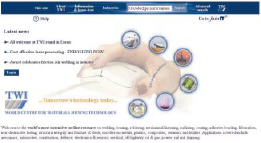
The ‘knowledge summaries’ by leading experts cover buckling, corrosion, failure, fatigue, fitness for purpose, inspection and testing, residual stress, stress analysis and structural analysis.
Free additional technical information on a broad range of summaries can be accessed by becoming a registered user of the site.
For further information please contact project manager Rod Griggs at rod.griggs@twi.co.uk or +44 (0)12 2389 1162.
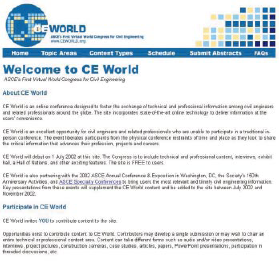
Online civil engineering conference planned
The American Society of Civil Engineers (ASCE) is planning a 15 month-long international on-line civil engineering conference called CE World. The free e-conference at www.ceworld.org will start on 1 July 2002 and run through to 30 October 2003.
Contributors are being sought for single submissions or to chair each of the 30-odd planned content areas. Content can take different many different forms, including audio or video presentations, interviews, case studies, articles, papers, PowerPoint presentations or threaded discussions.
Initial deadline for submissions is 11 February 2002.
For further information please contact content manager Walter Marlowe at ceworld@asce.org or +1 703 295 6294.
IN BRIEF
www.ticonline.co.uk – UK government-funded on-line research project to investigate the barriers and drivers of technical innovation in construction.
www.emapsite.com – supplier of wide range of digital raster maps and aerial photography as single compressed files, typically from £5
Showcasing concrete innovations
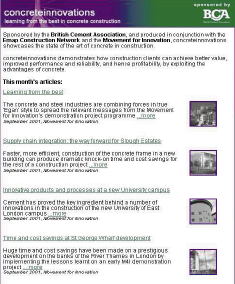
Selected articles on the latest developments in concrete construction are now freely available at the British Cement Association's new Concrete Innovations website at www.concreteinnovations.co.uk.
Produced in association with the UK government's best-practice promoter Movement for Innovation and magazine publisher Emap, the monthly updated site includes articles from New Civil Engineer, Architects’ Journal and Construction News in addition to BCA and M4I case studies.
The site aims to demonstrate how construction clients can achieve better value, improved performance and reliability by exploiting the advantages of concrete.
For further information please contact Dawson Smith or Martin Hopkins at the BCA on +44 (0)13 4476 2676.
Autodesk buys Buzzsaw
Autodesk, supplier of AutoCAD drawing software, has completed the acquisition of Buzzsaw (www.buzzsaw.com), one of the world's leading on-line construction collaboration websites, for US$ 15 million.
San Francisco-based Buzzsaw provides a range of easy-to-use collaboration applications that enable all documents and drawings for a project to be centralised, managed, printed and shared on-line.
Clients include Toys ”R” Us and Walt Disney.
For further information please contact Tina Naylor of Autodesk at tina.naylor@eur.autodesk.com or +44 (0)14 8346 2653.

Get the knowledge: ICE launches world's biggest civil engineering archive
Every paper published in the ICE Proceedings since the first volume was published in 1836 is now available for immediate download for just £5 a paper (£15 for non members) from a new ‘virtual library’ site at www.iceknowledge.com.
Containing more than 20,000 illustrated papers – including reports and drawings by almost every leading British civil engineer that ever lived – it looks set to be the profession's most comprehensive on-line archive in the world.
With much of the UK's Victorian and pre-war infrastructure coming to the end of its useful life the archive is expected to provide an invaluable resource for civil engineers planning refurbishment or replacement projects. Even for more recent works the archive may well be the only source of reliable, as-built data.
Scanning over 200,000 pages into a fully-searchable pdf format has taken ICE publishing division Thomas Telford and the ICE Library nearly a year. The work was part funded by a bequest from the late Gerald Marshall, a lifelong ICE member.
Papers can be located by author, date, region, country, keyword or words in the title. Payment can be made on-line with a credit card and users have up to 28 days to download each paid-for paper.
The archive currently extends from 1836–1998 and covers all refereed papers, discussions and meeting reports published in the various manifestations of the ICE Proceedings, which is currently published as six separate quarterly journals. Papers from the current and past three years are only accessible on-line to current journal subscribers but will be added to the archive on an annual basis.
For further information please contact journals publisher Leon Heward-Mills on 020 7665 2450 or leon.heward-mills@thomastelford.com.
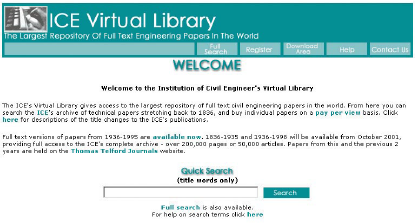
The virtual library offers a quick search facility of its 200,000 pages or a more detailed search based on author, title, keyword, location, country and date. All pages—including folded drawings—of all 20,000 papers published since 1836 can be downloaded as pdf files for just £5 per paper
The virtual library offers a quick search facility of its 200,000 pages or a more detailed search based on author, title, keyword, location, country and date. All pages—including folded drawings—of all 20,000 papers published since 1836 can be downloaded as pdf files for just £5 per paper
ICE website gets personal
The ICE website at www.ice.org.uk, which currently gets around 1.5 million hits a month, has been extensively redesigned to help its world-wide user base get relevant information more quickly. In particular, all 1000+ pages now carry a MY ICE button for users to check for updates in their personal fields of interest.
The home page now has just four key areas covering joining, knowledge, news and members. Through the knowledge area users can get straight to 15 new professional interest networks, each of which combines relevant news, information and discussion. There is also a new media centre in the news area that includes a daily update of UK newspaper and journal articles and nearly 200 photographs for free download.
A new ‘school zone’ has been created specifically for primary and secondary school children and their teachers. In addition to facts about civil engineering and careers it includes competitions, games and class teaching packs.
For further information please contact Helen Taylor, Thomas Telford E-services on +44 (0)20 7665 2451, or helen.taylor@thomas-telford.com.

EVENTS
The following meetings, seminars and social events have been organised by ICE headquarters staff on behalf of ICE Boards and Associated Societies. All are free to attend unless indicated by (£). Before travelling, please contact the organiser or visit the ICE web site at www.ice.org.uk to confirm details.
| Title | Date (dd/mm) and time | Organiser | Telephone (+44 outside UK) | Venue | |
|---|---|---|---|---|---|
| NOVEMBER 2001 | |||||
| Setting up of written assignments study groups | 01/11/2001 18:30 | Association of London Graduates and Students | 020 7665 2159 | joanna.holland@ice.org.uk | ICE |
| Uk waste: going forward-dialogue and decisions (£) | 07/11/2001 09:00 | British Nuclear Energy Society | 020 7665 2315 | sue.frye@ice.org.uk | ICE |
| Innovation in flood risk modelling | 07/11/2001 13:00 | British Hydrological Society | 0191 222 5614 | c.g.kilsby@ncl.ac.uk | University of Lancaster |
| The Scruton lecture - Slender but safe tall structures | 07/11/2001 17:30 | Wind Engineering Society | 020 7665 2238 | debbie.roberts@ice.org.uk | ICE |
| An explanation of arbitration | 07/11/2001 18:30 | Association of London Graduates and Students | 020 7665 2159 | joanna.holland@ice.org.uk | ICE |
| Young trophy inter-institution sports competition | 10/11/01 18:30 | Association of London Graduates and Students | 020 7665 2159 | joanna.holland@ice.org.uk | ICE |
| Second international conference on forensic engineering: the investigation of failures | 12/11/2001 09:30 | Structural and Building Board | 020 7665 2314 | penny.ryan@ice.org.uk | ICE |
| Flood risk management impacts on planning and development | 20/11/2001 09:00 | International Association for Hydraulic Research | 00353 1 647 6734 | mark.adamson@opw.ie | Tullamore, Ireland |
| Flood risk in a changing climate | 21/11/2001 09:00 | British Hydrological Society | 020 7451 2575 | hannah.jemmet@royalsoc.ac.uk | Royal Society, London |
| Flood risk management | 21/11/2001 09:00 | British Hydrological Society | 00353 1 647 6734 | mark.adamson@opw.ie | Tullamore, Ireland |
| Some problems related to the construction of embankment dams | 21/11/2001 | British Dam Society | 020 7665 2234 | tim.fuller@ice.org.uk | ICE |
| A structural and buildings board informal discussion | 21/11/2001 17:30 | Structural Buildings Board | 020 7665 2238 | debbie.roberts@ice.org.uk | ICE |
| New members tour around the Institution's buildings (booking essential) | 21/11/2001 18:30 | Association of London Graduates and Students | 020 7665 2159 | joanna.holland@ice.org.uk | ICE |
| British Dam Society prize competition | 26/11/2001 17:00 | British Dam Society | 020 7665 2234 | tim.fuller@ice.org.uk | ICE |
| Vibrations of the Millennium Bridge | 28/11/2001 17:30 | Society for Earthquake and Civil Engineering Dynamics | 020 7665 2238 | liz.marwood@ice.org.uk | ICE |
| DECEMBER 2001 | |||||
| A manager to a leader | 03/12/2001 18:30 | Association of London Graduates and Students | 020 7665 2159 | joanna.holland@ice.org.uk | ICE |
| New measurement techniques in hydrology | 05/12/2001 14:00 | British Hydrological Society | a.butler@ic.ac.uk | Imperial College, London | |
| An introduction to and explanation of PFI | 05/12/2001 18:30 | Association of London Graduates and Students | 020 7665 2159 | joanna.holland@ice.org.uk | ICE |
| SUDS: perceived principles and progress in Scotland | 06/12/2001 18:30 | British Hydrological Society | 0131 650 5420 | kate.heal@ed.ac.uk | University of Strathclyde |
| Advanced remote sensing techniques in hydrology | 12/12/2001 14:00 | British Hydrological Society | 0117 928 9108 | paul.bates@bristol.ac.uk | Bristol University |
| JANUARY 2002 | |||||
| Building for 1000 years: the sustainability Maitreya Buddha | 16/01/2002 18:30 | Association of London Graduates and Students | 020 7665 2159 | joanna.holland@ice.org.uk | ICE |
| Floods 2000, EA experience | 28/01/2002 17:00 | British Dam Society | 020 7665 2234 | tim.fuller@ice.org.uk | ICE |
| Vernon Harcourt lecture - A new age for inland waterways | 29/01/2002 18:00 | Maritime Board | 020 7665 2242 | kathleen.hollow@ice.org.uk | ICE |
| The history and future of water and plumbing development | 31/01/2002 17:30 | Water Board | 020 8421 0305 | tim.fuller@.ice.org.uk | Institution of Electrical Engineers, London |