

Following a seminar on recent experiences in attempting to restore severely damaged public services and infrastructure, the ICE is planning a new guide. Stephen Wearne of UMIST's project management division reports.
Governments, utilities and businesses have to acknowledge that man-made or natural disasters may strike despite ever-increasing attention to preventing them.
Such events may severely damage public and commercial systems and services. These systems are increasingly complex and interdependent – and so increasingly vulnerable to damage. Every system also tends to be needed up to its full capacity, so speed in restoring systems after damage is increasingly important.
Engineers thus have to be prepared to undertake unexpected and urgent emergency engineering work to overcome major damage.
Government experience
At a recent ICE seminar on managing unexpected work to restore systems after natural disasters, accidents and armed conflict, Martin Sergeant of the UK Department for International Development said the lessons for governments are that every disaster is different, depending upon whether natural or man-made, how predictable, the availability of local resources and the capacity of local institutions.
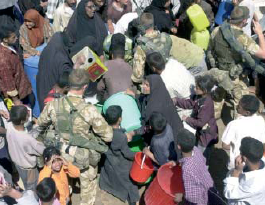
Chaos in Safwan, Iraq as the British Army attempts to restore water supplies – lessons learned are to be instilled in new ICE guide
Chaos in Safwan, Iraq as the British Army attempts to restore water supplies – lessons learned are to be instilled in new ICE guide
Rapid response needs detailed planning. There must be options for the response, drawing on military engineers in an insecure environment but using local contractors where possible, and with call-down contracts in place to bring in consultancy services.
Sustainability is as important in reconstruction as in new investment – and rebuilding institutions is as important as rebuilding the infrastructure.
Military experience
A three-stage approach to restoring public services after a disaster was recommended by Lieutenant Colonel Steven Boyd and Major John Taylor of the Military Work Force of the British Army's Royal Engineers. The military has limited but flexible resources, capable of providing protection, communications, and logistics and management services.
Its greatest role can be at the start, in immediate actions to save and protect lives, and then to restore at least temporary potable water, waste disposal and essential power services, as illustrated in Southern Iraq.
The need for attention to all players was one lesson of post-conflict situations—particularly relationships with international agencies and non-government aid organisations—and then with the host nation in planning the longer-term recovery and improvement of services.
Engineers for disaster relief
Actions on the health hazards of waste and restoring waste-management systems after conflict or natural disasters were examples of key needs described by Martin Petersen of Golder Associates, who had provided expertise through the Register of Engineers for Disaster Relief (Red-R).
Illustrated graphically with examples from Kosovo, the priorities were introduction of waste segregation, provision of distinct disposal boxes, treatment of waste and training, and working through the emergency government and relief organizations.
The tasks can include arranging for the armed guarding of rubbish, construction of temporary roads and bridges, and the demolition of unsafe structures. All need simple, effective solutions and quick delegation of responsibility for actions.
Common lessons for all
Emergencies vary in their causes, the authorities involved, public concern, nature, scale, immediate resources available, uniqueness and location. The seminar showed that each event is unique but all have common characteristics and therefore potentially common lessons for anyone in future who has to plan and control unexpected work.
The demands are unpredictable. Expertise is critical, and the earlier the better. All organisations can start to help themselves and others by compiling registers of the experience and expertise of all their employees.
The Institution of Civil Engineers is forming a working party to produce a common guide to managing infrastructure works to restore destroyed public services after disasters, particularly in overseas nations postconflict. The guide will focus on short- and medium-term actions, defining the roles of each agency involved in the restoration activities and the relationships between them.
The seminar papers and a bibliography on the topic can be obtained from Peter Fry at the ICE. A series of more detailed papers on the role of the military engineers in regenerating infrastructure post-conflict appears this month in a special issue of Civil Engineering. The role of voluntary engineers in such work will be covered in a special issue planned for November 2004.
FOR FURTHER INFORMATION CONTACT, Peter Fry, TEL 0207 665 2213, EMAIL peter.fry@ice.org.uk

