

The differing roles of civil and military engineers in civil emergencies were discussed at a joint ICE and Institution of Royal Engineers meeting earlier this year. Stephen Wearne of Manchester's Centre for Research in the Management of Projects was one of the presenters.
The meeting started with a review of the differing roles of the military, the police and the civil engineering profession in UK emergencies by Lt Col Alan Miller, a joint regional liaison officer with the British Army.
He referred to the Ministry of Defence's booklet Operations in the UK: the defence contribution to resilience, which sets out the legal requirements and rules under which the military can and must provide engineering or other aid in emergencies and threatening situations. This is generically referred to as ‘military aid to the civil authority’ (MACA).
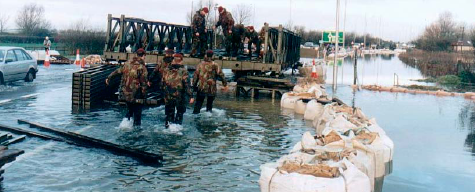
Local authorities can request military aid directly and regional military commanders can also take appropriate action if life and limb are at risk. Recent examples include building emergency bridges during flooding at Chichester, helicoptering sandbags to limit flooding at Selby and disposing of foot-and-mouth carcases in the recent outbreak.
However, contrary to popular belief, military resources are limited. While MACA is a stated military task under the overall defence mission, it is delivered from existing forces and equipment that are intended primarily for fighting wars. Furthermore, the full cost of military aid has to be paid, unless waived by the Treasury.
Civil incident command
Alex Marshall, assistant chief constable of Thames Valley Police, then reviewed the levels of command structure that need to be established for civil incidents.
Emergency planning legislation, notably with the new Civil Contingencies Act, provides the basis for national or regional control of resources when responding to major incidents. The primary responders to floods, fires and other disasters are of course the fire, ambulance and police services, with the latter normally responsible for overall coordination and control.
More specifically the Home Office guide Dealing with disasters recommends three control levels: ‘gold’, ‘silver’ and ‘bronze’. ‘Gold’ is a strategic level consisting of top managers of public services and local authorities. They need to set priorities, allocate resources, deal with representatives of all stakeholders and the media, and appoint a ‘recovery working group’ to plan the return from an emergency to normality.
‘Silver’ is the level which should coordinate the use of resources for an incident and ‘bronze’ is the level for operational control.
Emergency engineering
In my talk I observed that managing interfaces is crucial in engineers' responses to civil emergencies. Each event is unique, but all have common characteristics and therefore potentially common lessons for anyone who has to plan and control unexpected work after a future man-made or natural disaster.
Probably the most important lesson is that recovery from any event involves many organisations, some of which may be in some shock, some frustrated for lack of resources and some in demand by too many stakeholders. A single point of consultation and control is thus needed at any serious event, but double-headed – with a ‘gold’ level dealing with all interests, setting priorities and obtaining resources, and a ‘silver’ level planning and coordinating use of these resources.
Demands are also unpredictable. Lessons from flood, rail and other incidents are that expertise and communications are critical, and the earlier the better. For all affected assets immediate decisions are needed, whether to replace or improve. But a complication experienced after many events is that priorities change, rapidly, as stakeholders become aware of costs and new opportunities or problems are discovered.
Effective in all these conditions are leaders who understand how their organisation and their industries work. Also vital as costs are incurred are records of who did what for whom and when. Finally, as in any engineering work, managing the recovery phase should include agreeing handover conditions with owners and users of the assets involved.
Restoration of destroyed services
The specific lessons learned in managing the restoration of services after the Boscastle flooding and the war in southern Iraq were subsequently discussed and recorded at joint meeting between ICE and the UK Hazards Forum in June.
FOR FURTHER INFORMATION CONTACT, Stephen Wearne, TEL +44 (0)1625 582643, EMAIL wearne@manchester.ac.uk

