

Buildings use up nearly half the UK's total energy output. Shaun Fitzgerald and Andrew Woods of the BP Institute report on their pioneering work into natural ventilation systems that offer engineers a genuine opportunity to build a more sustainable, low-energy future.
Buildings account for 40–45% of energy consumption in the UK, a substantial proportion of which is associated with mechanical plant for air-conditioning. However, schemes using natural ventilation, thermal mass and night cooling can be designed to achieve comparable internal conditions but using over 50% less energy.
The opportunity to reduce UK carbon emissions through improved building design and hence reduced energy usage is vast – probably the biggest society has other than a step change from fossil fuel supply to nuclear or other non-fossil fuel sources.
But one of the key challenges for engineers is to design low-energy systems that provide comfortable conditions by responding effectively to changes in external conditions, such as wind and temperature, and internal heat loads.
Improving understanding
The design of a naturally ventilated building requires an understanding of the interaction between the heat sources and sinks and the air circulation pattern. In response to this need, a major research programme has been established at the BP Institute at Cambridge University to pioneer better understanding of the fundamental physics of natural ventilation.
The low-energy building research funded by the Cambridge–MIT Institute has involved pioneering new analogue laboratory techniques to visualise and quantify the flow patterns within naturally ventilated buildings. The experiments involve using perspex models immersed in a water bath, with hot wires to simulate heat loads and chilled water to simulate mechanical cooling in hybrid systems.
Quantitative models have also been developed to determine airflow rates and thermal comfort conditions in naturally ventilated buildings, including the benefits of thermal mass and the effectiveness of various control strategies.
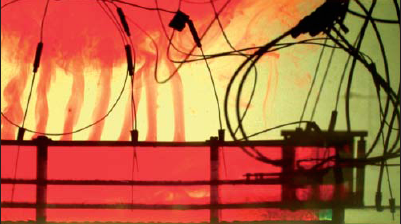
Laboratory simulation of natural ventilation airflows at Chapelfield Shopping Mall – such systems can consume less than half the energy of mechanically ventilated buildings
Laboratory simulation of natural ventilation airflows at Chapelfield Shopping Mall – such systems can consume less than half the energy of mechanically ventilated buildings
Considerable advances made
The research has led to considerable advances, such as:
discovery that multiple flow regimes can occur within naturally ventilated buildings – a fascinating and important phenomenon which has significant implications for design and control systems
identification of how natural cooling can be used to buffer buildings even in the height of summer
discovery of how ventilation stacks actually work in practice and how they can be designed to manage different seasons, from severe winter to high summer.
Implementation in real buildings
In parallel with the research, the new techniques have also been applied in practice. Small-scale analogue models have been used to explore the various operating modes of naturally ventilated offices, schools, a health centre and a shopping mall in the UK.
Working with architects and engineers throughout the UK, the authors have used the modelling work to make substantial inputs to the design of the buildings and their associated control strategies.
Examples of design projects undertaken over the past year include a 12 classroom extension to Hagley School in Worcestershire; the £275 million Chapelfield Shopping Mall in Norwich; a new five-storey building at University College London and a new suite of classrooms for St James School in Northampton – all of which use natural ventilation.
Encouraging more use
The new modelling techniques allow engineers fully to master the design of naturally ventilated buildings and should enable more design teams to consider such solutions for new buildings.
Since naturally ventilated buildings can consume less than half the energy of mechanically ventilated ones, the increase in number of naturally ventilated buildings will have a significant impact on society in terms of energy provision and allow the construction industry to play a significant part in limiting carbon emissions in the 21st century.
FOR FURTHER INFORMATION CONTACT, Shaun Fitzgerald, TEL +44 (0)1223 765714, EMAIL shaun@bpi.cam.ac.uk

