

Nearly half of all complaints against ICE members relate to misapplication of the Party Wall etc. Act 1996. Tony Ridley, chairman of the Institution's Professional Conduct Panel, warns that members taking on engagements where the Act applies must make sure they understand this significant piece of legislation.
The Institution of Civil Engineers' Professional Conduct Panel sees all complaints made to the Institution about members' conduct. It is responsible for deciding whether a member has a case of improper conduct to answer and, if so, whether it should be referred to the Disciplinary Board. The Board then decides through adjudication if a member has been guilty of improper conduct and, if so, the penalty to be imposed.
Around 90% of complaints are from lay clients against the principals of single-member consultancy practices or against members working for practices comprising only a few staff – and at least 50% of these involve misapplication of the Party Wall etc. Act 1996.
Knowledge of legislation essential
Under rule 2 in the ICE Code of Professional Conduct, members are required to be competent in the areas in which they practise. This means that they should have an appropriate level of knowledge about all legislation bearing upon the work on which they are engaged.
Domestic and small works projects frequently involve work affecting a neighbour's property and so the provisions of the Party Wall Act will very often apply. For members undertaking such projects, a good working knowledge of the Act and how it should be applied is therefore essential.
Complaints about the application of the Act generally occur because the member concerned is either not sufficiently familiar with the provisions of the Act and has failed to apply them properly or, despite knowing what should be done, has been negligent in applying the procedures the Act lays down.
Risk of disciplinary action
In either instance the member would be in breach of the ICE Code of Professional Conduct, which requires him or her to act with integrity (rule 1) and to be competent to undertake the work (rule 2).
Being negligent in applying the Act properly is likely to be regarded by the Professional Conduct Panel as failing to act with integrity, while not being sufficiently knowledgeable about the Act in circumstances in which it applies would be seen as meaning that the member was not competent. In the event of a complaint on either count, the member would therefore be in danger of disciplinary action.
Members should also remember they have an obligation to maintain their continuing professional development (CPD) so they are up-to-date in the fields in which they practise. If a complaint of improper conduct is made against a member, the Professional Conduct Panel has powers under ICE disciplinary regulation 9 to request the member concerned to submit his or her CPD record for inspection.
Published guidance and training
As with most types of legislation, there is a wide variety of published information available to members about the Party Wall Act.1–4
Training for members is also available from ICE's training subsidiary Thomas Telford Training, which regularly arranges courses for professionals needing detailed guidance on the Act. Members should consult the Thomas Telford Training website at www.tttrain.co.uk/ courses or phone 0800 1830133 for course details.
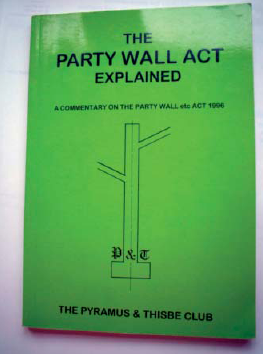
A better understanding of party wall legislation could help cut the number of complaints against the profession by nearly half
A better understanding of party wall legislation could help cut the number of complaints against the profession by nearly half
References
FOR FURTHER INFORMATION CONTACT, Paul Taylor, TEL +44 (0)20 7665 2064 EMAIL paul.taylor@ice.org.uk

