

Concrete is one the oldest and most sustainable construction materials, yet we still don't really understand it. Karen Scrivener says a new pan-European research consortium she co-ordinates could finally unravel its secrets, enabling the development of even better and smarter materials.
Despite being the most widely used construction materials on the planet, the complexity of cementitious materials such as concrete means they are also among the least understood. The reaction of dozens of chemical species on timescales varying from seconds to days creates a solid structure which may be in service for millennia – yet our lack of fundamental understanding means development tends to remain incremental and empirically based.
However, the advent of a wide range of characterisation methods capable of probing structures at increasingly smaller scales could lead to real breakthroughs in our understanding of the nano-scale mechanisms which govern the macro-scale performance of cementitious materials.
Integrating research efforts
Several research groups have already made significant progress over the past few decades. However, these groups are relatively small and scattered geographically, such that results from one technique cannot always be directly compared with those from another. What is needed is a critical research mass to work in a co-ordinated manner on the same materials, but unfortunately the money and effort required is beyond that of any one company or funding agency.
The Nanocem network has been created in an attempt to resolve the problem. Last year eleven European manufacturers formed a partnership with 21 European academic groups – including Imperial College and
Aberdeen, Leeds and Surrey universities from the UK – to form an integrated research and education environment. The primary aim is to generate basic knowledge on the nano- and micro-scale phenomena that govern the macroscopic performance of cementitious materials.
Improving sustainability
It is hoped that the output of the consortium's research will provide a platform for breakthroughs in production and use of cementitious materials worldwide. Such breakthroughs are needed for two main reasons. First, though cementitious materials have a lower environmental impact than any alternative materials (see table), the huge volumes used mean that progress still needs to be made to improve their sustainability – primarily by reducing raw materials, energy consumption and CO2 emissions.
For example, though cement clinker is being increasingly replaced by supplementary cementing materials – such as slag and other industrial wastes – the mechanisms governing reactivity of these substitute materials are far from being fully understood and this is a major impediment to increased levels of substitution.
More than a structural material
Secondly, cementitious materials have the capacity to provide functions beyond their traditional structural role. Some attributes – such as self-cleaning and self-repairing, or actively removing pollutants – have already been demonstrated in laboratory conditions and in field trials. The challenge is to make them robust properties and to have them simultaneously in specific applications.
The research consists of ‘partner’ projects, part of the ongoing fundamental research by the academic partners, complemented by ‘core’ projects funded by the industrial part-ners. The first three core projects launched in 2004 aim to:
predict the assemblage of hydrates forming in cementitious materials
develop new methods to determine the pore structure and water mobility in undried materials
identify and characterise the organo-aluminate products which form between superplasticisers and calcium aluminate in cement and lead to cement/admixture incompatibility problems.
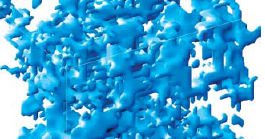
Three-dimensional pore structure in 3-day-old cement paste imaged by synchrotron X-ray tomography (Emmanuel Gallucci, EPFL)
Three-dimensional pore structure in 3-day-old cement paste imaged by synchrotron X-ray tomography (Emmanuel Gallucci, EPFL)
Nanocem is co-ordinated by a management team at Ecole Polytechnique Fédérale de Lausanne and has a steering committee of five industry representatives and five academic representatives. It held its first open meeting for the construction industry in Lausanne in April 2005.
Concrete is one of the lowest energy construction materials
| Material | Energy cost: MJ/t |
|---|---|
| Concrete | 600 – 800 |
| Wood | |
| - cut wood | ∼500 |
| - multi-layer board | ∼4 000 |
| Glass | 15 700 |
| Steel | 21 000 |
| - from scrap | 11 000 |
| Aluminium | 164 000 |
| - recycled | 18 000 |
| Plastics | |
| - HDPE | 81 000 |
FOR FURTHER INFORMATION CONTACT, Karen Scrivener, TEL +41 21 693 5843, EMAIL nanocem@epfl.ch, WEB www.nanocem.net.

