

In July this year the UK Government launched its third publication on national energy policy in just over four years. Robert Freer says there are at last some signs of positive action to solve the main problem, which is keeping Britain's lights on.
The first of the UK Government's three recent policy statements on energy was published in February 2002 by the Performance and Innovation Unit in the Cabinet Office.1
The comparatively workmanlike document was followed in 2003 by the more promising Energy White Paper,2 which set out four objectives which the Government sought to achieve. These were to cut CO2 emissions by 60% by 2050, maintain reliability of energy supplies, promote competitive markets in the UK and beyond, and ensure adequate and affordable home heating. But however commendable these goals might be individually, in practice they were unlikely to be mutually compatible.
For instance, cheap electricity was not necessarily a sensible long-term policy. By driving down the price of electricity for the consumer, there was less income for the generators to invest in new plant that would ensure continued security of supply from ageing power stations—and there was no other incentive for them to do so. Today that lack of investment in new plant is becoming a major problem.
Steps in the right direction
The latest energy review, published in July 2006, is entitled The Energy Challenge3 and again appears to be more of a wish list than to define a positive plan of campaign.
However, the foreword written by Prime Minister Tony Blair does contain some realistic observations which mark positive steps in the right direction. It recognises the importance of a secure supply of energy and says, ‘without it we could not function as an economy or modern society’.
The review puts energy security as the first of the ‘immense challenges’ facing Britain and it also recognises that the complete solution will depend partly on building ‘new nuclear power stations to replace those becoming obsolete.’
Trade and Industry Secretary Alistair Darling highlights in the preface the need to get the right incentives to encourage investment in low-carbon options. He also recognises the particular problem of getting planning consent, a problem which in the past has dogged and delayed the building of new transmission lines and new power stations, such as Sizewell B. He concludes, ‘it is time to overhaul the present planning system’.
Commitment to emissions trading
The review starts by committing the Government to the European emissions trading scheme, which it believes to be the incentive for energy efficiency and for investment in low-carbon technologies. The Government wishes to ensure the scheme ‘develops into a credible long-term international framework’.
A more realistic ambition is the challenge to use less energy. This is where society can contribute. One encouraging statement is the objective to reduce the energy used in Government buildings: ‘we aim to make the central Government estate of buildings carbon neutral by 2012’. For buildings alongside a river this could probably be done by using a heat pump, but those relying on solar panels and a windmill on the roof may find this objective more difficult to achieve.
The signals for new nuclear build are at amber if not yet at green. The Government promises, ‘a clear statement of our position on new nuclear build’, and, ‘to address potential barriers to new nuclear build’.
The Government also believes coal has a role to play in the energy mix, having realised that last winter more than half the UK's electricity was generated from coal. However, coal-fired stations also suffer from a lack of long-term investment
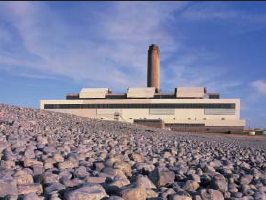
RWE npower's 1500 MW Aberthaw coal-fired power station—the UK Government now recognises the importance of such stations, which provided more than half the country's electricity last winter
RWE npower's 1500 MW Aberthaw coal-fired power station—the UK Government now recognises the importance of such stations, which provided more than half the country's electricity last winter
A need for more leadership
The failure of the Government's present energy policy has been criticised in the House of Lords, where it was said: ‘the electricity supply industry, since privatisation, has been without leadership, reacting only to external stimuli which masquerade as the discipline of a free market’ (Lord Tombs, House of Lords debate, 23 June 2005).
In conclusion, those looking for leadership from The Energy Challenge may still be disappointed. The Government should be taking giant strides towards their objective; this is just a small shuffle.
References
FOR FURTHER INFORMATION CONTACT, Robert Freer, TEL +44 (0)20 8244 9905, EMAIL rfreer.dulwich@virgin.net

