

Discussion
SPECIAL ISSUE: Channel Tunnel Rail Link, section 2: by Alan Dyke et al. (November 2007)
Contribution by T. Douglas
There are some differences in the overall costs quoted. Construction is quoted at £1·2 billion for section 1 and £2·5 billion for section 2, while the original budget (fixed in 1998) is quoted at £5·2 billion and the final cost quoted at £5·8 billion. Other figures referred to include Temple Mills depot at £402 million and Stratford and Ebbsfleet at £55 million, which are referred to as being constructed separately. It would be of interest if two further costing figures could be provided. What was the outlay pre-construction and were the funds for the extensive investigations and design studies included in the final budget price? Also, does the £5·8 billion final figure include the total cost of all the works and to what extent is it offset by the value of lands development opportunities at King's Cross, Ebbsfleet and Stratford?
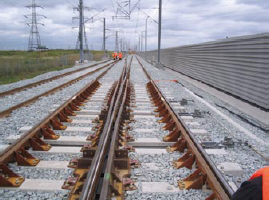
High-speed cross-overs on the Channel Tunnel Rail Link (now known as High Speed 1) use a swing-nose crossing, not switched frogs
High-speed cross-overs on the Channel Tunnel Rail Link (now known as High Speed 1) use a swing-nose crossing, not switched frogs
Authors' reply
The simple answer is that the £1·2 and £2·5 billion quoted for sections 1 and 2 respectively is the construction contracts cost, whereas the overall cost of £5·2 billion includes all monies spent pre-contract and up to completion on land purchases, project management, client cost and so on. As for whether the value of land made available for redevelopment goes to offset the cost of the project, the answer is yes. Indirectly, the increase in value of the land once it is developed will return profits back to the government, which can be offset against the government's contribution to the cost of the original project.
Contribution by David Leiserach
Due to the variability of ground conditions, were any ‘running-on slabs' used to ease the transition from soft ground or made ground to strengthened areas of formation or structures? Also, on page 33 Fig. 1 and on page 39, Fig. 2, the reference to ‘Paddington’ should presumably be to ‘St pancras'?
Authors' reply
Yes, we do have running-on slabs. At each change of formation, such as when the track runs from ballast to concrete slab track or even from an embankment to a bridge deck, both in ballast, we provide a transition slab that graduates the change in support stiffness and provides a smooth transition. The contributor is correct about the misnaming in the two figures.
Contribution by Ken Head
The most interesting feature of the high-speed crossing is not shown in Fig. 2 on page 50—the frog where the lines cross. I assume it is a switched frog?
Authors' reply
We do not have switched frogs on our railway. However, all of our high-speed turnouts are to an SNCF design that accommodates 160 km/h on the turnout and 300 km/h on the through alignment. This is facilitated by a swing-nose crossing—we do not call them frogs!
P900019: How Roman engineers could have flooded the Colosseum: by Martin Crapper (November 2007)
Contribution by John Porter
The volume of water calculated, 17 000m3, upon which all the timings are based, is too high by a factor of four. The size of the ellipse is stated as 80 m by 45 m, and that these are the overall dimensions is confirmed by Fig. 6. The depth of water is stated as 1·5 m and this is confirmed by the depth at time ‘0’ on Fig. 13. The volume appears to have been calculated as π × 80 × 45 × 1·5 = 16 964·6 m3 and rounded to 17 000 m3. Unfortunately the equation used is for the semi-major and semi-minor axis lengths, so the value is four times too high. The actual volume is π/4 × 80 × 45 × 1·5 = 4241·15 m3.
It means all the fill times are four times too long and the drainage times are also too high. If we take the shortest time of 2 h 15 min from Table 3 and divide by four, the fill time is 34 minutes. Considering it would have taken weeks to cross the Roman Empire, perhaps 34 minutes would have seemed relatively ‘sudden’ to contemporary authors. I have also tried to check the hydraulic calculations paper referred to in Ref. 11 but it does not appear when you search in that archive.
Author's reply
The contributor is correct; this is an error for which I must apologise. It is not however quite as simple as he supposes. The figure of 17 000 m3 featured early in the calculations and is the figure for filling the hypogeum to its full depth of 6 m. This figure is a rounded-off version of that quoted in the literature, notably in Coleman (Ref. 1).
I was subsequently persuaded that it was unlikely that this full depth would have been used for various practical reasons, and have worked on a 1·5m depth, but it appears I have omitted to correct the volume figure to (approximately) 4250 m3. It is obviously disappointing that this error should have made it through both my own and the reviewers' checks of the paper. It is however exciting to have discovered it, because the revised filling times are such that it would clearly have been possible to use the full 6 m depth, which gives much better audience sight-lines, provided that the practical issues—notably the sealing of the service passages—could have been achieved.
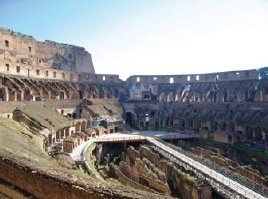
The arena of the Colosseum in Rome could actually have been flooded for mock sea battles in as little as 34 minutes
The arena of the Colosseum in Rome could actually have been flooded for mock sea battles in as little as 34 minutes
Re-worked figures based on the 4250m3 volume are included in new versions of Tables 2, 3 and 4 included in the online version of this discussion at www.civilengineering-ice.com. The filling figures in the original Tables 2 and 3 are correct for the full 6 m depth; but the drainage analysis based on open-channel flow would not be applicable to the full depth. I have not had the opportunity to consider this latter problem in full, but a cursory examination suggests that emptying the full depth would be possible in a timescale of hours, although high velocities (in excess of 10 m/s) would be developed in the early stages, which would have perhaps been a practical issue in terms of erosion of the stonework.
My own view is that the 1·5 m depth with the re-worked, faster filling and emptying times, remains more likely. I remain of the view that it is not for engineers to comment on whether these or any times would have been regarded as ‘sudden’. However, in view of the revised times, it seems likely that the structural alterations in removing and replacing the arena floor would clearly be the limiting factor controlling the impression made on the audience.
I have taken up the matter of Ref. 11 with the Edinburgh Research Archive; anyone wishing to see this paper can access it at http://hdl.handle.net/1842/2114.
P14989: A clearer vision for pedestrian guardrails: by Douglas Steward (August 2007)
Contribution by Norman Gill
I notice that Douglas Stewart did not include the statistics when, following a guardrail being bent by a car, a high-visibility guardrail at a road junction was mistakenly replaced with an infilled one, then later replaced again by a high-visibility one. The accident rate increased and then decreased again, though I do not have the figures.
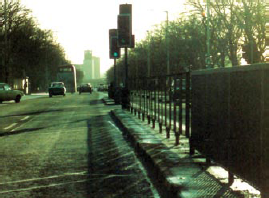
High visibility guardrail was accidentally replaced with infilled guardrail at this road junction, resulting in a five-fold increase in accidents
High visibility guardrail was accidentally replaced with infilled guardrail at this road junction, resulting in a five-fold increase in accidents
Author's response
The contributor is referring to the junction seen in Fig. 2 of the paper. A length of 22 m of masking guardrail had been replaced by high-visibility guardrail to rectify poor visibility for right-turn vehicles and pedestrians. Based on a study boundary 20 m from the high-visibility guardrail, total accidents fell from about five to one a year.
Three years later, the high-visibility guardrail was temporarily removed, then the original guardrail was replaced in error, again blocking visibility. By the time this was corrected, less than one year later, five injury accidents had occurred.
High-visibility guardrail was then re-erected, and the accident rate returned to about one a year. This evidence of improvement is so obvious that its significance level of more than 99·9% is rather academic. Considering right-turn accidents only, 12 were recorded with the masking guardrail, but none with the high-visibility guardrail.
There was no other significant change at the junction during the study period, so it was clear that over 40 people had been saved from death or injury solely by improving visibility.
The author (d.l.stewart@btopenworld.com) would welcome details of any other before-and-after statistics which may have been collected for high-visibility guardrails.
Erratum
In the discussion of this article in the November 2007 issue of Civil Engineering, the contribution of Steve Reeves was incorrectly attributed to Marin Hordyk. The publisher apologises for this error.
Full versions of these discussions can be read with all other discussion in the online version of the journal at www.civilengineering-ice.com
Proceedings: RECENTLY PUBLISHED PAPERS
In addition to Civil Engineering, the ICE Proceedings includes fifteen specialist journals. Papers and articles published in some of the most recent issues are listed here. Summaries of all these and other papers and articles published in the past three years can be read free at www.ice.org.uk/journals. ICE members can download any 15 papers published in 2007 for £25 from www.iceknowledge.com
Bridge Engineering
160, No. BE4, December 2007, 161–206
PAPERS
West Coast route modernisation: River Tame viaduct
A. H. W. Baker, D. Webb and
R. Fearnhead
The real service life of road bridges
H.-Å. Mattsson and H. Sundquist
Design and construction of a ‘pointed’ arch bridge
E. Vitiello
Site-specific traffic load modelling for bridge assessment
A. O'Connor and E. M. Eichinger
Pendel bearing replacement at A9 Kessock Bridge, Scotland
J. Redpath
Construction Materials
160, CM4, November 2007, 135–180
PAPERS
Life-cycle assessment and embodied energy: a review
G. F. Menzies, S. Turan and P. F. G. Banfill
VIP and their applications in buildings: a review
X. Wang, N. Walliman, R. Ogden and C. Kendrick
Making reinforced concrete immune from chloride corrosion
G. K. Glass, B. Reddy and L. A. Clark
Recycled waste glass as aggregate for lightweight concretes
A. Petrella, M. Petrella, G. Boghetich, D. Petruzzelli, D. Calabrese, P. Stefanizzi, D. De Napoli and M. Guastamacchia
Mechanical properties of cement-bound recycled pavements
M. Katsakou and S. Kolias
Engineering Sustainability
160, No. ES4, December 2007, 153–198
PAPERS
Proposal for a UK domestic water trading scheme
J. C. Griggs and P. Jeffrey
Life-cycle costing of metallic structures
L. Gardner, R. B. Cruise, C. P. Sok, K. Krishnan and J. Ministro Dos Santos
The load-bearing duct: biomimicry in structural design
S. Yiatros, M. A. Wadee and G. R. Hunt
Combined life-cycle cost assessment of roof construction
Z. Worth, C. Boyle and R. McDowall
Geotechnical Engineering
161, No. No. GE1, February 2008, 1–62
PAPERS
On-site characterisation of loessic deposits in Kent, UK
K. J. Northmore, I. Jefferson, P. D. Jackson, D. C. Entwisle, A. E. Milodowski, M. R. Raines, D. A. Gunn, D. I. Boardman, A. Zourmpakis, L. M. Nelder, C. D. F. Rogers, N. Dixon and I. J. Smalley
A practical design approach for piles with negative friction
H. G. Poulos
Loading tests on compacted soil, bottom-ash and lime layers
N. C. Consoli, A. Thomé, M. Donato and J. Graham
Effective-stress analysis of berm-supported retaining walls
J. A. Smethurst and W. Powrie
CFA pile behaviour in very stiff lodgement till
E. R. Farrell and M. Lawler
Ground Improvement
161, No. GI1, February 2008, 1–54
PAPERS
Predicting compaction of cohesionless soils using ANN
A. H. Abdel-Rahman
Analysis of soil–reinforcement interaction in reinforced soil beds
H. B. Raghavendra
Bearing capacity of square footing on reinforced pond ash
A. K. Brera, A. Ghosh and A. Ghosh
Efficacy of lime-stabilised fly ash in expansive soils
M. R. Rao, A. S. Rao and R. D. Babu
Analysis and comparison of displacement granular pile anchors
M. R. Madhav, B. Vidyaranya and V. S. Kumar
Coir geotextile drains for soft ground improvement
K. S. Beena and K. K. Babu
Management, Procurement and Law
160, No. MP3, August 2007, 91–136
BRIEFINGS
A changing climate for claims?
A. Hamer and C. Peters

The Contracts (Rights of Third Parties) Act 1999
J. Winter
Managing risk to maximise profit in an engineering environment
K. Betteley
Dispute avoidance—looking after the pennies
G. Bewsey
PAPERS
The delivery of the roof of Terminal 5
W. Frankland, J. N. Kitchener, T. Whitten and P. Hulme
The ICE Arbitration Procedure 2006
J. N. Tait
Undergraduate lessons from historical failures
J. T. Mottramm
Maritime Engineering
160, No. MA3, December 2007, 139–184
PAPERS
Modelling faecal bacteria pathways in receiving waters
I. Schnauder, B. Bockelmann-Evans and B. Lin

Realignment in low-lying coastal areas: UK experiences
N. I. Pontee
The occurrence and effects of wave impacts
G. Müller, W. Allsop, T. Bruce, A. Kortenhaus, A. Pearce and J. Sutherland
Safety of a deep water marine riser under random loads
R. A. Khan and S. Ahmad
Municipal Engineer
160, No. ME4, December 2007, 161–214
PAPERS
Major sporting events—planning for legacy
M. Taylor and I. Edmonson

Pedestrian planning for the 2006 Commonwealth Games
G. Mounsey, C. McPherson and N. Langdon
Safety and traffic management for PFA 2006 in Watford UK
L. Hejazi and A. Smith
Engineering—archaeology: reconciling what is possible
Fco. de asis Ramirez Chasco, A. Seco Meneses and E. Prieto Cobo
School transport, inclusion and pupil attendance
H. Murphy
Littering of a watercourse in north-west England
I. D. Williams and N. Deakin
Managing recovery after widespread damage
S. H. Wearne
Structures and Buildings
160, No. SB6, December 2007, 305–357
PAPERS
Progress of advanced composites for civil infrastructure
L. Canning, J. Hodgson, R. Karuna, S. Luke and P. Brown

Disproportionate collapse: a pragmatic approach
U. Starossek
A method for estimating fundamental periods of tall buildings
L. Y. Wang and Q. Wang
Testing a new reinforced brick masonry shell system
J. A. O. Barros, P. B. Lourenço, J. T. Oliveira and E. Bonaldo
Transport
161, No. TR1, February 2008, 1–54
PAPERS
Brixton station congestion relief project
G. Biggam and H. Jayawardena

Probabilistic analysis of train/track vertical impact forces
J. Leong and M. H. Murray
Energy balance framework for appraising road projects
J. B. Odoki and R. Akena
Modelling personality, attitudes and risky driving
S. F. Kalyoncuoglu and M. Tigdemir
Waste and Resource Management
160, No. WR3, August 2007, 87–129
PAPERS
Aerobic digestion of municipal solid waste in Durham, UK
M. Johnson
Pyrolysis of biodegradable wastes using microwaves
J. P. Robinson, S. W. Kingman, C. E. Snape and H. Shang
Anaerobic digestion of verge cuttings for transport fuel
A. Salter, M. Delafield, S. Heaven and Z. Gunton
Developing the evidence base for waste and resources policy
N. C. Blakey, D. C. Wilson and N. A. Smith
Ways to facilitate the use of recycled aggregate concrete
V. W. Y. Tam, K. Wang and C. M. Tam
Water Management
160, No. WM4, December 2007, 195–255
PAPERS
A simple method for estimating flood flow around bridges
G. Seckin, T. Haktanir and D. W. Knight

Experiments on stilling basins for dam outlets
A. Goel
Retrofit SuDS—cost estimates and decision-support tools
V. R. Stovin and A. D. Swan
Modelling water distribution systems with deficient pressure
M. H. Hayuti, R. Burrows and D. Naga
Fuzzy logic model to predict hydraulic jump aeration efficiency
S. Kucukali and S. Cokgor
3-D computation of flood processes in sharp river bends
M. Tritthart and D. Gutknecht
How Roman engineers selected their water supplies
S. Kucukali
Request for papers
All Proceedings journals rely entirely on papers sent in by civil engineers and related professionals, researchers, academics and students. Papers should be around 2000 to 5000 words long, in good English and with adequate illustrations and references. Project papers are particularly welcome.
All papers sent in will be assessed on merit and not on the status of the author. Simply submit your text and images using the online submission system via www.ice.org.uk/journals.
Personal on-line subscriptions to specialist Proceedings journals start from £11 a year for members. Print subscriptions start at £21 a year and include full on-line access to the current and past three years' issues. Please call +44 20 7665 2227, email subs@ice.org.uk
New online submissions system
Authors can now submit papers to Civil Engineering and all other ICE Proceedings journals via the internet. By clicking the ‘Online submission’ links on the individual journal home pages—which can be reached via www.ice.org.uk/journals—authors can submit, and immediately receive confirmation of receipt, 24 hours a day and from anywhere in the world. They can also track the progress of their submissions through the review process at any time. This is an important development and one that is required to support the continuing development and internationalisation of the ICE's world-class journals publishing programme.

Books
REVIEWS
Victorian engineering by L. T. C. Rolt, published by Sutton Publishing Limited, 2007, £9·99, reviewed by Graham Tombs

This book was first published in 1970 and this should be remembered when reading some passages. It is typical of Rolt's writings, in that he quickly engrosses the reader in such interest and enthusiasm for the subject that it is difficult to put the book down before it is finished. Unfortunately many of the illustrations in the original version have been omitted in this edition, which is also marred by a large number of typographical errors.
This book should nevertheless be a fascinating read to anybody who has an interest in British history or engineering and a select bibliography is provided for further reading which will surely be stimulated by Rolt's text.
Engineering analysis with Ansys software by T. Stolarski, Y. Nakasone and S. Yoshimoto, published by Butterworth Heinemann, 2006, £24·99, reviewed by Dennis Lam, University of Leeds

This is a fundamental textbook suitable for most students and engineers coming to use Ansys finite-element analysis for the first time. It exclusively structured around the software with tutorial instruction, worked examples and illustrative applications.
It also contains step-by-step procedures which enable students to follow and understand the basic principles of finite-element modelling techniques. Chapter 1 covers the basic finite-element method while chapter 2 provides an overview of the visual capacities. Chapters 3, 4, 5, 6 and 7 deal with application of the software to stress analysis, mode analysis, fluid dynamics, thermo mechanics and contact elements.
Full versions of these reviews can be read at www.civilengineering-ice.com
NEW BOOKS
The ICE's bookshop in London carries one of the most comprehensive ranges of civil engineering books in the world. New books received in the past three months are as follows.
2006 International building code companion
Roger Dodge Woodson £33·99
Battle for the North
Charles McKean £9·99
Biographical dictionary of civil engineers volume II—1830–1890
Peter Cross-Rudkin and Mike Chrimes £120·00
Bridge design, construction and maintenance
ICE £105·00
CDM2007—construction work sector guidance for designers (3rd edition)
Alan Gilbertson and Ove Arup and Partners £60·00
CDM2007—Workplace ‘in use’ guidance for designers
Alan Gilbertson £40·00
Coastal management international conference 2007
ICE £105·00
Communication skills for engineers and scientists (4th edition)
IChemE £12·50
Construction contracts law and management (4th edition)
John Murdoch and Will Hughes £24·99
Construction dewatering and groundwater control: new methods and applications (3rd edition)
Arthur Corwin, Paul Schmall, Walter Kaeck and Patrick Powers £95·00
Design of structural timber to Eurocode 5
William Mckenzie and Binsheng Zhang £34·99
Design risk management: advice for designers on the implications of the Construction (Design and Management) Regulations 2007 (with CD)
Nick Charlton Smith (editor) £56·00
Dispute boards: procedures and practice
Gwen Owen and Brian Totterdill £55·00
Early-age thermal crack control in concrete (with CD)
Phil Bamforth £80·00
FIDIC conditions of contract for design, build and operate projects (pre-press seminar edition 2007)
FIDIC £20·00
Handbook of civil engineering calculations (2nd edition)
Tyler Hicks £94·99
Handbook of structural steelwork (4th edition)
P. Kirby, D. Brown, A. Way, P. Williams, D. Moore £45·00
ICE design and practice guides: contaminated land—investigation, assessment and remediation (2nd edition)
Joe Strange and Nick Langdon £35·00
Laxtons building price handbook 2008, major and small works
VB Johnson Chartered Surveyors (editor) £150·00
Mastering project management (2nd edition)
James Lewis £33·99
On span and space
Bjørn Sandaker £35·00
Practical guide to project planning (with CD)
Ricardo Viana Vargas £28·99
Procurement systems
Derek Walker and Steve Rowlinson (editors) £45·00
Project management in construction (5th edition)
Anthony Walker £29·99
Red for danger: the classic history of British railway disasters
Lionel Rolt £14·99
Reuse of foundations
Tim Chapman, Sara Anderson and Jan Windle £60·00
Setting-out procedures for the modern built environment
Edwin Danson and B. Sandgrove £30·00
Spon's estimating costs guide to finishings: painting, decorating, plastering and tiling (2nd edition)
Bryan Spain £27·99
Spon's estimating costs guide to small groundworks, landscaping and gardening
Bryan Spain £27·99
Structural design: a practical guide for architects (2nd edition)
Rod Underwood and Michele Chiuini £60·00
Structural design of steelwork to EN 1993 and EN 1994 (3rd edition)
Lawrence Martin and John Purkiss £34·99
The architecture of parking
Simon Henley £24·95
The behaviour and design of steel structures to EC3 (4th edition)
Nick Trahair, Mark Bradford, David Nethercot and Leroy Gardner £35·00
The man who buried Nelson: the surprising life of Robert Mylne
Robert Ward £14·99
The structural engineer's professional training manual
David Adams £50·99
Victorian engineering
Lionel Rolt £9·99
Waste treatment and disposal (2nd edition)
Paul Williams £29·95
Water and wastewater calculations manual (2nd edition)
Shun Dar Lin £56·99
The bookshop is in the ICE foyer, 1 Great George Street, London SW1P 3AA and is open from 9.30am to 5.00 pm, Monday to Friday. Books can also be ordered by calling +44 20 7665 2462, emailing orders@thomastelford.com or by visiting www.thomastelford.com or the bookshop section of www.ice.org.uk
ICE review
A review or recent and forthcoming developments at the Institution of Civil Engineers by ICE director of communications and marketing Anne Moir. For further information please contact the Communications Office on +44 20 7665 2150.
Migrant worker safety
ICE commissioned a new report towards the end of 2007 calling for a single pan-industry body to support the health and safety of migrant construction workers employed in London and south-east England.
The Health, Safety and Welfare of Migrant Construction Workers in the South East report interviewed migrant workers, employers, trade unions and health and safety officials to gauge opinions on work conditions across their industry. Most workers taking part in the research were happy with their employment conditions, although concern was expressed that no single agency or body appeared to be taking the lead on migrant worker issues.
In terms of employment in south-east England, total construction labour requirement is expected to rise from 2·4 million in 2005 to over 2·8 million by 2011. This will create demand for over 87 000 employees annually to replace those leaving the industry, positions that will be filled in part by migrant workers.
ICE would like to see the pan-industry body coordinate and share good practice on employing migrant workers. Research is needed to establish routes to employment and a better understanding of workers' social integration into construction. The requirement on employers and labour agencies to ensure competence of their workers should also be strengthened.
Focusing on procurement
ICE's new president, David Orr, took office in November 2007 with a mission to make clients play a bigger role in the planning of construction projects. Better-informed clients will avoid what he calls the ‘million pound mistake’ occurring, when budgets increase due to wrong estimates or a failure to scope construction projects properly.
During his presidential year Orr will promote the importance of good procurement to make sure major projects—which provide so much value to the public—are delivered on time and on budget.
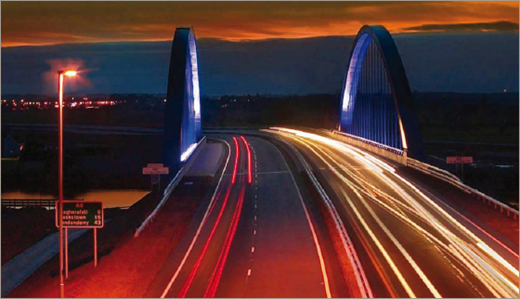
The new president strongly backs the use of ICE's NEC3 contract suite as way of achieving procurement excellence. As director of central procurement in the Northern Ireland Government, he first used NEC on the Toome Bypass on the strategic route between Belfast and the nort-west of Ireland (above). When opened in 2004, it was six weeks early and some 5% under the target cost.
Orr is also calling for the UK government to look at streamlining the planning process so vital infrastructure needed by the nation can be developed.
Daivd Orr's presidential address is printed in full on pages 3–8 of this issue.
Conservation awards
ICE announced the latest winners of the historic bridge and infrastructure awards in November 2007. The awards, now in their tenth year, celebrate civil engineering heritage conservation across England and Wales.
The four award-winning projects were
Shaken Bridge reconstruction, Helmsley, North Yorkshire.
High Level Bridge cast-iron testing and research, Newcastle (left).
Weetwood Bridge stabilisation, Wooler, Northumberland.
West Park Bridge restoration, Wolverhampton.

