

Discussion
08-00004: Camp Bastion, Afghanistan: haven in the desert of death: by Robert Hewson (August 2008)
Contribution by Andrew Wood
Can I object to the inclusion of a paper in the Proceedings of the Institution of Civil Engineers on a purely military project? The Camp Bastion scheme is for military purposes only and designed and constructed entirely by military engineers. As such, it has no place in a publication on civil engineering. We are either civil engineers or not; military engineers, by definition, are not. I am a civil engineer and pay my subscription to ICE, I have no wish for that subscription to be used to publicise military projects.
Author's reply
As a chartered member of ICE I am heartened that my paper has promoted discussion. In writing the paper I purposefully avoided discussion of the politics surrounding Camp Bastion and Afghanistan as I sought to promote awareness of the project and the associated logistic and project management considerations. The Corps of Royal Engineers and ICE have significant historical links: as a professional I firmly believe in recognising engineering achievement wherever it be found and that only through doing so can both professional bodies continue to develop. To ignore engineering accomplishment would be to the detriment of the profession.
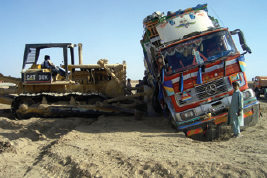
Why were the 1527 containers for Camp Bastion in Afghanistan delivered via the Khyber pass when a much shorter route was possible?
Why were the 1527 containers for Camp Bastion in Afghanistan delivered via the Khyber pass when a much shorter route was possible?
Contribution by Martin Fox
I would be interested to know the reason for routing the 1527 containers via Peshawar and the Khyber pass instead of the more direct route via Quetta.
Author's reply
The decision to establish the logistical supply route via Peshawar and the Khyber pass instead of the more direct route via Quetta was taken at a strategic level with consideration for the tactical situation on the ground. Additionally, consideration had to be given to the long-term capability of the logistic infrastructure and, significantly, the physical security of the route rather than basing it purely on distance. At the time of planning and indeed implementation of Camp Bastion, there was significant difference in the socio-political stability between the north and south of Afghanistan and thus its associated borders.
07-00063: Inquiry-based learning in civil engineering laboratory classes: by Joby Boxall and Simon Tait (August 2008)
Contribution by Christopher Calladine
The authors are surely right to be addressing the question of what sort of activities should take place in teaching laboratories in universities. But the first sentence of the abstract of their paper, namely, ‘Laboratory classes are a fundamental part of university education for civil engineers, reinforcing engineering theory through practical experience’, strikes me as being a false premise for such an undertaking.
The University Grants Committee's view is that, ‘The main purposes of higher education are to provide instruction in skills, and to promote the powers of the mind … higher education (at first degree level) should … emphasise underlying intellectual, scientific and technological principles rather than provide too narrow a specialist knowledge.’5 It seems to me that the laboratory in an engineering department is, par excellence, a place where the powers of the mind may be promoted.
Let me give just one example.6,7 For many years the University of Cambridge has run a second-year two-hour structures laboratory class which involves the students in testing a small-scale beam of ‘sandwich’ construction, with an expanded polystyrene core and aluminium sheet cladding. The students first make a prediction of the central deflection under central loading over different spans by using the classical theory of elastic beams. When they test the beam, however, they find that instead of the deflection per unit load being proportional to the cube of the span, as in the classical theory, it is more nearly proportional to the span itself. At this stage the demonstrator engages the students in conversation. What can we conclude when experiment and theory disagree? Is the experiment wrong here? Or the theory?
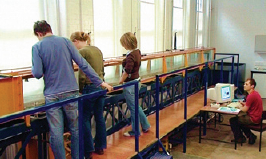
Students left alone in laboratories could miss the crucial learning input of a demonstrator
Students left alone in laboratories could miss the crucial learning input of a demonstrator
In the course of the ensuing discussion, the demonstrator invites the students to consider (if they have not already done so) the observed deflected shape of the beam – which turns out not to be a smooth curve (as in the classical theory) but a series of line-segments – and then steers them, if necessary, to the thought that in this particular beam the deformation is mainly by shear, rather than by bending as per the classical model.
The lesson learned by the students, in confronting this paradoxical behaviour, is that the classical theory – like all theories – is based upon certain assumptions; and that if these assumptions are not valid in a particular case, then also the theory will be devoid of predictive power. In this kind of laboratory session the role of a live demonstrator is clearly crucial; for otherwise the socratic dialogue which eventually resolves the paradox for the students cannot occur.
For these reasons I am sceptical about the value of laboratory classes that are designed, like those in this paper, to dispense with live demonstrators.
Authors' response
The contributor rightly points out that laboratory classes are about more than was captured in our introduction, in particular promoting the application of the mind for critical evaluation. The dialogue of his example demonstrates an ideal that classes should aspire to. However, for many students, such dialogue does not occur in a meaningful way.
The learning resources produced aimed to stimulate students to evaluate their observations critically in a manner that is meaningful to the largest possible number of students. We believe that the specially designed materials can aid student engagement.
For example, the spreadsheet-based resources allowed the students to undertake experimental design and predictions prior to entering the laboratory and hence ensured critical evaluation of previously encountered theory during the laboratory session. Additionally, the web resources, available in the laboratory, present the underpinning theory and all assumptions in a concise format. Such resources enable effective and efficient use of limited laboratory time, minimising the use of such time for straightforward calculations, such as those for deflection given in the contributor's example.
Our resources put the emphasis for learning onto the students so encouraging a professional attitude to their learning. However, great care and attention is required in the development of such resources to ensure that they provide sufficient support to all students within a class.
References
5. University Grants Committee. A Strategy for Higher Education in the 1990s: the UGC's Advice. Her Majesty's Stationery Office, London, 1984.
6. Calladine C. R. How should structures be taught in universities? In Education for Structural Engineering, Proceedings of a Conference held at Nottingham University, 16–18 September 1992 (McKay D. (ed.)). Sheffield, Innovative Engineering Press, Sheffield, 1992, pp. 37–44.
7. Calladine C. R. Some paradoxical experiments on beams. International Journal of Mechanical Engineering Education, 1996, 24, No. 1, 37–48.
07-00037: Tsunami wave loading on coastal houses: a model approach: by Navaratnam Thusyanthan and Gopal Madabhushi (May 2008)
Contribution by Anton Fernando
As a former housing research and development engineer at the National Engineering, Research and Development Centre of Sri Lanka, I believe that cost-effectiveness is vital.
As such, the raised foundations of the proposed tsunami-resistant house design, with stub columns to resist the superstructure moment due to wave impact, and extra walls at the centre to allow the wave to pass through the house, may not be desirable. Furthermore, allowing the wave to go through the house may also carry away its occupants and their belongings.
A circular plan shape would reduce the wave impact as well as giving a more economical floor-area-to-wall ratio.
I was working in Trincomalee in Sri Lanka when the 2004 tsunami struck and the region suffered much devastation. However, there was one area where houses near the sea remained undamaged. On investigation we found rows of coniferous trees in front of the houses, which had apparently dissipated most of the wave energy.
A strategy of planting recommended types of trees planted at correct distances, or a specified sand barrier, might also be adopted.
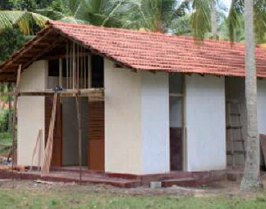
The prototype tsunami-resistant house abandoned the proposed raised floor due to costs – but still leaves occupants and contents unprotected
The prototype tsunami-resistant house abandoned the proposed raised floor due to costs – but still leaves occupants and contents unprotected
Authors' reply
The original design of the tsunami-resistant house by the MIT team had the floor raised to allow some passage of the wave underneath. However, we agree this is uneconomical and not practical for construction; the prototype houses built in Sri Lanka thus did not have this feature.
The design was never meant to keep the inhabitants safe – it was mainly to improve survivability of the house structure in an event of tsunami. It does not protect the people or contents from a wave.
The suggestion of a circular house plan is welcome and we will aim to investigate this in our future experiments.
A barrier of trees is an effective solution as well. However, Trincomalee has a unique topography in that the town centre and some areas are surrounded by high ground next to the shore. This meant the tsunami was diffracted way from these regions, protecting many structures.
07-00042: Heathrow Terminal 5: health and safety leadership: by Mike Evans (May 2008 special issue)
Contribution by George Tedbury
The paper gives a detailed description of the safety plan on the Heathrow T5 project, but the analysis of the outcome could give more information on the accident rate for different activities.
Some activities, such as the construction of the structural steelwork and tunnelling, are inherently more risky than others, especially when compared to many of the finishing trades such as (say) installing the departure desks or laying flooring. Consequently one would expect a decrease in the frequency of accidents as the main structures are completed.
In particular, although a full programme was not given, I imagine that much of the last year was devoted to fitting out, testing and commissioning inside essentially complete buildings. Consequently the low accident rates at the end of the project are what one would expect. On the face of it, the figures given in Fig. 7 show that up to the end of 2005, when the structural work was complete, the reportable accident frequency rates were improving but not on average substantially below the quoted ‘apparent national average of 0·53’ per 100 000 man hours. During the final two years a comparison with a different baseline would be appropriate.
It would be interesting if the author could give more direct comparisons with accident rates for different types of work.
Author's reply
The space allocated for the paper precluded inclusion of a detailed analysis of the vast amount of data that was amassed on T5. However, it is hoped that a follow-up paper will be published to provide some of the data analysis carried out and some ‘best practice’ examples of the more innovative working methods used.
The assertion that ‘one would expect a decrease in the frequency of accidents as the main structures are completed’ is interesting. It is an issue that was debated by the various safety professionals on T5 on a number of occasions through the course of the project. The general view was that while there was more scope for ‘low-frequency, high-consequence’ incidents during the early stages of the project, there were likely to be more ‘high-frequency, low-consequence’ incidents during later stages. It is also worthy of note that whilst the two main structures were largely complete by the end of 2005, there was still a significant amount of high-risk activity involved in the first-stage fit-out of these vast structures and on the many ancillary structures and airfield works.

At around the halfway stage in the project, with improvements in culture clearly starting to show, there were significant concerns that accident rates would actually increase during the later fit-out stages of the project, for the following reasons
large influx of new people in later stages causing erosion of established site practices and culture (new starters peaked at almost 1800 a month in September 2007)
shift from relatively small number of big employers to a multitude of smaller organisations with corresponding difficulties in getting consistent messages up and down a much more diverse communications chain
fit-out contractors, particularly in the retail sector, perhaps not being used to working under a highly prescriptive regime
people on site for much shorter periods of time and hence less opportunity to secure cultural change
‘hands on’ nature of fit-out work leading to more hand, eye and back injuries, as opposed to the more mechanised early phase work.
By December 2005, the T5 reportable accident frequency rate was down from 0·69 to 0·35. This was accompanied by a high degree of confidence in the reporting regime because of the success of the independent medical centre that was freely available to everyone on site. The quoted national average of 0·53 does not allow for under-reporting, which the Health and Safety Executive (HSE) believes to be as much as 50%, leading to a comparative figure of over 1 and, by definition, including all types of construction activity.
Unfortunately, there appears to be little published information on comparative accident frequency rates for different types of activity. The HSE national average was therefore considered the best figure available.
Notwithstanding any debate on reporting and statistical comparisons, the most compelling evidence of success in health and safety was that which came from the workforce itself. If 91% of workers felt that it was the safest place that they had worked (2006 survey), who were we to disagree?
Full versions of these discussions can be read with all other discussion in the online version of the journal at www.civilengineering-ice.com.
Proceedings
>RECENTLY PUBLISHED PAPERS
In addition to Civil Engineering, ICE Proceedings includes 15 specialist journals. Papers and articles published in some of the most recent issues are listed here. Summaries of all these and other papers and articles published in the past three years can be read free at www.ice.org.uk/journals. ICE members can download any 15 papers published in 2008 for £25 from www.iceknowledge.com
Bridge Engineering
161, No. BE3, September 2008, 101–158
New York City bridges: network and project management
B. Yanev

Inspection and maintenance of highway structures in England
A. S. Jandu
Developing a business process model for bridge management
J. Harvey and P. Owens
Forth Road Bridge – maintenance and remedial works
B. R. Colford
The role of assessments in highway bridge management
G. Cole
Assessment of concrete half-joints using non-linear analysis
D. Boothman, S. Leckie, I. MacGregor and A. Brodie
The benefits of bridge condition monitoring
D. Pearson-Kirk
Construction Materials
161, No. CM4, November 2008, 139–191
Strength characteristics of hydraulic lime mortared brickwork
Z. Zhou, P. Walker and D. D'Ayala

Using slag for unfired-clay masonry-bricks
J. E. Oti, J. M. Kinuthia and J. Bai
Performance of a fibre-reinforced lightweight concrete panel
B. Arisoy and H.-C. Wu
Corrosion protection for chloride-contaminated concrete
G. K. Glass, A. C. Roberts and N. Davison
Durability of FRP-confined concrete
F. Micelli and J. J. Myers
Energy
160, No. EN4, November 2007, 135–180
Neural network prediction of energy demand and supply in China
Z.-S. Li, G.-Q. Zhang, D.-M. Li, X.-H. Liu, S. Mei and J. Wu

Adoption of energy efficiency innovations in new UK housing
J. Ko and R. Fenner
Electric vehicles for low-carbon transport
J. Gibbins, A. Beaudet, H. Chalmers and M. Lamperth
Commercial development of underground coal gasification
L. K. Walker
Engineering and Computational Mechanics
161, No. EN3, September 2008, 101–153
The history of fluid mechanics at the University of Oxford
A. G. L. Borthwick

Generation and alleviation of sonic booms from rail tunnels
A. E. Vardy
A semi-analytical method for plate and grid structures
J. S. Kuang and H. Zhang
A 2D contaminant transport model for unsaturated soils
R. Praveen Kumar and G. R. Dodagoudar
Computational form-finding methods for fabric structures
W. J. Lewis
Engineering Sustainability
161, No. ES3, September 2008, 103–148
Achieving sustainability in the construction supply chain
I. Adetunji, A. D. F. Price and P. Fleming

A best practice policy for recycling and reuse in building
G. Brewer and J. Mooney
Assessing ‘carbon balance’ of intelligent transport schemes
I. Patey, J. Conquest and A. Holt
Educating for urban sustainability: a transdisciplinary approach
G. Brewer, T. Gajendran, C. Landorf and T. Williams
Geotechnical Engineering
161, No. GE5, October 2008, 225–277
Using trenches to reduce tunnelling vibrations
M. E. Rahman and T. L. L. Orr

Seepage control for Satpara dam, Pakistan
Z. M. Malik, A. Tariq and J. Anwer
Refining characteristic values of shear strength using experience
D. J. Baxter, N. Dixon, P. R. Fleming and K. Cromwell
Foundation behaviour below an embankment on soft soils
B. R. Rankine, B. Indraratna, N. Sivakugan, V. Wijeyakulasuriya and C. Rujikiatkamjorn
Investigating anisotropy in shear strength of clayey soils
M. F. Attom and N. M. Al-Akhras
Ground Improvement
161, No. G14, November 2008, 171–216
Prefabricated vertical drains: a simplified design procedure
I. Bellezza and R. Fentini

Reduction of smear effects around PVD using thermo-PVD
C. Pothiraksanon, J. Saowapakpiboon, D. T. Bergado and N. Y. Than
Experimental study on sand and gravel columns in clay
P. Andreou, W. Frikha, R. Frank, J. Canou, V. Papadopoulos and J.-C. Dupla
Field behaviour of granular pile-anchors in expansive soils
B. R. Phanikumar, A. Srirama Rao and K. Suresh
Behaviour of lime–slag-treated clay
R. James, A. H. M. Kamruzzaman, A. Haque and A. Wilkinson
Maritime Engineering
161, No. MA2, June 2008, 53–97
Sediment transport through rock groynes on mixed beaches
U. Dornbusch

Managed realignment – lessons from Wallasea, UK
M. Dixon, R. K. A. Morris, C. R. Scott, A. Birchenough and S. Colclough
Modelling effects of realignment of Keelung River, Taiwan
W.-C. Liu, W.-B. Chen and C. H. Wu
Numerical study of scour around a pipeline bundle
D. Liang and L. Cheng
Municipal Engineer
161, No. ME3, September 2008, 147–206
Dweller perception using fuzzy logic for slum upgrading
O. B. Moraes and A. K. Abiko
Developing an urban information system for local governments
A. Geymen, T. Yomralioglu and I. Baz
Socio-environmental impact of Cairo Metro line 2
O. W. Massoud
Spot improvements: safe, reliable access for rural communities
S. Done
Bridge-building in Malawi: a student expedition
H. Kirk
Global and sustainability issues for engineering graduates
D. Bourn and N. Sharma
Structures and Buildings
161, No. SB5, October 2008, 239–299
R. H. Wood's ‘The stability of tall buildings’: a contemporary view
C. King

Historical paper: The stability of tall buildings
R. H. Wood
Failure of rectangular masonry buttresses under concentrated loading
J. Ochsendorf and L. De Lorenzis
A new lateral force distribution formula for base-isolated structures
F. Khoshnoudian and S. Esrafili
Transport
161, No. TR4, November 2008, 169–236
Analysis of buckling in dual-gauge tracks
M. Cuadrado, C. Zamorano, P. Gnozález, J. Nasarre and E. Romo

Creep in conventional and modified asphalt mixtures
A. Aksoy and E. Iskender
Fatigue analysis of stabilised cement with image processing
A. B. Göktepe, A. H. Lav, S. Altun, C. Akgüner and A. Sezer
Indirect tensile versus two-point bending fatigue test
A. Cocurullo, G. D. Airey, A. C. Collop and C. Sangiorgi
An optimisation model for prioritising transport projects
A. Ahern and G. Anandarajah
Deleterious effects of corruption in the roads sector
M. S. Snaith and M. U. Khan
Urban Design and Planning
161, No. DP3, September 2008, 91–143
Does quality of the built environment affect social cohesion?
N. Dempsey

European urban policies and the neighbourhood: an overview
R. Atkinson
Karachi in 2020: approaching planning as a project
N. Ahmed
A simulation model for generating alternative scenarios
J. R. Ottensmann
Waste and Resource Management
161, No. WR2, May 2008, 43–87
Demolition waste: are we doing our best?
M. Bjerregaard

Resource flow analysis for sustainable construction: metrics for an integrated supply chain approach
J. Ravetz
Design and specification of tyre bales in construction
J. D. Simm, M. G. Winter and S. Waite
Constructed wetland as tertiary treatment for municipal wastewater
S. Ahmed, V. Popov and R. C. Trevedi
Resource recovery through catalytic cracking of waste plastics
P. A. Parikh and Y. C. Rotiwala
Water Management
161, No. WM5, October 2008, 239–299
Spatial variation in physio-chemistry in a small river estuary
H. Chanson and I. Ramsay

Improving bridge afflux prediction for overbank flows
G. Seckin, D. W. Knight, S. Atabay and N. Seckin
Flood risk management strategies using multi-criteria analysis
F. Yazdandoost and B. Bozorgy
Laboratory study of maximum scour depth downstream of sills
C. Chinnarasri and D. Kositgittiwong
Modelling of lake–groundwater interaction in Turkey
I. I. Soyaslan, A. Dogan and R. Karaguzel
Computer modelling of graded sediments in rivers
A. B. Shvidchenko and G. Pender
Assessment of existing soakaways for reuse
H.-P. Chen, M. W. Stevenson and C.-Q. Li
Cascade stilling basin design using continuous ant algorithm
M. H. Afshar and M. Daraeikhah
Hydraulic jumps in trapezoidal and circular channels
S. B. Mitchell
A methodology for regional-scale flood risk assessment
B. Gouldby, P. Sayers, J. Mulet-Marti, M. A. A. M. Hassan and D. Benwell
Request for papers
All Proceedings journals rely entirely on papers sent in by civil engineers and related professionals, researchers, academics and students. Papers should be around 2000 to 5000 words long, in good English and with adequate illustrations and references. Project papers are particularly welcome. All papers sent in will be assessed on merit and not on the status of the author. Simply submit your text and images using the online submission system via www.ice.org.uk/journals.
Personal on-line subscriptions to specialist Proceedings journals start from £11 a year for members.
Print subscriptions start at £21 a year and include full on-line access to the current and past three years' issues. Please call +44 20 7665 2227, email subs@ice.org.uk

Books
>>> REVIEWS
Nuclear power: by Janet Wood, published by The Institution of Engineering and Technology, 2007, £25, reviewed by Robert Freer
After many years of indecision the UK government has now given the green light to a new generation of nuclear power stations and developers can start preparing to build them again. However, it is 13 years since the last nuclear power station, Sizewell B, was opened in 1995 and there is now a new generation of young engineers in this country who have not had the opportunity to work on their design and construction. This book will help.

Today's developers of nuclear power stations can choose from a number of modern and efficient designs which are both simpler and inherently safer than earlier designs. Janet Wood describes these in detail in her book and discusses their pros and cons.
Public concerns about nuclear power stations are often focused on their safety, the long-term supply of uranium and the management of waste. Wood addresses all these concerns. The chapter on the nuclear accidents at Chernobyl, Three Mile Island and Windscale describes in detail the sequence of events and identifies the causes. Common to all these accidents was operator error. The supply of uranium is also not seen as a limiting factor in a programme of nuclear new-build. Large deposits occur in Canada and Australia, both politically stable countries, and there are also substantial reserves in Kazakhstan.
This book is well illustrated with a number of high-quality engineering drawings and the text is clear and very comprehensive. There is a helpful glossary of technical terms and a further reading list. It will be of special interest to everyone who wishes to learn about the background and renaissance of nuclear power and should be required reading for all young engineers fortunate enough to be starting their careers on the design and construction of Britain's new nuclear power stations.
Innovation in small construction firms: by Peter Barrett, Martin Sexton and Angela Lee, published by Taylor and Francis, 2008, £55, reviewed by Joe Gunning, University of Ulster
This 98-page volume appears to be over-priced for the value of its contents to a small or medium enterprise (SME) – the audience at which it claims to be aimed. However, the academic community in construction management will welcome its list of almost 200 references and should recommend the text to their libraries.

The underlying research by the three academic authors aims to investigate how small construction firms create, manage and exploit innovation. It does this by means of seven case studies of organisations – four consultants and three contractors – with average turnover of £1·5 million, employing around 20 staff and with a mean corporate life of 20 years.
The primary finding of the research is that SMEs with multi-project, value-oriented, client-relationship focus take more account of market-positioning than those with a single-project, cost-oriented focus. Small firms are advised to innovate gradually and safely. This is a logical position, rather than a ground-breaking conclusion.
The recommendations for practitioners in innovation can be summarised as the need for systemic thinking by the owner when prioritising and integrating the decisions made in implementing new ideas.
In conclusion, this is a scholarly book for an academic audience, which offers little real practical guidance to the SME construction market. It does, however, provide a useful guide for postgraduate students who are developing ideas for construction management research methods, models and contexts, and I commend it to them.
Precast concrete structures: by Kim Elliott, published by Butterworth Heinemann, reprinted 2007, £45·99, reviewed by Costas Georgopoulos, The Concrete Centre With precast concrete solutions increasingly becoming the preferred option for multi-storey building construction, this excellent textbook is one of the very few publications on the subject that provide sufficient information to enable the structural designer to carry out the detailed analysis and design of precast-concrete-framed buildings.
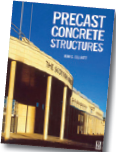
Precast concrete structures is mainly written for students and tutors of structural design with concrete for civil engineering degree courses in UK universities and hence fundamental in content – that is, assuming limited prior knowledge of the concrete industry and building design. Chapters on materials, frame analysis, structural-element design, connections and robustness present the structural theory with clear explanatory text supported by well-annotated figures and followed by practical case studies and invaluable worked examples.
The comprehensive design calculations of precast pre-stressed elements demystify their design, which is normally carried out by a handful of engineers working for the precast manufacturers in the UK. In addition, the book includes extensive calculations of strut-and-tie method applications, horizontal-floor diaphragms, joints and connections, columns and shear walls, and so on, thus offering a useful point of reference for practising structural engineers.
I thoroughly recommend this book to everyone interested in structural design of concrete-framed buildings and hope that future editions are updated to incorporate design to Eurocode 2 and some conceptual guidelines on the seismic performance and sustainability credentials of precast-concrete structures.
My world: the life and times of a civil engineer: by Peter Ackers, published by The Memoir Club, 2007, £17·50, reviewed by Sue Caccavone, Black and Veatch Ltd

Now retired, Peter Ackers was assistant director at HR Wallingford before going on to become a consulting engineer with Binnie & Partners. This trip down memory lane begins with a fascinating insight into life in Liverpool throughout the war years, during which Ackers obtained a place at grammar school and then university having gained a royal scholarship, only two of which were issued annually.
He proves with many anecdotal clips that it this is indeed a very small world, meeting people in far-flung places that have connections to both work colleagues and loved ones. The tone of the book is easy reading and it is written as if Ackers were sitting in an auditorium reciting his life history. Throughout the book you get introduced to his family, who were often able to accompany him on work trips or to conferences throughout the world.
Ackers does not lose the reader in unnecessary technical terminology and is also not frightened to voice his opinion on both events of the past and current issues. The second half of the book describes his many work-related travels, which to today's consulting engineers sound like a series of fortunate opportunities that do not often present themselves nowadays.
This book is of interest to anyone thinking of going into the consulting side of civil engineering as well as those who have already chosen that career path. Ackers sums up by saying, ‘My message to any young person reading this is that engineering is a good profession to follow. There are many challenges ahead too.’
A short course in geology for engineers: by Marcus Matthews, Noel Simmons and Bruce Menzies, published by Thomas Telford, 2008, £65, reviewed by Robert Freer.
Written by a team of authors from Surrey University, this book focuses on what civil engineers need to know about identifying and understanding different rocks and soils and learning how they behave, or can be expected to behave, under different conditions.
There are many specialisations in the science of geology but the authors say they asked themselves the question, ‘How does this information help the civil engineer?’ They then cut out everything which does not, resulting in a valuable introduction and guide to the essential properties of the ground on which we build.
The chapters on igneous rocks, sedimentary rocks and metamorphic rocks are helpfully subtitled ‘new ground’, ‘deposited ground’ and ‘changed ground’. The preceding chapters discuss the Earth's structure and explain the plate movements which create the conditions to generate and alter new ground. They are followed by chapters on understanding and reporting stratigraphy and on the practical use of geological maps.
The authors also offer helpful guidance on identifying the types of rock by visual characteristics such as colour, texture, grain size, mineral content and hardness, and by simple chemical tests.
Civil engineers do not necessarily also need to be geologists, although for many it would be helpful, but they do need to know that the science of geology exists and where to get the information they require. This book is probably one of the most useful and readable sources of information for the practising engineer and the authors are to be commended for their initiative in writing this book and for their success in its presentation.
Full versions of these and other reviews can be read at www.civilengineering-ice.com.
>>> NEW BOOKS
The ICE's bookshop in London carries one of the most comprehensive ranges of civil engineering books in the world. New books received in the past three months are as follows.
Architect and engineer: a study in sibling rivalry
Andrew Saint £45·00
AutoCAD workbook for architects and engineers
Shannon R. Kyles £24·99
Contemporary property development (2nd edition)
Dr Timothy Havard £40·00
Corporate social responsibility
Mike Murray and Andrew Dainty £29·99
Decoding Eurocode 7
Andrew Bond and Andrew Harris £75·00
Dictionary of architecture and building construction
Nikolas Davie and Erkki Jokiniemi £34·99
Employment law for the construction industry (2nd edition)
Michael Ryley and Edward Goodwyn £30·00
Environmental construction handbook
Anne Dye and Mike McEvoy £36·00
Extensions of time: good practice guide
Gillian Birkby and Albert Ponte £15·00
Geotechnical engineering (2nd edition)
Renato Lancellotta £29·99
High-strength concrete
Michael Caldarone £70·00
Introduction to health and safety in construction
Phil Hughes and Ed Ferret £41·99
Learning for action: a short definitive account of soft systems methodology and its use for practitioners, teachers and students
Peter Checkland and John Poulter £29·99
Practical road safety auditing (2nd edition)
Martin Belcher, Steve Proctor and Phil Cook £49·00
Principles of pavement engineering
Nick Thom £80·00
Spon's architects' and builders' price book
Davis Langdon £145·00
Spon's civil engineering and highway works price book
Davis Langdon £155·00
Spon's external works and landscape price book
Davis Langdon £115·00
Spon's mechanical and electrical services price book
Davis Langdon and Mott Green Wall £145·00
Sulfate damage to concrete floors on sulfate-bearing hardcore
Ian Longworth £20·00
Understanding the Building Regulations (4th edition)
Simon Polley £18·99
Work: the building of the Channel Tunnel rail link
Stephen Bayley £39·95
The bookshop is in the ICE foyer, 1 Great George Street, London SW1P 3AA and is open from 9.30am to 5.00 pm, Monday to Friday. Books can also be ordered by calling +44 20 7665 2462, emailing orders@thomastelford.com or by visiting www.thomastelford.com or the bookshop section of www.ice.org.uk
ICE review
A review or recent and forthcoming developments at the Institution of Civil Engineers by ICE director of communications and marketing Anne Moir. For further information please contact the Communications Office on +44 20 7665 2150.
New flooding report
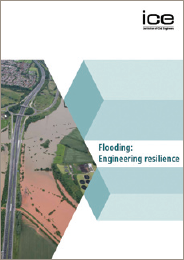
In June 2008, ICE released its report entitled Flooding: engineering resilience, which demonstrated how the UK's infrastructure – including power stations, water plants, and transport systems – is still far too vulnerable to flooding.
The Institution's flooding group chairman David Balmforth said, ‘Last summer's floods showed us how vulnerable the UK's infrastructure networks are, and little is being done to rectify the situation. If we want to prevent blackouts, water shortages and transportation failures, we need to ensure we have enough spare capacity in the system to deal with disaster. Basically, we need to make our critical infrastructure a little less critical.’
The report was launched at an event in Gloucester hosted by ICE president David Orr and attended by HRH The Duke of Gloucester to mark the one-year anniversary of the 2007 floods. Following a breakfast briefing to key stakeholders from local council and emergency services, there was a visit to Severn Trent's Tewkesbury works, which flooded in 2007.
Pitt review welcomed
The Institution endorsed Sir Michael Pitt's UK flooding review, published in June 2008, but urged the government to ensure a long-term view is taken.
‘We at ICE welcome Sir Michael's review and hope the government will now take the necessary action to mitigate and adapt to the growing threat of floods in the UK,’ said ICE flooding group chairman David Balmforth.
‘The review makes a number of important recommendations, but what we really believe the government needs to do is address these points within the context of a long-term assessment of the critical issues of flood risk management.’
Consultant adds to archives
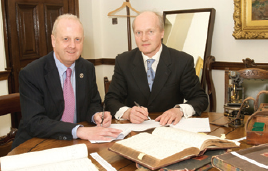
The Institution has signed an agreement with engineering and capital project consultancy HPR (formerly High-Point Rendel) to store a selection of its records dating from the 1820s to the 1970s in ICE's archives.
Deposited records include James Meadows Rendel's design for Clifton Gorge, nineteenth century report books on harbour schemes in Britain and abroad, and a number of twentieth century records revealing insight into Indian railways, major bridges such as Waterloo, and post-war power stations.
Sir Alexander Rendel's personal theodolite will also feature, as will photographic portraits of many of the partners.
Bogus caller warning
ICE has issued a warning to all members about people claiming to be from the Institution ringing up civil engineering companies and asking for names and contact details of staff members.
The caller often claims to be from a recruitment company originating within ICE, or claims the information is for use in an Institution report. The information is also often claimed to be needed to invite members to an event or conference.
ICE does not contact companies, either by phone or email, requesting such information. If members are being asked to contribute to reports, they will be contacted directly. Likewise, information contained in the Institution's own records would be used to contact people about upcoming events.
Companies are asked to beware of people contacting them, claiming to be from the Institution and be wary of handing out staff information. Please report any incidents to ICE's communications department on + 44 20 7665 2150 or email communications@ice.org.uk.
Head goes global
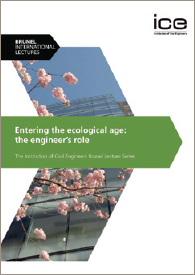
Following his inaugural presentation in June 2008, ICE fellow and Arup director Peter Head OBE is heading off around the world to deliver the Institution's 2008 international Brunel lecture entitled Entering the ecological age: the engineer's role.
He is presenting his lecture in a number of cities around the world, starting with Las Vegas in October and continuing on to Luxembourg, Delhi, Melbourne, Sydney, Auckland, Johannesburg, Abu Dhabi, Dublin, Hong Kong and many more.
The lecture focuses on the major changes required in the development of infrastructure, policy and legislation to mitigate and adapt to effects of climate change around the world.
A copy of the paper can be downloaded from www.ice.org.uk/brunel.

