

Discussion
09-00023: M25 Homesdale tunnel – setting a new standard for safety by John Tomkins, John Celentano, Eamonn Colgan and Ken Spiby (February 2009)
Contribution by Paul Moran
It appears from Figures 2 and 3 that the raised walkway has disappeared. Is this not a lot more dangerous for motorists who break down in the outside lane?
Authors' reply
As the contributor correctly observes, the raised walkways in the tunnel were removed as part of the tunnel refurbishment. BD 78/99 Design of Road Tunnels6 requires that, ‘Unobstructed pedestrian access, at low level, to emergency points shall be provided’.
Raised walkways have several disadvantages, including
loss of temporary standing for stranded vehicles (or usable road space)
unwelcome proximity of a vertical concrete wall influencing driver behaviour
restricting the opening of doors of stranded vehicles
loss of ready access to the emergency points
cross-connecting doors have to be at high level, making access difficult in the event of emergency evacuation between tunnel bores
more problematical maintenance (e.g. additional walls, rapid deterioration of hand railing and general cleaning difficulties due to poor access).
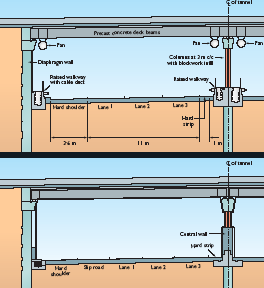
Did removal of the raised walkways in the M25 Holmesdale tunnel actually make it more dangerous?
Did removal of the raised walkways in the M25 Holmesdale tunnel actually make it more dangerous?
In the case of Holmesdale tunnel, removal of the raised walkways additionally allowed the slip-roads to be extended within the tunnel to meet the requirements of the EU tunnels directive to allow merge/diverge changes to occur outside the tunnel.
The refurbished tunnel has additional safety features that will detect stopped vehicles and pedestrians in the tunnel and enable the traffic control office to set signs and signals, such as speed limits and lane closures, on the approach to the tunnel and manage the incident.
With the additional tunnel safety equipment in place, the risk to individuals in the event of broken-down vehicles in the fast lane is less than on the motorway network in general.
References
6. Highways Agency. Design of road tunnels. In Design Manual for Roads and Bridges. The Stationery Office, London, 2009, vol. 2, section 2, part 9, BD 78/99.
08-00026: New approach puts Tube station upgrade back on track by Keith Sibley (February 2009)
Contribution by David Maitland-Wood
The author highlights the tremendous efficiencies and advances that have taken place in how London Underground station works are carried out and it is worth bearing in mind that this is a direct result of the public–private partnership, which deserves at least some credit. There is no prospect that London Underground could have successfully managed a programme of works on the scale undertaken, under the regime which existed before the public–private partnership.
The first tranche of projects was carried out under a partnering arrangement whereby there was a design consortium and a lead contractor for each line, for example Ruddle Wilkinson led the design team and YJ Li was main contractor on the Northern line. The projects were contracted under a target cost with a gain-share/pain-share; however, this gave insufficient control to Tube Lines when problems arose. There was too much uncertainty over scope in the early days and the capped gain-share/pain-share quickly became meaningless as costs rose.
While the paper mentions improvements in the assurance process, it gives insufficient credit to the improvements which also occurred in design management, where Tube Lines also took the leading role–thereby taking control of the programme and integration of disciplines.

London Underground could not have managed the scale of the station-upgrade works without the public–private partnership
London Underground could not have managed the scale of the station-upgrade works without the public–private partnership
SPECIAL ISSUE: Learning from failures Introduced by Mike Byfield (November 2008 special issue)
Contribution by Bill Johnson
I was delighted to receive the special issue of Civil Engineering entitled Learning from failures. It is vital in my view that we do not allow the risks of legal action to inhibit our frankness and honesty in such cases or to prevent or delay the giving of papers to institutions such as ICE. It is also important that other disciplines involved – such as administrative civil servants, police and others – are similarly open.
Author's reply
I agree with the contributor's call for greater openness, although I am not sure what can be done to improve the flow of first-hand accounts of failures into the public domain. Insurance and legal issues will continue and, as they say, ‘success has many fathers but failure is an orphan’.
Major civil and structural engineering failures in the USA, such as the Murrah building collapse, are often the subject of federally funded investigations by the National Institute of Standards and Technology (Nist) and the Federal Emergency Management Agency (Fema). In such cases, the forensic reports are made publicly available as pdf files and these serve to inform the wider engineering community.
In the UK we are probably less open in this regard and much reliance is placed on the technical media for disseminating lessons from failures. I hope this special issue helps.

The USA is more open than the UK with its forensic reports on failures, such as those for the 1995 Murrah federal building collapse (Fema)
The USA is more open than the UK with its forensic reports on failures, such as those for the 1995 Murrah federal building collapse (Fema)
07-00004: Learning from failures at the interface by Allan Mann (November 2008 special issue)
Contribution by Barry Walton
I would appreciate the author's instinctive and knowledgeable view on the approach to infrastructure investment in the UK water industry (particularly England and Wales), which is driven by meeting efficiency targets and a regulatory demand not to build-in or maintain redundancy.
The industry is peppered with instances of using up capacity to meet growing demand, when no-one in their right mind would design without any margin, and of taking measures that, if they fail, may have extremely inconvenient if not catastrophic consequences. An example is introducing pressure reduction to decrease leakage, it being reasonably certain that the leakage was related to loss of integrity of infrastructure.
Author's reply
I have no direct knowledge of water-industry practice, but generally all engineers are faced with the dilemma of designing for efficiency against scarce resources. Clients and designers are entitled to separate commercial risk from safety risk, but they need to be quite clear when there is a safety risk that they must act with prudence.
Part of that prudence involves assessing the consequences of any failure and taking that into account when assessing the uncertainties inherent in the design that might conspire to initiate failure. Even when there is no direct safety risk, an engineer's duty is to provide a robust design – and many would argue that it is not sensible to risk disproportionate commercial loss by capital skimping.
07-00038: Lessons learned from the bridge collapse in Palau by Chris Burgoyne and Richard Scantlebury (November 2008 special issue)
Contribution by John Turnbull
My own theory for collapse is that tendon corrosion may have had a significant effect. My reasoning is that as the tendons corrode, the prestressing force is reduced and the section begins to behave as a partially prestressed section, class 2 or 3, rather than a class 1 section for which it would have been originally designed.
To maintain equilibrium, the neutral axis would be progressively lowered, with corresponding increase in lever arm to the tendons and reduced lever arm to the concrete compression flange. Therefore the compressive force in the bottom flange has to increase. The only noticeable effect of this, prior to collapse, is that the increased compressive stress in the bottom flange would lead to increased creep-shortening of the flange and a corresponding increase in downward creep deflection of the cantilevers.
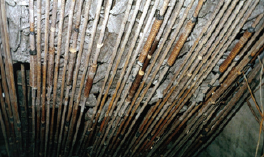
Very little corrosion is evident in the top flange prestressing in the failed Koror-Babelthuap Bridge in Palau
Very little corrosion is evident in the top flange prestressing in the failed Koror-Babelthuap Bridge in Palau
Authors' reply
Our Figure 9 (repeated here) is the only photo available to us which shows the condition of the top flange prestressing, but there is very little corrosion evident in the photograph. It should be stressed that what is being seen here is the outside of the ducts and, although there is some corrosion visible, it is likely that this is superficial corrosion that has occurred after the failure, taking account of the fact that the tendons are just above sea level in a tropical environment. It should be noted that there is no visible rust-staining on the concrete that was adjacent to tendons before failure.
Even if corrosion did occur in the tendons, this would not reduce the overall pre-stress force significantly. If the tendon area reduced, the stress in the remaining section would merely increase to maintain the same force – where else can it go, as there is no change in global strains? Tendon corrosion can result in failure, but this is due to this stress increasing eventually to the point of yield in the tendon, followed by yielding of the remaining tendons, with corresponding tension cracking of the top flange and compression failure of the bottom flange. This would not have led to the top flange delamination visible in Figure 9.
Readers may like to know that the embargo on publication of details has now expired and that a paper was presented at the 17th International Association for Bridge and Structural Engineering (IABSE) congress in Chicago in September 2008 by Gary Klein of Wiss, Janney, Elstner Associates (which was involved in the investigation) under the title Collapse of the Koror Babeldaob Bridge. That paper also concludes that failure was caused by damage to the top flange of the bridge and was caused by inadequacy of the original design.
07-00017: Teton dam, USA: uncovering the crucial aspect of its failure by Balasingam Muhunthan and Stihampara Pillai (November 2008 special issue)
Contribution by Scott Younger
I was particularly interested to note the authors' comments on the quality of the material used as the core – a very-low-plasticity fine-grained soil – which suggests a high silt fraction in the grading. Can the authors shed some further light on this? The method of compaction would also have had a bearing – sheep-foot or smooth-wheeled (or rubber-tyred) roller? The sheep-foot roller is effective where there is a sufficient amount of clay fraction present, but the indication for the core soil at Teton is that this will have been small.
In addition, the fact compaction conditions were controlled at moisture contents drier than optimum might suggest that incipient hairline cracks may have been left behind in the process. These points of weakness would then be vulnerable at the shallower depths, with lower volumetric stress levels, as the authors describe.
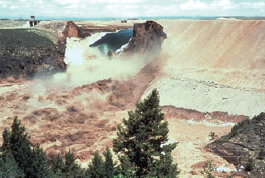
Failure of Teton dam in Idaho, USA in 1976 was not due to inappropriate compaction or piping
Failure of Teton dam in Idaho, USA in 1976 was not due to inappropriate compaction or piping
Piping was a common form of failure of early earth dams, usually in the lower reaches of a structure where the soil was predominantly silty in nature. The important benefit of an adequate clay fraction, preferably included in the main part of the earth structure or performing as a preventive seal, was only appreciated later. In my own experience, piping through a soil with high silt fraction was the cause of failure of a relatively small regulator dam for irrigation water from the Mekong in north-east Thailand in 1981.
Authors' reply
Unfortunately, clayey soils with medium plasticity, which are more crack-resistant and more suitable for the impervious core, were not available near the site of the Teton dam. This is generally the case in the Pacific north-west of the USA. Most of the earthfill dams in this region were constructed of clayey silts or glacial silty till-like soils of low plasticity.
To quote from Reference 7, ‘The soil material that formed the impervious core of the dam (Zone-1) was derived from aeolian deposits and consisted of a uniform clayey-silt (CL-ML) of low plasticity (PI = 4), 80 percent passing through #200 sieve and about 15% of clay fraction (< 2 micron)’.
As per the design and specifications, zone 1 material was placed at an average water content of 1% dry of optimum and compacted to a maximum dry density of 98–102% of the standard Proctor maximum dry density. The material was compacted using vibratory-roller compactors-tampers, mostly manufactured by the Caterpillar Company of America. The drums of these roller compactors consist of tamping pads (elephant-foot size) as compared to pointed deep pricks of sheep-foot rollers.
Since sheep-foot rollers tend to disturb the soil and are considered detrimental to the finished product, they have been rarely used for dam construction in North America since the early 1960s. We do recognise that sheep-foot rollers continue to be used widely in developing countries, partly because of technology gap and other budgetary constraints.
The contributor refers to piping failures of a dyke built on the Mekong delta in Thailand. It is true that dykes built on alluvial foundations tend to show piping near the downstream toe, mostly during full pool. This is largely due to the fact that seepage has many preferred paths within the foundations of deltaic soils, particularly through sand or gravel lenses. When the exit gradients through sand lenses in the foundation exceed the critical gradient, the toe areas would be sputtered with bubbly springs. Unless a toe drain or a downstream pressure-relief system is installed, such dykes could fail.
Therefore, examples of dyke failures on alluvial deltaic foundations are of no relevance to a well-designed compacted-fill dam. Such piping is very rare through the compacted impervious fill of an embankment. Thus, we believe piping through the Teton dam was not a cause for its failure. Flaws with these and other construed modes of failure of the dam were discussed in detail in the paper as well as in References 6 and 7.
Full versions of these discussions can be read with all other discussion in the online version of the journal at www.civilengineering-ice.com.
Proceedings
RECENTLY PUBLISHED PAPERS
In addition to Civil Engineering, ICE Proceedings includes 16 specialist journals. Papers and articles published in some of the most recent issues are listed here. Summaries of all these and other papers and articles published in the past three years can be read free at www.ice.org.uk/journals. ICE members can download any 15 papers published in 2009 for £25 from www.iceknowledge.com
Bridge Engineering
162, No. BE1, March 2009, 159–210
Procurement, design and construction of the Clyde Arc, Glasgow
C. Walker, T. Scott and D. Trail

Sir Alfred Pugsley OBE, FREng, FRS (1903−1998): his legacy
J.A. Gill, D. Muir-Wood, D. I. Blockley and R. H. J. Sellin
Lateral buckling of plate girders with flexible restraints
C. R. Hendy and R. P. Jones
Integral abutment bridge hysteresis model for long prediction
K. Pugasap and J. A. Laman
Civil Engineering Special Issue
162, No. CESI1, May 2009, 1–64
Forensic investigation of blast damage to British buildings
B. Keane and P. Esper

Forensic engineering of fire-damaged structures
J. Ingham
Learning lessons from forensic investigations of corrosion failures
G. John, T. Edwards, A. Wright, M. Broadhurst and C. Newton
Forensic study of wave loads on a pier in Belgium
J. Alderson, W. Allsop, G. Cuomo, Y. Duchene and V. De Vill De Goyet
Forensic investigation of fluvial flood damage in the Czech Republic
M. Holicky and M. Sykora
A systematic approach to forensic foundation engineering
H. Poulos
Forensic landslide investigations in Hong Kong
K. Ho, T. Lau and J. Lau
Forensic structural engineering practice in the USA
B. Ratay
Learning from the past to improve future practice
S. Matthews and G. Saunders
Construction Materials
162, No. CM2, May 2009, 47–92
Selecting sustainable materials for ceilings in Sri Lanka
U. G. Yasantha Abeysundara and S. Babel

Fly-ash-blended lean concrete mixes for concrete blocks
B. V. Venkatarama Reddy and A. Chander
Thermo-acoustic properties of cement-waste-glass mortars
A. Petrella, M. Petrella, G. Boghetich, D. Petruzzelli, U. Ayr, P. Stefanizzi, D. Calabrese, L. Pace and M. Guastamachia
Durability of rock-filled-dam face-slab concrete
S.-K. Woo, Y.-C. Song and J.-P. Won
Fuzzy logic approach for estimating durability of concrete
M. L. Nehdi and M. T. Bassuoni
Energy
162, No. EN1, February 2009, 1–53
Utilisation of geothermal resources
J. W. Lund
Methane from biomass: process-integration aspects
S. Heyne and S. Harvey

UK microgeneration. Part I: policy and behavioural aspects
N. Bergman, A. Hawkes, D. J. L. Brett, P. Baker, J. Barton, R. Blanchard, N. P. Brandon, D. Infield, C. Jardine, N. Kelly, M. Leach, M. Matian, A. D. Peacock, I. Staffell, S. Sudtharalingam and B. Woodman
Transforming low-voltage networks into small-scale energy zones
P. Trichakis, P. C. Taylor, P. Lyons and R. Hair
Engineering and Computational Mechanics
162, No. ECM1, March 2009, 1–54
Concrete grandstands. Part I: experimental investigation
J. N. Karadelis

Concrete grandstands. Part II: numerical modelling
J. N. Karadelis
Advantages of object-oriented finite-element analysis
R. I. Mackie
Dynamic analysis of planar geared linkage mechanisms
T.-J. Li and W.-Q. Cao
Computational models for fibre-reinforced composites
V. Kompiš and m. Štiavnický
Engineering History and Heritage
162, No. Eh2, May 2009, 63–118
Wellington Street Swing Bridge, Hull, UK
A. Taylor, C. Plant and J, Dickerson
History of high-alumina cement. Part I: the Stone report
A. Neville

Canal reservoirs
D. Henthorn Brown
1870s innovation in London, Canada's Blackfriars Bridge
F. M. Bartlett, J. M. Graham and J. Camiletti
Engineering Sustainability
162, No. ES1, March 2009, 1–54
Environmental flows from dams: the water framework directive
M. Acreman, J. Aldrick, C. Binnie, A. Black, I. Cowx, H. Dawson, M. Dunbar, C. Extence, J. Hannaford, A. Harby, N. Holmes, N. Jarritt, G. Old, G. Peirson, J. Webb and P. Wood

Can green infrastructure promote urban sustainability?
I. C. Mell
Managing knowledge of urban sustainability assessment
C. S. Thomson, M. A. El-Haram and C. Hardcastle
Geotechnical Engineering
162, No. GE2, April 2009, 85–138
Construction of linkspan foundation at Heysham Port, UK
R. S. Gascoigne
Face stabilisation of shallow tunnels using fibreglass dowels
P. P. Oreste
Key parameters dictating strength of lime/cement-treated soils
N. C. Consoli, L. da Silva Lopes Jr, D. Foppa and K. S. Heineck
Estimating clay undrained shear strength using CPTu results
C. Kim, S. Kim and J. Lee
Ground Improvement
162, No. GI2, may 2009, 57–106
Dynamic compaction of saturated sands and silty sands: theory
R. Nashed, S. Thevanayagam and G. R. Martin
Dynamic compaction of saturated sands and silty sands: design
R. Nashed, S. Thevanayagam and G. R. Martin
Dynamic compaction of saturated sands and silty sands: results
R. Nashed, S. Thevanayagam and G. R. Martin
Consolidation charts for non-linearly time-increasing loads
R. Jimenez, A. Serrano and C. Olalla
Fracture grouting of sand by microfine cement grouts
F. Tunçdemir and U. Ergun
Management, Procurement and Law
162, No. MPL1, February 2009, 1–45
Dispute boards on major infrastructure projects
P. H. J. Chapman
Improvement and innovation through collaborative partnerships
S. Wamuziri and S. Madan

Contractor perspective of the new Irish public works contracts
H. Fogarty
Maritime Engineering
162, No. MAI, March 2009, 1–46
Comparing environmental effects of Rance and Severn barrages
R. Kirby and C. Retière

Effect of rudder angle on propeller wash velocities at a seabed
G. A. Hamill, D. Ryan and H. T. Johnston
Municipal Engineer
162, No. ME1, March 2009, 1–62
Comparison of methods of assessing cycle routes
J. Parkin and A. Coward
Automated surveys for the provision of pedestrian crossings
W. Strydom and M. Mavroulidou

Intelligent transport systems in China
J. Wu, Y. Sui and T. Wang
Towards probabilistic projections of climate change
C. D. Hewitt, C. M. Goodess and R. A. Betts
Cost–benefit analysis of town centre car parks
A. Ibeas, L. Dell'Olio, F. Gonzalez and J. L. Moura
Core competencies in the public sector
N. D. Worthington
Structures and Buildings
162, No. SB2, April 2009, 87–148
Iroko studs connecting limecrete slabs to glulam beams
W. Sebastian, S. Tideswell and R. Mills
Modelling composite repairs to cracked metal structures
M. Roy, C. Lang and I. M. May
Non-linear analysis of strengthened RC beams with web openings
H. Madkour
A new approach to aerostatic analysis of long-span bridges
H. Ma, C. Su and Z. Huang
Transport
162, No. TR2, May 2009, 63–123
Performance of junctions with a high motorcycle proportion
I. Spyropoulou and D. Sermpis

Why should cities change from DOT to TOD?
C.-N. Li and T.-Y. Lai
Estimation of skid resistance and macrotexture thresholds
H. de Solminihac, T. Echaveguren, S. Vargas-Tejeda and A. Chamorro
Modelling surface access mode choice of air passengers
S. Jehanfo and D. Dissanayake
Modelling car ownership in Turkey using neural networks
M. Yasin Çodur and A. Tortum
Verification of rutting calculation for unbound road materials
L. Korkiala-Tanttu
Investigating the fatigue performance of grouted macadams
J. R. M. Oliveira, C. Sangiorgi, G. Fattorini and S. E. Zoorob
Request for papers
All Proceedings journals rely entirely on papers sent in by civil engineers and related professionals, researchers, academics and students. Papers should be around 2000 to 5000 words long, in good English and with adequate illustrations and references. Project papers are particularly welcome.
All papers sent in will be assessed on merit and not on the status of the author. Simply submit your text and images using the online submission system via www.ice.org.uk/journals.
Urban Design and Planning
162, No. DP1, March 2009, 1–46
International urban design: theory and practice
J. Lang
Car-free development through UK community travel plans
D. Morris, M. Enoch, D. Pitfield and S. Ison

Making a case for investment in the public realm
P. Buchanan and N. Gay
Urbanwords
R. Cowan
Waste and Resource Management
162, No. WR1, February 2009, 1–61
Accounting for food waste: comparative analysis within the UK
P. Bradley, C. Thomas, A. Druckman and T. Jackson

Improving social technologies for recycling
C. Alexander, C. Smaje, R. Timlett and I. Williams
Transport implications of bring-site recycling
A. J. Hickford, T. J. Cherrett and S. Maynard
Gauging HWRC performance from vehicle weigh-ticket data
S. Maynard, T. Cherrett and B. Waterson
Waste segregation presents thermal treatment opportunities
C. Ryu, Y. B. Yang, P. Gilbert, W. Chung, A. N. Phan, A. K. Le, A. Khor, Q. Chen, V. N. Sharifi and J. Swithenbank
Water Management
162, No. WM2, April 2009, 63–169
Weather radar to predict exceedances of faecal coliforms
M. Dale and R. Stidson
Differences in multi-sensor and rain-gauge precipitation amounts
N. E. Westcott

A water vapour flux tool for precipitation forecasting
P. J. Neiman, A. B. White, F. M. Ralph, D. J. Gottas and S. I. Gutman
Cinrad data quality control and precipitation estimation
Y. Chen, Q. Zou, J. Han and I. Cluckie
Modelling runoff in an urban catchment using VfloTM and QPE
R. Adams and P. L. Rees
On quality indicators for radar-based river flow forecasts
C. G. Collier
High-resolution precipitation estimates for hydrological uses
D. L. Harrison, R. W. Scovell and M. Kitchen
A review of the Scottish rain-gauge network
P. McGregor and K. MacDougall
Modelling of space–time rainfall for three UK regions
M.-L. Segond and C. Onof
Radar-based flood forecasting for river catchments
F. Reichel, H.-R. Verworn, S. Krämer, I. Cluckie and M. A. Rico-Ramirez
Personal on-line subscriptions to specialist Proceedings journals start from £11 a year for members.
Print subscriptions start at £21 a year and include full on-line access to the current and past three years' issues.
Please call +44 20 7665 2227 or email subs@ice.org.uk.
The following is a list of referees who have reviewed papers for Civil Engineering between 1 January 2008 and 31 december 2008. The Institution of Civil Engineers is very grateful for their assistance. If you would like to be considered as a referee, please contact the editorial coordinator Ben Ramster on +44 20 7655 2242 or e-mail ben.ramster@ice.org.uk
| A. Abbas | A. Ferreira | J. Morrison |
| J. Adam | J. Finch | J. Mottram |
| B. Adcock | H. Foerster | M. Muzzammil |
| B. Addis | W. Fok | P. Nathanail |
| J. Adriaanse | L. Fredendall | A. Neville |
| A. Aghayere | D. Frost | K. Nicholls |
| I. Ahmad | S. Fullalove | H. Ogawa |
| A. Alder | L. Gardner | G. Orchard |
| R. Alvarenga | M. Ghazimahalleh | R. Otter |
| I. Anderson | J. Gillvray | A. Ouzoonian |
| D. Anstice | A. Gooding | D. Parsons |
| C. Atkins | A. Griffith | K. Paylor |
| K. Austin | J. Gunning | L. Pelly |
| P. Ayres | A. Gupta | L. Polito |
| M. Bagci | A. Habibzadeh | J. Prichard |
| C. Bailey | Gh. | J. Prior |
| B. Bakht | W. Hager | L. Quinn |
| R. Balevicius | J. Hall | M. Ramanathan |
| S. Banwart | W. Hamilton | M. Rao |
| J. Barrett | S. Hare | S. Rao |
| J. Bartlett | R. Harris | Z. Rao |
| A. Beal | E. Hellawell | R. Ratay |
| S. Beamish | K. Hertz | M. Raybould |
| M. Beer | J. Hitchings | M. Razali |
| G. Bessant | S. Hodge | R. Reed |
| S. Bhattacharya | M. Holicky | M. Reid |
| L. Bisby | A. Hughes | K. Rens |
| E. Booth | D. Imhof | M. Roberts |
| P. Bowker | M. Inel | B. Rofe |
| W. Bradley | C. Ingerslev | M. Rudrum |
| M. Bramley | J. Ingham | M. Sanchez-Silva |
| A. Brencich | B. Izzuddin | P. Sayers |
| C. Brown | P. James | D. Schnurr |
| M. Budhu | M. Jamshidi | M. Scott |
| D. Burgos-Flores | Y. Jeong | G. Seckin |
| S. Burns | K. Jeremiah | K. Shahverdiani |
| S. Buttling | G. John | D. Sharrocks |
| T. Caccavone | I. Johnson | A. Siddique |
| R. Camposinhos | S. Jones | E. Sixsmith |
| K. Carper | S. Kandasami | P. Skolnik |
| D. Carr | A. Kappos | D. Smith |
| S. Chan | T. Kavzoglu | K. Smith |
| A. Charis | S. Kekwick | P. Smith |
| Y. Chen | I. Kelman | I. Smout |
| D. Child | B. Khadem | H. Soleimani Fard |
| J. Cho | M. Khan | R. Spence |
| N. Chouw | P. Klenk | J. Spitler |
| M. Chrisp | J. Knights | J. Stirling |
| N. Christakis | H. Koh | N. Subedi |
| D. Church | S. Krishnan | Y. Suh |
| G. Clark | M. Kruntcheva | M. Sykora |
| M. Clarke | D. Lambert | H. Taggart |
| C. Clear | Y. Lan | S. Tamari |
| R. Colton | R. Lapina | A. Taylor |
| M. Cooper | W. Lau | J. Thomasson |
| S. Coventry | D. Lee | P. Thompson |
| G. Crighton | S. Lee | D. Tonks |
| N. Crowe | I. Leepack | A. Turer |
| D. Cullen | Q. Leiper | J. Turner |
| K. Davies | G. Lippman | A. Unay |
| J. Davies | A. Lovell | M. Utsumi |
| R. Davis | H. Ma | D. Van Der |
| R. Dawson | A. Macdonald | Cruyssen |
| N. Delatte | A. Mackay | M. Veronez |
| T. Douglas | C. Macy | A. Visser |
| D. Downey | D. Maharaj | W. Wang |
| W. Du | G. Manfredi | P. Weeks |
| F. Duggan | G. Masterton | M. Winter |
| A. Dyke | I. Mcnair | R. Woodward |
| M. El-Badry | J. Mian | I. Yeda |
| R. Ellis | K. Millrath | I. Yilmaz |
| N. Fagan | J. Modro | J. Younger |
| C. Fairfield | J. Mondol | D. Zekkos |
Books
REVIEWS
Design and access statements explained
edited by Robert Cowan, published by Thomas Telford, 2008, £35, reviewed Mike Evans, European Commission
The UK Planning and Compulsory Purchase Act 2004 introduced an amendment to the Town and Country Planning Act 1990, requiring the submission of a design statement with all new planning applications (bar a few exceptions). This little document sets out in a few short pages exactly what a design statement is and how to go about preparing one.

We all know an example of poor design that just does not fit in a particular place, does not work, looks ugly or is out of context with the surroundings. Design and access statements (to give them their proper name) are designed to avoid such disasters by asking developers, architects and engineers to explain the rationale behind their proposals, set out the thought process and options they considered before arriving at their preferred solution. Design statements must now accompany all planning applications, both outline and full, and should enable local planning authorities to understand better why a particular set of proposals has been put forward.
What this publication is not is a manual of good design principles. As the authors explain, there are plenty of these around already. Rather, the document seeks to explain how design statements should be prepared and what they should contain. However, it offers no tick-box solution either, for the document is at great pains to point out that the preparation of a design statement should be an integral part of the design process and should be specific to the site in question.
For anyone who is involved in the design and planning of new development – as developer, architect, engineer or planner – this is a useful, easy-to-read document only 72 pages long that explains the fundamentals of what design and access statements are and what they should contain.
Convivial urban spaces: creating effective public places
by Henry Shaftoe, published by Earthscan, 2008, £39·95, reviewed by Anna Papagrigoraki, University of Southampton
Henry Shaftoe has produced a multi-functional book that defines convivial urban spaces and demonstrates how successful public spaces are created and sustained. This is achieved by linking the areas of environmental psychology, urban design, photography and practical guidance. The last is illustrated with the use of case studies from the UK, Spain, Germany and Italy.

Overall he makes a crossover between the fields of spatial definition, using a multiple-angle approach which makes him stand out from most urban-design authors, therefore making his book a welcome addition to the urban-design literature.
In my opinion this book is a practical, clearly represented and inspiring manual that can be used by landscape architects and urban planners to create spaces which – apart from being aesthetically pleasing and providing shelter, work and leisure – will also be sustainable and prevent crime and antisocial behaviour.
Furthermore, it can also be a reference book for engineering and architecture students who have urban design and development as part of their degree. In conclusion, this is a thoughtful and illuminating book that can be used by anyone interested in the management of public spaces.
Heat islands – understanding and mitigating heat in urban areas
by Lisa Gartland, published by Earthscan, 2008, £70, reviewed by Miklas Scholz, University of Edinburgh
This is an interesting, easy-to-read and well-illustrated book by Dr Lisa Gartland of PositivEnergy, a US consulting firm promoting heat-island mitigation. Her expertise is based on experience as the former director of the Sacramento Cool Community Program.

‘Heat islands’ are areas within towns that are relatively warmer than areas in the countryside. This is often due to the use of dark and impermeable construction materials and the lack of green space and sustainable drainage techniques. As a result, traditional materials degrade faster and humans suffer from excess heat.
The book concentrates on describing the causes of heat islands, suggests simple methods for documenting them and summarises well-known mitigation techniques such as green roofs, permeable pavements and other sustainable drainage techniques. The nine chapters cover definitions, problems, numerical methods, mitigation technologies, roofing, paving, green space, community benefits and action plans.
Much of the content of the book relies on well-documented research in areas such as urban design, hydrology and drainage. Nevertheless, Heat Islands should be seen as a wake-up call for traditional urban planners and designers not to overlook tools supporting them in implementing best management practices.
Self-compacting concrete
by Geert De Schutter, Peter J. M. Bartos, Peter Domone and John Gibbs, published by Whittles Publishing 2008, £85, reviewed by Dennis Lam, University of Leeds

Self-compacting concrete (SCC) is a relatively new product that sees the addition of superplasticiser and a stabiliser to a concrete mix to increase the ease and rate of flow. During the last decade, concrete technology has made an enormous advance through the introduction of SCC.
This book defines the key properties that make fresh concrete self-compacting and outlines test methods for its assessment. It covers the basic principles, materials constituent, properties of fresh SCC mixes, mix design, underlying scientific theory, practical advice for production of SCC and its use in construction practice.
It also reviews all stages of the SCC construction process. The range of benefits offered goes beyond fundamental aspects of concrete quality and productivity; it includes a major improvement in the health and safety of workers.
This book is essential reading for practising engineers using SCC and also invaluable for research students working on this area. I personally found chapter 5, on tests for key properties of fresh SCC, and chapter 6, on mix design, extremely useful. In addition, extensive references are given at the end of each chapter.
Reuse of foundations
By Tim Chapman, Sara Anderson and Janice Windle, published by Ciria, 2007, £60, reviewed by Costas Georgopoulos, The Concrete Centre
With sustainability and waste minimisation being at the top of the agenda in construction, reuse of structures and in particular foundations is increasingly becoming standard practice in stagnating urban environments. This concise Ciria guide sets the background and provides useful guidance to practising engineers and other members of the design team, including clients, on key issues for foundation reuse.

The guide traces the decision-making process followed in reusing foundations and gives valuable advice on how fundamental questions may be answered, such as whether existing foundations be used or should new foundations be enabled for future reuse.
Various tables, such as comparison of energy consumption for different foundation options, and relative cost elements for foundation options are excellent tools which the reader should use in taking decisions.
The guide covers technical considerations for reuse of old foundations including advice on assessing current condition, choice of field investigations and predicting the foundation's performance. It finishes with ‘smart’ foundations of the future, where state-of-the-art instrumentation monitors their behaviour, along with numerous references for further reading, codes and standards, and building and bridge case studies of foundation reuse in London.
I thoroughly recommend the guide to practitioners, academics and students as well as developers and funders.
Partnering to combat corruption in infrastructure services: a toolkit
by Mohammed Sohail and Sue Cavill, published by Loughborough University, 2007, £19·95, reviewed by Joe Gunning, University of Ulster
This practical toolkit has been produced as part of a series of outputs from a research project entitled ‘accountability arrangements to combat corruption’, initially funded by the UK Department for International Development. The authors are staff at Loughborough University's water, engineering and development centre.

Problems with corruption have long been recognised as key constraints to the development of sustainable infrastructure services. This text focuses on case histories of the provision of a wide cross-section of infrastructure services in urban and rural areas of countries in Asia, Africa, eastern Europe and South America. It particularly covers the impact of corruption on the poor, and offers a range of operational tools for both providers and users of services, as well as for regulators.
Each of the 16 individual tools is structured systematically, in the sequence of: description, history of application in the infrastructure sector, their value (particularly to the poor), action points, related case studies and surveys, and sources of further information and guidance. The range of tools extends from investigative methodology and responsible whistle-blowing to citizens' charters and anti-corruption initiatives.
In summary, this very readable volume of just over 200 pages should be essential study for all civil engineers involved in the provision of infrastructure services, both at home and abroad. It complements the work of the ICE presidential commission ‘engineering without frontiers’, and particularly its principles of engineering for development and poverty reduction.
Full versions of these and other reviews can be read at www.civilengineering-ice.com.
NEW BOOKS
The ICE's bookshop in London carries one of the most comprehensive ranges of civil engineering books in the world. New books received in the past three months are as follows.
Age of wonder
Richard Holmes £25·00
Basic water treatment (4th edition)
Christopher Binnie and Martin Kimber £32·50
Business organisation for construction
Chris March £24·99
CESMM3 price database 2009
Franklin + Andrews £150·00
Concrete bridge strengthening and repair
Iain Kennedy Reid £40·00
Construction law handbook 2009
Sir Vivian Ramsey, Ann Minogue, Michael O'Reilly, Jenny Baster £195·00
Durability design of concrete structures
Odd E. Gjorv £70·00
Finance and control for construction
Chris March £85·00
Forensic engineering: from failure to understanding
Brian S. Neale £100·00
Good practice guide: inspecting works
Nicholas Jamieson £17·95
Health monitoring of bridges
Helmut Wenzel £85·00
Long-term hazard to drinking water resources from landfills
P. Spillmann, T. Dorrie and M. Struve £85·00
Selected papers on geotechnical engineering
by P R Vaughan, FREng Imperial College and GCG Peter Vaughan Commitee £45·00
So you want to work in engineering
Margaret McAlpine £8·99
Structural analysis (6th edition)
Amin Ghali, Adam Neville, Tom Brown £39·99
Structural engineer's pocket book (2nd edition)
Fiona Cobb £21·99
The Edge futures
Jonathon Porritt, William J. Mitchell, Simon Foxell, Hank Dittmar, Geoff Mulgan, Frank Duffy £29·95
The shock of the old
David Edgerton £9·99
The bookshop is in the ICE foyer, 1 Great George Street, London SW1P 3AA and is open from 9.30 am to 5.00 pm, Monday to Friday. Books can also be ordered by calling +44 20 7665 2462, emailing orders@thomastelford.com and by visiting www.thomastelford.com or the bookshop section of www.ice.org.uk.
ICE review
A review of recent and forthcoming developments at the Institution of Civil Engineers by ICE director of communications and marketing Anne Moir. For further information, please contact the communications office on +44 20 7665 2150.
President tours China
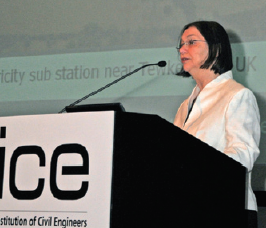
ICE president Jean Venables has completed a packed tour of China, where activities included the 2009 ICE Asia-Pacific convention, visiting the Olympic Park in Beijing, checking out the transport in Shanghai and taking in the wetlands in Hong Kong's famous Mai Po nature reserve.
Venables delivered the keynote address at the conference, Conserving our heritage – driving our development, which preceded the international convention. Taking place this year in Hong Kong, which has over 4000 ICE members, the convention for ICE local representatives included discussions focusing on future strategy across the region.
Talking about her trip, Jean said, ‘The institution's presence in this part of the world is expanding at an exciting rate, and I have learnt a great deal, through meeting with our members and industry leaders, about the intricacies of the construction and engineering sector across the country. This convention was also an important opportunity to strengthen communication and align ICE's vision for its future in the region.’
For more details of the tour please see the president's web log at www.ice.org.uk/about_ice/president_weblog_index.asp.
New UK energy briefings
ICE has released the first in a series of energy briefing papers, designed to investigate practical solutions to the UK's current energy problems. The initial briefing sets out the current state of the British energy sector and highlights the difficult challenges facing the country as it struggles to meet ambitious emissions and renewable-energy targets.

According to ICE, urgent action is needed by both government and the energy industry to review UK energy policy and prevent potentially devastating future shortfalls.
ICE makes a number of recommendations in the areas of regulation, infrastructure, carbon reduction, security and resilience, and demand management. There will be a series of briefing papers issued throughout 2009 addressing key areas of the sector.
The first energy briefing paper can be downloaded from www.ice.org.uk/downloads//energy%20report_2.pdf
UK airports panel launched
ICE has convened a new airport infrastructure panel to investigate how best to integrate current and future UK airport infrastructure into existing transport networks. The panel is chaired by WSP technical director Ian blackwell.
One of the most pressing areas the panel will concentrate on is how Britain can meet its aviation needs while managing carbon-dioxide emissions, so that the sector makes a reasonable contribution to the government's reduction targets.

ICE director general Tom Foulkes said, ‘The airport infrastructure panel believes ICE cannot support any individual airport infrastructure project that does not adequately address environmental issues and the challenge of reducing carbon emissions at a national level. It is vitally important that these challenges are met within the wider context of a fully integrated national transport policy. This new panel will work to ensure ICE develops a coherent and robust policy on the future development of airport infrastructure in the UK.’
Call to raise UK road budget
Clearing the maintenance backlog for Britain's highways could provide a much-needed injection of cash into the economy and prove a viable short-term measure to combat the worst effects of recession, according to ICE's 2009 budget submission.
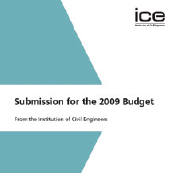
Given the maintenance budget shortfall is estimated to be at least £1 billion, ICE believes increased spending in maintenance would provide economic stimulus right across the UK, support highly vulnerable small and mediumsized businesses, and provide long-term benefits through reduced journey times and congestion.
As well as considering short-term measures, ICE sets out a longer-term strategy for general infrastructure development, which it believes can provide enormous value to the economy, increase the long-term rate of growth and help meet many other government objectives.
ICE's 2009 budget submission can be downloaded from www.ice.org.uk/downloads//budget%20submission.pdf.

