

A review of recent and forthcoming developments at the Institution of Civil Engineers, by ICE director of communications and marketing Anne Moir. For further information please contact the Communications Office on +44 20 7665 2150, email communications@ice.org.uk or visit www.ice.org.uk/news_events/latest.asp.
Unlocking offshore renewables
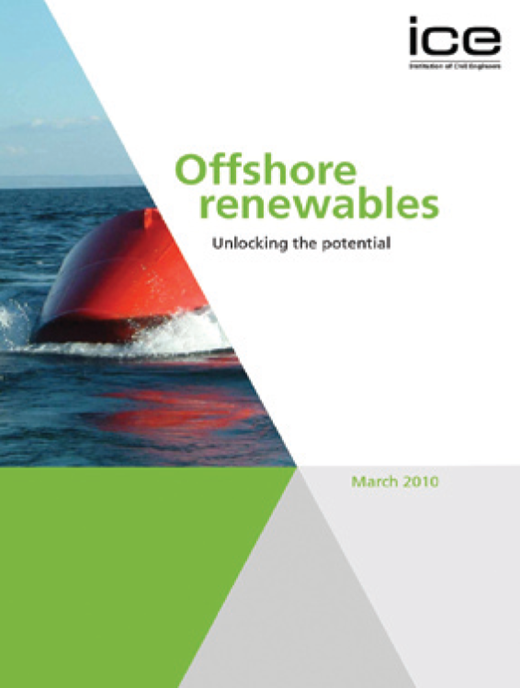
Harnessing Britain's abundant wind, tidal and wave resources could hold the key to tackling the UK's energy crisis, as well as make a massive contribution to the national economy with the creation of over 40 000 jobs, according to a recent ICE report.
The UK energy sector is facing a security-of-supply crisis. Over one-third of the country's power plants are due to close by 2025, which equates to a loss of 30 GW of generating capacity. At the same time Britain urgently needs to decarbonise its energy supply to meet pressing environmental targets.
ICE's March 2010 report Offshore renewables: unlocking the potential says the rapid up-scaling of offshore renewable resources, on a similar scale to that experienced by the North Sea oil and gas sector in the 1960s and 1970s, could provide the solution.
The UK possesses some of the richest wave, tidal and wind resources in the world, with the potential to provide up to half of the country's current energy demands as well as create a major new industrial sector, with significant export potential.
The report can be downloaded from www.ice.org.uk/downloads/offshore.pdf.
Securing the world's water

ICE, the Royal Academy of Engineering and the Chartered Institution of Water and Environmental Management published a report in April 2010 under the ‘Engineering the future’ banner on the UK's reliance on ‘virtual’ water in imported food and other supplies, which is exacerbating water shortages in other countries.
The report, Global water security – an engineering perspective, warned that with population growth, urbanisation, changing diets, pollution of water resources and climate change, global water resources are set to become even more stressed.
Two-thirds of the UK's water footprint is now effectively imported in the form of food, energy and other goods, which require water for production and transportation from countries that are themselves under water stress.
Water is one of the most undervalued natural commodities in the world, directly affecting economic growth, energy security, food supply and healthcare. This domino effect has been described by the UK government's chief scientific advisor John Beddington as a ‘perfect storm’, which could lead to global instability if each of the interdependent elements are not addressed.
The report can be downloaded from www.ice.org.uk/downloads/gws.pdf.
Prioritising infrastructure spending
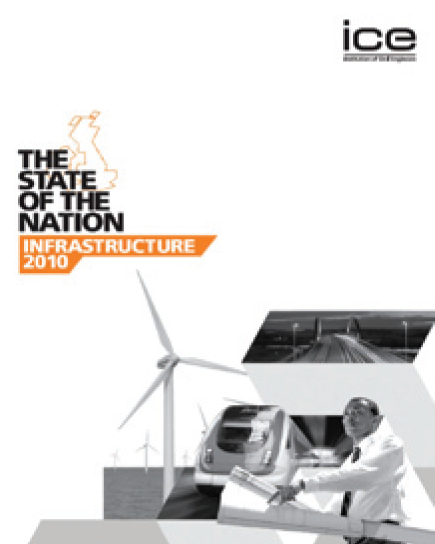
ICE published it latest ‘State of the nation’ report in June 2010. Entitled The State of the Nation: Infrastructure 2010, the report provided an independent assessment of the current state of the UK's infrastructure networks and outlined the priorities going forward for the new government.
Britain's energy sector and local transport networks fared the worst in the infrastructure appraisal. It also found the country's infrastructure to be in poor overall condition and warned the new government it has very little time to act if the UK is to have sustainable and working water, waste, energy and transport networks in the future.
The report scored water, waste, transport, flood and energy systems against the backdrop of public spending cuts, the urgent need to shift to a low-carbon-dioxide-emissions society and a recovering economy.
Within each sector, the existing infrastructure – power stations, road and rail networks, water treatment plants, waste facilities for example – were appraised on general condition, capacity, resilience and sustainability. The impact of significant budget cuts was also evaluated.
A briefing article providing more details on the report's findings is published in this issue (see page 99). The full report can be downloaded from www.ice.org.uk/SoN_infrastructure_2010_web_final.pdf.

