


PRESIDENTIAL ADDRESS NOW IS THE TIME
by Paul Jowitt (February 2010)
Contribution by William Bowie
From the time my parents gave me a Meccano set, I wanted to be an engineer. For 40 marvellous years I travelled the world building with bigger and bigger construction sets. To be an engineer was a great source of pride. However, whenever I open the ICE Proceedings, I feel embarrassment and sadness as it seems that the profession I joined has been subsumed into the Green Party. The focus seems to have moved from engineering to ‘saving the planet’
In his address our president repeatedly refers to ‘climate change’. This, together with changing the realities of world politics, seems to be high on his list of priorities. Neither of these objectives comes within the compass of an engineer. No-one can change the climate; to believe this is hubris. We may dicker at the edges, say with land use, but man cannot control the myriad factors that influence climate.
Nor can we install, ‘reasonable governance structures; a functioning civil society; an effective local economy; and freedom from persecution, conflict and corruption,’ or deal with the impact of population explosion. Developing countries must do that for themselves. Our function is merely to build that which society requires.
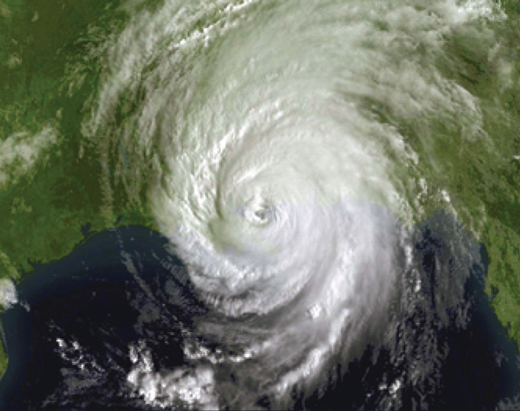
Contribution by Frederick Hespe
I am disturbed by recent papers in ICE Proceedings proselytising anthropogenic global warming. According to the most recent example by Paul Jowitt, ‘For all practical purposes, the climate change debate is over’. He calls on politicians, ‘to agree to massively reduced carbon dioxide emissions’, apparently failing to see the clear message from last year's UN climate change conference in Copenhagen that there will never be an international agreement to penalise emissions of carbon dioxide.
He and others appear not to understand the realities of the physics and chemistry of the atmosphere, or of the vast complexity of solar, planetary and terrestrial influences on the earth's climate. Nor have they taken the trouble to read the incontestable scientific evidence that none of the alarmist assertions of the global warming fraternity have any basis in fact.
Furthermore, the whole edifice of anthropogenic global warming has been comprehensively undermined over recent months by exposed shortcomings in the Intergovernmental Panel on Climate Change's (IPCC) assertions, including the so-called ‘climategate’ affair. There are numerous cases of alleged manipulation of climate change data and information, the perpetrators of which would be imprisoned if they were company directors.
I recommend the author reads the excellent paper in Proceedings of ICE – Civil Engineering entitled ‘Climate stability: an inconvenient proof’ (Bellamy and Barrett, 2007).
The public at large is at long last waking up to the inaccuracies to which they have been exposed and the enormous costs and loss of income they will face if draconian legislation to reduce emissions of carbon dioxide is introduced, or continued as the case may be. There is going to be an electoral backlash when the full realisation comes to them.
It would be wise for ICE to distance itself from this issue. The scientific community is already disgraced; my concern is that the engineering profession might be disgraced with it.
Author's response
Both contributors seem to think that the climate-change agenda is some left-wing conspiracy. It is worth noting that much of the opposition to anthropogenic global warming comes from rather more powerful vested interests in the oil-, coal- and gas-intensive industries, content with ‘business as usual’. Still, to be fair, I do know of a Marxist climatologist who is a climate change denier too. The ICE is not affiliated to the Green Party, the Flat Earth Society nor any political party and, for the avoidance of doubt, neither am I.
the whole edifice of anthropogenic global warming has been comprehensively undermined over recent months by exposed shortcomings in the Intergovernmental Panel on Climate Change's assertions
No-one doubts the long-term geological changes in climate which have seen the coming and going of ice ages in the recent geological past. But what is happening now is, on the balance of the evidence available, over and above that – and it is largely the result of human activity. This is not even a recent hypothesis: in 1896 the Swedish chemist Arrhenius, subsequently a Nobel laureate for chemistry, suggested carbon dioxide emissions from the burning of coal would enhance the earth's greenhouse effect – first mooted by Fourier (1824) – and lead to global warming (Arrhenius, 1896).
I suspect neither of the contributors is any more of a climate scientist than I am. One points to the paper by Bellamy and Barrett: to imagine this is the most authoritative paper on climate change is flattering to ICE but actually a little fanciful.
Certainly neither of the contributors seems to accept that man's activities can have a global consequence – though they might recall the impact of chlorofluorocarbons on the ozone layer, now widely accepted and remediated. As engineers we have to take informed decisions and balance risks, and then present the options to society. So what are the options? And what are the assumptions and potential outcomes? Let me pose two possibilities.
Option A: adopt a policy based on the assumption that anthropogenic emissions have no impact on climate change – that is, business as usual.
Option B: adopt a policy that assumes man-made carbon dioxide emissions do have an effect and therefore seek to move to a low-carbon-dioxide economy.
Table 1 shows the possible outcomes of these two policy options. In terms of preferences, we can safely assume that A2 is the least preferred. B2 and A1 might compete for the most preferred and B1 is somewhere in between. If we were to score them, the following might not be unreasonable to the fair minded: A1 and B2 score 2, B1 scores -2 and A2 scores -10. For those wishing to see how such quantitative scores might be determined, see the seminal work of von Neumann and Morgenstern (1944).
| State of nature 1: anthropogenic global warming is a myth | State of nature 2: anthropogenic global warming is a reality and has a discernable impact | |
| Option A: business as usual | Outcome A1: economy continues to be driven by oil, coal and gas; no anthropogenic environmental crisis; any climate change is beyond human control and is adapted to by hard engineering; only concern is finding enough resources. Score: 2 | Outcome A2: uncontrollable climate change; IPCC predictions realised; disaster; effects are locked in; too late to shift to low-carbon-dioxide renewables. Score: -10 |
| Option B: move to a low-carbon-dioxide economy | Outcome B1: unnecessary investment in low-carbon-dioxide energy sources; any climate change effects are beyond human control and are adapted to by hard engineering; energy supply met by combination of fossil fuels, nuclear and renewables. Score: -2 | Outcome B2: investment in low-carbon-dioxide renewables and nuclear attenuate locked-in effects; environmental disaster avoided/mitigated. Score: 2 |
If we were totally risk averse – ignoring any assessment of the likelihoods of the various climate change theories – then we would adopt option B, and the worst that can happen is outcome B1. I sense the contributors are made of sterner stuff – they would assess the likelihood of the two climate change theories, assume there was no chance of anthropogenic global warming and go for option A.
Personally I would not go for option A unless I thought the probability (p) of there being no relationship between human carbon dioxide emissions and climate change were at least 75%. Based on the scoring above, that is when p × (2) + (1 - p) × (−10) = p × (−2) + (1 - p) × (2) = −1.
I know who I would rather send down to the climate change casino with society's chips and their children's.
I know who I would rather send down to the climate change casino with society's chips and their children's.
REFERENCES
09−00041 CLIMATE VARIABILITY IN CIVIL INFRASTRUCTURE PLANNING
by Peter Mason (May 2010)
Contribution by Keith Rollinson
There does not appear to be any reference to global warming by man's carbon dioxide emissions and their effect on the variations referred to. Why is this?
Author's reply
I refer the contributor to the opening three paragraphs of the paper which explain why potential man-made climate change was not pursued. Indeed, one purpose of the paper was to raise awareness of the natural variations that need to be identified before additional factors, such as change induced by increased carbon dioxide, can be assessed.
However, I would also mention the results of the Kafue Gorge study referred to in my paper (MWH, 2009). This examined carbon-dioxide-induced hydrological climate change in the Kafue Gorge region of Zambia as projected by eight international climate change models. The results were inconclusive, with some models predicting a wetter climate and others a drier climate.
Conversely, the natural cyclic patterns were clear and would therefore seem worth monitoring while the uncertainties of carbon dioxide effects and its modelling become clearer.

Kafue River in Zambia: natural climate patterns are clear, unlike potential man-made changes(NASA)
Kafue River in Zambia: natural climate patterns are clear, unlike potential man-made changes(NASA)
09-00004 THE PHILOSOPHY OF ENGINEERING: A CRITICAL SUMMARY
by Joseph Hillier (May 2010)
Contribution by David Howard
The linking of philosophy and engineering overlooks Isaac Newton's observation that, ‘nature is pleased with simplicity, and affects not the pomp of superfluous causes’.
Engineering can most simply be defined as the practice of problem solving. It uses the ‘scientific method’ first defined by al-Hassan Ibn al-Haytham in his Book of Optics (Ibn al-Haytham, 1021) and, six centuries later, further developed by both Francis Bacon and Newton himself.
Problem solving by error elimination was also the concern of one of the most important philosophers of the twentieth century, Karl Popper. In his critical assessment of the scientific method (Popper, 1934) he stated that a scientific theory should be considered scientific if and only if it is falsifiable. This, of course, is the ultimate responsibility of all engineering.
It is problem solving that links the long-established arts and practice of philosophy and engineering. The current paper overlooks this simple connection between its two subjects while seemingly following a semantic, even tautologous, line of argument.
Engineers, natural philosophers no less, should treasure a love of wisdom and acknowledge that the roots of their value to society are deeper set than in the writings of just recent decades.
Author's reply
The contributor has misunderstood the paper. It was not intended to outline all ways (or argue for a single way) in which philosophy and engineering might come together, but to comment on the field ‘philosophy of engineering’.
I agree that engineers should embrace work not ‘just [from] recent decades’, but I should point out that my aim was to provide a reasonably current snapshot of a developing field. I disagree that engineering is simply ‘problem solving by error elimination’ and hence linked with science/philosophy. Aside from the generally well-known and now dominant philosophical objections to Popper (note that Newton himself did not follow the Popperian view of science), how do you define problems and errors?
It is problem solving that links the long-established arts and practice of philosophy and engineering. The current paper overlooks this simple connection
Contribution by Martin Stockley
For all of my career in engineering going back to 1971, and in particular in the last 15 years or so, I have been arguing for engineers to stop thinking only as engineers and to begin all their work by first thinking as citizens. Our engineering skills are just that, skills. They do not amount to a philosophy on which to base our lives.
In fact our reliance on engineering to solve human problems has brought with it many unfortunate results. I often use the Ebbsfleet cartoon by Steve Bell (2008) to illustrate how our best endeavours as engineers have resulted in us not achieving the human gain that we desire as a society.
Author's reply
I agree with Steve Bell – beauty (even in engineering) is in the eye of the beholder.
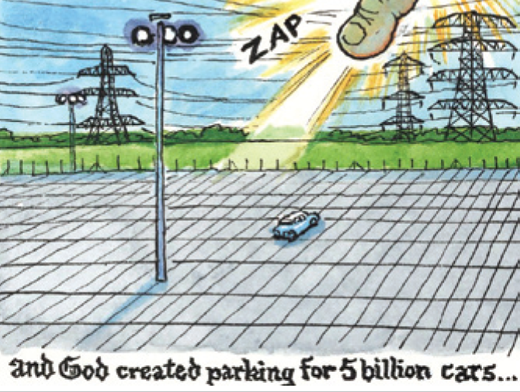
Reliance on engineering to solve human problems has brought with it many unfortunate results (SteveBell)
Reliance on engineering to solve human problems has brought with it many unfortunate results (SteveBell)
REFERENCES
09-00016 EUROCODES IN BRITAIN: THE QUESTIONS THAT STILL NEED ANSWERING
by Alasdair Beal (February 2010)
Contribution by Howard Taylor
Eurocode 1990 has been publicly available for 15 years, in its final EN form for 8 years and the UK national annex for 6 years. It is a sad reflection on our profession that such a thoughtful paper appeared a month before Eurocodes superseded previous British standards.
The author has clearly read Eurocode 1990 and puts some quite proper questions; the language is unfamiliar, it offers choice and options in areas which are new to engineers in the UK and concern is expressed that in some way it could put engineers into some kind of legal jeopardy.
Starting with the last point first, as did the author: neither of us are lawyers but I find his argument ingenious. Perhaps as engineers we should be straightforward and simply read the code and put down the design assumptions that we have made in a form which will follow through into the project file. The lawyers will then know that the decisions were made after reflection and not through ignorance or neglect.
The dilemmas the author describes are not new traps which come from the Eurocodes. I have experienced something like his minimum design conundrum before, but in reverse. Many years ago, as a contractor's designer in a fixed-price design-and-build project, I was confronted by a client's design engineer who said that the structural screed in my accepted design was, in his opinion, unnecessary and that the quantity surveyor should reduce our payment even if we still provided it.
The author comments on the way that load combinations are dealt with in EN 1990 with respect to equation 6.10. He has picked on the freedom that Eurocode offers to designers in deciding how to combine loads and he comments that the more loads are divided up into different types, the lower the load safety factors can become. This is a good debating point but ignores the whole point of Eurocode 1990: that the load combinations may be used to advantage if loads are not positively correlated.
Thus, in the example in the paper, if all the loads are not statistically correlated, all of the combinations allowed by equation 6.10 can be used with benefit. If they are positively correlated, that is they can credibly all be maxima at the same time, then they should, in my opinion, be considered as one load as far as equation 6.10 is concerned. Those interested in more background on this topic can read the paper Eurocodes: using reliability analysis to combine action effects by Gulvanessian and Holicky (2005).
There are a number of other clauses in Eurocode 1990 which the author could have commented upon critically. Informative annex B, table B1, for example, appears to suggest that the Eurocodes have been written to produce the required reliability for ‘normal buildings’ and that for special buildings ‘where consequences of failure are high’ the Eurocode suggests four ways for increasing the reliability accordingly. These include using more exacting quality-control regimes during design (table B4) and construction (table B5), and an additional load factor, KFI, of 1·1 (table B3). Again, I suggest that the designer should consider the correct response with respect to the design being carried out and mark the design summary appropriately.
the new material in the Eurocodes is a logical evolutionary step and would have been in the next generation of our national codes had Eurocodes not been developed
If, as engineers, we insist that all questions and considerations such as these are settled for us, we cannot complain if our status is diminished to becoming software jockeys. In the years that I have been an engineer, we have had to cope with the introduction of computers (the first computer that I used when a student is now in the Science Museum), metrication, limit-state design and other responsibilities coming from the very necessary focus on safety. I believe that the new material in the Eurocodes is a logical evolutionary step and would have been in the next generation of our national codes had Eurocodes not been developed.
This is not to say that the change to the Eurocodes will be easy: it will not. But a direct approach, with a clear expression of all of the design assumptions that have been made by the designer written at the start of each design, will be a great help. I also agree with the author that if any aspect of a Eurocode design is counter-intuitive, then check thoroughly. Finally, start with the design of something familiar and not with a structural type that you have never designed before.
Author's reply
The contributor raises several interesting points. Although my paper only appeared on the eve of ‘Eurocode day’, some of the issues were first raised some time ago (Beal, 1993, 2001).
As the contributor says, the ‘minimum design conundrum’ is not new. However, the idea Eurocodes should ‘remove technical barriers to trade’ and the Treaty of Rome adds a new dimension which could create problems for engineers.
The question about whether the combined load factor for multiple loads in BS EN 1990 should be 1·22 or 1·5 is neither a debating point nor about engineers' freedom to use their judgement: it is about the failure of BS EN 1990 to define how its complex system of partial factors works with standard BS EN 1991 loadings on a simple beam. In the modern competitive environment, a code which fails to make clear whether the safety factor should be 1·22 or 1·5 is simply not fit for purpose.
BS EN 1990 annex B requires either increased safety factors or better construction standards for grandstands and major public buildings such as concert halls. The UK national annex then says, ‘Annex B may be used. If used it should be in accordance with the full reliability based approach described in Annex C of EN 1990’. It seems that engineers using Eurocodes to design a new concert hall or grandstand must use a new, complicated, unproven design method. However, according to annex C, clause C4, the full probabilistic method (level III) is, ‘seldom used in the calibration of design codes because of the frequent lack of statistical data’. It seems that Eurocodes cannot be used for major public buildings in the UK.
Maybe we cannot have every question answered, but is it right to ask engineers to use Eurocodes for real designs when there are so many unresolved problems?
the plethora of national annexes has, in effect, produced different codes for each country
Contribution by Geoffrey Pinfold
The author has highlighted many of the uncertainties and ambiguities with application of Eurocodes in the UK and there are plenty of further issues.
One of the stated objectives of Eurocodes is harmonisation across Europe and thereby to reduce barriers to trade. Unfortunately, the plethora of national annexes has, in effect, produced different codes for each country. It has been estimated that over the whole set of Eurocodes there are 1450 optional national choices, and for a structure as simple as a chimney there are 415 choices (Berger, 2010). Many of these are matters of physics or mechanics without any geographical or national safety basis. These matters should never have been allowed to have become the subject of national preferences. For example, why is value of the density of air different in the UK and France from the ‘recommended’ value of 1·25 kg/m3? The national annexes appear to have been used to raise rather than reduce barriers to cross-border trade.
As for implementation within the UK, it is generally accepted that non-contradictory complementary information manuals are needed to assist designers in interpretation. For general structural work, trade organisations and The Institution of Structural Engineers have produced such manuals. For more specialist structures such as chimneys, silos and steel tanks, such manuals are unlikely to be forthcoming.
Author's reply
The contributor criticises unnecessary national variations in Eurocodes: insisting on an air density of 1·225 kg/m3 for UK designs instead of the standard 1·25 kg/m3 seems like extreme nit-picking. Much more support is needed to help engineers designing structures such as chimneys, silos and steel tanks for use in other countries.

For Eurocode design of chimneys there are 415 optional national choices, but no designmanuals
For Eurocode design of chimneys there are 415 optional national choices, but no designmanuals
Contribution by Simon Thomas
The author has provided a wide-ranging and informative commentary, and is to be congratulated for drawing attention to some important matters. Given the paper's title, he restricts discussion on legal considerations to the UK. It would be interesting to know his views on the potential problems for British engineers using Eurocodes on projects in other EU countries, which may or may not have their own annex, and by designers from other EU countries working on UK projects.
In view of the inevitable conflicts – both linguistic and technical – between different national annexes, does he agree that implementation of the Eurocodes will not remove but only reduce trade barriers for civil engineering designers within the EU?
Author's reply
I agree with the contributor that current Eurocodes will not remove trade barriers for engineers. Indeed, they are so complicated and difficult to understand that they may actually make it harder for engineers to work in other countries.
REFERENCES
09-00055 THE DESIGN OF SHIP-TO-SHORE LINKSPANS FOR RO-RO TERMINALS
by Stephen Osborn (May 2010 special issue)
Contribution by Ian Jenkinson
The author states that the semi-submersible linkspan tends to be the cheapest ship-to-shore connection. This understates the case: all costs are substantially cheaper than competing systems – including the shore works and lifetime operation and maintenance costs. Portsmouth installed four of this type at its continental ferry port and cost was a key consideration (Maber, 1989).
The disadvantage of the design is the need to support live loads by a pendant system. First, it is a manual operation that places shore staff in an exposed and potentially dangerous position at the ship-to-linkspan interface. Second, vehicles loaded in excess of highway standards require special pendant arrangements.
The issue of geometry is a problem for all linkspan arrangements. Research on this matter was presented at the Queen's Silver Jubilee conference at the Institution of Mechanical Engineers in London in 1986. However, the conclusion of the discussion was that all ramp geometries through the spring tide cycle, plus predicted ship heel movements during loading, should not cause a change in gradient to exceed 14% (1 in 7) over a 3 m length; a crude but effective rule of thumb.
As an aside, the word ‘linkspan’ was a registered trademark of the semi-submersible design developed by John Rose of Marine Developments Ltd, Glasgow. He made several attempts to protect the word but finally gave up as he could not afford the legal costs.
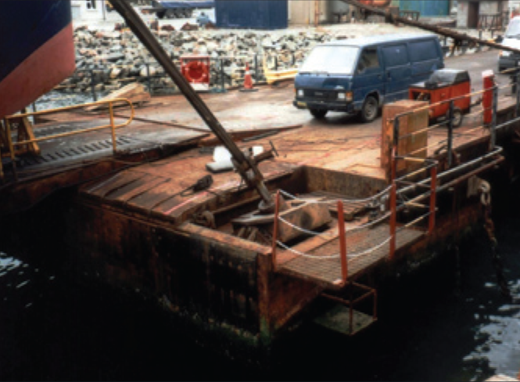
the word ‘linkspan’ was a registered trademark of the semi-submersible design developed by John Rose of Marine Developments
Author's reply
I accept the contributor's comment that the cost reductions are even more significant than my paper suggested, and this remains the case today. Nevertheless, the semi-submersible system has tended to fall out of favour and I attribute this to a requirement for operators to reduce manpower and give greater emphasis to safety of their operatives in their decision making.
Also, the ever-increasing size of vessels has meant that linkspans have correspondingly had to increase in size and carriageway width, changing the relative economics of the systems. I have not studied this in detail, but could imagine it sufficiently improves the chances that rival systems such as integral-tank linkspans become economically viable on a whole-life basis.
With respect to the use of the term ‘linkspan’, I joined the roll-on-roll-off industry a little after the time when Mr Rose's designs were being most widely specified and found this term was being used in a very general way. Personally, I always found it rather inappropriate to use it for pontoon and link-bridge assemblies, but in my experience it is often used in that way. I can empathise with Mr Rose if he was frustrated about the way in which the term came into such general use.
Full versions of these discussions can be read in the supplementary data to the online versions of the relevant papers and articles at www.civilengineering-ice.com.

