

A review of recent and forthcoming developments at the Institution of Civil Engineers by ICE president Barry Clarke. For further information please contact the communications office on +44 20 7665 2152, email communications@ice.org.uk or visit www.ice.org.uk//news-public-affairs.
Championing infrastructure commission1

ICE vice president Sir John Armitt's report calls on the UK to set up an independent infrastructure commission
ICE vice president Sir John Armitt's report calls on the UK to set up an independent infrastructure commission
In September 2013, ICE vice president Sir John Armitt published an independent report on long-term infrastructure delivery in the UK. The report, commissioned by the Labour party, called for the upgrading of UK infrastructure to be made a national priority alongside health and education.
It made a number of recommendations aimed at taking politics out of decision making when it comes to UK infrastructure delivery. The key recommendation was for a national independent commission, which would be tasked with looking 25–30 years ahead at the country's infrastructure needs and setting priorities to be voted on by parliament.
The concept of an independent commission is one ICE has championed and was a lead call in our recent State of the Nation: Transport report (ICE, 2013). We believe it could help to ensure projects stand above political fault lines and hope the proposal is adopted by the main parties going forwards.
It is important to note, however, that the commission is not, a ‘magic bullet’; a web of other organisations, rules and established practices affect how our infrastructure is developed and this means further reforms will be needed.
Hosting High Speed 2 update
Following the launch of ICE's flagship State of the Nation: Transport report in June 2013, ICE was approached by the UK Department for Transport to host an event setting out the government's investment programme for transport, including reinstating its case for the controversial High Speed 2 railway.
The event, held on 11 September at One Great George Street, was opened by incoming ICE president Geoff French and led by the secretary of state for transport Patrick McLoughlin. He told the ministers, industry leaders and media present that Britain needed High Speed 2, ‘as a heart bypass for the clogged arteries of our transport system’ and that the project would lift the long-distance burden from overcrowded main lines.
New research was also published from KPMG on the economic benefits of the scheme. The report claimed that the railway would boost the national economy by £15 billion a year, with the north and midlands gaining at least double the benefit of the south.2
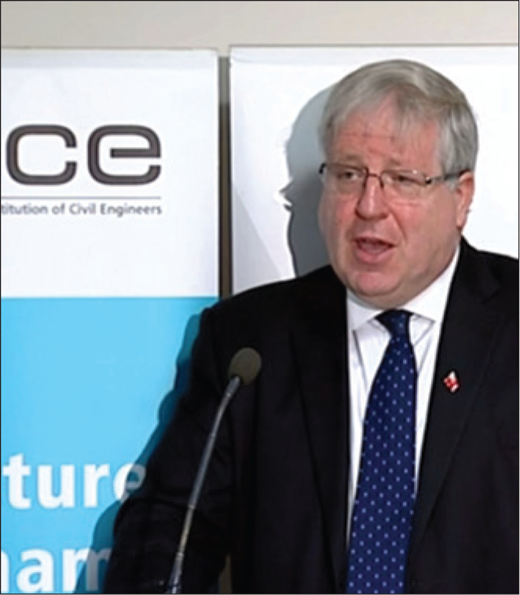
UK transport secretary Patrick McLoughlin chose ICE's headquarters to restate the case for High Speed 2
UK transport secretary Patrick McLoughlin chose ICE's headquarters to restate the case for High Speed 2
ICE believes High Speed 2 remains the best option for greatly increasing rail capacity, strengthening connectivity between city-regions and creating economic and regeneration opportunities. But we would like to see the government better communicate that the scheme is a complement, not an alternative, to other transport investment. It should be positioned as an integral part of a national transport strategy, rather than a project developed in isolation.
Refining national infrastructure plan
The UK government's national infrastructure plan has been supported by ICE since its launch back in 2010 and we have worked with Infrastructure UK on its development. In September 2013, ICE made a further submission to government ahead of publication of the revised version, which is expected in December.
The need for a focused strategy and delivery programme for enhancing the UK's economic infrastructure has if anything grown since the publication of the first national infrastructure plan. However, confidence in the effectiveness of the plan remains fragile, so we believe priority must be given in the 2013 edition to production of a more robust delivery programme.
ICE recommends that the next iteration of the plan includes a shorter, prioritised list of nationally important economic infrastructure projects, improved project-level information on future opportunities for investors and the supply chain, and better communication on how project delivery is progressing. We look forward to seeing the revised plan.

