


CDM 2015: questions and answers
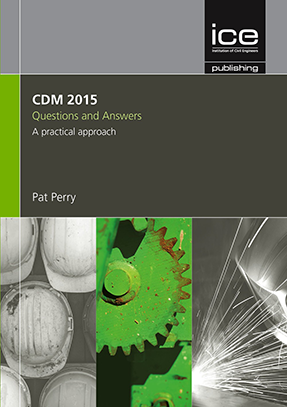
The third edition of the UK Construction (Design and Management) Regulations (CDM 2015) has applied to all construction projects since October 2015. The revised regulations impact the entire project life cycle, but there is increased emphasis on early engagement by the client and on the role of the designer in maximising opportunities to eliminate risks.
This is a surprisingly accessible book about legal responsibilities under CDM 2015, describing health and safety best practice on construction projects. The format of this book makes it highly readable, with questions and answers arranged under easy-to-reference sections, and interspersed by short case studies.
The book is split into two parts. Part one is on the regulations, roles and duties, describing the legal responsibilities of the duty holders and the recent changes to the legislation. The second part covers construction safety, with guidance included on the construction phase health and safety plan, working at height and asbestos. Answers reference the relevant legislation that forms the legal basis for the responsibility.
First and foremost, this is a highly practical guide, covering real-world scenarios so readers can confidently assess whether they are complying with the law. Questions include, ‘the client refuses to accept my advice as principal designer, what shall I do?’, ‘what type of temporary works should be medium risk?’ and ‘what is a permit to work?’. The book also includes a range of example forms, including an appointment letter for a principal designer and a hot-works permit.
It is a little bible that cuts through the myths and uncertainty to give clear, confident and concise guidance.
Health and safety: questions and answers – a practical approach (2nd ed.)
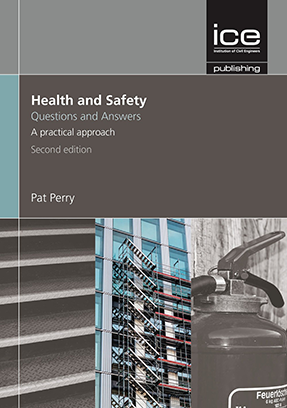
This second edition has built on the success of the first edition to produce very good material on a very important subject. It covers a wide range of health and safety issues in the construction industry.
The logical presentation makes it easy to interact with the book. The first five chapters deal largely with concepts, laws and regulations, while the next five chapters relate mostly to human factors including training requirements – which are particularly important for health and safety management and accident prevention.
The next 14 chapters cover common questions asked in respect of work processes and the requirements to work safely and guarantee the safety of others. Significantly, they also cover the practicality of occupational health matters. The last three chapters deal with the unique aspects of stress, lone working and working with others – including managing contractors.
Although readers may tend to see ‘Q&A’ books either as handy quick-reference guides or non-conventional textbooks, this book succeeds in bridging that gap. Each chapter contains relevant and up-to-date information, templates to aid application of discussed concepts and case studies that can further help the reader. As such it is a good reference for students, graduates, trainers and other practitioners.
Successful professional reviews for civil engineers (4th ed.)
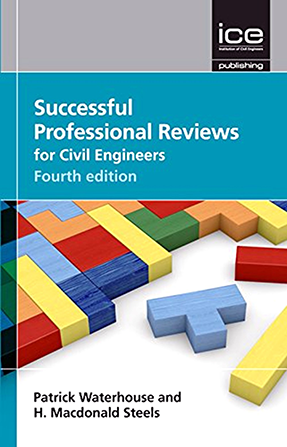
This book provides comprehensive guidance on the Institution of Civil Engineers’ (ICE) professional review and offers advice as to how the candidates should comply with each of the requirements given in ICE’s professional review guidance.
The fourth edition has been updated to cover the simplified review process introduced by ICE in 2015. The authors have drawn upon their experience and included a number of practical tips and common mistakes made by candidates in writing the report and preparing the presentation.
Similar to the previous edition, it also describes what to expect on the review day. While some of the information could be considered as just common sense, there is a good amount of useful advice as well.
If you have nearly completed your initial professional development, I would recommend you and your supervising civil engineer reach for this book well before you actually start putting your submission together.
For those earlier in their career, looking for advice on the initial professional development process, I would recommend Initial professional development for civil engineers by Macdonald Steels instead.
Trust in construction projects
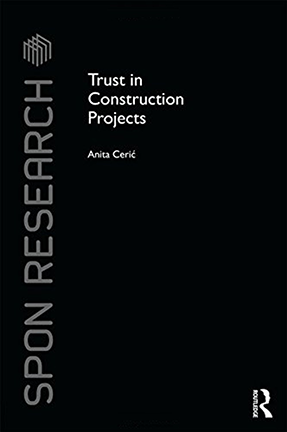
Anita Cerić presents in this book the result of 4 years of empirical research complemented by a thorough literature review. After setting the scene by stating why trust matters in construction projects, she analyses the new roles of construction project managers.
The argument of the book is straightforward and relevant considering the increasing complexity of current projects, particularly in terms of the number of actors involved. It is supported by much evidence, making the book very easy to read.
This is definitely a book that will convince its readers of the importance of trust as an essential project success factor. Though inspirational in this regard, the book gives little practical information on how to build the trust. It is nevertheless a significant and useful contribution to support Simon Sinek’s essential quote, ‘A team is not a group of people who work together. A team is a group of people who trust each other.’
Structural analysis and design to prevent disproportionate collapse
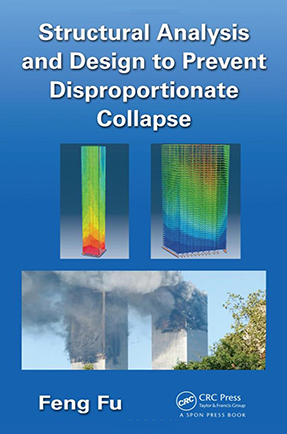
This book presents a disproportionate collapse analysis based on the alternative path method initially proposed by Ellingwood in 1978. Author Feng Fu, who has 10 years of practical experience before joining academia, has produced a clear and practical guide for design engineers.
The book cites existing British standards, Eurocodes and US codes, and covers many different types of structures – including multi-storey buildings, space structures and bridges. It also contains detailed information on fire and blast, the two forms of extreme loadings which typically lead to disproportionate collapse.
The analysis method is based on Abaqus software and the author provides the corresponding files for easy application. The many applications in the book could also be useful as case studies for engineers and students.
From a research perspective, the state of the art is perhaps under-examined and references to past publications, including Ellingwood’s, are missing. But it is of major practical interest and I would definitely recommend it for design engineering offices and lecturers in structural mechanics.
NEW BOOKS
The ICE library maintains one of the most comprehensive collections of civil engineering books in the world, including all titles from ICE Publishing (shown in bold below). New books received in the past 3 months include the following.
| 2015 International Building Code illustrated handbook | D Thornburg and J Henry | £122·99 |
| ACE find a consultant 2016 | ACE | £70·00 |
| Assessment and management of unexploded ordnance (UXO) risk in the marine environment, Ciria C754 | N Cooper and S Cooke | £110·00 |
| Building futures: managing energy in the built environment | J Powell, J Monahan and C Foulds | £34·99 |
| Construction planning (2nd ed.) | R Neale, D Neale and P Stephenson | £30·00 |
| Deformation and failure mechanism of excavation in clay subjected to hydraulic uplift | Y Hong and L Wang | £59·99 |
| Delivering value with BIM: a whole-of-life approach | A Sanchez, K Hampson and S Vaux | £44·99 |
| Engineering geology for underground works | P Gattinoni, E M Pizzarotti and L Scesi | £117·00 |
| Fit-out environmental good practice on site guide, Ciria C757 | S Harris | £70·00 |
| Geomechanics in soil, rock, and environmental engineering | J Small | £57·99 |
| Geomodels in engineering geology: an introduction | P Fookes, G Pettifer and T Waltham | £35·00 |
| Highway bridge maintenance: planning and scheduling | M A Hurt | £85·00 |
| Innovative bridges | C Broto | £44·71 |
| Low car(bon) communities: inspiring car-free and car-lite urban futures | N Foletta and J Henderson | £41·99 |
| New forms of procurement: PPP and relational contracting in the 21st century | M Jefferies and S Rowlinson | £95·00 |
| Non-destructive techniques for the reverse engineering of structures and infrastructure | B Riveiro and M Solla | £99·00 |
| Offshore wind farms: technologies, design and operation | C Ng and L Ran | £180·00 |
| Railway transportation systems: design, construction and operation | C Pyrgidis | £95·00 |
| Setting up in business as a mediator | S Walker | £80·00 |
| Structural analysis and design to prevent disproportionate collapse | F Fu | £82·00 |
| Structural design of buildings | P Smith | £49·95 |
| Structural steel design to Eurocode 3 and AISC specification | C Bernuzzi and B Cordova | £99·95 |
| Structures and their analysis | M Fuchs | £63·99 |
| The fully integrated engineer: combining technical ability and leadership prowess | S Cerri | £33·50 |
| Triaxial testing of soils | P Lade | £125·00 |
| Urban quay walls | A Roubos and D Grotegoed | £89·00 |
All books can be borrowed from the ICE library on the first floor of 1 Great George Street, London, SW1P 3AA from 8.30 am to 6.30 pm, Monday to Friday. ICE Publishing titles can also be purchased from the ICE library or ordered by calling +44 1892 832299, emailing orders@icepublishing.com or by visiting www.icebookshop.com.

