


Initial professional development for civil engineers (2nd ed.)
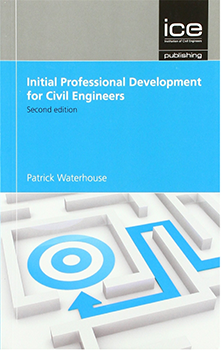
This book provides essential guidance on the skills, knowledge and understanding required by civil engineers seeking to develop their careers, especially in the context of their initial professional development (IPD) in preparation for professional reviews at the Institution of Civil Engineers (ICE).
The book starts by considering aspects of the profession of a civil engineer and what skills are needed by the engineer to fulfil them, before discussing aspects of learning and development, and ICE requirements. The attributes required to be demonstrated in IPD are then covered in separate chapters.
As a chartered civil engineer with over 20 years of experience as an ICE reviewer, the author writes with authority on transitioning from academic learning to learning in the workplace. Overall this is a valuable guide and source of information for both trainee engineers and their mentors, and also for those with a wider interest in the development of civil engineers through work-based learning.
Wind turbine foundations
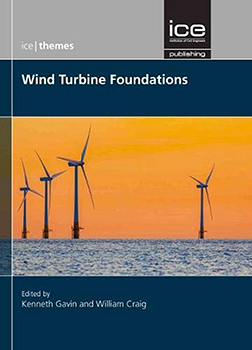
The design of renewable energy assets is now a major part of the work of civil engineers. This book pulls together various interrelated papers on the design of wind turbine foundations, with a particular focus on geotechnical design aspects of offshore wind farms.
Included are papers on three main themes – monopile foundations, jacket structures with axially loaded piles and jacket structures with suction caissons. The quality of the graphics provided brings life to the technical content of the papers.
A vast array of test data is shown as well as clear schematics and sketches of experimental set-ups and project arrangements. The papers are well referenced, allowing the reader to delve into further technical detail if needed.
Many of the papers are related to experiments carried out in test laboratories. Select project examples are also given – for example, the soil response around the Donhai offshore wind farm in China.
This book will be useful to all civil engineers involved in the detailed design of wind turbine foundations.
Strategic management of flood risk
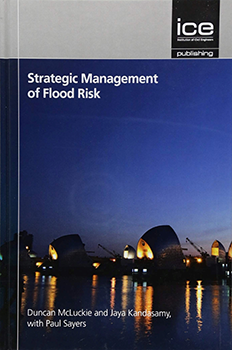
The book is a solid development of the analysis and practice of strategic approaches to managing flood risk. It is logically set out and written in a clear way, developing ideas and themes. While many of the practical examples are drawn from Australia, where the authors practise, the approaches are equally relevant irrespective of geography.
The management approaches highlighted are understanding the flood risk, prevention, preparation, response and recovery. Of particular interest is the section on planning restrictions for buildings with particular purposes and adapting to the actual environment. This mitigates the risk to reasonable and considered levels.
Mature approaches to engagement with stakeholders are put forward. Few flood-protection solutions can solve all eventualities, so there is always a need for communities to prepare for circumstances of exceedance.
The book is clear and practical in its thinking and I found it thought-provoking and readable.
Tension structures: form and behaviour (2nd ed.)
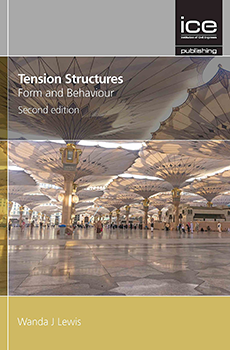
This second edition includes the most commonly used computational methods used in modelling tension structures, where examples are illustrated covering a wide range of tension-structure projects worldwide.
The close link between practical and theoretical views helps readers understand the behaviour of tension structures and the problems of modelling, forming and designing. The author explains the fundamental concepts in ways that are easy to understand, either by mathematical expositions or non-mathematical language.
The new edition benefits from the results of the latest research achievements in understanding the concept of the soap-film analogy in form-finding of fabric membranes. Form-finding is the key to designing tension structures and runs throughout the book, from conceptual design issues to principles observed in nature.
The book is without doubt a useful tool for researchers, architects, civil and structural engineers and students who are working on tension structures. In addition, it serves as an aid in developing computational methodologies for non-linear problems.
NEW BOOKS
The ICE Library maintains one of the most comprehensive collections of civil engineering books in the world, including all titles from ICE Publishing (shown in bold below). New books received in the past 3 months include the following.
| A practical guide to the NEC4 Engineering and Construction Contract | M Rowlinson | £89·00 |
| A strategic approach to the UK construction industry | S Gruneberg | £45·00 |
| Adapting cities to sea level rise: green and gray strategies | S Al | £27·56 |
| Advanced topics in earthquake engineering | C Scawthorn and W F Chen | £100·00 |
| Aeration, mixing, and energy: bubbles and sparks | D Rosso | £95·00 |
| Ageing and life extension of offshore structures: the challenge of managing structural integrity | G Ersdal et al. | £81·50 |
| Aqueducts and viaducts of Britain | V Owens | £14·99 |
| Atlas of sustainable development goals 2018: from world development indicators | World Bank | £22·95 |
| Building on knowledge: developing expertise, creativity and intellectual capital in the construction professions | D Bartholomew | £21·78 |
| Centrifuge modelling in geotechnics | C Gaudin et al. | £99·99 |
| Composite structures: effects of defects | R Elhajjar et al. | £82·50 |
| Concrete – case studies in conservation practice | C Croft et al. | £45·00 |
| Concrete-filled stainless steel tubular columns | V Patel et al. | £79·99 |
| Construction contractual handbook (5th ed.) | BCSA | £90·00 |
| Deepwater drilling: well planning, design, engineering, operations, and technology application | P Aird | £135·00 |
| Design of foundations for offshore wind turbines | S Bhattacharya | £81·50 |
| Design, assessment, monitoring and maintenance of bridges and infrastructure networks | F Biondini and D M Frangopol | £115·00 |
| Earth science for civil and environmental engineers | R Jackson | £59·99 |
| Engineered transparency 2018: glass in architecture and structural engineering | B Weller | £45·00 |
| Engineers fees 2019: a survey of the fees charged by consulting civil and structural engineers | Fees Bureau | £225·00 |
| From engineer to manager: mastering the transition (2nd ed.) | B Aucoin | £89·00 |
| Geotechnical investigations and improvement of ground conditions | A Patel | £115·00 |
| Geotechnics of roads: fundamentals | B Caicedo | £132·99 |
| Guide to safety at sports grounds (6th ed.) | Sports Grounds Safety Authority | £95·00 |
| Handbook of environmental engineering | M Kutz | £148·00 |
| Inside London’s airport policy: indecision, decision and counter-decision | P Le Blond | £70·00 |
| Lock gates and other closures in hydraulic projects | R Daniel and T Paulus | £155·00 |
| Masonry design | P McMullin and J Price | £21·99 |
| Modern construction handbook (5th ed.) | A Watts | £79·00 |
| Moving the earth: excavation equipment, methods, safety and cost (7th ed.) | R Schmitt | £90·99 |
| Pedestrian facilities: geometric design for safety and mobility (2nd ed.) | J Schoon | £65·00 |
| Seismic design of foundations: concepts and applications | S Bhattacharya et al. | £85·00 |
| Soil mechanics through project-based learning | I Gratchev et al. | £45·99 |
| Structural load determination 2018 IBC and ASCE/SEI 7-16 | D Fanella | £68·99 |
| Sustainable construction technologies | V Tam and K Le | £91·95 |
| Sustainable construction (2nd ed.) | S Halliday | £39·99 |
| The Oxford handbook of megaproject management | B Flyvbjerg | £30·00 |
| The urban ocean: the interaction of cities with water | A Blumberg and M Bruno | £44·99 |
| Tilikum crossing: bridge of the people | D MacDonald | £13·52 |
| Urban resilience to droughts and floods: the role of policies and governance | C Tortajada et al. | £115·00 |
All books can be borrowed from the ICE Members’ Resource Hub on the second floor of 1 Great George Street, London, SW1P 3AA from 9.15 a.m. to 5.30 p.m., Monday to Friday. ICE Publishing titles can also be purchased from the ICE Members’ Resource Hub or ordered by calling +44 1892 832299, emailing orders@icepublishing.com or by visiting www.icevirtuallibrary.com/content/books.

