The article examines the possible long-run and short-run impact of regulatory quality on stock market performance in Nigeria for 1996–2019 period.
The study adopts autoregressive distributed lag (ARDL) bounds test and cointegrating regression techniques.
Findings reveal that regulatory quality positively and significantly influences the performance of stock market, which strengthens the view that market-enhancing governance can engender an improvement in stock market performance. The study further demonstrates that quality of the regulatory environment is a critical component of market operations, since the improvement of the operation of stock market performance depends on appropriate policy measures, which could be the outcome of improved governance.
It is suggested that, while improving the institutional environment is a challenge to regulators, there is need for strong and effective regulatory mechanism to enhance the development of stock market in the country.
Based on the two competing hypotheses and limited attention, previous studies accorded the role of regulatory quality in the performance of stock market in the context of Nigeria. This study assessed the gap in the literature by taking the task of validating the impact of regulatory quality on stock market development.
1. Introduction
The quality of governance presents primal concerns for the viability of a business environment. Since ensuring proper surveillance of political activities and business operations, institutions play a central role in terms of facilitating the effectiveness of rules and regulations, and adherence to rule of law. According to World Bank (2020) report, for the attainment of higher economic performance, strengthening institutions is crucial. The report emphasizes that developing economies should strengthen their governance structures for proper functioning of their financial markets. The state of stock market in an economy is determined by government policies and the soundness of regulatory framework (Asongu, 2012). Viable institutions could advance the operation of rules and regulations for efficient resource mobilization and allocation, and thus engendering a sound business environment. However, poor regulatory framework and inadequate supervision mechanisms could lead to the erosion of investors' confidence and the undermining of the development of stock market (the engendering of immature stock markets) and the economy as a whole Milyo (2012). Hence, effective governance systems offer tailoring support for the space of stock market development. Nonetheless, there are two noticeable competing hypotheses in the literature regarding the effect of institutional quality on stock market performance. For instance, one side argues that by attaining economics of scale, good governance quality causes a reduction in transaction and agency cost, and thus enhances increased stock returns for shareholder (Hooper et al., 2009). Another side states that countries with weak governance quality have experienced higher stock returns compared to those countries that have stronger governance quality (Low et al., 2011).
This development and the state of institutions in most developing countries have been a critical issue for policymakers. The concern for improved governance and to ascertain the exact role of institutional quality in the promotion of the development of stock market have prompted the move to strengthen the regulatory framework and explore further its impact in developing economies. Specifically, in Nigeria, in spite of numerous reforms initiated to address the huge institutional gaps, the quality of regulation and its estimate remain poor (see Table 1). Most reform programmes (such as the establishment of economic and financial crimes commission [EFCC]; central securities clearing system [CSCS]; and independent corrupt practices and other related offences commission [ICPC]) have failed to drastically fortify the rules of enforcement and market discipline for enhanced stock market performance (Manasseh et al., 2014). Recognizing that there are strong reasons why government intervention could stimulate capital market development, some authors have revealed that enabling government policies substantially determine issuer demand for capital markets funding (North, 1990; Law and Azman-Saini, 2008). A good example of this development is China. Weak regulatory quality and poor adherence to the rule of law could account for the country's underdeveloped capital market compared to that of peer countries (Uwaleke, 2018). For instance, the Nigerian Stock Exchange (NSE) is small (see Table 2), compared to the key international exchanges, with a total market capitalization around $80bn (circa N23 trillion, based on NSE data) and with just 166 listed companies. Comparing this to the Johannesburg Stock Exchange, with equities capitalization alone circa $1tn accounting for over 280% of South Africa's gross domestic product (GDP) and with over 380 listed companies. This incidence seems to be the result of not having measures that advocate for capital market expansion and development.
Sound regulation is fundamental to improved economic governance (Kirkpatrick, 2014). In this study, regulatory quality is termed as a set of measures designed or developed with a view to strengthening the regulatory and institutional environment including regulatory institutions, policies and processes (OECD, 2011). The evidence provided in the literature in relation to the role of regulation in investment in most developing countries seemed to be consistent with the proposition that the quality of the regulatory environment is a critical component of effective business operations (Eifert, 2009; Haider, 2012; Kirkpatrick, 2014). This further suggests that relatively well-managed poor economies can benefit significantly from a broad push for streamlining regulatory processes. Relating to this hypothesis, for donors, business operators and policymakers, there is reassurance that improving the quality of regulatory governance can be anticipated to have a positive influence on economic performance, and thus affects stock market performance. In spite of this, Nigerian regulatory environment has disdained the opportunity for efficiency and effectiveness across all key sectors of the economy which include financial sector, trading and investment, among others. Where there is noticeable regulatory laxity, poor regulatory supervision is often instigated in governance systems (Canare, 2017). Hence, Nigerian case has given rise to uninspiring business performance, coupled with the increased dilemma faced by listed corporations operating in the country, as evidenced in unceasing poor trading result in the stock market, weak market capitalization, high-risk fluctuations and ill-returns (Ojeka et al., 2019). These scenarios have consistently challenged the availability of evidence-based for the government of its role in the designing of viable regulatory policy in the country. Since the bulk of studies concerned with elucidating why a sound regulatory policy can have real effects for the stock market have mostly employed regression approach to cross-country or panel data (Eita, 2015; Winfu et al., 2016; Umar and Nayan, 2018; Imran et al., 2020), there is need to provide critical evidence that would help the government develop regulatory measures that could work better. The study's aim is not concerned with particular categories of regulation (such as competition law and employment law) but rather how to enhance the processes for improving regulation in Nigerian context.
Moreover, as the debasement of the Nigeria's institutional environment seems to have exacerbated, the dwindling state of the country's stock market which has engendered the high incidence of market manipulations, market rigging, illicit trading and false representations in the country (Ojeka et al., 2019), the improvement of the operation of stock market performance depends on appropriate policy measures, which could be the outcome of improved governance. Therefore, it is crucial to know how regulatory quality influences the stock market development in Nigeria. This is necessary considering the fact that most previous studies for Nigeria have given attention to other institutional factors. For example, in the work of Manasseh et al. (2017) and Ajide (2019) for Nigeria, the former employed democratic accountability, corruption control and bureaucratic quality as governance measures, while in the latter only the democratic indicator was used as governance measure. Also, with a focus on the role of corruption and institutional quality in the performance of stock market, Ojeka et al. (2019), with 135 listed companies in Nigeria, employ panel data. In view of this, it is clear that the role of regulatory quality as one of the institutional indicators in the development of stock market has not been accorded much scholarly investigation regarding Nigeria. As a result, it is pertinent to assess the effect of regulatory quality on long-term capital market performance dynamics. Although these indicators are mostly correlated, the problem with the institutional quality concept is that it does tell us very little about the impact of specific components of the quality of institutions on the performance of stock market performance. Hence, it is empirically plausible that gauging their respective effects on stock market performance may result in different outcomes.
Based on the two competing hypotheses and limited attention, previous studies accorded the role of regulatory quality in the performance of stock market in the context of Nigeria, this study tends to assess the gap in the literature by taking the task of validating the impact of regulatory quality. To carry out this objective, the regulatory quality measure of the World Governance Indicators (WGIs) proposed by Kaufmann et al. (2010) is considered. With this process, the study's findings could offer viable remedies for the Nigeria's stock market challenges by making provisions for sound policy measures that might ensure the strengthening of the regulatory framework and the advancement of the rule of law.
2. Literature review
2.1 Theoretical review
The bourgeoning interest among economic scholars on the role of institutions in economic performance has been to unravel the critical causal factors of economic growth and development trajectory across countries. This is necessitated by the need to offer convincing argument to the seemingly unresolved issues by the proponents of neoclassical growth model (such as Solow, 1956; Becker, 1962). Over the years, there has been increasing concern that since output levels could be truly shaped by capital accumulation and technological innovation across economies, why is it that measures required to accumulate and acquire the capital and technology needed to engender a balanced growth have often been neglected by some countries? In order to address this issue, the New Institutional Economics (NIE), mainly based on the work of North and Thomas (1973); and North (1990), which incorporate the essence of institutions in the narrative, stressed that institutions are the significant determining factor of development and long-term economic outcomes. Accordingly, institutions are defined as the humanly devised constraints that influence human interactions and decisions (North, 1990). In this light, political and institutional factors are viewed as important facilitators of the development of stock markets, indicating that the financial market operations are influenced by some factors including institutional setups. The main role of institutions in most economies is to regulate and monitor the level of transparency in the market, governance procedures and the economic competitiveness. Furthermore, the quality of governance does affect foreign investors' decision and thus the level of foreign direct investment. As a result, improved governance quality could lead to reduced transaction costs and enhanced business environment (Williamson, 1985). It gives rise to stable rules, which are critical factors for the advancement of viable investment and projects (North, 1990).
Thus, the work of Levine (1997) clearly substantiates the nexus between financial markets and institutions. Institutions are perceived as “third type” factors, suggesting that good institutions are very critical elements which if not allowed, the development that could be present in the financial sector might be a mirage. In theory, NIE has established that the quality of institutions influences economic performance in the long run through the reduction of transaction costs, risks containment and the disappearance of fluctuations that could destabilize the functioning of the markets (Chtourou, 2004). Also, in the success of the market reforms, sound institutions can cause drastic change, and even for long-term economic growth, institutional environment is assumed to have represented a key factor (Yahyaoui, 2009). The author further stresses that the flow of information in the financial market would be improved by such reforms, given that the existence of strong institutions would enhance social standards that could lead to the entrenchment of property and contract rights. Analogously, La Porta et al. (1997, 1998) posit that legal origin shapes the level of financial development. Their view is based on the notion that common law-based systems better stimulate the development of financial markets compared to civil law systems — in protecting private property, common law has been more instrumental. The protagonists of this assertion include Rajan and Zingales (2003); Acemoglu and Johnson (2005); Law and Azman-Saini (2008); and Roe and Siegel (2009). For instance, according to Law and Azman-Saini (2008) and Law and Habibullah (2009), for enhancing the development of financial markets, sound legal and institutional systems interact with financial opening. Hence, in their conclusion, fortifying the institutional framework could engender financial market development. In addition, Rajan and Zingales (2003); and Acemoglu and Johnson (2005) summit that governance measures such as, political instability, regulatory quality, government effectiveness and property right among others are key determinants of financial sector development and long-run economic growth and development.
2.2 Empirical review
In line with the view that a complex institution imbued with underlying mechanisms that enhance the effective mobilization of long-term funds of the surplus sectors to the deficit sectors in the economy, the state of institutions is no doubt pivotal to the improvement of the financial sector and the level of economic performance (Nyong, 1997). This empirical assertion seems to have given the researchers a strong footing for moving beyond the horizon of stated knowledge regarding governance quality–finance nexus. Given the different indicators of institutional quality, some authors focus on the relationship between the quality of legal systems and the financial sector. For instance, Demirguc-Kunt and Maksimovic (1998) argue that high quality legal systems facilitate the use of long-term external financing by firms operating in countries with such sound legal systems as these countries often score high on an efficiency index. Thus, productivity is enhanced, since external financing is linked with a well-functioning stock market and an effective banking sector. Also, Djankov et al. (2007) stress the significance of contract rights and good institutions in financial market development, positing that legal origins is a key determinant of creditors' rights and sharing of information. Girma and Shortland (2008) analyse the effect of the political system and legal origin in the development of the financial sector with the use of panel data on developed and developing countries. The authors argue that political stability and the degree of democracy are crucial factors in determining the rate of financial development. In another study, Chinn and Ito (2006), with a focus on 108 countries, note that among emerging market countries, a lower level of corruption, a higher level of bureaucratic quality and law and order elucidate financial opening in promoting the market development.
Using instrumental variable approach, Asongu (2012) examines the relationship between government quality and stock market performance in Africa, noted that institutional dimensions such as political stability (no violence), corruption control, regulation quality government effectiveness, voice and accountability and rule of law, substantially influence stock market performance. The author posits that countries with strong institutions would foster stock market development. Similarly, Yartey (2008), based on emerging economies which include South Africa, Nigeria, Kenya, Botswana, Ghana and Zimbabwe, finds that governance quality enhances stock market development. Using panel data of 65 developing countries, Khafagy (2016) suggests that democracy, civil liberties and political rights stimulate the rate of financial cooperative development. Following a focus on the nexus between political regimes/events (autocracy vs democracy) and the development of stock market, Chien et al. (2014), with the use of data between 1900 and 2008 for 27 separate presidential regimes in the United States (US), submit that political events have a significant effect on the performance of stock markets. In line with this, Nazir et al. (2014) also examine political events in Pakistan and its impact on Karachi Stock Exchange performance. These authors find a similar effect, but the impact is found to be more pronounced in autocratic system in Pakistan. While focussing specifically on the effect of democracy and political risk, Lehkonen and Heimonen (2015) for 49 emerging markets (2000–2012) suggest that democracy and political risk substantially impact stock market returns. Hartwall (2014); Lipscy (2011); Ganioğlu (2016) have equally argued in support of this submission. In addition, Selçuk (2018) examined the nexus between the quality of governance and financial development over the period 1975–2015. With the use of democracy as governance quality, it is found that improved democracy stimulates financial development. Some authors also found that good quality of institutions enhances financial development (Asif et al., 2019; Ondoa and Seabrook, 2020).
Regarding studies specifically on Nigeria, while some authors have posited that stock market development is critical to Nigeria's economy (Akinlo and Olufisayo, 2009; Fagbemi and Ajibike, 2018), efforts to ascertain the key determinants of stock market performance seems to be limited and few findings on this are mixed. Given this concern, Maku and Atanda (2010); Okpara (2010) submit that macroeconomic variables such as GDP, exchange rate, interest rate, stock market liquidity and income level play a substantial role in stock market development. Also, Manasseh et al. (2012) assess the causal effect of stock market development, financial sector reforms and economic growth in Nigeria between 1981q1 and 2010q4. These authors take into account the role of institutional quality in stock market development, while a legal framework is captured for institutional quality. Their findings also support the view that governance quality is significant in explaining stock market development. Recently, Manasseh et al. (2017) examines institutional quality–stock market development linkage between 1985 and 2013. In their work, institutional quality is represented by democratic accountability, corruption control and bureaucratic quality. These authors argue that democratic accountability and corruption control are major institutional measures that influence substantially stock market development. Similarly, Ajide (2019) contributes to the argument by assessing the dynamic non-linear impact of democracy on stock market development over the period of 1984–2015 with the application of nonlinear autoregressive distributed lag (ARDL) framework. Findings indicate that, in the short run as well as long run, the response of stock market to democracy is negative in Nigeria. It is, therefore, suggested that weak governance system, economic mismanagement and lack of independence of the monetary authority are the main cause of challenges facing Nigeria's stock exchange market. The author affirms that the state of institutional environment matters. Thus, the study seeks to assess the effect of the quality of governance on Nigeria's stock in the context of the institutional measure of regulatory quality. It could be observed that most previous studies reviewed specifically for Nigeria seem not to have incorporated this governance measure in their analyses. Since the level of regulatory framework and maintenance of law and order are critical in any economy, it is essential to examine the nexus between this measure and stock market development in Nigeria's context. The study could offer a better elucidation on the effect of the quality of regulations on stock market in the country.
3. Methodology and data description
The theoretical model underpins the study is based on studies that have established the link between stock market performance and governance quality in the literature (Williamson, 1985; North, 1990; Levine, 1997). These authors maintain that institutions are critical to the state of financial sector development. Thus, the model for the study can be specified in a functional form as;
where is the stock market performance indicators — market capitalization ratio (MRK) and Value trade ratio (VTR); represents regulatory quality, while is a vector of some economic indicators that could affect stock market performance; is the time dimension. These stock market indicators have been widely used in the literature and they are regarded as key measures of market performance (Akinlo and Akinlo, 2009; Fagbemi and Ajibike, 2018; Umar, 2018).
Furthermore, based on Pesaran et al. (2001), the conditional ARDL (p, q) error correction model (ECM) is stated as:
where is the first difference operator; are vector matrices; is the k x k estimated matrices given that the vector autoregressive process in maintains stability (Pesaran and Shin, 1995); is the k-dimensional; and represent serially uncorrelated disturbances. The delineation of equation (2) can be based on the way the deterministic components are stated. In the study, the third case of unrestricted intercept and no trend are adopted and specified as;
where is a vector of and variables; is an I (1) regressand and is a vector matrix of a given set of regressors. This set of regressors can either be I (0) or I (1).
In this case, ARDL is better than others’ cointegration techniques, since they can only be used in the presence of I (1) variables. According to Odhiambo (2009), ARDL approach is more conventional, efficient and reliable in the estimation of long-run association compared to other techniques such as Engle and Granger (1987); Johansen (1988); Johansen and Juselius (1990). Therefore, with emphasis on the long run nexus, the impact of governance quality on stock market performance can be examined based on Pesaran et al. (2001). Hence, the ARDL order p is stated as;
where is the intercept; and measure the estimated parameters of the variables, represent short-run dynamics of the model; is the GDP per capita; is the inflation; represents trade openness. They are used as control variables. The inclusion of and are informed by the work of Akinlo and Akinlo (2009); Fagbemi and Ajibike (2018); Imran et al. (2020), while is included to capture the effect of external influence on the performance of stock market in the country.
To test for the existence of a cointegrating long-run association ARDL bounds testing approach is adopted which is based on the Wald test (F-statistics) to determine the joint significance of the lagged levels of the estimated variables.
The null hypothesis of no long-run association among the variables is stated as: H0: against the alternative hypothesis of cointegration; H1: . As developed by Pesaran et al. (2001), the computed F-statistic is then compared to the critical bounds values. If the computed F-statistic lies below the lower critical values, the null hypothesis of no cointegration is accepted. However, if the computed F-statistic lies above the upper critical values, the null hypothesis is rejected, while the test is termed inconclusive if the computed F-statistic falls within the lower and upper critical values. With the confirmation of the existence of cointegration in the model, the ECM is stated, and it measures the speed of adjustment to restore to the equilibrium in the dynamic model.
where represents the speedy of adjustment. Theoretically, they are expected to be significant and negative.
Since the central point of focus is the investigation of long-run relationship among the variables, in the absence of I (0), the existence of I (1) series in the model, implies that dynamic ordinary least squares (DOLS) and conical cointegration regression (CCR) techniques can also be employed in the study. As these methods can only be applied when there are only I (1) variables in the model, the work of Stock and Watson (1993) is followed. The use of DOLS and CCR in the study would account for the robustness check of the estimates. Thus, the model is specified as:
where represents the lag length; connotes the cointegrating vector; is the lead length; is the matrix of the independent variables.
The study covers the period between 1996 and 2019. Since we intend to use institutional indicators constructed by Daniel Kaufmann et al. (2010), the scope is based on the data availability. The data description and their respective sources are stated in Table 3.
3.1 Empirical results and discussion
3.1.1 Summary statistics and correlation analysis
In the study, Tables 4 and 5 report the descriptive statistics and correlation results, respectively. This first approach is necessary in order to know the features of each of the variables. For example, in Table 4, the mean (average) values of market capitalization ratio (MRK) and value traded ratio (VTR) are 12.58 and 1.23 (suggesting low market performance), respectively. Based on the large differences between maximum and minimum values in the Table with respect to stock market indicators, there is a high volatility in the stock market performance. Regarding the explanatory variables, regulatory quality (REG), GDP per capita (GDP), trade openness (TOPEN) and inflation (INF), their respective average values are −0.89 (implying weak REG), 1986.45, 37.97 and 12.32. With exemption of GDP and TOPEN, other variables have significant (at 5%) probability values. While MRK is skewed towards 1.17, VTR level of skewness is 2.73, and REG is −1.18. Also, in Table 5, the correlation results indicate that while INF has a negative relationship with VTR and REG, and TOPEN is negatively related with REG, other variables are found to be positively related with one another.
3.1.2 Unit root test
With a view to know the order of integration of both the dependent and independent variables, following Augmented Dickey–Fuller (ADF) and Philips–Perron (PP), the unit root test is conducted. In Table 6, the results reveal that the whole variables are integrated at order one (I (1)) at 5% level of significance. In light of this order of integration, ARDL bounds test is appropriate for the study, and to ascertain long-run relations among the series (Pesaran et al., 2001). Furthermore, since the variables are I (1), both DOLS and CCR can as well be applied (Stock and Watson, 1993). In the study, DOLS and CRR are employed to further validate the robustness of the estimates obtained under the ARDL approach.
3.1.3 Cointegration and stability test
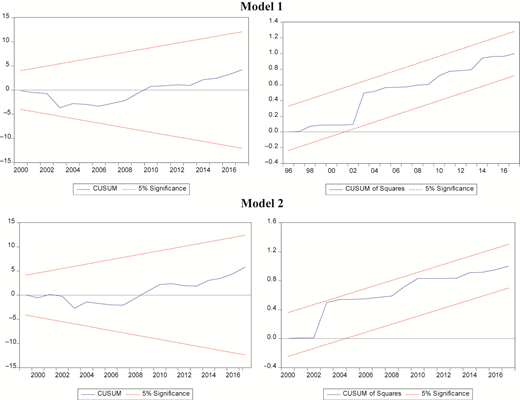
In Table 7, F-bounds test for cointegration indicates that the variables have a cointegration relationship, that is, there exists a cointegrating association between the stock market indicators and the explanatory variables in the model. As the study comprises two models, in each of the models, calculated F-statistic is found to be above their upper bound value at 5% level of significance. Hence, in favour of the alternative hypothesis, the null hypothesis of no long-run association is rejected. On the test of stability, the cumulative sum of recursive residuals (CUSUM) and cumulative sum of squares of recursive residuals (CUSUMSQ) reported in Figure 1 confirm the stable nature of the model specifications. This is ascertained following the falling of the plotted charts within the critical bounds at 5% significant level. In addition, the outcomes of both CUSUM and CUSUMSQ indicate that testing for structural break points, unlike Chow test, is no longer necessary, since even with unknown and unspecified structural break points, their applicable, reliable and appropriate (Brown et al., 1975). Based on the analysis, model 1 represents the inclusion of MRK as the dependent variable, while model 2 accounts for the use of VTR as the dependent variable. This is done with a view to eliminating any possible statistical multicollinearity in the study's model. In all, diagnostic tests conducted validate the robustness of the estimation results in the models.
3.1.4 ARDL long run and short-run estimates
The estimates obtained in this section are used to elucidate the way in which REG results in stock market impact, since it is possible to link market outcomes to the nature of regulation in the economy. Thus, in Table 8, the estimation results show that REG has a positive and significant effect on both MRK and VTR in the study period (both short- and long-run), indicating that the quality of regulation is an essential ingredient of stock market performance. This can be further explained that the improvement of the regulatory framework is highly associated with better market performance — it has strong explanatory power for the level of stock market performance in Nigeria. As posited by Eita (2015), Winfu et al. (2016), Imran et al. (2020), that countries with sound regulatory frameworks would experience good stock market returns, these findings strengthen this proposition for the country. In the long run, poor regulatory framework and inadequate supervision mechanisms could lead to the erosion of investors' confidence and the undermining of the development of stock market. Hence, the soundness of regulatory systems could offer tailoring support for the space of stock market development. This buttresses the argument that the role of regulation in investment in most developing countries seem to be consistent with the proposition that the quality of the regulatory environment is a critical component of business operations (Eifert, 2009; Haider, 2012; Kirkpatrick, 2014).
Regarding the control variables, INF has a significant negative effect on the stock markets indicators across models. This implies that as INF increases, shareholders will demand for higher premium, while higher trading rates can result in higher stock returns and vice versa — this supports the work of Imran et al. (2020). On the effect of GDP, estimates are significant and positive, suggesting that any variation in the level of economic growth will have a noticeable impact on stock market returns. By and large, this marries up with the assertion of Maku and Atanda (2010), Okpara (2010) that GDP plays a substantial role in stock market development. However, TOPEN is found to have an insignificant impact on the stock market measures included across models. The overdependence of the country on imports in relation to exports could be responsible for these estimated outcomes, as the level of international trade might not contribute meaningfully to market performance. In all, ECM conforms with theoretical expectation, indicating that the speed of adjustment restored to the equilibrium.
3.1.5 Cointegrating regression
In this section, while trace statistic and max-eigen test (see Table 9) is conducted, lag order selection criteria (see Table 10) is also determined for the cointegrating regression in Table 11 — to improve the efficiency of the results, these techniques are introduced. The lag selection order is based on Schwarz information criterion which seems to be more suitable. The results obtained in this section are somewhat similar to the findings of the previous section, as both DOLS and CCR estimates reveal that REG has a substantial effect on stock market performance which further affirms the centrality of regulatory framework to market operations. As Eita (2015) showed for South Africa and Zambia, these estimation outcomes support that REG positively influences stock market performance in Nigeria. These results can be compared favourably with the previous studies' findings (such as OECD (2011); Kirkpatrick (2014); Haider (2012); Canare (2017); Ojeka et al. (2019)) — regulatory laxity and poor regulatory supervision could hamper stock market performance. Nonetheless, the study contradicts the findings of Low et al. (2011) who stress that institutional quality adversely affect the performance of stock market, although the difference might be as a result of varying measuring components or differences in variable inclusion.
In sum, it is interesting to note that regulatory quality as one of the components of institutional quality is a significant determinant of the performance of stock market in Nigeria based on the findings. The implication is that the inability of the government to strengthen the regulatory frameworks may engender poor market performance in the country. Regulatory systems supportive of the efficiency and effectiveness of market operations tend to result in improved performance (Kirkpatrick, 2014; Canare, 2017). However, a poor regulatory environment often spurns the need for efficiency and effectiveness. Therefore, if the quality of regulation is sufficiently high, stock market performance will drastically improve, then it is more reasonable to ascertain solely the impact of regulatory governance on the stock market operations in Nigeria's context, and sub-Saharan Africa as a whole.
4. Conclusion
Given that it has been empirically established that components of institutional quality could have an influence on the performance of stock market in any economy, evidence on the role of regulatory quality is in scarce report, especially in Nigeria's context. Hence, this study aimed at addressing the lacuna by examining the possible long-run and short-run impact of regulatory quality on stock market performance in Nigeria. Based on ARDL bounds test and cointegrating regression, this objective is explored for 1996–2019 period. We use MRK and VTR for the analysis, which represent stock market performance indicators. For the impact of regulatory policy on the market performance, the estimates of regulatory quality is employed as a measure. In all, two different models are estimated, and findings generated consistently followed the estimated outcomes of each models in the study period.
The study's findings reveal that regulatory quality positively and significantly influences the performance of stock market, which strengthens the view that better regulatory policy can engender an improvement in stock market returns (Kirkpatrick, 2014). It is plausible to argue that strong and effective regulation encourages better market performance, as the financial sector seems to be more prone to regulation. However, in the long run, poor regulatory framework and inadequate supervision mechanisms could lead to the erosion of investors' confidence and the undermining of the development of stock market. Thus, the soundness of regulatory systems could offer tailoring support for the space of stock market development. The study demonstrates that quality of the regulatory environment is a critical component of business (market) operation. In addition, it is affirmed that both GDP and INF play a substantial role in stock market development in the country.
In view of these findings, by implication, the study suggests that while improving the institutional environment, for stakeholders, Nigeria seems to need more effective and strong regulatory mechanisms critical to enhancing the practices and development of stock market. This tends to be supportive of the level of efficiency and effectiveness of market operations for improved performance. It is therefore a challenge to regulators to learn from prevailing institutional arrangements elsewhere (such as developed countries) even if they cannot be replicated fully but to use them as a basis for developing locally viable policy measures. Since the impact of regulations may be context specific, the government should be alert to the consequences of adopting imported blueprints and instead take into cognizance the need to design, modify and adapt the most effective regulatory processes that best fit domestic conditions.
The study has only focused on Nigeria. Thus, a study of this nature could be good for the entire sub-Saharan Africa countries or be conducted for each sub-region in Africa. Since findings from the study are mainly based on Nigeria's context, in term of policy implication, it may not be applicable elsewhere. Hence, further research studies in this area should focus on cross-country study or employ panel data approach, especially regarding African countries. This will help policymakers know the overall role of governance regulatory quality in the performance of stock markets across countries in the continent.
Authors are very grateful for the comments of anonymous referees, which have significantly enhanced the quality of the paper. The authors specially thank the editorial team of the journal for the professional support offered.
Funding: This study received no specific financial support.