This study investigates the relationship between firms' corporate sustainability performance, reflected in their environmental, social, and governance (ESG) scores, and the market reaction to seasoned equity offerings (SEOs), in addition to examining how stock price volatility affects this relationship.
This study utilizes a sample of 2,061 different firms that conducted 4,853 SEOs over the period from 2011 to 2022 in the G-10 countries. Both the market model and the mean-adjusted models are used to analyze the market reaction to the announcement of SEOs. In addition, a series of multivariate regressions and the Heckman self-selection approach are conducted to ensure the robustness of the results.
The findings reveal a positive and significant impact of ESG performance on the market reaction to SEOs. Further, this positive impact is more pronounced among stocks characterized by higher stock price volatility. This confirms the critical role that corporate sustainability practices could play in conveying favorable information that helps alleviate the negative reaction in the financial markets.
From a managerial perspective, it highlights the role of the ESG discourse as a value-protection tool that firms can utilize to mitigate the negative impacts in financial markets. For policymakers, this highlights the need to ensure the quality of firms' ESG disclosures to enhance transparency in financial markets by creating stricter regulations for ESG disclosures.
To the best of our knowledge, no previous research has investigated the nexus between ESG practices, market reactions to SEOs, and stock price volatility in the context of G10 markets. Therefore, this study extends not only the literature that focuses on corporate sustainability performance, but also enriches the corporate finance literature that investigates stock price behavior and corporate actions. This study helps provide answers to a broader question: whether firms' ESG practices can indeed play a role in conveying favorable information that helps alleviate the negative reaction in the financial markets.
1. Introduction
It is well-documented that SEOs, as a seminal corporate event, act as a more sustainable and preferred choice commonly used among publicly traded firms to boost their operations and enhance their asset expansion (Ahn et al., 2017; Oh and Kim, 2018; Li and Wang, 2022). However, a large body of studies examining the market reaction to SEOs have reported a negative market reaction to such announcements (Gajewski and Ginglinger, 2002; Feng et al., 2018; Ngo et al., 2024). Recently, extant studies (e.g. Chan et al., 2016; Feng et al., 2018; Dutordoir et al., 2018; Feng and Tseng, 2019; Broadstock et al., 2021) posit that corporate social responsibility (CSR) could mitigate the negative market reactions to new equity issues by reducing the information asymmetry between managers and external investors. Further, previous studies have revealed that ESG performance and disclosure result in a reduction in information asymmetry (Bilyay-Erdogan, 2022; Xu et al., 2022; Yuan et al., 2022; Al-Hiyari et al., 2023; Luo et al., 2023). Cui et al. (2018) reveal that less information asymmetry is more associated with better firm CSR practices, and this effect becomes more pronounced for companies with higher levels of risk. This reduction can be attributed to the reduced costs associated with acquiring information and the alleviated uncertainty of prices surrounding the new equity issuances.
From a theoretical point of view, these findings stand in line with the signaling theory's notion that the public would gain positive signals from companies' actions through the disclosure of sustainability performance. Therefore, the reduction in information asymmetry is attributed to better CSR reporting, which acts as an indicator of firms’ good conduct and sustainable environmental and social practices (Mahoney et al., 2013). The stakeholder theory posits that the adoption of ESG practices contributes to better financial performance, a favorable corporate reputation, and sustainable business operations (Peng and Isa, 2020). Related to that, the legitimacy theory posits that it is crucial for corporations to sustain levels of legitimacy and acceptability (Deegan, 2002). Therefore, the preservation of the perception of adherence to societal norms and standards is consistently sought after by companies. Consequently, if ESG practices emerge as a pivotal societal value, it would be damaging to companies' image and reputation in society if they act irresponsibly in the context of environmental, governance, and social issues (Deegan and Unerman, 2011; Eliwa et al., 2021).
Therefore, in this study, we investigate the influence of corporate sustainability performance through ESG performance on the market reaction to SEOs, to test whether corporate sustainability practices play an influential role in mitigating the negative market reaction to SEOs. We also investigate how the effect of corporate sustainability performance on market reaction to SEOs would differ among firms with higher levels of stock price volatility. We do so to test whether having better corporate sustainability performance would be especially advantageous (in terms of decreasing the asymmetric information and so lowering unfavorable market reaction) for those risky firms.
For this purpose, we conduct the following tests. First, to examine the market reaction to the SEO announcement, we use both the market model and the mean-adjusted model to calculate the cumulative abnormal return (CAR) over two event windows. Second, to examine how the market reaction to SEOs can be affected by ESG practices, we utilize a series of regression analyses to test the effect of ESG score and each of its individual pillars (Feng et al., 2018; Dutordoir et al., 2018). Then, to test how the impact of ESG performance on the market reaction to SEOs would differ in the presence of more price volatility, we include the interaction term between ESG score and stock return volatility as a proxy for price risk. To further ensure the robustness of our results in the presence of self-selection bias, the Heckman self-selection model was also utilized. We analyze a sample of firms that conducted SEOs in the G10 countries from 2011 to 2022. Drawing our results based on firms listed in the world's largest economics is mainly driven by the notion that there has been more emphasis placed on the role that corporates can play in the transition towards a sustainable world, where companies in these markets are either required (e.g. France and the UK) or encouraged (e.g. Germany and the US) to disclose ESG-related information (Amin et al., 2025).
Our findings reveal that firms with higher ESG scores, which are an indicator of corporate sustainability performance, exhibit more favorable market reaction around the announcement of SEO, robust across a wide range of tests. In addition, we also show that in the presence of higher stock return volatility, the positive role of ESG performance in reducing the negative market reaction to the SEO announcement returns is more pronounced. This indicates that corporate sustainable practices can act as a tool to convey favorable signals and reduce asymmetric information, and so issuing firms with higher ESG scores exhibit less negative market reaction. These findings lend empirical support to the stakeholder theory, which emphasizes that the adoption of ESG practices contributes to enhanced corporate performance (Peng and Isa, 2020). This also stands in line with the signaling theory, which highlights that the public would gain positive signals from companies' actions through the disclosure of sustainability performance (Amin et al., 2024).
We contribute to the literature in several ways. First, this study examines how the impact of firms' ESGs practices on the negative reactions to their SEOs announcement is affected by stock price volatility. To the best of my knowledge, this study is the first to investigate the nexus between the nexus between ESG practices, market reactions to SEOs, and stock price volatility. By doing so, this study helps provide answers to a broader question: whether firms' ESG practices can indeed play a role in conveying favorable information that helps alleviate the negative reaction in the financial markets. Our findings underline the role that firms' ESG practices can indeed play in conveying favorable information (as posited by signaling theory) and enhancing corporate financial performance (as posited by stakeholder theory). Therefore, this study extends not only the literature that focuses on corporate sustainability performance, but also enriches the corporate finance literature that investigates stock price behavior and corporate actions. Secondly, by examining not only the impact of the aggregate ESG score but also the disaggregated ESG pillars, our findings provide a better understanding of how firms can leverage the different components of ESG to build an insurance tool that mitigates negative price movements. Third, by conducting our study using evidence from G-10 countries, which are characterized by a high level of investor awareness and public activism, we aim to provide international evidence rather than only the US and/or a single country.
The rest of the paper is organized as follows. Section 2 reviews the literature. Section 3 describes the dataset and methodologies employed, while Sections 4 and 5 report and discuss the results. Section 6 concludes.
2. Literature review and hypothesis development
It is well-documented that SEOs act as a more sustainable and preferred choice commonly used among publicly traded firms to boost their operations and enhance their asset expansion (Ahn et al., 2017; Oh and Kim, 2018). However, a large body of studies examining the market reaction to SEOs have reported a negative market reaction to such announcements. Early studies exhibit an average 2–3% negative announcement day associated with SEOs (Masulis and Korwar, 1986). More recently, Gajewski and Ginglinger (2002) reveal a negative average two-day excess return for rights issues made by French firms. Slovin et al. (2000) find that the announcement of insured rights offerings is associated with a negative 2.9% excess return in the UK market. Other studies, including Marsden (2000) and Ching et al. (2006), exhibit similar results in other international markets. More recently, Feng et al. (2018) and Li and Wang (2022) report that SEOs were associated with an average return of −1.4% and −1.8%, respectively. Several explanations have been proposed to interpret this negative market reaction to SEOs. For example, the price pressure hypothesis attributes the decrease in the stock price of equity issuances to the downward-sloping characteristics of the demand curve (Kalay and Shimrat, 1987). Furthermore, the cash flow signaling hypothesis offers a plausible explanation and posits that the decision to use equity issuance as a means to fund raising might be perceived by investors as an indicator of the firm's inability to generate earnings adequate to fund these extant investment opportunities (Akjhigbe and Harikumar, 1996).
In another context, the emergence of ESG factors goes back to the late 1990s and has increasingly grown over the recent years (Malhotra, 2025). Starting with the United Nations Principles for Responsible Investing, Equator Principles, and Global Reporting Initiative, all of which are regarded as principles and standards endorsing and standardizing ESG practices (Sairally, 2015). By definition, the environmental dimension of ESG is shaped by the prospective impacts on the environment and society resulting from companies' actions over the long term. This determination is substantiated through an assessment of their operational practices, including both the effects on the environment and the management of energy utilization (Bhatnaggar, 2021). While companies, considering human rights, community interests, and workforce well-being, act as a part of the social screening of ESG (Peng and Isa, 2020). Moreover, the focus of the governance dimension is constituted by issues related to corruption, firm policies, vision, and strategies within the governance component (Lee and Raschke, 2023). Firms' transition to disclose both financial and nonfinancial information has enabled investors to make informed decisions regarding firms' performance and outcomes. In recent studies, Bajic and Yurtoglu (2018), David et al. (2025) and Oubahou et al. (2025) lend compelling evidence in support of the effect of sustainability/ESG practices on the value relevance of financial metrics and valuation models.
Theoretically, the impact of ESG practices on firm performance has been tackled in several theories. Among these, stakeholder theory posits that the implementation of ESG practices may be a more effective way to meet the stakeholders' needs and enhance the company's reputation, while also achieving improvements in sustainability and financial performance (Peng and Isa, 2020). Signaling theory suggests that conveying crucial information helps reduce the information asymmetry that exists between stakeholders and firms (Spence, 1973; Yekini and Jallow, 2012). Therefore, better sustainability practices and reporting can act as signaling strategies intended to reduce information asymmetry and enhance corporate legitimacy (Hahn and Kühnen, 2013). Related to that, the legitimacy theory postulates that firms can obtain legitimacy and acceptance from society (Deegan, 2002). Accordingly, firms can use their ESG practices and disclosure to do so (Şeker and Şengür, 2021).
In this context, empirical evidence confirms the signaling and monitoring effects of ESG disclosure on driving pricing (mis)behavior (Wang et al., 2024), suggesting that ESG performance can act as a credible information signal that may reduce information asymmetry, adverse selection concerns, and investor uncertainty around equity issuance. For example, Mulchandani et al. (2022) report a negative association between ESG performance disclosures and cost of equity capital, as such disclosures alleviate information asymmetry and signal firms' long-term commitments towards sustainability. Consistent with this view, Ellili (2022) provides evidence supporting the role of ESG disclosures in enhancing transparency and mitigating information asymmetry. In addition, Pinto and Gaio (2025) find that ESG performance plays a critical role in enforcing legitimacy and preserving reputation for firms operating in environmentally sensitive sectors, since firms with strong ESG performance are associated with lower levels of information asymmetry. Further, Ji et al. (2019) find that high corporate social responsibility is associated with the disclosure of more precise information, a mechanism that mitigates information asymmetry and enhances price efficiency.
The question of how firms' sustainability performance might affect the market reaction to their SEOs has also been investigated in recent literature. Feng and Tseng (2019) show that within the context of SEOs, the reduced asymmetric information, resulting from superior corporate social responsibility performance by issuers, can contribute to alleviating the negative market responses to the SEOs' announcements. Similarly, Chan et al. (2016) report that companies committed to CSR tend to receive more positive reactions from market participants during the announcements of SEOs. Consistently, Ok and Kim (2019) show that the firms that have enhanced socially responsible management and corporate governance are associated with a lower cost of raising new equity capital. Kim and Purnanandam (2014) provide supportive evidence that the costs associated with SEOs are raised in the presence of poor corporate governance. More recently, Li and Wang (2022) reveal that the reduction of SEO flotation costs could be realized when significant attention is devoted to environmental and social practices by SEO issuers. Ho et al. (2024) show that firms' environmental and social risks have increased the cost of raising equity capital. Even during the hard time of the COVID-19 pandemic, Xiao and Xi (2021) show that the negative market reaction to SEOs was mitigated among firms with better CSR scores, owing to their role in reducing the information asymmetry.
2.1 Hypothesis development
2.1.1 ESG performance and market reactions to SEOs
As emphasized within stakeholder theory, the adoption of ESG practices contributes to improved financial performance, better corporate reputation, and sustainable business operations (Peng and Isa, 2020). Moreover, according to legitimacy theory, it is essential to highlight the relationship between firms' sustainable/ESG practices and their legitimacy, where a firm's survival and legitimacy are closely related to its commitment to society and ESG practices. This disclosure is significantly shaped by the institutional context and regulatory obligations governing ESG reporting and sustainability practices of firms (Abdul Rahman and Alsayegh, 2021).
Empirically, extant studies lend supportive evidence. For instance, Dutordoir et al. (2018) report that better CSR performance is associated with less negative SEO stock price reactions. Feng et al. (2018) find that a reduction in the negative market reaction to SEO announcements is associated with more strategic emphasis on the environmental and social dimensions of CSR. Li and Wang (2022) find that the mitigation of abnormal returns during SEO announcements and the reduction of the likelihood of offer withdrawal can be attributed to issuing firms' better CSR performance and incorporating environmental and social practices as integral components of CSR.
Building on the above discussion, a positive relationship between firms' active engagement in ESG practices and the mitigation of negative market reaction to SEOs is hypothesized. Therefore, it is empirically sound to posit that ESG performance acts as a mitigating mechanism for the unfavorable market reaction to SEOs. In other words, when firms issue SEOs while being committed to ESG practices, they anticipate a less negative market reaction to these SEOs. This formulates our first hypothesis.
Firms with higher ESG/pillars scores will experience less negative announcement-period abnormal returns to SEOs.
2.1.2 ESG, market reactions to SEOs, and stock price volatility
Indeed, signaling theory highlights that the public would gain positive signals from companies' actions through the disclosure of sustainability initiatives and environmental and social practices (Mahoney et al., 2013). Additionally, the reduction in information asymmetry that is attributed to CSR reporting can serve as an indicator of the positive conduct exhibited by firms. If this argument holds, to the extent we believe that ESG practices can play a significant role in mitigating asymmetric information, it would be expected that the role of ESG practices would be more critical for riskier firms. Consistently, Cui et al. (2018) find that reducing information asymmetry, achieved via CSR practices, is most advantageous for high-risk companies. Related to that, empirical findings (e.g. Usman et al., 2020; Du and Yu, 2021; Hasudungan and Bhinekawati, 2022; Kim and Park, 2023) have well-documented an inverse relationship between ESG and CSR practices and asymmetric information. Moreover, it is also found that the unfavorable reaction to SEOs could be mitigated by lower levels of asymmetric information (D'Mello et al., 2003; Lee and Masulis, 2009). Other studies show that CSR and ESG practices could mitigate the negative market reactions often observed in SEOs. So, firms that actively engage in CSR/ESG practices tend to have less asymmetric information, leading to more favorable reactions to SEOs (Feng et al., 2018; Li and Wang, 2022). In recent studies, Suryani et al. (2025) reveal that ESG news can act as an effective signal mechanism to investors in the stock market, and highlight the role of transparent ESG reporting in alleviating negative effects on the stock market and enhancing investor confidence in the long term. Other studies (e.g. Xu et al., 2025) find that the enhanced information and transparency due to ESG disclosure enhance the firm valuation by investors, leading to lower market volatility.
Combined together, these findings indicate that firms with higher ESG scores are expected to exhibit reduced levels of stock price volatility. Consequently, the less negative market reaction to SEO announcements by issuing firms that have better ESG scores would be especially advantageous for those firms that have more risk. In other words, in the presence of higher stock price volatility, firms with higher ESG/pillars scores will experience less negative announcement-period abnormal returns to SEOs. Built on that, our second hypothesis is formulated as follows:
The positive association between ESG/Pillar performance and SEO announcement returns is expected to be stronger when stock price volatility is higher.
3. Research methodology
3.1 Sample
This study uses a sample of firms that conduct SEOs in the G10 countries from 2011 to 2022. Our data sample is obtained from the LSEG (formerly Eikon Database). This study has an initial sample of 8,198 firm-year observations for firms that conduct SEOs from 2011 to 2023. We dropped observations with missing ESG scores and offerings in 2023 (i.e. 3 firms), and excluded Utilities firms due to their different characteristics (Masulis and Korwar, 1986; Feng et al., 2018), along with Financial firms (Dutordoir et al., 2018). This final sample consists of 2,061 different firms that conducted 4,853 seasoned equity offerings over the period (2011–2022). Firms are then classified into eleven different industries according to the Industry Classification Benchmark (ICB). Table 1 presents the sample distribution. Panel A illustrates the distribution of the sample by industry, with the healthcare sector accounting for the majority (28.56%), followed by real estate (16.24%) and consumer cyclicals (13.97%). Further, Panel B shows sample distribution by country, where the most represented country is the US (60.25%), followed by the United Kingdom (10.90%) and Canada (5.65%). Moreover, Panel C shows sample distribution by year, where most offerings were in 2020 (19.55%), followed by 2021 (19.45%) and 2019 (10.36%). This substantial increase in SEO activity during 2020 and 2021 could be associated with increased financing needs resulting from the COVID-19 pandemic, as firms have shown a tendency to raise more funds during the hard times of the pandemic (Ali et al., 2025).
3.2 Variable definitions and measurements
The dependent variable in this study is the CAR estimated using the market model and the mean-adjusted model over two event windows. The first event window is three days around the announcement date of SEO (−1,1). To further ensure the robustness of our results, we test a seven-day short-term event window around the announcement date of SEO (−3,3). As for the main independent variable, following Okasha et al. (2025), the ESG and its three pillars are used as a proxy for corporate sustainability performance. Where “ESG/pillar scores are a reflection of the company's ESG performance, commitment, and effectiveness based on publicly reported information (LSEG, 2023). When it comes to the control variables, we account for a wide range of variables identified in the literature. Firstly, leverage is defined as the total debt divided by total assets (Li and Wang, 2022). Secondly, firm size is defined as the natural logarithm of a firm's market capitalization (Zenzius et al., 2022). The third variable is the market-to-book (MTB) ratio, defined as the market value of equity divided by the book value of equity and used to account for the growth opportunities of the issuer (Dutordoir et al., 2018; Tarek et al., 2024). Further, we account for the impact of firm profitability, measured using return on assets (ROA) defined as “earnings before interest and taxes divided by total assets” (Dutordoir et al., 2018). We also accounted for asset tangibility, since lower information asymmetry is exhibited by firms possessing larger tangible assets (Li and Wang, 2022); asset tangibility, defined as the ratio of property, plant, and equipment to total assets, is incorporated in the model (Dutordoir et al., 2018; Boasiako et al., 2022). Stock offering announcements are affected by the market sentiment (Li and Wang, 2022). Therefore, the individual stock return and market return over the pre-announcement period are controlled for by Runup_it and Mktrunup_it. Runup_it represents the individual stock return over the 60 trading days preceding the seasoned equity offering (SEO) announcement, while Mktrunup_it denotes the market return over 60 trading days before the SEO announcement (Kim et al., 2013; Feng et al., 2018).
As a measure of stock price risk, stock return volatility is used (Cormier et al., 2010; Feng et al., 2018). Thus, volatility, which is a widely used measure of stock price risk, is measured as the standard deviation of daily stock returns (Lee and Masulis, 2009; Li and Wang, 2022) during one year before the announcement date (Gao and Jia, 2017).
3.3 Method
To examine how the market reaction to SEOs can be affected by ESG practices, as posited by H1, this study utilizes a series of OLS regressions, controlling for year, industry, and country fixed effects (Feng et al., 2018; Dutordoir et al., 2018). In particular, accounting for year fixed effects is essential for the 2020–2022 period to capture the financial effects of the COVID-19 pandemic, a common shock that affected all firms undertaking SEOs during this interval (Paun et al., 2025). Further, to address the effect of outliers, variables are winsorised at the 1st and 99th percentiles. In addition, the ESG and its three pillars are included in all models in their natural logarithm form, since this transformation improves distributional properties and mitigates the impact of outliers (Li and Wang, 2022). Moreover, skewness in a measurement variable is often reduced through the application of log transformation (West, 2022). Furthermore, this approach is useful in allowing the theoretical distribution of the sample mean to conform to a normal distribution (Curran-Everett, 2018).
In addition, all models include cluster-robust standard errors to control for heteroskedasticity and within-cluster correlation (Cameron and Miller, 2015). Consequently, following Li and Wang (2022), all standard errors are clustered at the country level. Since dependencies stemming from shared institutional and regulatory environments are accounted for through country-level clustering. This approach ensures robust inference even when national sources of correlation are present (Mos, 2026). Further, the result (reported in Appendix 1: Table A1) on the variance inflation factor (VIF) indicates that multicollinearity is not a significant problem.
Specifically, to test H1, the following econometric model is used:
In addition, to test how the impact of ESG performance on the market reaction to SEOs would differ in the presence of more price risk, as hypothesized by H2, our second model includes the interaction term between ESG score and stock return volatility as a proxy for stock price risk. Moreover, both variables of the interaction term are included in their mean-centered values to enhance the interpretability of regression coefficients, and precision of estimates is attainable through the mean-centering procedure (Afshartous and Preston, 2011; Shieh, 2011). Specifically, the following model is tested:
4. Findings and analysis
4.1 Descriptive statistics
Table 2 displays the descriptive statistics for the dependent, independent, and control variables in Panels A, B, and C, respectively. Panel (A) represents the dependent variable. The market model and mean-adjusted model estimate the dependent variable “CAR” over a 3-day event window (−1, 1). As seen in Panel A, the mean values are −0.015 and −0.014, respectively, which confirms the presence of negative announcement returns for SEOs. Panel (B) shows the descriptive statistics for the dependent variable ESG score and its pillars. As shown, the average ESG score for firms is 36.96, placing them in the second quartile with a C score, which indicates that firms show “satisfactory ESG performance with a moderate degree of transparency in reporting ESG data publicly”. Further, the large standard deviation of 19.49 shows the large disparity in the ESG score, ranging from the highest ESG score of 94.8 to only 0.69. Panel (C) shows that the leverage ratio has an average of 0.31, indicating lower concerns regarding the risk of financial distress since this risk increases with higher levels of the leverage ratio (Lee and Masulis, 2009; Gao and Jia, 2017). Furthermore, the firm size ranges from 8.64 to 19, with the average size equal to 14.17. This average size indicates a greater likelihood of uncertainty prevailing among small firms (Chan and Chan, 2014). In contrast, larger firms face lower levels of stock price volatility due to the greater attention towards large firms by institutional investors and stock analysts (Lee and Masulis, 2009). Further, the mean market-to-book value (MTBV) of 4.9 indicates that, on average, firms exhibit high growth opportunities, with potential signs of overvaluation. Furthermore, the average ROA for firms is −12.13, raising concerns regarding profitability and financial performance. Additionally, the asset tangibility ratio has an average equal to 0.31, which might result in increased risk, as the degree of risk decreases with higher levels of tangible assets (Walker and Yost, 2008).
Additionally, the mean value of the market run-up is 0.03, ranging from −0.99 to 0.43, which is similar to the previous findings of Li and Wang (2022). Furthermore, stock run-up has a mean value of 0.16, similar to Corby and Stohs's (1998) findings. The market run-up and stock run-up are usually perceived as positive signals surrounding the stock offerings announcement (Masulis and Korwar, 1986; Harjoto and Garen, 2003; Carpentier et al., 2012). Moreover, the growth expectations, along with overall market and economic conditions, are accounted for by market run-up (Li et al., 2019). Finally, the volatility of stock returns shows a mean value of 3%, closely aligning with the findings of Lee and Masulis (2009) and Bowen et al. (2008). The stock return volatility is a measure of stock price risk (Kim and Park, 2005; Lee and Masulis, 2009). Furthermore, it is an indicator of “ex-ante uncertainty” associated with the firm that issues seasoned equity offerings (Chan and Chan, 2014).
4.2 Regression analysis
Table 3 demonstrates the regression results. We find that the ESG/pillar scores have a significant and positive effect on the CAR, whether estimated by the market model or the mean-adjusted model over a 3-day event window (−1, 1). We also estimate the economic significance of the effect of ESG/Pillar scores as follows. We multiply the ESG score coefficient by its standard deviation and report it in percentage form. For example, in Panel A, the coefficient on ESG in Model I is 0.00857. The standard deviation of ESG (in log form) is 0.57. Therefore, as the ESG score rises by one standard deviation, SEO-announcement return increases by 0.49% (0.00857 x 0.57 x100). Similarly, a one standard deviation increase in ESG score leads to an increase in SEO announcement returns by 0.55% (0.00964 x 0.57 x100) when CAR is estimated by the mean-adjusted model, as reported in Panel B. Overall, these results indicate that firms with higher ESG scores have higher and significant announcement returns and support H1. To further strengthen our analysis, Table 4 reports the results based on testing the CAR over a 7-day event window (−3,3), estimated by the market model. Robustly, the results confirm the significantly positive impact of ESG/pillar on SEO announcement returns.
These results confirm Feng and Tseng's (2019) findings that the diminishment of agency costs and the adverse selection issue is achievable through superior CSR performance by issuers, and this improved CSR performance contributes to alleviating negative market reactions to the announcements of seasoned equity offerings. Moreover, the results are compatible with the findings of Chan et al. (2016) that the attenuation of negative abnormal returns around the announcement of SEOs is evident for companies committed to CSR. From a board perspective, this finding also stands in line with the supportive evidence on the role of ESG/CSR in alleviating the negative reactions to bad news (Chakraborty et al., 2023). From a theoretical lens, our results support the stakeholder theory because, within the framework of stakeholder theory, an equal responsibility is posited to be exerted by companies toward social communities, designated as secondary stakeholders, as well as customers and employees, identified as primary stakeholders (Manita et al., 2018). Consequently, the bolstering of the firm's reputation, alongside advancements in sustainability and financial performance, may be achieved more effectively through the adoption of ESG practices (Peng and Isa, 2020). Moreover, those findings support the legitimacy that posits that the preservation of the perception of adherence to societal norms and standards is consistently sought after by companies. Furthermore, it is crucial for firms to fairly consider the rights of both the public and investors. Consequently, if ESG practices emerge as a pivotal societal value, operational challenges may be encountered by companies if their performance falls short in the domains of environmental, governance, and social issues (Deegan and Unerman, 2011; Tripathi and Jham, 2020; Eliwa et al., 2021).
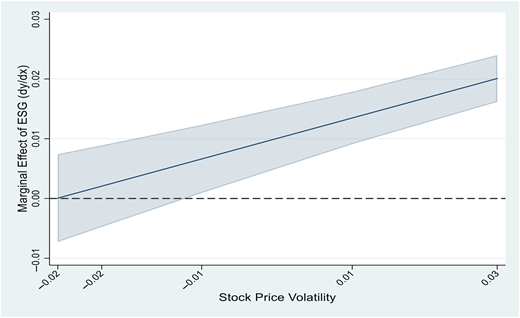
To test how stock volatility would affect the role of corporate sustainability performance in mitigating the negative reaction to SEOs' announcement, as postulated by H2, Table 5 reports the regression results over the event window (−1, 1). Our overall findings still show a significant and positive impact of ESG and its pillars on CAR. Specifically, in the presence of higher stock price volatility, the positive effect of ESG scores on SEO announcement returns is more pronounced for firms with higher ESG scores, as indicated by the positive and significant coefficient of the interaction term. To further gain insights into the nexus among ESG, SEO announcement returns and stock price volatility, Figure 1 reports the marginal effect of ESG score on CAR estimated over a 3-day event window across different volatility levels. Interestingly, the findings reveal an upward trend in the combined effect of ESG and stock price volatility. In detail, as volatility levels (estimated at 10th, 25th, 50th, 75th, and 90th percentiles) increase, the positive effect of ESG scores on SEO announcement returns gets more pronounced for firms with higher volatility.
Taken together, these results lend more support to H2 and are consistent with prior studies that attributed a reduction in stock risk to more enhanced ESG performance and disclosure (Bilyay-Erdogan, 2022; Xu et al., 2022; Yuan et al., 2022; Al-Hiyari et al., 2023; Luo et al., 2023). Furthermore, these results are consistent with the findings of Beloskar and Rao (2023) in the Indian market, who reported that during the COVID-19 pandemic, higher ESG scores led to greater stock resilience.
4.2.1 The Heckman self-selection model
As a robustness check for potential self-selection bias, the Heckman self-selection model was utilized to account for potential bias of self-selection into firms with higher ESG scores. This results from the notion that firms with specific attributes, such as superior quality, are more likely to engage in CSR initiatives (Feng et al., 2018). Further, Li and Wang (2022) argued that when the costs associated with obtaining a CSR rating are surpassed by the benefits derived from engaging in corporate social responsibility, such as the reduction in costs related to seasoned equity offerings, a strong incentive for firms to participate in CSR activities is created. Similarly, this study employed the Heckman self-selection model to address the issue of self-selection bias, wherein firms may engage in ESG practices to achieve higher ESG scores. These higher scores, in turn, could mitigate the negative market reactions to the announcement of seasoned equity offerings.
Accordingly, the two-step Heckman procedure (Heckman, 1979) is employed to address potential self-selection bias. In the first step, a Probit selection model is estimated, where the dependent variable is a dummy variable set to one for firms identified as high ESG firms. High ESG firms are defined as those with an ESG score equal to or greater than the median ESG score in the year preceding the SEO announcement (Dutordoir et al., 2018). This dependent variable is then regressed on the same set of control variables used in the baseline regression. Further, the inverse Mills ratio, denoted as Lambda, derived from this first stage, is then incorporated into the second-stage regression, along with the independent and control variables. The results, reported in Table 6, demonstrate that the ESG/pillar scores have a significant and positive effect on the CAR, whether estimated by the market model or the mean-adjusted model over a 3-day event window (−1, 1). Thus, these results are consistent with the findings reported in the earlier sections and lend more support to our hypotheses, underscoring the robustness of the results, even after adjusting for self-selection bias.
4.2.2 Weighted least squares (WLS) method
Given that the United States constitutes 60.25% of the sample, followed by the United Kingdom at 10.9% and Canada at 5.65%, collectively accounting for 76.8% of the sample, with the remaining 8 countries representing only 23.2%, the dataset exhibits significant heterogeneity in observations across countries. To address this sample bias and enhance the accuracy of parameter estimation, the weighted least squares (WLS) approach is employed. This method ensures that each data point is assigned an appropriate degree of influence, thereby maximizing the effectiveness of the parameter estimation (Li and Wang, 2022). The results in Table 7 show that the ESG score has a positive effect on the CAR whether estimated by market model or mean adjusted model around the event window (−1, 1) as indicated by the positive and significant coefficient of ESG score, and similar results were found when analyzing the effect of each pillar (environmental, social and governance score) on the CAR around the SEO announcement.
5. Summary and conclusion
This study examines how ESG performance, as an indicator of corporate sustainability performance, can mitigate the negative market reaction to the announcement of SEOs in the presence of high stock price volatility. Based on an analysis of a comprehensive sample of international SEOs issued in the G-10 markets, the findings reveal that firms with higher ESG scores exhibit more favorable market reactions around the announcement of SEOs. Interestingly, we also find that the positive effect of ESG/pillar in decreasing the negative reaction to the announcement of SEOs is more pronounced for firms with higher stock price volatility. Finally, the findings revealed that each pillar of the ESG score has a positive and significant impact on the market reaction to SEO announcements. To further ensure the robustness of the results, this study utilizes the Heckman two-stage model to address potential self-selection bias. The results remain positive and significant.
These findings support the stakeholder theory, which emphasizes that the adoption of ESG practices contributes to improved financial performance, enhanced corporate reputation, and sustainable business operations (Peng and Isa, 2020). Further, the results support the close relationship between ESG practices and legitimacy theory, where a firm's survival and legitimacy hinge on the comprehensive disclosure of ESG information (Abdul Rahman and Alsayegh, 2021). In addition, the findings show support for signaling theory, which highlights that the public would gain positive signals from companies' actions through the disclosure of sustainability performance (Amin et al., 2024).
In addition, the findings have important implications for investors, suggesting that they should invest in firms with higher levels of ESG scores. Our study also bears implications for policymakers, investors, and practitioners. From a managerial perspective, it underlines the role of ESG discourse as an assurance factor for investors and shareholders during periods of higher uncertainty. For investors and practitioners, the findings help provide insights into firms' behavior towards supporting ESG and their role in supporting firms' resilience to adverse impacts in financial markets. For policymakers, our findings highlight the crucial need to ensure the quality of firms' ESG disclosures to enhance transparency in financial markets by creating stricter regulations for ESG disclosures. Future research might examine a sample of developing countries and compare the effects of corporate sustainability performance between developed and developing countries on the announcement returns of SEOs. The impact of the COVID-19 pandemic on these effects should also be considered.
The supplementary material for this article can be found online