Contemporary brands increasingly cross boundaries in novel and surprising ways and form complex social relations. However, existing research provides limited explanations for such transgressions. This article reconceptualizes brand transgressions from a broader perspective and develops a conceptual and theoretical explanation of the transgressive nature of brands.
The article conducts a meta-theoretical analysis of four approaches to branding, examining how the underlying models of communication shape different conceptualizations of brands and their potential for explaining transgressions. It further draws on Luhmann’s social systems theory to develop an alternative understanding of brands as inherently transgressive communicative entities.
Brand transgressions are reconceptualized as social processes of transcending boundaries. The analysis reveals that conceptualization of brands as cognitive, symbolic or socio-material entities rely on distinctions that are implicitly or explicitly grounded in different communication theories, leading to divergent interpretations of transgressions. Furthermore, it demonstrates that conceptualizing brands as communication systems helps to explain the integrative mechanisms that enable transgressions and stabilize social relations.
The article contributes to communication scholarship by demonstrating that transgressions are not anomalies or accidental deviations but an inherent feature of the communicative structures of brands. It offers a theoretical perspective that reframes contemporary brand phenomena as transgressive processes and clarifies the role of brands in shaping and facilitating complex social relations.
Introduction
Contemporary society is undergoing a shift towards a branding of almost everything: of products, organizations, countries, cities, religions, political parties, politicians, celebrities and even of “ordinary” individuals (Kornberger, 2010). Brands are no longer exclusively used for commercial purposes, but they serve as a way of thinking, managing and communicating across diverse domains of society. Moreover, brands today cross their traditional boundaries and interfere in almost everything, increasingly engaging in social and political issues (Moorman, 2020; Swaminathan et al., 2020). As such, contemporary brands have evolved into open and transgressive social entities embedded in complex social relations, connecting various organizations and entities with multiple actors, relating to various myths, ideas and ideologies, and engaging in various spheres of society. However, this expansion and openness have also made brands increasingly exposed and susceptible to various contestations and attacks (Fournier and Avery, 2011; Siano et al., 2022b). Brand managers face new challenges, such as loss of control and difficulties to manage the brand (Fisher and Smith, 2011), handling complex social relations and uncertainties in predicting the impact of the environment (Swaminathan et al., 2020), as well as facing negative brand meanings that destabilize the brand identity (Brodie et al., 2017). This article suggests the concept of brand transgressions to capture the shifting nature of contemporary brands and their capability of crossing boundaries and transgressing in new and often surprising ways.
Existing research conceptualizes brand transgressions predominantly as negative events that violate consumer expectations and damage consumer–brand relationships (Aaker et al., 2004; Khamitov et al., 2020). However, this narrow framing overlooks a growing set of contemporary branding phenomena such as brand co-creation (Hatch and Schultz, 2010), brand hijacking (Siano et al., 2022a) and brand activism (Moorman, 2020), that similarly involve the crossing of social, cultural or political boundaries, but do not fit within traditional definitions of transgression. As a result, these instances are often treated as isolated or exceptional phenomena, rather than recognized as interconnected manifestations of a broader and more fundamental dynamic within branding. What remains underexplored is how transgressions function as mechanisms through which brands transcend boundaries, establish new social relations and participate across multiple societal spheres.
The aim of this article is to contribute to communication and branding scholarship with a conceptual and theoretical explanation of the transgressive nature of brands. First, it contributes with a broader conceptualization of brand transgressions as social processes. Drawing on a sociological understanding of transgressions as social processes of transcending boundaries and exceeding limits (Jenks, 2003), this study reframes diverse brand-related phenomena as forms of transgression and reconceptualizes them as boundary-transcending processes. The second contribution is a theoretical understanding of brand transgressions from multiple perspectives. The article examines how four distinct branding theories and conceptualizations of brands could understand and theoretically explain brand transgressions. It begins by deconstructing two established and one emerging branding approach, examining how the underlying communication models in the different branding approaches shape the distinctions used for conceptualizing brands as cognitive, symbolic or socio-material entities, and how brand transgressions could be interpreted within each theoretical approach. The article further proposes a fourth theoretical perspective based on social systems theory (Luhmann, 1995a) to advance a conceptualization of brands as communication systems and develop an alternative understanding of transgressions as an inherent feature of brands. This perspective offers a framework that explains the mechanisms that make transgressions and social relations possible and demonstrates that transgressions are not anomalies or accidental deviations but an inherent feature of the communicative structures of brands.
The article consists of five sections, including the introduction, review of brand transgressions literature, outline of social systems theory, theorization of brand transgressions and a concluding section that offers avenues for future research.
Conceptualization of brand transgressions
The concept of brand transgressions was firstly introduced in the branding literature within the context of consumer–brand relationships. Aaker et al. (2004) define brand transgressions as violations of the implicit or explicit rules that guide the performance and evaluation of these relationships. Subsequent research describes brand transgressions as brand or product failures, incidents, harms, poor service, wrongdoings, betrayals or broader violations of social or moral norms (e.g. Arsel and Stewart, 2015; Lin and Sung, 2014; Magnusson et al., 2014; Puzakova et al., 2013; Sayin and Gürhan-Canlı, 2015). This literature most commonly conceptualizes transgressions as negative acts and events that violate consumer expectations and often lead to damaging consequences (Khamitov et al., 2020). For instance, Sayin and Gürhan-Canlı (2015) argue that such transgressions dilute brand meaning and undermine the brand’s ability to transfer its associations to consumers. However, despite this relatively narrow and predominantly negative framing, contemporary examples suggest that brand transgressions may involve crossing different kinds of boundaries that can extend beyond consumer–brand relationships and are not necessarily negative events or violations. This broadening of the phenomenon provides a foundation for reconsidering the transgressive nature of brands.
Contemporary brands are increasingly understood as open and dynamically co-created entities that are no longer controlled solely by brand managers (Diamond et al., 2009; Fournier and Avery, 2011). The brand co-creation paradigm extends beyond the traditional consumer–brand relationships, emphasizing that brands are shaped through complex interactions among diverse stakeholders (Hatch and Schultz, 2010; Siano et al., 2022b). Some stakeholders, such as fans or influencers, contribute positively by infusing the brand with new meanings, while others, including angry consumers or anti-brand activists, may appropriate the brand and destabilize its identity. These dynamics illustrate how the openness of brands enables various forms of boundary-crossing. Such processes are particularly evident in cases of brand hijacking, defined as an unauthorized manipulation, subversion and reinterpretation of a brand by external parties (Siano et al., 2022a). Seen through this lens, both brand co-creation and brand hijacking demonstrate how contemporary brands function as open, communicatively constructed entities that transcend traditional boundaries, facilitate complex social relationships and bridge different forms of brand-related communication. Consequently, these phenomena can both be understood as instances of brand transgressions. The first represents a positive form of transgression and the second a disruptive one.
The transgressive nature of brands is further evident in contemporary brand phenomena such as sustainable branding (Nascimento and Loureiro, 2024), green branding (Bhardwaj et al., 2026), purpose branding (Swaminathan et al., 2020) and brand activism (Vredenburg et al., 2020). These approaches illustrate how brands increasingly operate at the intersection of economic, social and political domains, thus crossing traditionally boundaries of branding. For example, brand activism refers to a strategic engagement in partisan sociopolitical issues through public statements or actions aimed at fostering social change (Moorman, 2020). Activist brands cross traditional commercial boundaries by entering the political sphere and adopting the role of political actors. In doing so, they seek to communicate simultaneously within the economic and the political spheres and create a link between them. However, such engagement frequently provokes significant backlash, as activist brands may be targeted by political opponents, publicly criticized by various audiences, and even boycotted by consumers, which can ultimately destroy the brand. The phenomenon of brand activism thus illustrates the transgressive nature of brands by showing how diverse social relations emerge and are facilitated through brands, including connections between the economic and the political spheres and between positive and negative forms of brand-related communication.
These examples demonstrate that transgressions occur frequently and represent a widespread phenomenon in contemporary branding. Although previous research has examined specific forms of brand transgressions such as brand hijacking or brand activism, these are often treated as isolated and exceptional phenomena. Consequently, the understanding of transgressions as a general and inherent characteristic of contemporary branding remains limited. This gap highlights the need for a broader conceptualization that moves beyond framing them solely as negative or fragmented events. To theorize transgressions more broadly, this article turns to a sociological understanding of the phenomenon. Within the sociological literature, transgressions are understood as social processes that transcend boundaries and exceed limits (Jenks, 2003). Such processes have been explored across diverse fields, including literature, art and architecture, and they involve transcending limits that can be physical, racial, aesthetic, sexual, legal, national and moral. As Jenks (2003) emphasizes, transgressions do not simply deny limits or break boundaries but rather exceed them while simultaneously reaffirming their existence. Building on this understanding, the present study reconceptualizes brand transgressions as boundary-transcending processes and examines how the capability of brands to cross boundaries and facilitate social relations could be understood theoretically.
Social systems theory
Niklas Luhmann is an influential German sociologist whose theory and innovative insights about how society functions have provided inspiration for research in various fields, including sociology, political science, media and communication studies, organization studies, etc. According to Luhmann (1992), society should be understood as a social system that consists of multiple subsystems. The central idea of social systems theory is that social systems are communication systems that operate by selecting relevant information and distinguishing themselves from their environment. The key concepts of social systems theory relevant for this study are communication, distinctions, self-reference, other-reference, unity of distinctions and social systems. All the concepts will be further elaborated (see Table 1 for summary).
Social systems theory posits that society consists of communication as its main operation (Luhmann, 1992). While most social theories understand society as based on actions and see communication as a specific type of action, social systems theory suggests that communication should not be understood as an action where a sender sends a message to a receiver. Luhmann (1992, 1995a) argues that communication has no access to the body or the mind. The body is a system of its own that operates through biological process (and not trough communication), and the mind is a system that operates only through perceptions and thoughts. Thus, Luhmann sees communication not simply as sending and receiving messages but as a process that involves selections and distinctions. Specifically, he defines communication as a process of three selections (information, utterance and understanding) made from an infinite range of possibilities that happen by drawing distinctions. Communication occurs only when a link between the three selections is established, that is, when a message that carries certain information is uttered in a specific way and accepted as communication. For instance, in the context of branding, any sign that is coded with brand-specific information is an utterance, aiming to create an understanding through brand recognition.
The concept of distinction is the key conceptual building block of social systems theory. Drawing inspiration from Spencer-Brown’s The Laws of Form, Luhmann (1995b) defines distinction as a form with two sides that makes a difference between something (the marked side) and something else (the unmarked side). The use of distinctions is evident in many examples. For instance, Luhmann makes a distinction between communication and thinking, identifying them as two separate operations. Similarly, branding scholars employ the distinction between brands and perceptions to explain that brands are entities owned by companies, whereas perceptions are constructs created in consumers’ minds. At the level of individual brands, when a brand refers to itself, it creates a distinction between the brand and other brands. Importantly, the marked side of a distinction is produced through self-reference, while the unmarked side by other-reference. In this process, self-reference includes any reference to the brand or branding more broadly, whereas other-reference includes any reference to the product, the company or other brands.
Luhmann suggests that the two sides of any distinction form a unity. In this view, the distinction functions as a boundary that simultaneously separates and connects the two sides (Andersen, 2003). When a communication refers for example to an entity, it simultaneously presumes and includes another element that stabilizes the meaning of that entity. In the context of branding, for instance, referring to a product brand involves both a reference to the brand and an implicit assumption of a product. This can be understood as a unity formed through the distinction between the brand and the product. In this unity, the brand and the product are separated as two distinct entities, whereby the meaning of the brand is stabilized by its connection to the specific product.
Finally, Luhmann (1995a) introduced the concept of social system defined as a system of communication that functions by establishing a distinction between itself (self-reference) and its environment (other-reference). He has described three types of social systems, including interactions, organizations and functional social systems. For example, two fans of Lego talking about the brand constitute an interaction system, while Lego Group constitutes an organizational system. Furthermore, Luhmann (2006) suggests that modern society consists of multiple functional social systems, such as the systems of economy, politics, law, religion and media. For example, the economic system constitutes of any communication that makes a general reference to payments, whereas the political system constitutes of references to political power. In the context of branding, we can observe how various communication systems emerge. These systems oscillate between self-reference and other-reference and create unity of distinctions, such as for example product brands, service brands, corporate brands or place brands.
The following section builds on the proposed conceptualization of brand transgressions as boundary-transcending processes and develops a meta-theoretical analysis of the potential of different branding approaches for theoretical understanding of brand transgressions. The analytical strategy aims to carve out the underlying communication model in four distinct approaches and show how it informs the distinctions employed in conceptualizing brands (e.g. brand versus perception; brand versus culture). In doing so, the analysis points more precisely to how brand transgressions are, and possibly can be, explained in these approaches. The section further employs social systems theory to build an alternative understanding of transgressions as an inherent feature of brands.
Theorization of brand transgressions
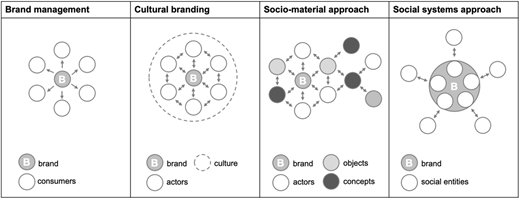
This section begins by deconstructing three distinct branding approaches and conceptualizations of brands, including brand management and cultural branding as two established approaches and a social-material approach as an emerging one (see Table 2 and Figure 1 for an overview). Building on this comparative meta-analysis, the theorization continues with developing a social systems approach, conceptualizing brands as communication systems and offering a systems-based understanding of brand transgressions.
Deconstructing branding theories and their potential for explaining brand transgressions
Brand management: brands as managerial tools and mental representations
The most dominant school of thought in the branding literature is the brand management approach, which focuses on understanding how companies build and manage brands (Aaker, 1991; de Chernatony, 2006; Kapferer, 2008; Keller, 1993, 2003), as well as how organizations use corporate brands to guide and organize the entire organization (Hatch and Schultz, 2003). Initially, marketing scholars conceptualized brands as symbolic representations of products and trademarks functioning as differentiation tools on the markets (Aaker, 1991; Keller, 1993). This tradition has gradually shifted towards a consumer-centric conceptualization of brands as mental representations constructed in the consumer’s mind (Keller, 2003). This conceptualization was influenced by cognitive psychology and information processing theory and grounded in a psychological understanding of knowledge processing, cognitive reasoning and memory formation (Kapferer, 2008; Keller, 1993, 2003). Thus, the focus of brand management research turned to understanding how consumers learn, process and retain brand-related information in their memory, and how these processes shape brand perceptions (Aaker, 1991; de Chernatony, 2006; Kapferer, 2008; Keller, 1993, 2003).
The underlying communication model that is reflected in this approach is a transmission model of communication (Figure 1), whereby communication is seen as a linear, one-way process of sending brand messages (Aaker, 1991). The magic bullet thinking behind this approach suggests that the company is the sender that shoots brand messages, while the consumer is a passive receiver of these messages. Based on this communication model, the initial conceptualization suggests that the brand operates on a distinction between form and content, i.e. between the symbolic representations of the brand and the perception. The emphasis in this conceptualization was firstly on designing symbolic representations and brand messages and managing brand perceptions in consumers’ minds. However, as the control of the perceptions proved to be more difficult, the focuses shifted to understanding the brand as a mental construct and reframing consumers as active receivers that can process and respond to brand messages. While the early conceptualization was based on a distinction between the brand as form and the perception as content, this distinction is blurred in the conceptualization of the brand as a mental construct.
This approach makes it possible to observe how brands transgress across different domains. When the brand is defined as perception, in principle any perception can be conceptualized as a brand (Kotler, 2003). Thus, brands appear to transgress into new domains of branding, such as political branding (Pich and Newman, 2020), place branding (Lucarelli and Berg, 2011) and personal branding (Fournier and Eckhardt, 2019). However, these instances of transgression are never fully addressed as such, because conceptualizing the brand as perceptual content removes the burden of theoretically describing how brands, understood as a unity of form and content, cross boundaries and transfer from one domain to another. As a result, the transgressive nature of branding remains opaque.
Within this approach, the evolution of branding moves from a process strictly controlled by the sender to one that emphasizes how to navigate the “mind spaces” of consumers. Nevertheless, as the analysis shows, the managerial approach remains grounded in a transmission model of communication, conceptualizing brands as a unity of the distinction between form and content that is controlled by a sender (i.e. a brand manager). These assumptions have important implications for how the approach understands boundary-crossing and transgressions. It is noticeable how managerial branding theory cannot abandon the notion of control over the brand. Managing the brand according to the transmission model emphasizes control of the form/content distinction but encounters limitations when this control is challenged by transgressions. This limitation is evident, for example, in recent brand activism literature which remains preoccupied with control over the brand and the brand perception (Pimentel et al., 2024). Accordingly, within this approach, transgressions are understood as external risks from which the brand should be protected.
Cultural branding: brands as cultural symbols
The cultural approach to branding has emerged as a critique to the managerial and psychological conceptualization of brands purely as mental constructions and ignoring the broader context in which they reside (Schroeder and Salzer-Mörling, 2006). From this perspective, the brand meaning cannot be controlled by a single actor and is not limited to the individual mind. Instead, brands are conceptualized as culturally embedded symbols that convey diverse meanings and ideologies and function as resources for consumers’ identity construction (Askegaard, 2006; Holt, 2004, 2006; Lury, 2004). This approach focuses on the relationship between brands and culture, reflecting a post-structuralist view that brands cannot be fully managed and controlled by companies, and understanding culture predominantly from an interpretivist perspective. Branding is seen as a cultural and symbolic process of meaning-making and the focus is on how symbolic brand meanings are interpreted, negotiated and contested by multiple actors (Diamond et al., 2009; Luedicke et al., 2010).
The underlying communication model in this approach is a semiotic model (Figure 1). Namely, the conceptual foundation of cultural branding draws primarily from the interpretivist tradition and is further fueled with insights from post-structuralist semiotics. It is important to note that semiotics operates on the distinction between signifier and signified, which constitutes the unity of the sign (Saussure, 2011). Following Saussure’s conceptualization of the sign, poststructuralists (e.g. Barthes, Derrida etc.) see the signifier as a material side of the sign and the signified as a cognitive side of the sign. What is different from a structuralist understanding of the sign is that the unity of the distinction between signifier and signified becomes unstable. This means that signifiers, through connotations, refer to new signifiers which in turn produce new and unexpected meaning. A poststructuralist conceptualization of the brand reaches a conclusion that is strikingly similar to the brand management approach: the brand (as a sign) cannot be controlled. However, by linking the brand to cultural myths, cultural branding offers a different solution (Arnould and Thompson, 2005; Holt, 2006; Holt and Thompson, 2004). Through its condensed ideological content, cultural myths stabilize the uncontrolled free flow of signification and create a sign that “naturalizes” its own meaning (Barthes, 1972). Therefore, cultural branding offers a compelling solution to stabilizing the brand as a unity between signifier (as form) and signified (as cultural content).
The approach allows to see how some forms of brand transgressions, such as co-creation or brand hijacking, can be seen as a part of the branding process. The underlying semiotic model of communication advances the understanding of the transgressive nature of brands insofar that the previous emphasis on sender control is, if not abandoned then at least, loosened significantly. Although brand managers are interested in infusing the brand with different positive meanings, the cultural approach highlights the active role of multiple actors in communicating about the brand, contributing both with positive and negative meanings (Brodie et al., 2017; Siano et al., 2022b). Instead of attempting to control a process that involves a multiplicity of consumers’ and other stakeholders’ “mind spaces”, this approach seeks to stabilize the brand by making a unity between the brand as a form and culture as content. Therefore, this shift in the conceptualization of the brand offers a viable path to tempering the transgressive nature of brands, understanding transgressions not as risks but rather as a regular feature of branding. However, the cultural approach does not offer a clear conceptualization of how this is possible and falls short of explaining the mechanisms that make the brand prone to transgressions.
Socio-material approach: brands as assemblages and actor-networks
A third stream of research has emerged more recently within the branding literature as an evolution of the cultural branding approach, reflecting an ontological turn towards socio-materiality and emphasizing the complexity, multiplicity and heterogeneity of social life. The socio-material approach conceptualizes brands as complex, heterogeneous and dynamic assemblages or actor-networks composed of various human and non-human entities (Lury, 2009; Molander et al., 2022; Parmentier and Fischer, 2015; Preece et al., 2019; Rokka and Canniford, 2016). According to these scholars, brand assemblages may include various components, such as humans, objects, technology, concepts or ideas, that are interrelated and gain their capacities through interaction with other entities (Parmentier and Fischer, 2015). Branding is therefore theorized as a dynamic process of establishing relationships and interactions between multiple human and non-human entities (Giesler, 2012; Molander et al., 2022; Preece et al., 2019).
This approach is mainly inspired by actor-network theory (Latour, 2005) and assemblage theory (DeLanda, 2006, 2016; Deleuze and Guattari, 1987). It is grounded in a decentered, flat ontology that positions all entities on an equal ontological level, thereby distributing agency across the heterogeneous networks they form (Latour, 1990, 2005). More specifically, it reflects Latour’s (2005) material-semiotic view that semiotic elements, such as mythologies, ideologies and narratives, cannot be viewed independently of material objects. According to Latour (1996), objects are necessary to provide energy for ideas to travel, and ideas are constantly translated based on the conditions and needs of the objects. The process of translation involves multiple actants that transform into actor-networks through associations (Latour, 2005). Latour’s translation model was strongly influenced by Hjelmslev’s and Greimas’ semiotic model of the sign that considered materiality and introduced a double distinction of content versus expression and substance versus form (Hjelmslev and Whitfield, 1961, ch. 13; Høstaker, 2005; Greimas et al., 1989). It is important to highlight that this model introduces substance as an indispensable resource for the sign. The generation of meaning is dependent on giving form to content and expressions that serve as semiotically amorph resources.
The brand in this approach is no longer conceptualized as the unity of a distinction between form and (mental or cultural) content, but as a unity of two different distinctions: content/expression and substance/form. Latour (2005) describes the communication process as a separation of form and content where the content constantly undergoes more or less faithful translations when connected to and gaining energy from new forms (Figure 1). Moreover, actor-network theory assumes that content is potentially unstable because it undergoes such translations that transform it into new functions through material forms. Accordingly, in the conceptualization of brands as assemblages or actor-networks, brand materiality and brand meanings are separated, and the focus is on their dynamic relations (Michel and Zeitoun, 2022).
Drawing on Latour’s (2005) translation model and DeLanda’s (2006) similar ideas of how components of assemblages gain capacities through dynamic relations and interactions, the socio-material approach helps to explain transgressions as brands’ ability to connect to any kind of entity through processes of translations. Within this perspective, transgressions are no longer understood exclusively as perceptions or cultural content, but they may also take physical and material forms. The example of Nike’s brand activism campaign supporting the athlete and activist Colin Kaepernick, illustrates this dynamic. Nike shoes became a form of expression of political protest, while the act of burning the shoes transformed them into a new form representing counter-protest against the brand. This example demonstrates that brand activism can be understood as a form of transgressive branding where multiple transgressions emerge. The socio-material approach thus offers an analytical potential for understanding brand transgressions as dynamic relations with diverse social entities established through translations. In other words, it conceptualizes brand transgressions as social relations that manifest in various forms, through which brands connect with human actors, material objects and immaterial content. However, by emphasizing the dynamic and constantly changing character of brands as assemblages or actor-networks, this approach is less apt at explaining how brands also possess integrative mechanisms that enable and stabilize transgressions.
Towards a social systems perspective on brand transgressions
The following section proposes a social systems approach rooted in a systems-based understanding of social reality and demonstrates the potential of conceptualizing brands as communication systems to offer an alternative understanding of transgressions as an inherent feature of brands. The concept of system has been used in branding research in multiple ways and with various meanings to conceptualize brands as networks, interaction systems, communication systems, ecosystems, cultural systems, semiotic systems, etc. (Padela et al., 2022). The social-systems approach conceptualizes brands specifically as communication systems that emerge and maintain their existence exclusively through communication (cf. Giesler, 2003; Giesler and Venkatesh, 2005; Luedicke (2006a, b)). According to these scholars, brands function as systems constituted of all brand-related communication, while everything else belongs to their environment (Giesler and Venkatesh, 2005). In this view, the brand as system is not controlled by the brand owner who produces brand-specific communication, but it consists of any social communication that refers to the brand (Luedicke, 2006b).
This approach is grounded in social systems theory (Luhmann, 1995a) and an underlying model of communication as selections and distinctions. For Luhmann (1992), communication does not involve a transfer of messages, but it rather occurs as a continuous process of selections and drawing distinctions. Luhmann (1995a) suggests that social systems reproduce their communicative operations by selecting relevant information from the environment (self-reference), while at the same time distinguishing from other social entities (other-reference). In other words, the boundary between the system and its environment is established by constantly oscillating between self-reference and other-reference.
Based on Luhmann’s understanding of communication, the conceptualization of the brand as communication system operates on the guiding distinction of self-reference and other-reference. The function of each brand is to create a specific identity, serving as a tool for differentiation in the marketplace. In doing so, the brand depends on referring to other entities from the environment that serve as identity markers (Figure 1), such as products, other brands, myths, stories, systems, etc. From a social systems perspective, this process of creating brand identity can be understood as a process of maintaining the brand as a communication system through self-reference and other-reference. In this process, each brand is firstly associated to a specific branded entity, such as product, corporation or place. Secondly, the brand shapes its identity by referring to competing brands, establishing its position within a specific category while simultaneously differentiating itself from the competitors. For example, Nike establishes its identity in relation to other sports brands. Finally, the brand identity can be constructed by referring and connecting to any other social entity, such as cultural myths, ideas or systems. For example, Nike as a commercial brand is primarily connected to the economic system, but when creating an identity of an activist brand, it simultaneously refers to a socio-political idea and connects to the political system (Petkoski and Merkelsen, 2026).
Although brands create identity and maintain their existence through communicative operations that are similar to autopoietic social systems, they differ in crucial ways: they are not fully self-referential and lack a stable identity. In contrast, social systems are operationally closed, autopoietic systems capable of reproducing themselves through self-referential communication. Brands, however, rely on and operate by continually referring to other social entities from their environment. Furthermore, these external entities may also select the brand in their own communication and therefore impact its identity. For example, political activists may criticize a brand for failing to take a stance on a political issue, labeling it as ignorant and irresponsible. Such dynamics illustrate that the brand environment becomes increasingly complex and unpredictable, thereby increasing the challenges of maintaining control and stabilizing its identity. Consequently, this dependence on external entities and the lack of control make brands highly vulnerable, but at the same time highly open and flexible. Their identity boundaries are therefore not fixed and can easily be crossed, which enables brands to establish connections with various social entities.
The conceptualization of brands as communication systems and the mechanism they develop to establish and maintain their identity provide a useful lens for understanding transgressions as inherent to the communicative structures of the brand. In this view, transgressions are not exceptions but rather an outcome of how brands operate as open communication systems. More specifically, the mechanism of identity formation through self-reference and other-reference makes crossing boundaries not only possible but fundamental to the ongoing brand identity construction. Based on this understanding, brand transgressions can be explained as communicative processes of transcending boundaries, connecting to diverse social entities and facilitating social relations. Moreover, a social systems perspective helps theorize how brands transgress and influence multiple social spheres. Luhmann (1995a) conceptualizes distinct spheres of society, such as the economy, politics, art or religion, as autonomous social systems. As open systems, brands are capable of connecting to these social systems. Therefore, instances in which brands facilitate connections across diverse social spheres can also be understood as forms of transgressions. Overall, this perspective demonstrates that boundary-crossing is a structural consequence of how brands operate, making transgressions central to the ongoing production and reproduction of brand identity.
The social systems perspective offers a way to reframe and develop an alternative understanding of contemporary brand phenomena as brand transgression. For example, research on brand hijacking shows that, in addition to brand managers who produce campaigns and aim to build positive brand meanings, various other actors may appropriate and manipulate the brand in a way that elicits negative meanings (Siano et al., 2022a). In this sense, the brand is neither fully controlled by brand managers, nor can be fully taken over by brand hijackers. Rather, both brand managers and hijackers produce communication that refers to the brand and contributes to the ongoing identity formation. As a communication system, the brand operates by uniting all the brand-relevant communication and incorporating it into the process of brand identity construction. Although a clear boundary is established between brand campaigns as positive communication and hijacking practices as negative communication, the brand nevertheless crosses this boundary and connects the two forms of communication. Therefore, brand hijacking should not be understood as an isolated phenomenon, but as a form of transgression that emerges from the brand’s communicative operations.
Furthermore, brand activism can be reframed as a form of cross-systems transgression. More specifically, brand activism refers to the strategic engagement of brands in partisan sociopolitical issues (Moorman, 2020; Vredenburg et al., 2020). Traditionally, brands are primarily associated with the economic system and operate through commercial communication. However, when engaging in activism, brands also act as political entities and aim to communicate within the political system. Brand activism can be understood as an attempt to establish a link between the economy and politics as two distinct and autonomous social systems (Luhmann, 2006) by simultaneously producing an economic and a political communication. From the perspective of the economic system, this communication may be accepted as an effort to integrate political messages into brand communication, which may potentially resonate with politically conscious consumers. In contrast, from the perspective of the political system, the same communication may be interpreted as an attempt to influence political processes, which may be accepted when it generates political debates but may also be rejected since brands are not legitimate political actors. This illustrates how brands can transgress the boundaries of the economic system and connect to the political system. However, this transgression does not dissolve the distinction between the two systems. It rather demonstrates how brands facilitate cross-systems relations while the boundaries between social systems remain intact.
If we draw more directly on the conceptual vocabulary and the toolkit of social systems theory, brand transgressions can be theorized as instances of crossing a distinction. From this perspective, brands are conceptualized as a unity of the distinction between self-reference and other-reference. This means that brands constantly operationalize this distinction in different forms by constructing their identity in relation to other entities from their environment. The distinction creates a boundary between the two sides that can be crossed. However, this boundary is not eliminated when transgressions occur. Instead, transgressions at the same time maintain the connection between the two sides of the distinction and reproduce the established boundary. Moreover, social systems theory allows these processes to be analyzed from a second-order perspective, specifically focusing on the distinctions through which brands operate, the communicative mechanisms that make transgressions possible, and the ways in which brands establish and stabilize relations with other social entities and social systems. As a result, the second-order analytical perspective provides a systematic framework for explaining why transgressions are not anomalies or accidental deviations but an inherent feature of the communicative structures of brands.
Conclusion and suggestions for future research
This article addresses a need for more sophisticated theorizing that can capture the increased complexity of contemporary branding and the shifting nature of brands as open, transgressive entities that engage in various social relations (Keller, 2021; Swaminathan et al., 2020). The aim of this article was to contribute with a conceptual and theoretical explanation of the transgressive nature of brands and their capability to cross boundaries. First, the article develops a broader conceptualization of brand transgressions as social processes of transcending boundaries. This conceptualization moves beyond the predominantly narrow view on brand transgressions as negative events, violations or deviations (Aaker et al., 2004; Khamitov et al., 2020) and reframes diverse brand-related phenomena that involve crossing of social, cultural or political boundaries as forms of transgression.
Second, the article contributes with a theoretical understanding of brand transgressions and advances a social systems perspective explaining the mechanisms that make transgressions and social relations possible. The conceptualizations of brands as cognitive, symbolic, socio-material or communicative entities rest on distinctions grounded in different understandings of communication as transmission, symbolic meaning-making, translation or distinctions-making, leading to divergent interpretations of brand transgressions. Established branding theories view transgressions as external risks or links with cultural myths but offer limited explanation of the underlying mechanisms. Contemporary approaches emphasize complexity and multiplicity, providing a more nuanced view of transgressions as relational phenomena. The socio-material approach sees transgressions as dynamic relations emerging through translations but does not explain how they stabilize. The social systems approach addresses this by explaining the integrative mechanisms that enable transgressions as inherent features of the communicative structures of brands. This perspective extends previous research (Giesler, 2003; Giesler and Venkatesh, 2005; Luedicke, 2006b; Luedicke, 2006a) by demonstrating how brands function as open communication systems capable of transgressing and facilitating social connections.
This article opens several avenues for future research and invites communication and branding scholars to deepen understanding of the transgressive nature of brands and their role in shaping and facilitating complex forms of social relations. First, future studies may employ this theoretical framework to reframe existing brand-related phenomena, such as brand hijacking and brand activism, as forms of brand transgressions. Examining specific cases would clarify how transgressions emerge and manifest across different contexts, as well as their implications for managing brand communication, including challenges such as loss of control and difficulties in managing brand identity in unpredictable environments. Second, future research could identify new forms of cross-systems transgressions and explore how brands facilitate relations between different social systems beyond the economic and political spheres. For example, scholars might investigate how brands facilitate less understood relations, such as for example between religion and politics. Third, researchers could adopt a social systems approach as a second-order perspective to more precisely examine how brands' communicative structures enable transgressions and stabilize social relations. Such work could also address the communicative challenges of maintaining transgressions, including tensions and paradoxes that arise when connecting traditionally separate social spheres.