This study focuses on fabrication of geopolymers reinforced with chemically synthesised MnO2 nanofibres, as alternatives to traditional cement-based materials. MnO2 nanofibres were investigated by X-ray diffraction technique, transmission electron microscope, and particle size analyser. Different geopolymer batches were prepared using Feeder’s waste-clay and alkali activator after curing at 70°C. These geopolymers were reinforced with 0.1, 0.3, and 0.5 wt.% MnO2 nanofibres. The mineralogical composition and microstructure of prepared geopolymers were investigated by X-ray diffraction and scanning electron microscope, respectively. The physical properties were determined according to the Archimedes rule, while the compressive strength was measured by the suitable testing machine. The results showed that MnO2 nanofibres were successfully synthesised by the proposed hydrothermal method. Moreover, the synthesised MnO2 nanofibres were successfully utilised for reinforcement of geopolymers. The addition of fibres up to 0.3 wt.% has a significant effect on the physical properties, microstructure, and compressive strength of prepared geopolymer, while the addition of 0.1% or 0.5% changed the properties. The geopolymer sample that included 0.3 wt.% MnO2 fibres exhibited the lowest porosity value (28.47%) and highest compressive strength (28 MPa) among the tested geopolymers. These interesting properties make them applicable for many structural and building applications.
1. Introduction
Generally, it has been recognised that the polymer is a large molecule composed of small molecules bonded together. Geopolymer is a type of inorganic polymer that comprises of alumino-silicate groups connected together in three-dimensional networks through alkali/alkaline metals. It is a cementitious eco-friendly material that can replace ordinary Portland cement that emits CO2 during its manufacturing, consequently polluting the environment. Due to its unique form, shape, and composition, geopolymer demonstrates outstanding physical, thermal, and mechanical properties. To reduce CO2 emissions, lower energy consumption, decrease costs, and create a binding material with excellent characteristics, the advancement of industrial geopolymer should be prioritised (Korniejenko et al., 2020a, 2020b). Geopolymerisation occurs via a polycondensation reaction involving alumino-silicate groups, which consist of aluminum and silicon atoms in the network. This process takes place in the presence of a highly concentrated alkali activator, which can be a combination of sodium hydroxide (NaOH) and sodium silicate (Na2SiO3), or potassium hydroxide (KOH) and potassium silicate (K2SiO3) (Gailitis et al., 2020; Łach et al., 2019; Reckard et al., 2013; Silva et al., 2020; Silva and Thaumaturgo, 2003). The sources of alumino-silicates are either natural/artificial materials like meta-kaolin (calcined kaolin at about 850°C), zeolite, minerals, pure aluminum/silicon oxides, or industrial wastes (various by-products), for example red mud (RD), glass waste, mine waste, ashes, and blast furnace slag granulated (BFS), or other slags (Davidovits, 2020; Samal and Blanc, 2021; Zawrah et al., 2022a; Zawrah et al., 2025). The stages of geopolymer fabrication include grinding of raw materials, preparation of batch composition, mixing with alkali activators, moulding, and finally curing in humidity or air at room temperature or a temperature below 100°C for 24/48 h. The de-moulded geopolymer can be further cured for a longer time in air or humidity before testing. The geopolymers are interesting materials that can be applied in several applications as construction and building materials, restoring materials, fire-resistant materials, catalysts for biodiesel production, as absorbents for removal of pollutants or toxic chemicals from wastewater, waterproof roof-coatings, biological applications, and encapsulation. One of the most important properties needed for geopolymer is the mechanical strength or fracture toughness. There are many techniques that are used for improving the mechanical properties of geopolymer. One of those techniques is the reinforcement of geopolymer by fibres (Ke and Baki, 2021). Fibres in geopolymers serve to limit and reduce crack propagation, thereby increasing toughness, enhancing durability, and suppressing brittle behaviours and deformation, which ultimately improve mechanical properties (Abo Sawan et al., 2020; Khale and Chaudhary, 2007). Moreover, the fibre can improve the physical properties of geopolymer and flexural strength of geopolymer composites (Arthiban and Vaithianathan, 2015; Barbarey et al., 2024; Chen et al., 2020; Zawrah et al. 2022b). Various inorganic and organic fibres are used to reinforce geopolymer, including glass fibres, carbon, cotton, wool, cellulose, sweet sorghum, peat wood, sawdust, and wood (Paruthi et al., 2023). However, there has been limited research focused on reinforcement using inorganic oxides (Davidovits, 1991; Korniejenko et al., 2016; Lin et al., 2009; Lv et al., 2022; Matteo et al., 2021; Zawrah et al., 2020; Rashidi et al., 2024; Yan et al., 2016; Zawrah et al., 2021). Recently, one-dimensional MnO2 (Feng et al., 2014; Ngida et al., 2020; Subramanian et al., 2005) nanostructures like nanowires/nanofibres/nanorods have generated great interest because of their excellent electrical, catalytic, optical, magnetic, and electrochemical properties (Feng et al., 2014; Li et al., 2005; Subramanian et al., 2005). This is due to their ease of preparation, low cost, and eco-friendly nature (Wang and Li, 2002). However, their applications as reinforcements in geopolymers remain limited. This work on geopolymer reinforced with MnO2 nanofibre advances beyond prior studies on MnO2 or other nanofibre reinforcements (e.g., TiO2). This is because the study contributes to the growing body of knowledge by demonstrating the unique benefits of MnO2 nanofibres in geopolymer systems (enhanced performance, cost effectiveness, sustainability, scalability, and broader applications), highlighting their potential for future advancements in material science. Different techniques have been applied to synthesis of MnO2; those approaches include self-reacting microemulsion (Duan et al., 2012), co-precipitation (Li et al., 2006), solid-state reaction (Ngida et al., 2019), sono-chemical (Subramanian et al., 2005), and hydrothermal methods (Chin et al., 2010). The last technique is noteworthy for its ability to produce pure or multi-phase materials under mild conditions, such as controlled temperature and pH levels. However, in some cases, slight differences in morphology, size, phase composition, and crystallinity of synthesised materials might be altered when the reaction conditions are changed (Ding et al., 2006). Hydrothermal method has been easily utilised to prepare fine, stable/de-agglomerated, and homogeneous MnO2 nanoparticles at low temperatures (Chin et al., 2002; Chin and Pang, 2010; Pang et al., 2000; Pang and Anderson, 2000; Xu et al., 2008). The objective of this study is to investigate the effect of chemically synthesised MnO2 nanofibres on the physical and chemical properties of geopolymers fabricated from waste clay. The synthesised MnO2 nanofibre is firstly characterised by different techniques, and then utilised as reinforcing agent for geopolymers. The prepared geopolymers are investigated for their phase composition, physical properties, and compressive strength by the suitable techniques. This means that the current study investigates the unexplored role of MnO2 nanofibres in waste clay geopolymers, focusing on optimal dosage and mechanistic effects.
2. Materials and experimental procedures
2.1 Materials
In the present study, for hydrothermal synthesis of MnO2, KMnO4 (99%), manganese chloride tetrahydrate (MnCl2.4H2O) (99%), and NaOH pellets was utilised. All chemicals were purchased from Sigma-Aldrich and used as provided. On the other hand, for geopolymer fabrication, the feedstock waste clay, produced as a by-product from refractory production, was supplied by Asfour Company for Refractory in Egypt. Moreover, sodium silicate was supplied by Fisher Company, while NaOH pellets provided from Sigma-Aldrich were used in preparation of alkali activator.
2.2 Synthesis and investigation of MnO2 nanofibres
It is well known that the hydrothermal method depends on reaction of aqueous mixtures that are heated above 100°C in a sealed reactor under generated pressure (Saoussen et al., 2015; Wu et al., 2006; Xu et al., 2008; Subramanian et al., 2008; Yan et al., 2009; Yuan et al., 2009; Zolfaghari et al., 2007). It has higher potential for preparation of material in industry without limitation than other methods. By controlling reaction conditions like time, temperature, pH and solvents, the desired properties of synthesised materials can be obtained easily in the lab and on industrial scales. For preparation of MnO2 by hydrothermal method (Jeroen and Richard, 2005; Qiu et al., 2011; Teng, 2009; Wang and Li, 2002), typically 5.6 g MnCl2.4H2O is dissolved in 100 ml de-ionised water, then KMnO4 is added to the solution where the mass ratio between KMnO4: MnCl2.4H2O was 1:3. The prepared solution is stirred for 10 min, adjusting the pH value at 12–14 by alkaline solution. Subsequently, the obtained solution is moved into 100 ml Teflon-lined stainless steel autoclave and kept at 220°C for 48 h. After that, the autoclave is left to cool at ambient temperature and the obtained reaction product collected, filtered, washed by de-ionised water and acetone many times, then dried at 100°C for 24 h. The phase composition, morphology/particle size, and particle size distribution of synthesised MnO2 nanofibres are investigated by X-ray diffraction (XRD) technique model Philips PW-1373, transmission electron microscope (TEM) type HRTEM JEOL JEM-2100 Japan operating at 120 kV and attached by selected area electron diffraction (SAED), as well as particle size analyser model Nano-ZS, Malvern instruments Ltd., UK, respectively. For testing the particle size distribution, the synthesised MnO2 nanopowder is suspended in water and sonicated for 1 h before measuring at 25°C.
2.3 Fabrication and characterisation of geopolymers
Generally, the preparation of geopolymer pastes requires two essential components such as alkali activator and sources for alumino-silicates (Zawrah and Abo Sawan, 2023a, 2023b). The alkali activator was prepared by mixing of 12 m sodium hydroxide solution and sodium silicate solution with the ratio 1:3. The solution was prepared 24 h prior to the geopolymer preparation and kept away from atmosphere in order to maintain its stability and prevent its carbonation. The feeder’s waste clay was firstly calcined at 850°C for 2 h to be converted into meta-kaolin (active source of alumino-silicate). The chemical analysis, as conducted by XRF technique, of calcined and uncalcined waste clays is given in Table 1. To prepare the reinforced geopolymer pastes, the alkali activator was well mixed with the calcined Feeder’s clay and 0.1, or 0.3 or 0.5 wt.% of MnO2 nanofibres, until getting workable and homogenous pastes. Table 2 illustrates the batch composition and NaO/SiO2 ratio in alkali activator as well as SiO2/Al2O3 ratio in the geopolymer. The reinforcement percentages were selected according to the previous studies dealing with the reinforcement by nanoparticles and also on the economic base (Abo Sawan et al., 2020; Zawrah et al., 2020, 2022b, 2025). To ensure homogeneity, the fibres were firstly mixed with alkali activator before adding the clay. Afterwards, the pastes were cast in acrylic moulds of dimensions 2.5 × 2.5 × 2.5 cm3, and the moulds protected by a thin plastic cover to avoid evaporation of water. The covered moulds were kept in a lab oven for 24 h at 70°C (Abo Sawan et al., 2020; Zawrah et al., 2020, 2022a, 2025). The de-moulded samples were kept for 28 days in open air at room temperature, after which the samples were tested by different techniques. The dried specimens were subjected to various investigations such as chemical composition by XRD technique and infrared (FTIR model Jasco-300E Japan), physical properties (bulk density and apparent porosity) by the Archimedes principle, microstructure by scanning electron microscope (SEM) type QUANTA FEG250, and compressive strength by controlled hydraulic machine model SHIMADZU having maximum load 1000 kN and loading rate of 0.025 kN/mm2/s.
3. Results and discussion
3.1 Phase composition, morphology and particle size distribution of synthesised MnO2 nanofibres
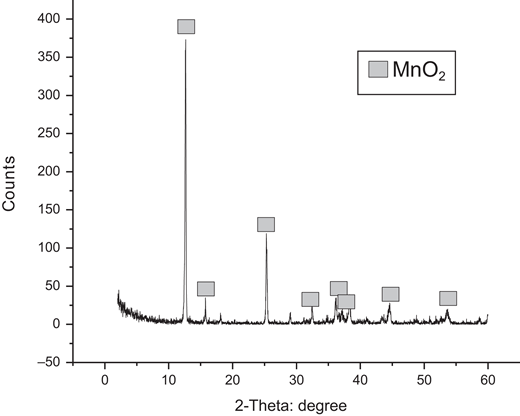
One of the most important techniques used to identify the qualitative phase composition of materials is the XRD technique. Figure 1 shows the XRD pattern of synthesised MnO2 nanofibres. The pattern indicates that the peaks are well defined for polycrystalline MnO2 nanofibres, with no peaks from other phases, indicating their purity. The peaks are comparatively broad and short, confirming the semi-crystalline or amorphous nature and the nanoscale characteristics of the synthesised particles.
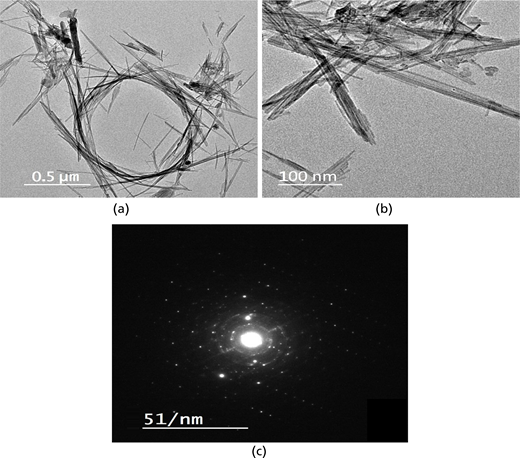
The TEM is usually utilized to investigate the morphology and size of the synthesised nanomaterials. Figure 2 shows TEM images with different magnifications (Figures 2(a) and 2(b)) and SAED pattern (Figure 2(c)) of hydrothermally synthesised MnO2 nanofibres. It can be seen from Figure 2 that the synthesised MnO2 consists of fibre-like nanoparticles with an average diameter less than 5 nm and an average length of about 100 nm. All particles have regular and homogeneous shape and size. All obtained nanofibres have smooth surfaces with consistent ends and straight sides. The synthesised MnO2 nanofibres are polycrystalline with some agglomeration as indicated by SAED pattern that identifies the polycrystallinity of synthesised materials (Figure 2(c)). The driving force of MnO2 nanofibre particle growth is attributed to the inherent crystal structure and its chemical potential. Through the hydrothermal process, spherical amorphous MnO2 is firstly formed in the medium; after that the particles are grown and crystallised into nanofibres.
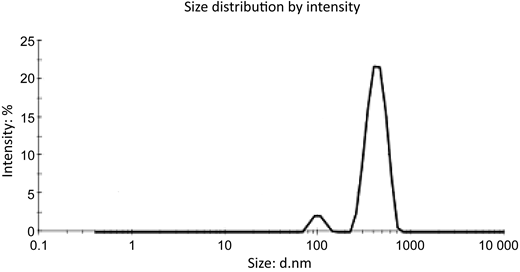
Figure 3 shows the particle size distribution of prepared MnO2 nanofibres. The figure indicates that two peaks with maximum intensities corresponding to particle sizes of 100 and 430 nm are observed; the intensities of these peaks represent approximately 6.4% and 93.6%, respectively. Generally, the particle size ranges between 25 and 800 nm with an average particle size of about 450 nm. Although the result of TEM indicated smaller size, larger sizes are obtained by particle size analyser due to agglomeration of the particles that might occur during preparation of the sample.
3.2 Properties of geopolymer reinforced with MnO2 nanofibres
3.2.1 Mineralogical composition of geopolymers
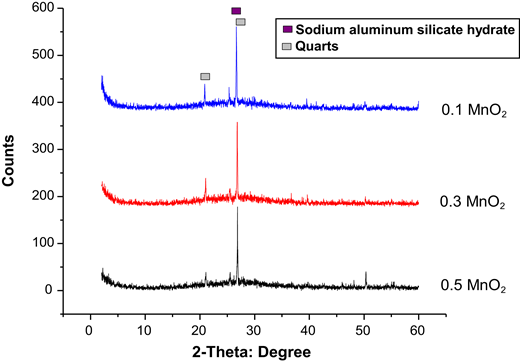
Figure 4 depicts XRD patterns of geopolymers reinforced with different ratios of synthesised MnO2 fibres. As indicated in the figure, the patterns of the prepared geopolymers are very similar to small deviations in peak intensity. It is widely recognised that geopolymers are semi-crystalline or amorphous materials primarily composed of sodium aluminum silicate hydrate or calcium aluminum silicate hydrate, depending on the alkalis or alkaline earth metals present in the starting materials. Figure 4 indicates the formation of semi-crystalline sodium aluminum silicate hydrate phase, in addition to the appearance of unreacted small amounts of quartz phase as indicated from its small peak intensity. According to the peak intensities of patterns detected for prepared geopolymers, it is noted that the sample that includes 0.3% MnO2 nanofibres exhibits lower peak intensity related to sodium aluminum silicate hydrate phase indicating its higher polymerisation and amorphous nature. Chemically, it might be concluded that the optimum quantity of MnO2 nanofibres needed to enhance the geopolymerisation process is 0.3%, after which the geopolymerisation might deteriorate due to the separation between the particles that might occur when the percentage of MnO2 nanofibres is higher than 0.3%. When the added MnO2 nanofibres are in the suitable range, they can display a dual effect; firstly, it can interact with the precursors, increases polymerisation, while secondly, it can act as reinforcement, interlocking the geopolymer matrix which consequently improves the mechanical properties.
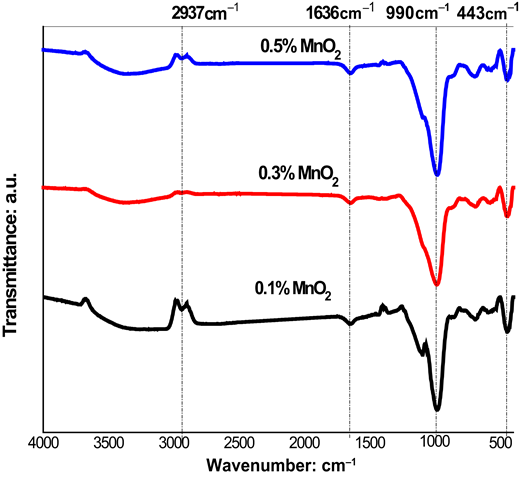
The function groups in the formed geopolymer as detected by FTIR can confirm the composition identified by XRD (Abdel Aal et al., 2014). Figure 5 represents the FTIR spectra of geopolymer reinforced with various percentages of MnO2 nanofibres. FTIR can give a good insight on the effect of MnO2 when imbedded inside the geopolymer structure, and can exhibit a new band in FTIR spectra. The broad band at 3200–3700 cm−1 and small band at 1639 cm−1 are related to the bending vibration and stretching of HOH and OH groups of water molecules produced from hydration of geopolymer. The main intense band centred at 990 cm−1, within the range between 850 and 1250 cm−1 is attributed to asymmetric stretching vibration and flexural vibration of O–Al–O and Si–O–Al bands. The appearance of these bands indicates the formation of geopolymer networks. These bands show a slight shift in the wavenumber due to the incorporation of MnO2 nanofibres, which alters the silicate network. The increased substitution of MnO2 leads to polycondensation of Si–O–Mn bonds and changes in the chemical bonding within the system. The small band located at 1350–1400 cm−1 is assigned to asymmetric stretching of Si–O–Si bonds. This band is relatively high in geopolymers that include a lower amount of MnO2, while with increasing MnO2, the band vanishes, confirming the bonding of Mn with Si–O–Mn bonds. The characteristic bands at about 550 and 700 cm−1 indicate the amorphous nature of formed geopolymer or unreacted meta-kaolin. The short broad band in the range 443–500 cm−1 is assigned to O–Mn bonds.
It has been reported that the geopolymerisation process proceeded through condensation of alumino-silicate groups with alkali polysialate forming polymeric Al–O–Si bonds, that is, Mn[–(Si–O2)z–Al–O]n.wH2O, where M is the alkaline element, z is 1, 2, 3, and n is the degree of polycondensation (Abdel Aal et al., 2014). Furthermore, the ideal composition of geopolymer should satisfy the following oxide ranges: M2O/SiO2, 0.2–0.48; SiO2/Al2O3, 3.3–4.5; H2O/M2O, 10–25; and M2O/Al2O3, 0.8–1.6. The mechanism of geopolymerisation can be summarised by the following equations:
3.2.2 Bulk density and apparent porosity of reinforced geopolymers
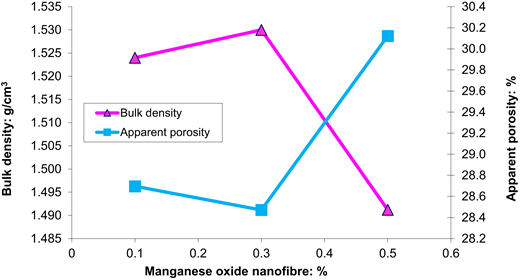
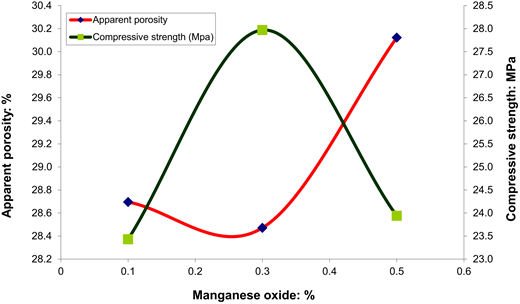
It is well known that physical properties such as apparent porosity and bulk density significantly impact and are widely used to assess material quality in various industries (Zawrah et al. 2018). The effect of MnO2 nanofibre reinforcement content on the bulk density and apparent porosity is shown in Figure 6. It appeared that the apparent porosity reduces with increasing of MnO2 ratio from 0.1% to 0.3%, and then increases again with increasing amount of MnO2 up to 0.5%. This is attributed to increasing geopolymerisation after addition of 0.3% MnO2 nanofibres followed by reduction of polymerisation after addition of higher amounts of MnO2 nanofibres. Increasing geopolymerisation leads to reduction of open porosity while decreasing geopolymerisation leads to increasing open porosity (Khale and Chaudhary, 2007). This means that the existence of a suitable amount of MnO2 nanofibres (e.g., 0.3%) leads to enhancement of the geopolymerisation, while a higher amount of MnO2 (e.g., 0.5%) reduces the geopolymerisation. Moreover, the differences in particle size between alumina, silica, and added MnO2 nanofibres might play an important role in this phenomenon. The incorporation of a higher percentage of nanofibres (0.5%) deteriorates the geopolymerisation process and might prevent the connection of geopolymer networks which consequently increase the porosity. On the other side, bulk density goes in opposite trend to the apparent porosity, that is, it increases with decreasing porosity and vice versa.
3.2.3 Microstructure of reinforced geopolymers
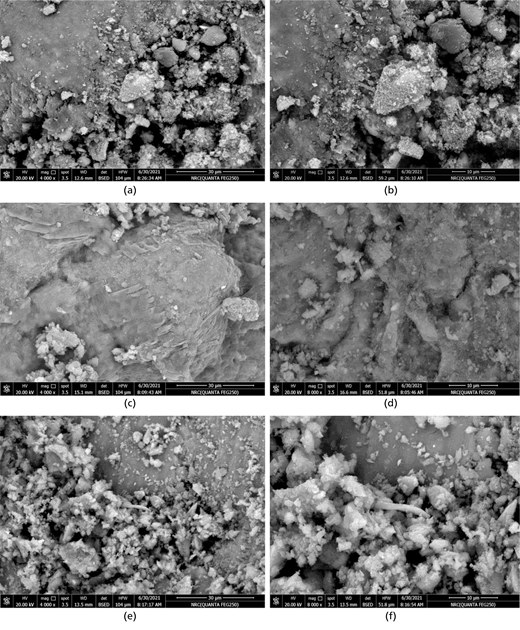
Generally, SEM is applied to give good insight and information on the microstructural changes after the geopolymerisation process (Zawrah et al. 2018). The formed geopolymer gel networks in the matrix and their interconnection with the reinforcement are important features in the microstructure of reinforced geopolymer. The reinforcement of geopolymer by nanofibres is important in improving the mechanical properties and preventing the crack propagation. The direct boding, macro/micro/nanopores and their sizes, as well as pore size distribution are also interesting factors that have an effect on the physical and mechanical properties of geopolymers. Thus, it is important to examine the microstructure of fabricated geopolymers. Figure 7 shows SEM images (different magnifications) of geopolymers reinforced by various ratios of MnO2 nanofibres, i.e., 0.1, 0.3, and 0.5 wt.%. It appears that all geopolymer samples exhibit gel structure with some unreacted starting materials and various degrees of porosity as well as voids. The first sample that includes 0.1% MnO2 nanofibres includes agglomerated gel structure with large voids and some unreacted grains of metakaolin and quartz (as shown in Figures 7(a) and 7(b)). The reinforcing MnO2 nanofibres are not detected between the gel matrices due to their small amounts in the sample. The fibres might interfere with the agglomerated geopolymer gel due to the magnetic properties of MnO2. The radius of connected voids in this sample reaches about 50 µm. For the sample that contains 0.3% MnO2 nanofibres (Figures 7(c) and 7(d)), the microstructure is relatively different. Condensed or fused-like gel structure without large voids is obtained. This microstructure includes some micro and nanopores. Very few fibre grains are also detected in this microstructure and most of fibres are embedded homogenously in the matrix. The gel structure appears as large lumps without aggregation into different small aggregates that form large voids. The gel structure is composed of nano-amorphous particles. When the percentage of MnO2 nanofibres is increased to 0.5% (Figures 7(e) and 7(f)), agglomerated small lumps are formed, creating a large number of micro voids. This is probably due to the existence of higher amounts of MnO2 nanofibres that act as separators for the gel structure. This increases the total porosity of this specimen as compared with the other two samples. The sizes of formed lumps range between 3 and 10 µm while the pore sizes between them range between 5 and 10 µm.
3.2.4 Compressive strength of reinforced geopolymers
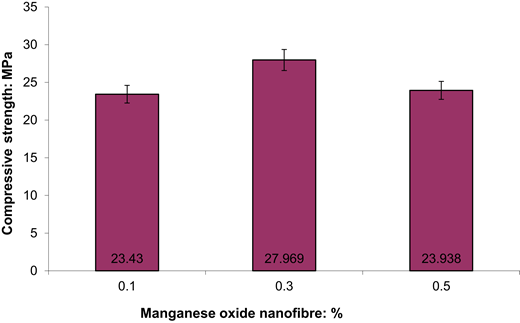
The compressive strength of geopolymer materials reinforced by nanofibre is dependent on many factors such as the type and properties of fibres, the amount and volume of pores formed after geopolymerisation, the amount of formed geopolymer gel and the amount of unreacted phases (Zawrah et al., 2016). The relationship between compressive strength of prepared geopolymer and percentage of added MnO2 nanofibres is shown in Figure 8. The compressive strength increases with the amount of added MnO2 nanofibres up to 0.3 wt.%, then decreases again after addition of 0.5 wt.%. This is attributed to the formed compacted gel structure and lower porosity in the sample containing 0.3 wt.% MnO2 nanofibres. In the sample containing 0.5 wt.% MnO2, the increased number of voids and pores in the microstructure leads to a reduction in compressive strength. Moreover, it seems that 0.5 wt.% is not suitable and can make separation for geopolymer network structure which consequently enlarges the pores, volume and reduces the compressive strength. The compressive strength of the sample containing 0.5 wt.% MnO2 nanofibres is lower than that of the sample containing 0.3 wt. but still relatively higher than that of the sample containing 0.1 wt.%. This is of course attributed to the variation of porosity and size of agglomerated lumps in all specimens. These results are confirmed by the data presented in Figure 9 which presents the relationship between compressive strength and apparent porosity. Opposite trends for compressive strength and apparent porosity are obtained in these results. In a previous study conducted by Zawrah et al. (2025), geopolymer reinforced by TiO2 nanofibres was prepared. The study reported that the inclusion of TiO2 nanofibres (0.3%) positively impacts the physical and mechanical properties, as well as the microstructure of the prepared geopolymers, by enhancing the geopolymerisation process, filling pores, and promoting interlocking within the microstructure. It is worth mentioning that the geopolymers are generally used for encapsulation of some materials and industrial wastes, thus, the geopolymer reinforced by MnO2 nanofibres can exhibit a long-term stability without degradation over time.
4. Conclusions
MnO2 nanofibres were successfully synthesised by hydrothermal method using the suitable precursors. The diameter of the synthesised fibres was less than 5 nm and average length was of about 100 nm.
Eco-friendly and cost-effective geopolymers with improved properties were successfully prepared from Feeder’s waste clay and alkali activator. In addition, the properties of prepared geopolymer were enhanced by adding MnO2 nanofibre as a reinforcing agent. On the industrial scale, the produced geopolymers can serve as alternatives to traditional cement-based materials that require significantly more energy for their production compared to geopolymers. The large quantities of waste clay available and the low cost of adding a small percentage of MnO2 nanofibre make it easier to scale up this type of geopolymer.
The physical properties, microstructure, and compressive strength of prepared geopolymers were improved after addition of 0.3 wt.% MnO2 nanofibre, then deteriorated after addition of 0.5 wt.%. This higher percentage of MnO2 nanofibre might cause gel structure separation with formation of highly porous microstructures that affect the compressive strength. The porosity decreased from 28.69% in the sample with 0.1 wt.% MnO2 to 28.27% in the sample with 0.3 wt.% MnO2. In addition, the strength increased from 23.43 to 27.97 MPa. This results in improvement percentages of 0.76% for porosity and 19.37% for strength, compared to the geopolymer sample containing 0.1% MnO2.
For the future directions, further studies such as thermal stability and durability are still recommended, taking into consideration the variation of raw and waste materials used for production of geopolymers.
Author’s contribution
M.F. suggested the plan of research and wrote the main manuscript text; S.E. and R.N. conducted the methodology; A.A. investigated the materials and supervised the research work. All authors reviewed the manuscript.