Collaboration is an essential component in addressing the diverse needs of children and adolescents with neurodevelopmental disorders (NDDs). However, the development of multi-sector service systems and professional collaboration face challenges due to siloed healthcare, social care and education. This study aims to examine Finnish professionals’ perspectives on optimal collaboration for adolescents with NDDs (AwNDDs).
Qualitative content analysis was used to examine five focus-group interviews with 25 professionals from the healthcare, social care and education sectors, all of whom work with children or AwNDDs.
The results suggest that both the service system and professional collaboration should be improved to achieve optimal collaborative service for AwNDDs. The unique aspects of professional collaboration with AwNDDs and their families were also highlighted, although to a lesser extent.
This study contributes to the scholarly debate on collaboration between professionals in health, social services and education, an area that has been under-researched compared to collaboration in health and social services in the context of AwNDDs. The study concludes with an interpretative summary constructed using Rose and Norwich’s (2014) model in the context of cross-sectional services and optimal collaboration for AwNDDs and their families, addressing practical issues and overarching principles for organising these services and enhancing collaboration between professionals.
Introduction
Collaboration refers to work carried out between professionals and organisations in which the skills, knowledge and responsibilities of experts and organisations from the same or different fields are shared to achieve a common adolescent- and family-centred goal (Corrigan, 2013; D’Amour et al., 2005; Petri, 2010). Children and adolescents with special needs, in particular, benefit significantly from effective collaboration between social care, healthcare and education professionals (e.g. Woodside-Jiron et al., 2019). In this target group, neurodevelopmental disorders (NDDs) are common and significantly impact an individual’s everyday life, learning and well-being. Many of these conditions have cross-sectoral support needs, which require a functioning service system between healthcare, social care, education, parental involvement and skilled professionals (Salminen et al., 2025).
Having professionals work alongside the family and adolescent does not automatically guarantee optimal support. Professional collaboration is acknowledged as having qualitative differences in its implementation, yet its definitions and scope remain somewhat imprecise and unclear (Sell et al., 2022). Despite this ambiguity, it is possible to recognise various forms of collaborative effort. Professionals may operate in parallel (multiprofessional or multidisciplinary), combine expertise, skills and responsibilities across professions and disciplines (interprofessional or interdisciplinary) or cross and break traditional boundaries between professions and functions to develop more holistic approaches that bridge ecosystems (transprofessional or transdisciplinary) (Olenick et al., 2010; Sell et al., 2022; Varagona et al., 2017). Moving towards transprofessionalism or transdisciplinarism enhances the concept of shared work, whereby the expertise of all professionals or disciplines is combined into a single entity (e.g. Bernstein, 2015) and involves shared knowledge, genuine collaboration and dialogue (Tsoukas, 2009). However, this requires a change in the working cultures of various services, which is often time-consuming.
The results of collaboration between different professions and disciplines are predominantly positive and have been shown to impact the person in need of support, professionals and the organisation or service system (Petri, 2010). Extensive research has been conducted on collaboration between different health professionals and health and social care (Juhila et al., 2021; Kallio et al., 2022; Pedersen, 2020) but less so on collaboration between healthcare, social care and education (Almendingen et al., 2021; Timperi et al., 2024), particularly in the context of NDDs (e.g. Salminen et al., 2025; Widmark et al., 2011). Existing health and social services and education are often siloed, which means that the individual is not treated holistically (Ungar et al., 2014). However, from the perspective of children and adolescents, the need for integrated services and functional collaboration among these professionals is significant.
Adolescents with neurodevelopmental disorders in a cross-sectoral service system
Although there are marked variations in the findings from studies and the prevalence of NDDs has rarely been assessed as a whole, it can be estimated that up to 15% of children and adolescents have NDDs that affect their everyday lives (Francés et al., 2022; Yang et al., 2022). Typical NDDs include attention deficit and hyperactivity disorder (ADHD; prevalence rate 4%–8%) (Thomas et al., 2015), autism spectrum disorders (ASD; prevalence rate 1%–3%) (Zeidan et al., 2022) and learning disorders (prevalence rate 3%–10%) (Francés et al., 2022). In Finland, the rising prevalence rate of ADHD has attracted attention. In 2022, the lifetime prevalence of ADHD was 6% in 13–20-year-old girls and 12% in boys of the same age group (Auro et al., 2024). Recent population-wide prevalence data are not available for other NDDs, but published findings correspond to international prevalence rates (e.g. Delobel-Ayoub et al., 2020; Mattila et al., 2011). NDDs also show high comorbidity i.e. many individuals with ASD also have ADHD or intellectual disability. Research also highlights a strong overlap, especially between ADHD and ASD (Thomas et al., 2018).
Growing awareness of ADHD and ASD highlights that they exist on a spectrum, with individuals experiencing a wide range of challenges – from mild difficulties to severe impairments requiring continuous support. Furthermore, Al-Saoud et al. (2025) also suggest that NDDs are best conceptualised in terms of multiple continuous dimensions along which individuals may be situated. As a result, the needs of people with AwNDDs vary greatly in both type and intensity (American Psychiatric Association, 2022). Therefore, ADHD and ASD affect individuals in diverse ways, often making social interaction, communication and everyday life more challenging (Hamed et al., 2015). Moreover, individuals frequently experience behavioural difficulties and significant challenges in recognising emotions in daily situations (Löytömäki et al., 2023). In school settings, common concerns include for example, academic failure, social exclusion and absenteeism (Hatton, 2018; Polderman et al., 2010). Also, children with NDDs are more likely to experience social exclusion and loneliness than their typically developing peers, which is linked to negative effects on their mental health, behaviour and emotional development – potentially persisting into adulthood (Kwan et al., 2020). These difficulties can lead to frustration, isolation and emotional strain – not only for the individuals themselves but also for their families. Moreover, stigma driven by misunderstanding and lack of awareness can further increase the burden on both those with AwNDDs and their families (Karst and Van Hecke, 2012; Theule et al., 2013). The transition from adolescence to adulthood is a critical period, often linked to increased vulnerability to mental health issues (MacLeod and Brownlie, 2014). Early difficulties related to neurodevelopmental disorders can have lasting effects, highlighting the importance of timely support to promote long-term well-being.
The service system has recognised challenges for AwNDDs, at least in Finland. In the past, the focus was on the specialisation of expertise to deliver effective services; in contrast to this, there has been the creation of silos between services (Juhila et al., 2021). As a result of this fragmentation, NDDs traits may not be identified early enough, or support may be inappropriate (Chakrabarti et al., 2005). Today, problems have become more complex, and instead of fragmentation, closer and more effective coordination is needed (Bernstein, 2015; D’Amour et al., 2005). Effective professional collaboration is seen as essential when supporting children and adolescents with NDDs, as it enables coordinated assessment, intervention and care across education, healthcare and social care. Such collaboration reduces service fragmentation, eases the burden on families and promotes more holistic, timely and individualised support. By fostering shared understanding, communication and joint decision-making, professionals can better address the complex and long-term needs of these children and adolescents and improve their overall well-being and outcomes (Gardner et al., 2022; Salminen et al., 2025).
However professional collaboration faces challenges not only due to structural issues, such as differentiated services and data protection practices, but also because of the difficulty professionals from different disciplines have in working together in a client-oriented manner. There are also recognised barriers to interprofessional collaboration between health care, social services and schools. These include unclear allocation of responsibilities, a lack of mutual trust and understanding and communication difficulties arising from differing professional perspectives and organisational structures. Such challenges are often exacerbated by insufficient managerial support and the absence of shared goals or collaboration skills (Widmark et al., 2011). In addition, they often struggle to understand each other and recognise and appreciate each other’s expertise and skills (Bowman et al., 2021; D’Amour et al., 2005). The current study investigates the perspectives of healthcare professionals from adolescent psychiatry, social care professionals and special education professionals on optimal professional collaboration in services for AwNDDs
A collaborative approach to successful support
Drawing on a conceptual analysis of various theoretical perspectives (e.g. Edwards, 2007; Edwards et al., 2010; Engeström, 1999; Wenger, 1998), Rose and Norwich (2014) developed a theoretical ecological framework for professional and cross-sectoral collaboration. This framework emphasises issues at the policy, local, group and individual professional levels and their interactions. Their approach encompasses both social-level analysis and sociopsychological analysis. Social-level analysis involves identifying factors that impact professional collaboration, such as policies, structures, regulations and codes of practice across various services and professions. These factors bear influence and interact during collaboration, potentially creating tensions that affect a team’s functioning. In their sociopsychological analysis, the researchers delineated positive collective preferences pertaining to both the group and individual team members. Within the group, individuals collectively aim for optimal outcomes while actively participating and being held accountable for their actions, ensuring collaborative success.
The framework for collaboration in practice is defined at the political and local levels, which also interact (Rose and Norwich, 2014). These levels can be used to define the boundaries within the NDDs youth service system, which, as mentioned, currently faces several challenges. Services supporting children, adolescents and their families are fragmented across sectors such as physical and mental health, education, social care and child protection. As areas of expertise have developed independently, service providers often prioritise maintaining their own boundaries over collaboration with other sectors (Bulling and Berg, 2018). However, the increasing challenges to child and adolescent well-being heighten the need for effective professional teamwork in everyday settings, such as schools (e.g. Woodside-Jiron et al., 2019). This fragmentation complicates the coordination and development of activities and hinders a comprehensive understanding of the situations faced by children, adolescents or families (Bronstein, 2003). In a networked and collaborative operating environment, children, youth and family services require organisations and leaders to be adaptable and responsive to change as well as to effectively manage complex phenomena, foster collaboration and maintain an orientation towards the service’s users (Fournier et al., 2022).
Although Rose and Norwich’s (2014) model – as does this study – focuses exclusively on the professional perspective, it is important to also acknowledge the service users’ perspective in collaboration. It has been acknowledged that service user orientation, encompassing aspects such as adapting services to incorporate the user’s perspective and respecting their dignity, autonomy and right to make independent decisions, is important (Kallio et al., 2022; Pedersen, 2020). Moreover, it fosters shared decision-making (Cooper et al., 2016) and treats the service user as an active agent whose views are valued in professional collaboration (Almendingen et al., 2021).
The success of professional collaboration is closely linked with the organisational service structures within which professionals work (Rose and Norwich, 2014). The context for this study is the Finnish service system, where professional collaboration between healthcare, social care and education professionals has grown more challenging following an administrative reform in 2023. This reform shifted the responsibility for organising both primary and specialised social welfare and healthcare services from municipalities to 21 newly established wellbeing services counties (Ministry of Social Affairs and Health, 2025), while education professionals remain under municipal jurisdiction. Even though the reform was specifically aimed at the integration of services (Tynkkynen et al., 2023), this structural division raises concerns in sustaining and fostering effective partnerships across these sectors now operating within separate organisational frameworks.
In conclusion, the current state of the benefits and challenges of professional collaboration has been widely reported (e.g. Hjörne and Säljö, 2014; Paton and Hiscock, 2019). Studies on professional collaboration in the context of supporting children with NDDs have been compiled in a scoping review (Salminen et al., 2025). This study extends the perspective from the present to the future by examining optimal collaboration to support AwNDDs. The research question is as follows:
what do professionals of healthcare, social care and education consider to be the optimal state of collaboration from the perspective of supporting AwNDDs?
Data and analysis
To answer the research question, five focus group interviews were organised in the autumn of 2023 as a part of the research project Adolescents with neuropsychiatric symptoms in the turmoil of the service system – an interdisciplinary study of social work, adolescent psychiatry and special education. A total of 25 experienced professionals participated, all skilled in collaboration and working with children or AwNDDs. In each interview, 4–6 professionals participated, ensuring representation from three fields: education (n = 10, special education teachers), healthcare professionals from adolescent psychiatry (n = 8, psychiatrists, psychiatric nurses, occupational therapist) and social care (n = 7, social workers from family and school social care, child protection and NDDs projects).
Adolescent psychiatry professionals and social care professionals were approached based on the suggestion of persons in supervisory positions in the wellbeing services counties. Some of the special education professionals interviewed were approached based on preliminary information from the research team, while others were approached using information found online. All interviewees received an information letter to confirm their eligibility for participation. The adolescent psychiatry professionals and social care professionals interviewed came from four wellbeing services counties, while the special education professionals represented three wellbeing services counties.
The interview framework and themes discussed were developed by a multidisciplinary team of researchers from the same fields as the interviewees. The themes of the interviews concerned the current practices of professional collaboration, those that need to be developed and the interaction and collaboration between service actors and organisations. The first focus group interview included a fictional case involving an AwNDDs. However, discussion shifted towards sector-specific case solutions, and the interviewers needed to steer it back to the themes of collaboration. Consequently, the case was removed from the later interviews, and the interview structure was modified to work without a case study. However, as the themes of the interview remained unchanged, the results of the first interview were considered usable as data and were included in the study.
Each interview was conducted by two researchers representing social work and education equally. All the interviews lasted about two hours and were arranged remotely via the Zoom application. The interviews were recorded and transcribed verbatim, resulting in 117 pages of transcribed material (Arial, font size 12, line spacing 1). Guided by the research question, we followed the principles of qualitative content analysis (Krippendorff, 2019) as follows. The analysis began with a careful reading of the interviews and then searching for comments that addressed the research question. Some of the extracts pertained to direct hopes, needs or suggestions such as, “We should focus hard on the collaborative meeting objectives to make the meeting successful”. Interviewees also shared opinions on ineffective collaboration. For example, “[…] it”s quite embarrassing when, during some consultations, disability services, social services and healthcare start arguing about who pays for what”. The authors interpreted these negative comments as actually expressing hopes for improved collaboration.
There were 332 extracts in the data that were interpreted as expressing desires for increased professional collaboration. The identified extracts were then classified into 18 categories in Excel spreadsheets by three researchers (JS, AE, ML) working both independently and collaboratively through dialogic interactions. That is, the researchers worked together to analyse data and discuss findings. The 18 categories were then organised and assigned to three main categories, which are presented in the following section.
Results
The main categories describing optimal collaboration in the interviews, identified from the sub-categories (Table 1), were 1) the perspective of the service system, 2) the perspective of professional collaboration and 3) recognising the needs and participation of the adolescent and family.
The perspective of the service system
Interviewees described an optimal scenario where a service system allows the professionals to avoid duplication and unnecessary work, tailoring services to the specific needs of adolescents and their families. The professionals interviewed in this study suggested the better allocation of resources to empower schools, particularly when a school physician’s input is needed to adjust an adolescent’s school day. They highlighted the need for seamless, timely and continuous service pathways for AwNDDs, advocating for early support before they reach school age and ongoing services to ensure staff stability. In addition, the value of maternity and child health clinics in supporting parents during early childhood was recognised, with an emphasis on extending these services to support families throughout the child’s school years. The interviewees envisioned a scenario where families receive support in a timely manner, and professionals can prioritise preventative care. Continuity and support between different service levels, such as between professionals working in specialised healthcare and those working in schools was seen as essential. Also, to enhance service pathways, there was a call to move away from a diagnosis-centred approach, as current practices often require a diagnosis before support is provided; instead, the adolescent’s behaviour and symptoms should guide support:
Somehow the path usually starts from the middle; it starts at the point when the problems already exist. The fire needs to be extinguished to get to the root of the problem, or to decide how to move forward. Especially from the school’s perspective […] they usually need to have a diagnosis in the background in order to get help easier but the adolescent’s behaviour and symptoms should play a more significant role. (special education teacher)
The future functional service path should also be related to the coordination of services, according to the professionals interviewed. This coordination could be managed by an individual professional (e.g. case manager) or a specific organisation (e.g. NDDs centre). The responsibility of such a professional or unit would involve, in the long-term “taking the reins”, “taking charge of the adolescent”s and family’s issue’s’, and “taking over the whole package”, and there should be enough time allocated to allow this work. In practice, this would mean that every professional knows who to contact about the adolescent’s affairs as well as taking care of monitoring and sharing information so that the adolescent and the family know that progress is being made.
The interviewees also felt that a presence of a case manager could mean that an AwNDDs would not have to go to a new location with a new referral if their situation worsened but could continue in a familiar environment with a familiar professional. In such cases, support and rehabilitation can be built on top of the previous support because the professional has long-term knowledge of the resources and challenges of the young person inquestion. The importance of leadership for the success of professional collaboration was also highlighted, describing how collaborative processes are insufficient in themselves but must be managed so that families do not get stuck in the “limbo between services”.
According to the interviewees, to provide optimal services for AwNDDs, a wide range of resources are needed. Some suggestions related to the number of professionals who work with adolescents, but it was seen that obtaining the ideal situation would require more professionals in the student welfare sector, such as psychologists and school social workers with adequate time and facilities for collaboration. However, it was pointed out that simply increasing the number of professionals is insufficient; planned time for ongoing collaboration as well as minimising turnover in collaborative groups was seen as the ideal.
In addition, information flow, data protection and information systems were highlighted as important enablers for successful professional collaboration. According to the interviewees, the role of the school should be as an active user of information rather than merely sharing details about the adolescent’s situation with other agencies. This would require schools to have more and easier access to information on adolescents’ and their families’ issues from social and healthcare services. Shared knowledge between all involved professionals can enhance teamwork in the adolescent’s best interest, with informal communication encouraged (e.g. brief communication between professionals by telephone).
The role of parents in the flow of information and in ensuring data security was seen as important. Ideally, parents should have a sufficient understanding of different professionals’ knowledge about the adolescent’s and family’s situation; these professionals can regulate information about the family and allow its transfer when necessary. The solutions proposed during the interviews included the relaxation of rules on confidentiality and the development of new authorised channels for information transfer and communication. In addition, there was a call for a joint information system and the provision of access to the student administration program for all student welfare professionals working in schools:
If we all had the same information system […] we would see how this child is doing in school; what kind of notes they have; what is the child protection plan, and you could see their rehabilitation plan. That would be great. And we would all have permission from parents [to share information], that’s the dream. (psychiatrist)
According to the interviewees, schools could take the lead in developing collaboration at the beginning, when assessing the adolescent’s situation and determining involved parties. Moreover, the school could serve as a hub for various professionals to familiarise themselves with adolescents’ circumstances, since many challenges they face, such as school absenteeism, occur in educational setting. There was also a call for increased collaboration within the school environment, given their significant role in adolescents’ lives and the information they hold. Furthermore, the interviewees envisioned that schools and learning environments should be designed in conjunction with various experts to enhance the educational experiences and learning outcomes of AwNDDs.
The perspective of collaboration between professionals
The interviewees articulated various needs and expectations concerning professional collaboration for AwNDDs and their families. Ideally, all parties involved should have a comprehensive and shared understanding of NDDs with an emphasis on increasing knowledge among school professionals due to their significant role in adolescents’ lives. In addition, supporting AwNDDs and their families requires professionals to demonstrate collaborative competencies. In an ideal situation, all professionals involved should have a comprehensive knowledge of available services and the procedures for accessing them. Understanding different services is linked to recognising the roles of other professionals, fostering better interactions and shifting discussions towards supporting the adolescent and family rather than service-based debates or finger pointing:
It’s really difficult when discussions about responsibility – whether it’s school, healthcare, or child welfare – are held in front of the client and their family. […] If we understood each other’s work better, it might reduce the need for those discussions about responsibility. We don’t necessarily need to know the details of each other’s daily tasks, but understanding the nature of each person’s work and what they do could help. (social worker)
In addition, professionals engaged in collaboration should optimally share common values and attitudes towards collaborative work and supporting AwNDDs and their families. The interviewees also considered it important for individuals to have the capacity to reflect on their professional identities and exhibit flexibility in collaborative settings when working with others. In addition, they suggested ideas for developing the competencies needed to achieve the desired outcome of collaboration. In the interviewees’ opinion, it is necessary to begin learning about the work and roles of other professionals and the different services during undergraduate studies. Moreover, professionals engaged in collaborative efforts should ideally have opportunities for joint training and discussions to enhance the effectiveness of collaboration in supporting children and families. Practical exposure to others’ work was also considered important:
There could be more joint training between different professional groups. It came to my mind because we had joint training sessions with the police when I first started. They were incredibly constructive, and they gave me a whole new perspective and understanding of police work and how it connects to my job. It’s really important. (psychiatric nurse)
Moreover, according to the interview participants, in an optimal situation, collaboration objectives are collectively defined, shared, realistic and sufficiently specified, and meaningful milestones are established for joint progress to prevent the objectives from being felt as overwhelming. To foster effective collaboration, importance should be placed on the thorough planning of meetings by carefully considering attendees and agendas. Meetings should have a clear structure and consistent objectives, occurring regularly to ensure ongoing progress. Assigning a leader to steer discussions towards objectives is essential. After each meeting, it should be clear which issues need further attention, who is responsible for each task and when the next meeting will be held. This is vital in the development of trusts and respect among professionals, which is essential for successful collaboration, ideally fostered by dedicating time and space for this purpose.
The interviewees described that in an ideal world, service structures, management and the cultures within organisations support successful collaboration. This means, for example, that professionals are encouraged to seek collaboration, that managers have an understanding and knowledge of its importance, and that organisations work together to create structures that support professional partnerships that are recognised as being necessary for the optimal delivery of support for AwNDDs and their families.
In envisioning optimal collaboration, the interviewees in our study emphasised the importance of having a trusted professional or volunteer support person for AwNDDs. This should be someone reliable and with a strong understanding of neurodiversity. This person would actively participate in cooperative activities and assist in preparing adolescents for collaborative meetings, among other responsibilities. There was also a call for a greater involvement of family therapists (e.g. psychologists or social workers specialising in family therapy) in professional collaboration. In addition, the interviewees suggested improving collaboration through informal consultations among professionals, collective assessments of adolescents’ situations and partnerships across various settings, such as in schools and homes. Examples were provided, such as teachers and occupational therapists cooperating at schools, and social workers and school counsellors working together at home. Sharing adolescents’ successes among professionals was seen as important for transferring skills to other contexts.
Recognising the needs and participation of the adolescent and family
The third category described the specificities of professional collaboration with AwNDDs and their families. When it came to an ideal working relationship with the families and the adolescents themselves, the interviewed professionals considered it essential to carefully examine the overall situation. A thorough assessment of relevant background information was seen as a prerequisite for organising effective, up-to-date support from different professionals. Detecting the root causes of problems was considered more productive than a symptom-focused approach. The interviewees concluded that a comprehensive rehabilitation orientation should cover the whole collaborative procedure.
According to the interviewees, the importance of genuine communication and open dialogue cannot be overemphasised when working with AwNDDs and their parents, and it is essential that the AwNDDs feel accepted as themselves. It was seen crucial that a professional who knows an adolescent’s situation can be the “voice” and best verbalise the interests of the young person to other professionals if they are unable to speak for themselves. Furthermore, according to the experiences of the interviewees, some parents of AwNDDs have first-hand experience of living with the condition, and these experiences of collaboration with professionals can be negative and therefore might also affect the care of their adolescent’s affairs.
Child and service user-centred work orientation was seen as the being the fulcrum of professional collaboration. Giving recognition to the adolescent’s opinion, appreciating his/her interpretation of the situation and giving importance to the views of the young person affected were seen as starting points for optimal collaboration. The interviewees highlighted the importance of clarifying the goals of professional meetings for the adolescent and the family. Every network meeting should foster an atmosphere that enables open dialogue, where the adolescent and their relatives feel sufficiently confident to talk openly about their challenges in everyday life:
When networks are being run, adolescents have told us that it is a very distressing situation and there are experts from healthcare, social work, from school and others. We have now started to wonder how we can lighten these. […] We should talk in advance about what we are dealing with and what the concrete objectives would be. […] they are terribly stressful occasions when you sit down, at best a crowd of this size, and there’s an adolescent in the middle and there’s family members sitting next to him/her. And then you wonder who’s going to open Pandora’s box and how I’m going to stand it or what they’re going to propose to me. Quite rarely in that kind of situation, an adolescent is able to react in the way he/she really thinks and even the guardians may not be able to do so. I am sure that each of us could bring up what is being discussed here; what I am going to bring up here; what is good now and what we need to think about for the future. (special education teacher)
In the interviews, the professionals underlined the point that collaborative meetings should not be held without the participation of the adolescent themself. Great care was also taken to highlight that their family’s specific situation should be included. It was deemed crucial to carefully consider who should attend the meetings, ensuring that only professionals directly relevant to the adolescent and the matter in hand, even if it means excluding representatives from organisations typically or previously involved. The interviewed were aware that AwNDDs and their friends may find large networks distressing. Professional collaboration should always prioritise enhancing the well-being of the adolescent, rather than being pursued as an end in itself.
Discussion
This study contributes to the scholarly debate on collaboration between professionals who work with AwNDDs and their families but also on collaboration between health care, social care and education, an area that has been under-researched compared to collaboration in healthcare and social care. By focusing on optimal collaboration, the present study not only addresses the need for knowledge to improve the conditions for closer ties between professionals from these sectors but can also strengthen the shared knowledge base for the development of person-centred support and services for AwNDDs.
In this study, extracts related to the optimal collaboration from the perspective of appropriate support for AwNDDs focused mainly on improving the service system and collaboration between healthcare, social care and education professionals. According to Rose and Norwich’s (2014) model, the perspectives that emerged from our data were located at the local services/policy, group and individual levels, but the data did not address national policy-level issues. In addition to Rose and Norwich’s (2014) levels, one key perspective that emerged was that of the AwNDDs and their families. However, there were far fewer mentions of this aspect in the data compared to other perspectives. In general, the opinions were moderate and rational.
The interviewees highlighted a wide range of needs related to the service system and its development that affect how optimal collaboration can be achieved and, thus, ensure effective support for AwNDDs and their families. At the service system level, this means effective integrative management between social and health providers and schools but also, for example, with IT services regarding information systems. In organisational reforms, such as Finland’s wellbeing services county reform (Ministry of Social Affairs and Health, 2025), this issue requires particular attention. Co-leadership can be challenging but can also enhance integrative management by providing a broad range of competencies, promoting continuous learning and responsibility sharing within and among services (Mattila and Kallio, 2025). This approach also plays a crucial role in ensuring the AwNDDs -centred integration of services. Key contextual prerequisites for successful co-leadership include an organisation-wide model that supports this management style and the co-location of AwNDDs services. On the personal level, the requirements include seeing management as a collective activity, maintaining ongoing communication and minimising prestige issues such as competing with other leaders (Fournier et al., 2022; Klinga et al., 2016).
The results of this study corroborate the findings of previous research on the factors contributing to successful collaboration in general, such as collective ownership of goals (e.g. Bronstein, 2003) and the importance of leadership in collaboration (e.g. Brewer et al., 2016). However, according to the results, collaboration should, optimally, address both the general characteristics of professional collaboration and the specific needs of clients – in this article, within the context of AwNDDs and their families. Therefore, beyond general collaboration competencies, it is imperative that professionals possess in-depth expertise in NDDs, along with the ability to jointly identify and understand the unique needs of AwNDDs and their families. This specialised, shared understanding is essential for building truly effective interprofessional collaboration and delivering meaningful, tailored support that can significantly impact long-term outcomes. Identifying the specific needs of AwNDDs and the family through interprofessional collaboration is also essential for supporting the transition from adolescence to adulthood and addressing possibly emerging mental health challenges (MacLeod and Brownlie, 2014) and other issues that may rise.
As in previous research (e.g. Bronstein, 2003; Solvason and Winwood, 2022), the participants in this study also highlighted the importance of collaboration skills, successful interaction and flexibility in action, aligning with the framework and levels of collaboration outlined by Rose and Norwich (2014). The development of these skills should begin during undergraduate studies, with more possibilities for learning and training with other disciplines (Almendingen et al., 2021; Kallio et al., 2023). This is important because conflicts in collaborative practice are not uncommon given that the professionals come from varying educational backgrounds and may have opposing core values, fundamental goals and overall approaches (Bowman et al., 2021). For example, medical students could contribute to enhancing other students’ understanding of the nature of AwNDDs through joint studies. In doing so, their own understanding of supporting learning and well-being of AwNDDs in a broader sense – areas typically outside their core expertise – would also develop.
The interviewees emphasised numerous specific aspects of collaboration when working with AwNDDs and their families. Due to the diverse support needs of these cases, interviewees underlined the importance of having a professional to coordinate the overall implementation of support. This coordinator or case manager would ensure that various areas of the network are integrated and mutually beneficial, facilitating a seamless information flow among all parties involved. While case manager interventions have proven effective in delivering high-quality, cost-effective care for various health conditions (e.g. Joo and Huber, 2015), further evidence is needed to assess their benefits specifically for AwNDDs.
However, even with the introduction of a new professional or structure, such as the case manager role proposed above, it is important to focus on enhancing collaboration among existing professionals that work with AwNDDs. The interviewees’ call for better coordination may stem from confusion regarding the current state of professional collaboration, its effectiveness, collaboration competencies or conflicts they have experienced (e.g. Hjörne and Säljö, 2014; King et al., 2009). Therefore, having a coordinator may not overcome these challenges, which could continue to hinder efforts to collaborate. Ideally, as the interviewees suggested, professional teamwork should aim to breakdown the traditional silos. This would involve both professionals and the service system transcending and dismantling existing boundaries between professions and activities, fostering holistic transprofessional approaches that bridge ecosystems (Sell et al., 2022). On the other hand, developing professional partnerships in this direction could also address challenges that collaboration faces (see King et al., 2009). One solution could be for professionals to work and AwNDDs to receive services in the same place; for example, on school premises, since young people spend a large part of their time there. This would also inherently strengthen dialogue and coordination between different professionals by providing more opportunities for physical interaction.
Although the interviewees paid less attention to the AwNDDs and their families regarding ideal collaboration, child orientation and user-centred service approaches were still regarded as the cornerstones of professional collaboration, consistent with previous studies (e.g. Almendingen et al., 2021; Kallio et al., 2022). In practice, this means that the client’s right to self-determination and autonomy must be paramount. The role of professionals in user-centred support and services is as skilled partners who assist clients in managing, maintaining and controlling their own lives (Kallio et al., 2022). The interviewees stressed that collaborative meetings should not be organised without the participation of the AwNDDs and the family. However, while their participation is crucial for defining their situation and support (Didier et al., 2018), an absolute requirement for their presence in all collaborative meetings can hinder effective professional collaboration. Professionals should have the opportunity to meet and consult each other (e.g. Griffiths et al., 2022) occasionally without the adolescent present to plan appropriate measures and resolve professional disagreements, provided the adolescent and family are informed about these meetings and their purpose.
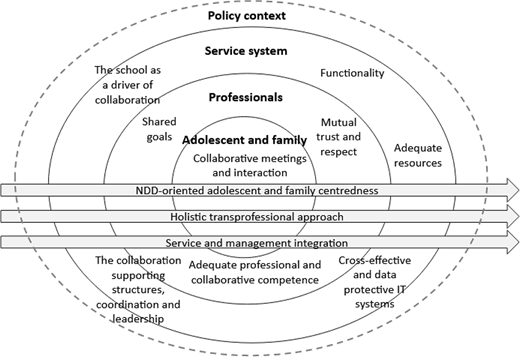
Based on the findings of this study, we conclude with an interpretative summary diagram constructed using Rose and Norwich’s (2014) model in the context of cross-sectional services and optimal collaboration for AwNDDs and their families (Figure 1). The figure includes both practical issues and over-arching themes about what needs to be considered when organising services and improving professional collaboration, optimally within them.
Our interpretative summary diagram reflects the overarching need to reform the support system for AwNDDs at all levels – together. The AwNDDs and their family are at the core of the model, surrounded by professionals within the service system. The involvement and participation of AwNDDs and their families is a prerequisite for optimal collaboration. Shared goals and mutual trust and respect between professionals are essential, as is sufficient professional and collaborative competence. An optimal support system for AwNDDs includes, for example, the ability to identify diverse support needs and their specific characteristics. The efficiency of the service system is prerequisite for optimal collaboration, with key elements including functionality, adequate resources, data-protected IT systems and supportive structures for coordination and leadership. The school as a driver of collaboration was also highlighted. The model is based on NDD-adolescent orientation and family centredness, a holistic transprofessional approach and service and management integration.
While each professional and unit can make a significant contribution to achieving optimal collaboration – that is, moving towards transprofessional collaboration – individual efforts alone are not enough. Reaching this ideal requires a collective will and substantial cultural change rather than the efforts of a single individual or service (Corrigan, 2013; Juhila et al., 2021). Only through the development of multifaceted and multilevel collaboration (Rose and Norwich, 2014) can professionals’ work be combined into a single entity (e.g. Bernstein, 2015) and incorporate shared knowledge, genuine collaboration and open dialogue (Solvason and Winwood, 2022; Tsoukas, 2009).
Limitations and future directions
This study has limitations that should be acknowledged. Firstly, while considering professional aspects of collaboration is important, as shown in this and many previous studies (e.g. Kaiser et al., 2018; Petri, 2010; Strype et al., 2014), this alone is not enough. To meet the needs of clients, including adolescents and their families, it is essential to involve them, as highlighted by the interviewees in this study. In the future, it will be important to deepen the understanding of collaboration in this field by also looking at the needs of AwNDDs and their families for collaboration and linking these results to the findings of this study. Furthermore, there should be a stronger emphasis on developing participatory research where AwNDDs and families are at the heart of designing collaborative services.
Although the interviewed professionals were experienced in collaborating and working with AwNDDs and their families, they could only provide personal views and experiences, which may limit the generalisability of this study’s results. In addition, while the interviews included representatives from adolescent psychiatry, social care and special education, involving a broader range of professionals from these fields – especially from healthcare – and other sectors could have provided more or different perspectives.
In the future, it would be meaningful to explore this research topic also from the perspectives of integrative management and national policy, as they play a crucial role in the integration of services and the success of professional collaboration.