The study aims to contribute to information behaviour research by examining how attitude-based appeals are used to persuade fellow participants in online discussion about contentious issues.
The empirical findings draw on the descriptive quantitative analysis and in-depth qualitative content analysis of 1,376 posts submitted to a sample of 30 Reddit discussion threads within the period of January 2020–May 2025. It was examined how the participants of online discussion drew on attitude-based cognitive, affective and behavioural appeals while debating about the establishment of a drug consumption room (DCR) in Glasgow, Scotland. Cognitive appeals include, for example, pleading on one's personal opinion, and the provision of evidence for or against DCR. The affective appeals draw on the positive and negative emotions towards DCR and their users. Behavioural appeals are based on personal experiences about the relevance of DCR.
The participants mainly presented cognitive appeals while the role of affective and behavioural appeals remained marginal. The division of favourable (positive) versus unfavourable (negative) evaluations permeated appeals of diverse types. The cognitive appeals mainly drew on personal opinions, but such appeals also incorporated analytical elements when the participants weighed the expected benefits and harms of the establishment of DCRs. The affective appeals were predominantly negative, thus reflecting the contentious nature of the DCR eliciting irritation and fear, rather than empathy and hope. The paucity of behavioural appeals is due to the fact that the Glasgow's DCR has just started and that the number of people having personal experience about DCRs and their users is likely to be low even globally.
As the study concentrates on the analysis of appeals presented in Reddit discussion threads focusing on a specific issue, the findings cannot be extended to concern appeals articulated in other contexts of online discussion.
The study is among the first to characterize the role of cognitive, affective and behavioural appeals in online debates about controversial issues.
Introduction
Attitudes play a significant role when information is generated and shared about contentious topics in particular. In general, an attitude can be understood as a global evaluation of one's overall predisposition towards an issue, event or person (Breckler and Wiggins, 1989). An attitude adopted by an individual may largely explain why an individual accepts or rejects an idea or argument in online debates, for example.
Although attitudes can remarkably affect the information content created and shared in such contexts, there is a paucity of empirical studies examining how people's attitudes manifest themselves in online discussion (e.g. Luberto et al., 2016; Sung and Lee, 2014). The present investigation fills gaps in research by examining how attitudes manifest themselves in online discussion about controversial topics. To achieve this, an empirical case study was made by focusing on the debate about the establishment of a drug consumption room (DCR) in Glasgow, Scotland. DCRs are legalized places where people who inject drugs can self-administer substances in hygienic conditions under the supervision of qualified staff. DCRs aim to attract people who engage in high-risk injecting behaviours such as overdosing (Tran et al., 2021). Since the 1980s, over a hundred DCRs have been established in various countries in Europe, e.g. Denmark, Germany and Spain, as well as in Canada, USA and Mexico. In the United Kingdom, as well as other countries, the establishment of DCRs has been a contentious issue attracting support but also eliciting resistance among citizens and politicians. Largely for this reason, the UK's first DCR was taken into use in Glasgow as late as January 2025.
The present investigation departs from the assumption that in online debate, positive and negative attitudes towards DCR manifest themselves in cognitive, affective and behavioural appeals. In online discussion, attitude-based appeals are discursive elements that are used to persuade fellow participants to accept or resist the establishment of DCRs. As explained in more detail later on, cognitive appeals include, for example, pleading on one's personal opinion, and the provision of evidence for or against DCRs. Affective appeals are presented by expressing positive and negative emotions towards DCR and their users, while behavioural appeals are drawn on personal experiences about the relevance of DCR. To examine the nature of appeals of diverse kind, the present study concentrates on online discussion occurring in Reddit – a major social media platform. To this end, a sample of 30 discussion threads with 1,376 posts submitted within the period of January 2020–May 2025 were analysed.
The main goal of the study is to elaborate how cognitive, affective and behavioural appeals are used as elements of persuasion in online debate. The findings offer a unique contribution to information behaviour research, more specifically, studies on information sharing. This is done by examining how persuasive information based on the articulation of attitude-based appeals is shared in online discussion about controversial issues. The viewpoint of information sharing is relevant because studies on persuasive communication mainly focus on how, why and when messages change people's attitudes or behaviours. For example, the Elaboration Likelihood Model developed by Petty and Cacioppo (1986) identified two main routes to persuasion individuals use in information processing. The central route is based on careful and logical evaluation of arguments, resulting in lasting attitude change. In contrast, the peripheral route in information processing draws on cues like source attractiveness, credibility, or emotional appeal, leading to temporary attitude change. Different from studies such as these, the present investigation does not focus on attitude change at an individual level but the ways in which attitude-based persuasive information is articulated when it is shared in online communities. This brings a new perspective to persuasive information by showing how it is communicated by sharing cognitive, affective and behavioural appeals to other people.
The rest of the article proceeds as follows. First, to create background, the key concepts of attitude, appeal and DCR are specified in more detail. Thereafter, the research framework, empirical research questions and methodology are specified, followed by the report of the findings. The last sections discuss the findings and reflect their significance.
Literature review
The nature of attitudes
Since the 1930s, researchers have proposed a variety of approaches to the construct of attitude (Bohner and Dickel, 2011, pp. 393–394). For example, Eagly and Chaiken (1993, p. 1) defined attitude as “a psychological tendency that is expressed by evaluating a particular entity with some degree of favour or disfavour”. More recently, the American Psychological Association (2018) characterized attitude as “a relatively enduring and general evaluation of an object, person, group, issue, or concept on a dimension ranging from negative to positive.” Attitudes can also differ in strength (Haddock and Maio, 2008, p. 124). For example, one person can feel strongly about DCRs, while another person may approach them neutrally.
Historically, one of the most influential approaches to the construct of attitude has been the multicomponent model proposed by Eagly and Chaiken (1993). The model suggests that attitudes are summary evaluations of an object and that such evaluations have affective, cognitive and behavioural components. The affective component refers to feelings or emotions associated with an attitude object, while the cognitive component refers to beliefs, thoughts and attributes associated with a particular object. For the formation of the cognitive component, belief-based values dealing with the personal relevance of an issue, for example, abstinence from drugs, as well as moral values related to it are important. This is because such values can legitimize attitudes and make it subjectively appropriate to act on those attitudes (Miller and Effron, 2010). Values such as the preference for abstinence may predict negative attitudes toward an issue, for example, the public funding of DCRs, while altruistic values can be associated with a positive attitude towards them (Albarracin and Shavitt, 2018, p. 306). Usually, one's general predisposition or attitude toward an object is based on both affective and cognitive reasons; what defines an attitude as being affect-based or cognition-based is more a matter of its position on one side or the other of a continuum (Dube and Cantin, 2000, p. 252). Finally, the behavioural component of attitudes identified by Eagly and Chaiken (1993) refers to past behaviours with respect to an attitude object. For instance, people may adopt a negative attitude towards DCRs if they recall cases in which there were discarded drug syringes on the street.
Attitude-based appeals
The present study departs from the assumption that the role of cognitive, affective and behavioural attitudes in online debates can be approached more concretely by examining how attitudes towards an issue are articulated in appeals presented by online participants. It is assumed that cognitive attitudes form the basis for cognitive appeals. Respectively affective attitudes manifest themselves in affective appeals and behavioural attitudes in behavioural appeals. In the context of the present investigation, online participants use attitude-based appeals to persuade fellow participants to accept or reject an interpretation dealing with the attitude object, that is, DCR.
Studies on the nature of cognitive appeals can be traced to Aristotle's idea of separating passionate or emotional persuasion and rational persuasion (Kennedy, 2015). Aristotle approached cognitive appeals in terms of rational persuasion by introducing the category of logos. It covers the logical appeal, based on offering facts and evidence. Recent persuasion research posits that cognitive appeals influence the recipient's thoughts and beliefs, for instance, by having the recipient read about some facts related to the attitude object (Casais and Pereira, 2021, p. 287). Cognitive appeals also involve reasoning and the proposition of constructive solutions. While debating about the usefulness of DCRs, online participants may present cognitive appeals by drawing on statistical facts about the decrease of deaths caused by drug overdosing in cities where DCRs are operating. On the other hand, those resisting the establishment of DCRs may draw on contrary evidence obtained from other cities.
Aristotle approached affective appeals in terms of pathos which aims to stir the feelings and emotions of the audience (Kennedy, 2015). More recently, affective appeals are conceptualized in terms of positive and/or negative emotions that people associate with the attitude object (Zhang et al., 2024). Affective appeals can encompass a variety of positive emotions such as empathy and hope, as well as negative emotions, for example, discomfort and fear. For instance, fear appeals are indicative of how a person experiences an attitude object as frightening (So et al., 2016, p. 130). Participants of online debate may argue that DCRs attract drug dealers and thus increase the probability of violence in the vicinity of the DCRs. In contrast, positive appeals drawing on emotions such as empathy and hope emphasise the benefits of behaviour change (Casais and Pereira, 2021, p. 285). Participants may draw on hope appeals by suggesting that DCRs offer a better future for drug users as a stigmatized group of people (Averill et al., 1990). Finally, behavioural appeals draw on a person's positive or negative experiences about the attitude object. In the former case, the person may report how a DCR helped to avoid overdosing. In the latter case, negative experiences are shared in order to get the fellow participants convinced about that DCRs rather encourage than decrease drug use.
Attitudes and persuasive information in studies on information behaviour
So far, there is a paucity of studies examining how attitudes and persuasive information are approached in information behaviour. Many of these investigations focus on health-related information seeking. Enwald et al. (2017) explored attitudes towards health information and motivating factors for encouraging physical activity among older people. The findings indicated, for example, that almost 90% of the respondents exhibited the attitude that experts often disagree on what is healthy and what is not, while about 60% of the study participants viewed that health-related information in magazines and on the internet is mainly addressed towards young persons. Mierzecka and Laczynski (2025) investigated parents' vaccine attitudes in the context of information source use. The findings revealed, for example, that as sources of information, health-care providers were significantly rejected by respondents exhibiting anti-vaccination attitudes, while among the “orthodox” supporters of vaccination, information seeking centred on professional advice, not peer opinion. The above results lend support to the conclusion drawn by Wang et al. (2021) on the sharing of attitude-based persuasive information occurring in social media forums. People select and interpret new information to make it consistent with their existing beliefs. When new information does not match prior attitudes, people resist persuasion and may actually become more entrenched in their original position. More recently, Lewin (2026) demonstrated that while evaluating and sharing belief-conflicting information in the context of diversity initiatives, the study participants devalued information that conflicts with their attitudes and beliefs. This subsequently reduced their likelihood of sharing that information with other decision-makers.
Taken together, the above studies offer general-level characterizations about the ways in which attitudes shape people's information source preferences, as well as their willingness to seek and share belief-consistent persuasive information. On the other hand, investigations such as these are wanting in that have not elaborated the ways in which cognitive, affective and behavioural appeals indicative of their attitudes manifest themselves in the sharing of persuasive information.
Attitudes towards DCRs
Since the 1980s, DCRs have been established in various countries to adopt public health policies centred on harm reduction. It works as an alternative to the dogma of abstinence as the only path available to users (Jauffret-Roustide and Cailbault, 2018, p. 209). The primary mission of DCRs is not to rehabilitate their clients but rather to reduce potential harm, especially that which is caused by overdosing (Kappel et al., 2016).
Surveys conducted in diverse countries indicate that the levels of social acceptability of DCRs among the general public tends to vary. For example, a nationally representative survey conducted in Australia in 2022–2023 indicated that 58% of respondents supported DCRs (Lloyd et al., 2024, p. 1898). To compare, McGinty et al. (2018) found in a survey of a nationally representative sample of US. adults in 2017 that only 29% of the respondents supported legalizing DCRs. More recently, in the context of proposals to establish the UK's first DCR in Glasgow, the majority (75%) of drug users in Scotland expressed willingness to use a DCR (Trayner et al., 2021). All in all, the above surveys suggest that the implementation of DCRs is a contentious issue eliciting both support and resistance. Jauffret-Roustide and Cailbault (2018, p. 216) found that while assessing the pros and cons of DCRs, the dominant counterargument among local residents was the difficulty of cohabiting daily with drug users. As they are often stigmatized as loitering “junkies”, it is feared that DCRs cause public disorder and nuisance (Lloyd et al., 2024, p. 1893). Closely related, the phenomena of NIMBYism (“not in my backyard”) seem to particularly common in times of the proposed implementation of DCRs (Kolla et al., 2017). Negative attitudes towards DCRs are interwoven with concerns about neighbourhood attractiveness, as well as the decreasing value of real estates (Bardwell et al., 2017). People's attitudes towards DCRs are also affected by the terminology surrounding DCRs. The term consumption may create the impression that a facility is funded merely for the consumption of illicit substances, invoking critical interpretations about DCRs as publicly funded “shooting galleries” or “drug dens” (Atkinson et al., 2019, pp. 66–67). It is also argued that DCRs send “a wrong message” because the facilities attract drug users and drug dealers (the “honey pot effect”) (Dolan et al., 2000. Empirical research from the USA suggests that there is greater public support when the name used for these types of services emphasises the core goal of saving lives (e.g. “overdose prevention site”), rather than implying the purpose to facilitate the consumption of controlled drugs (Parkes et al., 2022).
So far, there is a paucity of empirical studies examining how people's views on DCRs are reflected in online debates. A rare example is the investigation where Väisänen (2019) analysed online discussion dealing with an initiative to establish a DCR in Helsinki, Finland. The study focused on a sample of newspaper readers' comments on articles dealing with the DCR initiative. The findings indicate that the online debates were highly polarized between those supporting and opposing the initiative. The opponents presented drug users in a stereotypical and negative manner and characterized the implementation of the DCR as an illegal and even an immoral project. In contrast, the supporters of the initiative argued that drug users are an oppressed group of people lacking human rights, and that DCRs are one solution to alleviate their difficult situation.
The establishment of DCR in Glasgow, Scotland
The first initiative to establish DCRs in the United Kingdom dates back to 2016 when the UK Advisory Committee on the Misuse of Drugs gave a recommendation to implement such facilities. However, the initiative was rejected by the UK Government in 2017, due to concerns for law enforcement, ethical hesitations of the medical professionals and critical views presented in the media (Atkinson et al., 2019). Despite the rejection of the proposal, plans to implement a DCR in the United Kingdom gradually moved forward. Finally, Glasgow was selected to pilot the first DCR for three years, due to high rates of public injecting and drug-related deaths, which had risen by 85% from 157 deaths in 2015 to 291 in 2020. Scotland also had the highest rates of drug-related deaths in Europe, with 224 drug-related deaths per million people in 2023, compared to 22.5 per million reported across the European Union in 2022 (Burrows, 2025). In response to rising drug deaths, the Scottish Government made addressing drug-related deaths a key priority. As a result of the pilot project, on 13th January 2025, Glasgow opened the United Kingdom's first DCR, The Thistle.
The Thistle is located within the existing Hunter Street Health and Care Centre, within the Calton area of the city and accessible from the city centre. The facility is staffed by a multidisciplinary team, including harm reduction workers and medical staff. Staff do not assist service users in administering drugs and service users are not allowed to share drugs or assist each other with injecting (Burrows, 2025). The Scottish Government has committed to providing up to £2.3 million per year to fund the three-year pilot from 2024 to 2025. The opening of the DCR is expected to result in financial savings due to fewer ambulance callouts for overdoses and drug-related hospital admissions, as well as reductions in costs of clearing drug-related litter in the surrounding areas. In the first two weeks of operation, 239 people attended The Thistle. The most commonly injected drug was cocaine, used by 87% of attendees. As of February 2025, no medical emergencies related to drug use within DCR were reported (Burrows, 2025).
Research framework
The review of prior studies demonstrated that attitudes occupy a central role in the sharing of persuasive information about controversial topics such as DCRs. It appeared that DCR is an attitude object whose controversial nature is reflected in opinion surveys and online debates. Drawing on Eagly and Chaiken (1993, p. 1), the present investigation approaches attitude as a multicomponent construct. Attitudes are understood as summary evaluations of an object that have affective, cognitive and behavioural components. The cognitive component of attitudes refers to beliefs, thoughts and attributes that people associate with DCRs as an attitude object, while affective component of attitudes refers to feelings or emotions associated with the above object. Finally, the behavioural component of attitudes refers to past behaviours with respect to DCRs. The above model was chosen because the tri-partite specification of the components enables a nuanced analysis of attitude-based appeals articulated in online debate about DCRs. In online discussion, cognitive appeals are presented in order to influence the recipient's thoughts and beliefs, for instance, by persuading the fellow participants to consider facts related to the attitude object. Furthermore, it is assumed that affective appeals influence the recipient's feelings and emotions via the message content. Affective appeals may encompass a variety of positive and negative emotions such as empathy, hope, anger and fear. Finally, behavioural appeals draw on an individual's positive or negative experiences about the attitude object, for example, the services offered by DCRs.
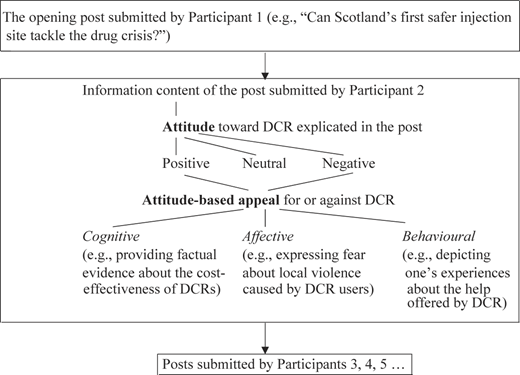
Drawing on the above assumptions, it is posited that the content of information generated and shared about DCRs is affected by people's attitudes towards such facilities and that such attitudes manifest themselves in the cognitive, affective and behavioural appeals that are directed to the fellow participants of online discussion. Appeals are presented to persuade the fellow discussants to support or resist the establishment of DCRs. As specified later on, such appeals can be articulated in diverse ways, for example, pleading on a personal opinion about DCRs, providing evidence for or against them, presenting a fear appeal or depicting one's personal experience about the help offered by a DCR. The research framework specified in Figure 1 takes together the above assumptions.
Figure 1 suggests that online discussion about a DCR-related issue is initiated by an opening post submitted by Participant 1. He or she presents a question or claim concerning DCRs, for example, their potential to solve the drug problem in Glasgow. Participant 2 offers an answer or comment in Post 2 whose content is affected by his or her positive, negative or neutral attitude towards DCRs. The post submitted by Participant 2 can also contain a cognitive, affective or behavioural appeal for or against DCRs, indicative of his or her attitudes towards such facilities. As neutral attitudes are unprejudiced, it is evident that they cannot contain any appeals for or against an issue, for example, the implementation of a DCR. Therefore, it is assumed that appeals are based on positive or negative attitudes. Participant 2 may, for example, present a cognitive appeal by offering empirical evidence about the cost-effectiveness of DCRs, thus persuading fellow discussants to view such facilities as services deserving public funding. Alternatively, Participant 2 may present an affective appeal claiming, for example, that DCRs elicit fear among local people because DCR users tend to behave in an uncontrolled way. He or she may also present a behavioural appeal by drawing on his or her personal experience about DCRs, for example, professional help offered by the staff. The online discussion continues, as other participants react to the above posts by presenting their views on the DCRs.
Research questions
Drawing on the above framework, the present study examines the following research questions.
How are cognitive appeals articulated in online discussion while sharing attitude-based persuasive information about drug consumption rooms?
How are affective appeals expressed while sharing such information about the above topic?
: How are behavioural appeals articulated while sharing attitude-based persuasive information in the above discussion?
Empirical data and analysis
The empirical data were gathered from Reddit – a major social media platform headquartered in San Francisco. Reddit consists of individual forums called subreddits, which are mostly user-created and organized by topic of discussion. Subreddits are managed by volunteer moderators who enforce rules for posting. Reddit users (Redditors) can join a forum to participate in posting and commenting on others' posts (Eldridge, 2025). As of May 2025, Reddit had an estimated 1.2 billion monthly active users all over the world (Kumar, 2025).
The empirical data were downloaded in the end of May 2025 from four subreddits: r/Scotland, r/unitedkingdom, r/Glasgow and r/uknews. These subreddits were chosen because within Reddit, they offer the most relevant repertoire of discussion threads dealing with the establishment of the DCRs in the United Kingdom. To obtain an overall picture of the posts submitted to the above subreddits, DCR-related discussion threads were first identified using the search term drug discussion room. In the end of May 2025, the search resulted in the identification of 47 discussion threads in the above subreddits. It appeared that 17 discussion threads contained only the opening post or a small number (1–9) of posts submitted by other contributors. As these threads appeared to be of low informational value, they were excluded. As a result, the remaining sample of 30 discussion threads with 10+ posts was chosen for a closer analysis. Altogether 812 individual participants contributed to them during the period of 1 January 2020–31 May 2025. The earliest discussion thread dates back to 2020 when research from Glasgow University revealed that the majority of Scots back the introduction of DCRs. The most recent discussion threads were initiated in May 2025, in times when there already were empirical data and use experiences about Glasgow's first DCR. Examples of the opening posts indicative of the topics of the discussion threads include “All eyes are on Glasgow: UK's first legal drug consumption room ready to open”, “Scotland's ‘shooting gallery’ for drug addicts will lead to disaster, think tank warns” and “Living beside the UK's first drug consumption room”.
The empirical data include 1,376 posts. Of them, 30 are opening posts and 1,346 responses submitted by other participants. The majority of the 812 participants, that is, 507 contributors wrote only one post. In contrast, there was a handful of active participants; the most frequent contributor wrote 11 posts. All in all, the online discussion about Glasgow's DCR mainly attracted occasional contributors who did not delve more deeply into the debate. The number of posts submitted to the discussion threads varied from 10 to 150. On an average, a discussion thread contained 46 posts. The sample of 30 discussion threads appeared to be sufficient for the needs of a qualitative study because the data became saturated. Data saturation occurs at the point at which collecting any further data will not produce value-added insights about the matter under investigation (Saunders et al., 2018, p. 1895). Therefore, it became evident that the inclusion of additional discussion threads initiated after the end of May 2025 would not essentially change the qualitative picture of how the Redditors express their attitudes towards DCRs and appeal for or against them.
The sample of 30 discussion threads was downloaded in a separate file and coded by making use of the categories specified in Table 1. The coding categories were derived in two ways. First, the three categories depicting positive, negative and neutral attitudes were taken from the study of Haddock and Maio (2008, p. 124), while the categorization of appeals is based on the tri-partite specification of attitudes (cognitive, affective and behavioural) proposed by Eagly and Chaiken (1993). Moreover, the specification presented by Casais and Pereira (2021, p. 287) was used to identify two subcategories of cognitive appeal, that is, reasoning, and proposing constructive solutions. As to the affective appeal, the studies of Averill et al. (1990), Casais and Pereira (2021, p. 285) and So et al. (2016, p. 130) were used to identify the subcategories of empathy, hope, anger and discomfort. Second, the rest of coding categories were inductively identified from the empirical data. These categories include, for example, pleading on one's personal opinion, expected benefit, provision of evidence, irritation and positive behavioural appeal.
The coding was an iterative process in which the data were scrutinized several times by the author. The pre-defined categories specified in Table 1 were used to code all the data–while still allowing new codes to emerge. However, the content of all posts submitted by the Redditors fit into the existing categories defined in Table 1 and no new categories were needed to cover the data. The 1,376 posts were assigned with altogether 1299 codes. Of them, 611 dealt with the attitudes, while 688 focused on the appeals of diverse types. In the coding, attitude towards DCRs (positive, negative, neutral) was coded first, followed by the coding of appeals. A post was coded only once for a criterion category once it was identified for the first time in the post. In long posts in particular, it was not unusual that the same criterion was identified in several segments of the same post. In these cases, once a message was coded for a criterion category, for example, cognitive appeal/pleading on one's personal opinion, other instances were simply ignored. On the other hand, a post could be assigned with several criteria indicative, for example, diverse instances of cognitive appeal such as assessment of the harm and the provision of evidence, as well as an instance of an affective appeal, for example, irritation.
In the coding, the category of pleading on one’s personal opinion – a subcategory of cognitive appeal–appeared to be most difficult to define. This is because the personal opinions are closely related to personal beliefs. In general, a belief can be understood as a deeply held conviction that a proposition is true, often based on faith, experience, or a worldview. To compare, personal opinion is a judgment that falls short of certainty. It often concerns matters of preference or incomplete evaluation. Belief is indicative of “how it”, for example, a DCR is (really), while personal opinion indicates “how it, for instance, a DCR looks to me”. Given that DCRs represent a relatively new phenomenon, it is likely that the Redditors have no foundational or deeply ingrained beliefs about them. Instead, they operate at the level of personal opinions which are based on subjective judgements, possibly subject to change in the future. Therefore, pleading on one’s personal opinion was chosen to represent the ways in which the online participants depicted their subjective judgments about DCRs, based on an individual's perspective on this issue.
To strengthen the reliability of the coding, the initial coding was refined by repeated reading of the data. Miles and Huberman (1994, p. 65) noted that check-coding the same data is useful for the lone researcher and that code-recode consistencies should be at least 90%. To achieve this, several iterations were executed to ensure that the codes appropriately describe the data and that there are no anomalies.
In order to examine the relative share of the categories specified in Table 1, percentage distribution was calculated for individual items indicative of the attitudes and diverse types of appeals. To this end, the number of codes assigned to a category, for example, pleading on one's personal opinion about DCRs (n = 159) was divided by the total number of the codes dealing appeals of diverse types, that is, 688. Second and more importantly, the data were scrutinized by means of qualitative content analysis. To achieve this, the constant comparative method was used to capture the variety of the participants' articulations (Lincoln and Guba, 1985, pp. 339–344). More specifically, the qualitative analysis concentrated on the participants' articulations dealing with cognitive, affective and behavioural appeals. The articulations of positive, negative and neutral attitudes were not analysed qualitatively because the focus was placed on cognitive, affective and behavioural appeals as concrete indicators of positive and negative attitudes towards DCRs. The participants' responses concerning the appeals of diverse types were systematically compared per individual instances of appeals of diverse kind. In this way, it was possible identify similarities and differences in the ways in which the Redditors, for example, articulated their personal opinions about DCRs indicative of cognitive appeals or how the participants expressed their negative experiences about such facilities indicative of behavioural appeals.
The reporting of the qualitative findings incorporates an ethical issue because they are illustrated by quotations taken from the Redditors' posts. Since the posts submitted to the subreddits are freely accessible to all readers, these posts can be seen as contributions which are intended to elicit public interest in the ways in which people approach DCRs. Due to their public nature, the posts submitted to online forums may also be utilized for research purposes, provided that the identity of an individual contributor is sufficiently protected. To achieve this, the participants were identified by technical codes. For example, in P294-T24, P294 refers to a participant who appears in the 294th place in the alphabetical list of the 812 Redditors, while T24 identifies a post that appeared in Thread 24. Second, all information about the submission dates for messages was deleted from the quotations. This procedure makes it more unlikely that an individual message and its author could be identified from the discussion threads.
Findings
Quantitative overview
Altogether 611 codes were assigned to the articulation of attitudes. Of the codes, 47% were indicative of the positive attitude towards DCRs, while 31.2% of the codes dealt with negative attitudes. The rest, that is, 21.8% of the codes were indicative of a neutral or undefined attitude. This suggests that overall, the Redditors took a favourable rather than unfavourable view on DCRs. On the other hand, the share of codes indicative of neutral attitudes was quite high, thus suggesting that many of the participants had not defined their position to DCRs. As noted above, the present study focuses on the articulation of the attitude-based appeals towards DCRs. The percentage distribution of the appeals of diverse kind presented by the Redditors is specified in Table 2.
Table 2 indicates that the great majority of the appeals presented by the participants were cognitive in nature. No less than 86.8% of the codes assigned to the appeals were of this type. In comparison, the share of affective appeals (7.4%) and behavioural appeals (5.8%) remained quite marginal. As to the cognitive appeals, most of them were based on the personal opinions about DCRs. The contributors also often appealed to the expected benefits of DCRs while defending their establishment. On the other hand, negative appeals drawing on expected harms caused by DCRs were quite frequent. This reflects the contentious nature of the DCRs. The participants also proposed a few constructive solutions for the improvement of DCRs. Cognitive appeals of other type, for example, reasoning for or against these facilities were presented quite seldom. Table 2 also indicates that affective appeals were mostly negative in nature. In particular, the participants expressed irritation while critiquing the establishment of DCRs. They also expressed, though fairly seldom, discomfort, anger and fear while resisting the implementation of DCRs. Positive affective appeals were rarely expressed; they mainly dealt with the empathy towards drug users who were seen to need help in their difficult life situations. Finally, behavioural appeals were quite rarely articulated. Appeals of this kind are based on the personal experiences obtained from existing DCRs and their users. Overall, such experiences were mixed in nature, thus suggesting that DCRs established so far have their pros and cons.
Cognitive appeals
Pleading on one’s personal opinions. The quantitative analysis indicated that the participants most frequently presented cognitive appeals. To this end, they were particularly active to draw on personal opinions about the DCRs. Such opinions were presented both for and against the DCRs. Overall, reflecting the fact that most attitudes towards the DCRs were positive, the personal opinions were articulated in a similar spirit. Some of the participants thought that the establishment of the DCR in Glasgow is “a great idea” (P426-T3) and that The Thistle is “fantastic, finally, a step in the right direction” (P689-T5). Positive views such as these were grounded in greater detail by referring to the significance of DCRs as effective instruments of harm reduction policy and modern health care. DCRs were also defended by taking examples of everyday situations where the harm caused by public drug use could be avoided.
We should have drug rooms, membership for which is maintenance and cleaning, make drug users have a sense of house pride about it. The facility should have a landline for medical attention, and an on-call PCSO (Policy Community Support Officers) for anti-social behaviour. (P301-T13)
If like me you have ever waited twenty minutes outside a baby changing room with a screaming baby while someone shoots up, I'm sure you would agree that we need these (DCRs) everywhere. (P268-T29)
Reflecting the contentious nature of DCRs, however, many participants adopted a critical view towards them. It was argued that these facilities would not essentially solve the problems related to drug misuse. Rather, DCRs may encourage it. Another major argument behind the negative opinions was that as DCRs are funded by taxpayer money, they are associated with public support for drug use occurring in “shooting galleries”.
I may be misinformed here but I cannot possibly imagine how the government paying for a crack house is going to help stop the issue. (P337-T1)
The establishment of a DCR in Glasgow was also resisted by arguing that in the end they would not attract drug users from the streets because the location of the DCR is not optimal. It was also believed that the drugs users would not find The Thistle as a preferred option.
Do you think the guy who usually shoots up in a bin shed in Milton is going to jump on a bus to a drug consumption room? (P650-T9)
Expected benefits. Many of the cognitive appeals highlighted the expected benefits of the DCRs. Appeals of this type are indicative of strongly positive attitudes towards the DCRs. These facilities were expected to enhance health care and improve public order in places favoured by drug users.
This is a long-term solution. It is not just about injecting. It is about getting these people in places where they can use services that will get them clean. People can decide to get clean anytime, they just need the right help from the right people at the right time. (P324-T23)
I imagine this will actually be welcomed by locals as there should be fewer littered needles. (P614-T-30)
However, some of the participants were less optimistic about whether consumption rooms would offer a final solution to the drug problem. Nevertheless, it was believed that they can offer some benefits for the drug users and society at large. At least, as one of the participants (P185-T4), put it, DCRs can “reduce drug abuse and save lives”.
Expected harms. The controversial nature of DCRs was reflected in the critical considerations of the expected harms resulting from the establishment of such facilities. Fellow participants were persuaded by reminding that DCRs will cause many problems for local people, as well as their living environment.
Drug users go to the area to use the facilities. Dealers go to sell because a basic principle of selling almost anything is you go where the foot traffic is. Prostitutes also go here because it is where the dealers go. (P161-T12)
Cognitive appeals highlighting the expected harms were bolstered by depicting negative experiences received from public injection rooms established in other countries.
They put one (DCR) into a neighbourhood I was just moving out of a few years back over here in Toronto. The area immediately started noticing a marked increase in vehicle break-ins, damage to property and petty theft (porch pirates, grab-and-run shoplifting, etc). (P238-T12)
Drawing on evidence. Cognitive appeals were also grounded by the provision of evidence, both for and against the establishment of DCRs. The presentation of cognitive appeals of this kind was rendered more difficult because Glasgow's DCR was just started recently. However, evidence could be found from other countries with long-time experience about such facilities. Again, reflecting the majority of favourable attitudes towards DCRs, the participants mainly drew on evidence supporting the advantages brought by the DCRs. Positive evidence was also supported by offering facts, even though the reference to the study of Andresen and Boyd (2010) appeared to be inaccurate in the quotation presented below. Their investigation was published in the International Journal of Drug Policy (not Canadian Medical Association Journal).
The idea that supervised injection facilities (SIFs) or drug consumption rooms are a “waste of money” has been studied extensively. The results consistently show long-term cost savings to public services, even if the initial annual outlay (e.g. Glasgow's £2.8M) seems high at first glance. Let’s talk evidence. Vancouver’s Insite (Canada): A 2010 peer-reviewed study (Andresen & Boyd) found that for every $1 CAD spent, the SIF generated $4-$5 in healthcare savings, mostly by reducing HIV/HCV infections and preventing overdose-related hospital visits. Reference: Andresen & Boyd, Canadian Medical Association Journal, 2010. Link to the website. (P634-T14)
On the other hand, counterevidence presented by critical participants suggests that DCRs are not necessarily a success story.
They (DCRs) were introduced in Denmark in 2012. Drug deaths have remained at the same level since 1991, so they did hew haw there. (P407-T18)
Look at Vancouver. This has been tested, tried and failed. (P612-T15)
Proposing constructive solutions. As a way of to persuade fellow contributors, the participants first praised the potential offered by DCRs and then proposed various ways in which they could be enhanced further.
Hopefully, they open more across the city, so people don't have to travel across the city if they want to use them. (P72-T3)
Medically supervised consumption rooms would be coupled with existing needle exchange programs, which have a proven amount of users, and they would then handle disposal as well, which is objectively better than letting people take needles out of the place. (P755-T10)
In contrast, participants taking a critical view on the DCRs suggested alternative solutions for the renewal of harm reduction policy.
(DCRs) also fuel addiction that prevents people making meaningful improvements to their lives. Trading one evil for a lesser evil. The real solution is to actually provide proper support to people addicted to drugs to help get them clean, not fuel their habits. (P332-T13)
Reasoning. Quite rarely, cognitive appeals were based on reasoning about how DCRs would affect drug consumption habits. In most cases, reasoning manifested itself in the identification of the causes and consequences, that is, if – then connections.
If someone craves drugs and has drugs, I think they will just end up doing it then and there, rather than taking the time to travel to a specific place. (P669-T10)
Affective appeals
Positive appeals: drawing on empathy and hope. As Table 2 indicated, the participants quite seldom presented affective appeals by drawing on emotions elicited by DCRs. Although positive attitudes towards DCRs were more frequent than negative ones among the participants, they seldom drew on positive affective appeals. However, there were a few examples of appeals drawing on empathy towards the drug users which could be helped by means of DCRs.
I'm hoping it (DCR) saves some of these poor people's lives. (P301-T5)
God help the poor buggers. We can at least give them somewhere safe. (P18-T2)
Positive affective appeals were also presented by drawing on the emotion of hope. DCRs could have a potential to ease the drug users' difficult situation and offer a perspective for the return to normal life.
It (DCR) results in a stable situation which people then have a chance of improving. (P30-T2)
Negative appeals: expressing anger, fear and irritation. Negative affective appeals appeared to be more common among the participants. Often, they were connected to expected or already experienced harms caused by drug use. Affective appeals of this kind were also expressed by depicting one's irritation about DCRs as publicly funded facilities. Similarly, irritation was articulated while reflecting the expected or real harm caused by DCR users for local people. Sometimes, irritation was embedded in sarcasm.
So glad that our government want to spend my taxes on free smack. (P330-T21)
Safe and supervised environment to take their drugs and then a burly nurse to put a pill over their face when they are on the nod. (P445-T3)
Negative affective appeals also were based on the articulation of anger. In particular, it manifested itself in the resistance of the use of taxpayer money for the establishment of DCRs.
Great, 2.3 million pounds of decent people's tax money spent, so these junkies can shoot up in peace. It is absolutely disgusting. (P365-T11)
As DCR users can cause disorder in public places, critical participants expressed discomfort arising from “nimbyism”. In addition, they felt that DCRs would not provide attractive facilities for the drug users.
It (DCR) is creating a hellhole. I would not want this near me. Try selling your house after that. (P554-T6)
They have made it (DCR) look like a cross between a hospital room and a prison cell. So, people don't use it like a coffee shop. (P125-T2)
In a few cases it was feared that DCRs can attract users who are potentially dangerous for other people.
What poor sods are going to have to monitor junkies shooting up. What happens when one gets angry and tries to slash someone with a needle. Then, unleashed onto the town centre to cause hell for everyone else. (P427-T13)
Behavioural appeals
Finally, behavioural appeals were presented by drawing on the participants' personal experiences about DCRs and their users. Again, both positive and negative appeals were articulated. The former were used to persuade fellow participants to devote attention to the potential of the DCRs.
It (DCR) is going to save lives. I'm a current heroin user, so I feel I'm a bit more knowledgeable on how an addict thinks than most. I would happily travel to the Barras if it meant I could safely use. (P71-T3)
Positive behavioural appeals were also based on the experiences of local residents, as well as drug users who had already visited The Thistle.
David Clark has been using drugs for 26 years and has spent long periods of his life on the streets. The 47-year-old told Disclosure he used The Thistle service to inject cocaine in February. From there, staff referred him to new supported accommodation. He said: “When I went to the consumption room, it was not what I expected. I thought you would go in, do what you are doing and out. But it is not like that. The members of staff in there supported me and helped me get to where I'm at now. It has helped me massively. I feel better in myself”. (P44-T8)
To compare, negative behavioural appeals were slightly more common. They were based on the description of unpleasant experiences received from DCRs and their users.
Talking from experience of living near the first safe injecting room in Melbourne, Australia, I hope this has been thought about a lot more. The local park and school are covered in needles now and friends are constantly clearing their gardens of needles as well. Lives have been saved but for local residents, the situation has gotten worse. (P643-T15)
Discussion
The present investigation contributed to empirical research on information behaviour by examining how attitude-based appeals are used in online discussion to persuade fellow participants to accept or resist an idea or project. The quantitative findings indicate that the Redditors predominantly presented cognitive appeals, while the share of affective and behavioural appeals remained relatively small. In addition to pleading on one's personal opinions about DCRs, many of the cognitive appeals were based on the highlighting of their expected advantages and disadvantages, as well as the provision of evidence for and against such facilities. Overall, the quantitative results suggest that cognitive appeals are not merely based on the description of one's personal opinions about the attitude object. Such appeals can also incorporate analytical elements when the participants weigh the expected benefits and harms of the DCRs. The findings also revealed that affective appeals were predominantly negative, thus reflecting the contentious nature of DCRs eliciting irritation and fear, rather than empathy and hope. The relatively low share of affective appeals may be explained, at least partly by the fairly strict moderation policy adopted by Reddit. The preliminary reading of the discussion threads revealed that a number of posts were deleted by the moderators. It is possibly that such posts contain strong emotional expressions serving the ends of negative affective appeals. The relative paucity of behavioural appeals is probably due to the fact that the Glasgow DCR has just started and that the number of people having personal experience about DCRs and their users is likely to be low even globally.
The qualitative findings enriched the above observations by demonstrating the variety of the ways in which the participants appealed for or against DCRs. Within all three types of appeals, there was a constitutive division of favourable contra unfavourable evaluation of the attitude object, that is, DCR. Fundamentally, such division deals with the value-based (moral) acceptability or unacceptability of such facilities, particularly if they are funded by taxpayer money. The division of favourable versus unfavourable evaluations permeated not only personal opinions but also other subcategories of cognitive appeals, for example, the reflection of expected benefits and harms, as well as the provision of positive and negative evidence. To compare, the constitutive division determining the nature of affective appeals was positive contra negative approach towards DCRs. Positive appeals drawing on empathy and hope reflect the favourable attitudes toward DCRs, highlighting their future potential as a new approach to compassionate drug policy. In contrast, negative appeals drawing on fear and irritation indicate unfavourable attitudes toward DCRs, highlighting the expected or real-life harms brought by such facilities. Finally, positive and negative behavioural appeals are indicative of the perceived personal relevance or irrelevance of the DCRs. Again, appeals of this type are constitutive of one's favourable or unfavourable personal experiences about the use of such facilities.
The evaluation of the novelty value of the empirical findings in rendered more difficult due to the paucity of similar investigations. However, a few comparative notions can be made. The analysis of the appeals of diverse types revealed that overall, the view presented by Redditors largely were in accord with the main arguments for and against DCRs identified in empirical studies on people's views on DCRs. For example, similar to the present investigation, Jauffret-Roustide and Cailbault (2018, p. 216) found that while assessing the pros and cons of DCRs, the dominant argument against the establishment of such facilities was related to the nuisance caused by DCR users and the difficulty of cohabiting with user populations whose profiles and practices are considered incompatible with the course of local people's daily life. Moreover, similar to observations made by Bardwell et al. (2017), many of the Redditors viewed that local stakeholders tend to be ambivalent about DCRs, expressing support for some objectives but also voicing concerns, including whether DCRs are a good use of resources. The findings of the present study concur with the results of prior investigations characterizing the arguments against the implementation of DCRs, for example, that they would facilitate the congregation of drug users and drug dealers (Dolan et al., 2000). On the positive side, similar to prior studies (e.g. Kolla et al., 2017; Parkes et al., 2022), many Redditors appealed for the expectation that DCRs would save lives and primarily serve the ends of compassionate drug policy.
Finally, the results offer support for Väisänen´s (2019) findings about the nature of online debates focusing on the DCR initiatives. Väisänen demonstrated that that DCR-related online debates were highly polarized between those supporting and opposing the initiative. The opponents presented drug users in a negative manner and characterized the implementation of the DCR as an illegal and even immoral project. In contrast, the supporters of the initiative argued that drug users are an oppressed group of people lacking human rights, and that DCRs are one solution to alleviate their difficult situation. Different from the present investigation, however, Väisänen's study concentrated on the rhetorical aspects of arguments for and against DCRs. The unique contribution of the present study is the elaboration of the attitude-based cognitive, affective and behavioural appeals as discursive factors that are used to persuade fellow contributors to accept or resist an issue or project.
Taken together, the main conceptual contribution of the present study is the elaboration of attitude-based subcategories of cognitive, affective and behavioural appeals used in online discussion. The main empirical contribution is the qualitative analysis of the ways in which the appeals of diverse kind are used to persuade online fellow participants about the acceptability of a contentious project, exemplified by the implementation of a publicly funded DCR. The findings also have practical implications for information literacy (IL) education. IL educators should devote attention to the fact that attitudes and attitude-based appeals can significantly affect the content and tone of online debates. This is because appeals may be an effective way to persuade the fellow participants both affectively and cognitively, to win the hearts and minds of the online publics.
Conclusion
Attitudes form a significant though insufficiently analysed factors making it understandable why people adopt a favourable or unfavourable view towards an issue or object. The present investigation deepened our knowledge about how attitude-based appeals manifest themselves in the sharing of persuasive information dealing with controversial issues. The findings demonstrate how attitudes manifest themselves in cognitive, affective and behavioural appeals and how such appeals are used to persuade fellow participants in online discussion. The results highlight that in online debates about controversial issues, attitude-based cognitive appeals are particularly significant. Depending on whether an attitude is favourable or unfavourable towards an issue, persuasive messages can be supported by affective appeals drawing on diverse emotions such as empathy, hope, fear and irritation. Moreover, behavioural appeals based on one's experiences about the attitude object may be used to persuade the fellow contributors.
The present study is limited in that appeals of diverse kind were approached separately. In online discussions, however, affective and cognitive appeals may appear together and complement each other. Liu et al. (2019) devote attention to this issue in an empirical study examining reason and passion in public discussion on Sina Weibo–a major Chinese online discussion platform. The study revealed that the online participants users sought attention and persuasion by appealing both to affective and cognitive factors, or “hearts and minds”, as they put it. To achieve this, the participants strengthened rational arguments by adding emotional components and vice versa. This suggests that one of the important topics of future investigations is the elaboration of the relationships between cognitive, affective and behavioural appeals. As the present investigation focuses on a sample of Reddit discussion threads dealing with a particular topic, that is, DCR, the findings cannot be generalized to concern the ways in which attitudes orient people's ways to generate and share information about controversial topics. To elaborate the role of attitudes in information sharing, more research is required by focusing on contentious topics of other kind, for example, climate change and immigration. Comparative studies would be useful in that they could offer a broader and more nuanced picture of the significance of attitudes and attitude-based appeals as factors orienting debates in online forums.