The paper analyses the research in Library and Information Science (LIS) in 2025 and the evolution of LIS research longitudinally from 1965 to 2025.
The study employs a quantitative intellectual content analysis of articles published in ∼30 scholarly LIS journals, following the design by Jarvelin and Vakkari (2022). In content analysis, articles are classified using a multi-dimensional faceted classification covering topical content and methodology. The classification schedules and the journal set are held stable through the years. The classification serves as an explicit definition of the scope of LIS.
The study indicates that the trend of diminishing focus in LIS on Library and information (L&I) services has accelerated, while scientific and professional communication (S&PC) has become the most popular topic. Information storage and retrieval (IS&R) has lost its earlier strong position toward the end of the analysed period. LIS research is methodologically increasingly varied since survey, scientometric methods, experiment, case studies and qualitative studies have all gained in popularity. Consequently, LIS may have become over the years more versatile in the analysis of its research objects. As concrete evidence of change, in all 41% of top-journal articles fell outside LIS topics in 2025. This reflects changing research paradigms and publisher interest.
Among quantitative intellectual content analyses of LIS research, the study is unique in its scope: length of analysis period (60 years); width (5 dimensions covering topical content and methodology) and depth (the annual batch of ∼30 scholarly journals).
1. Introduction
Table A1As a relatively young and small discipline, (Library and) Information Science (LIS) has not solidified its content, methodology and scope (Hsiao and Chen, 2020; Ma and Lund, 2021; Zhang et al., 2024). This is due to dependency on radical developments in underlying technologies of information dissemination and in the corresponding research areas like digital libraries, data mining/science, artificial intelligence, machine learning and web science, among others. There is a risk of fragmentation (Vakkari et al., 2022; Vakkari, 2024). LIS may be analyzed theoretically to set its content, structure and scope, and methodology (Saracevic, 1992; Vakkari, 1994). Alternatively, one may analyze empirically, what LIS scholars do, reporting on their research topics (Chang et al., 2015), adopted theories (Kim and Jeong, 2006) and research methods (Ma and Lund, 2021; Chu, 2015) and academic backgrounds. We take the latter approach. It helps understand the state of a discipline and to consciously build its possible futures.
An obvious way to learn about the development of LIS is to analyze its publications – the development of research foci and methodological choices (e.g. Åström, 2007; Tuomaala et al., 2014; Zhang et al., 2024). The methodologies of empirical analyses of LIS have varied, including content analysis (e.g. Chang, 2018; Järvelin and Vakkari, 1990; Ma and Lund, 2021), bibliometric analysis (e.g. Chang et al., 2015) and topic modeling (e.g. Han, 2020; Miyata et al., 2020).
The present paper reports an intellectual content analysis (ICA) of articles published in top scholarly journals of LIS, following the study design by Tuomaala et al. (2014), Järvelin and Vakkari (2022) and covering research from year 1965–2025 at 1–2 decades' intervals. To cover such a long range requires that the conceptions of LIS, and the publication data sets, are compatible over the years. Enforcing compatibility risks exercising anachronisms, whereas overt liberalism risks instability of the scope and structure of LIS.
The paper has two main research questions (RQs): (1) What was the topical and methodological state of LIS research in 2025? We analyze this through scholarly articles published in core LIS journals in 2025. (2) How has LIS evolved from 1965 to 2025? We examine this in the light of comparable statistics for the years 1965, 1985, 2005, 2015 and 2025, reporting on the changes in LIS research foci and methodological choices.
2. Literature review
There are only a few recent major conceptual analyses of LIS, unlike in earlier years (c.f. Tuomaala et al., 2014; Vakkari, 2024), while there are many empirical ones. Next, we will review topical findings and then methodological ones based on different research strategies.
2.1 LIS topical evolution
Content analyses. Ma and Lund (2021) and Järvelin and Vakkari (1993, 2022) represent the very few studies using content analysis to explore the evolution of LIS. Ma and Lund (2021) analyzed the topics and methods of scholarly articles in 31 major LIS journals in 2006, 2012 and 2018, using categorizations of Tuomaala et al. (2014). They found a shift of emphasis toward scientific and professional communication (S&PC) and information seeking topics while the share of information search and retrieval (IS&R) and library and information (L&I) service topics sank. In 2018, IS&R was still the most common research topic, followed by SP&C. Järvelin and Vakkari (1993, 2022) analyzed the evolution of LIS research longitudinally from 1965 to 2015, using scholarly article abstracts in ∼30 LIS journals, keeping the journal collection stable. The topical findings indicated a change from the earlier emphasis on L&I services to SP&C. IR&S had lost its initial position toward 2015.
Bibliometric analyses. Chang et al. (2015) analyzed the evolution of LIS based on keywords, bibliographic coupling and co-citation analyses during four five-year periods between 1995 and 2014. The cited top-5% journal articles in ten major LIS journals were analyzed. The articles were clustered, and the clusters were reduced into four major fields. Information seeking and retrieval took the largest share of articles, followed by bibliometrics in 1995–1999. In the later periods, the popularity of bibliometrics increased its share beyond IS&R.
Hou et al. (2018) employed co-citation analysis to reveal LIS structure between 1996 and 2016. Twelve journals for 1996–2008 were selected based on co-citation analysis with JASIST, Scientometrics and Journal of Informetrics and another 12 journals, based on an earlier study, for 2009–2016. The findings indicated that LIS developed toward S&PC but must be considered with care because of the unique journal selection method.
Li et al. (2019) surveyed LIS trends between 1989 and 2018 by document co-citation analysis. Their data included 88,304 publications from 159 journals and proceedings. Over the past 30 years, research on LIS has mainly focused on areas such as I&R, social media, information system, information behavior, bibliometrics and webometrics, scientific evaluation and knowledge management.
Hsiao and Chen (2020) investigated LIS subfields between 2009 and 2018 by word bibliographic coupling. They selected 44 journals from the Journal Citation Report (JCR), excluding journals belonging to management information systems. The data included metadata of 21,066 articles in two periods: 2009–2013 and 2014–2018. The top-3 subtopics among 25 subtopics in both periods were scientific impact and research quality, information behavior and users and technology adoption.
Topic modeling. Figuerola et al. (2017) examined the evolution 1978–2014 using topic modeling. The data included article metadata from 737 journals. Modeling produced 19 topics with IS&R, and bibliometrics with a growing trend, and library topics with a negative trend. Han (2020) investigated LIS evolution 1996–2019 by analyzing journal articles using Latent Dirichlet Allocation (LDA). The explored period was divided into five sub-periods. For each period, 10 highest-scoring LIS journals in JCR were selected for analysis, which focused on article (n = 14,053) metadata. Ten clusters in each period were chosen for final analysis. The results indicate that library service -related topics disappear after 2005; topics in IS&R proliferate during 2000–2010; various topics in citation analysis and bibliometrics are well represented across periods and that topics belonging to information and knowledge management proliferate after 2005. Miyata et al. (2020) applied LDA to identify LIS topics. They analyzed full texts of articles in five LIS journals in 2000–2002 and 2015–2017. Thirty topics were constructed for each period and grouped into 5–6 fields. In the first period, the field of IR and information search (IS) included most topics, while in the second, the number of topics in IR decreased and in IS increased notably. In the field of library, the number of topics decreased during the periods observed, while that of scholarly communication increased.
Other research strategies. Wu et al. (2025) analyzed the evolution of LIS research from 1990 to 2023. Their dataset consisted of semantic information and metadata of over 140,000 LIS publications from the Web of Science. The analysis mapped research across three semantic dimensions: library, people and algorithm. The library dimension was strong initially but declined after 2011. The focus shifted toward the people dimension, with people-related studies becoming more independent. Recently, the algorithm dimension has rapidly gained momentum. It is concurrently detaching from the two other dimensions.
In a methodological evaluation, Ylikruuvi et al. (2025) compared ICA and topic modeling in empirical analysis of the same data set, 1,514 scholarly articles from the year 2015 volumes of 30 IS journals. The ICA applied a multidimensional faceted classification for article topics and methods. When topic modeling was set to produce four topics, these matched well the four main classes of the ICA classification of topics: Library services, IS&R, information seeking and S&PC. Topic modeling was found strong in identifying new directions of a discipline but semantically hazy in the topics produced. Both approaches were found likely to support some conceptions of what LIS is and where it should go – only different.
2.2 Research methods in LIS
Ma and Lund (2021) found that in LIS, experiment was the most popular method in 2006, 2012 and 2018 with a share of about 30%. The second in popularity was survey. Its share increased from about 19% to 25%. Citation analysis was the third with about a 13–14% share. The shares of the top research methods of the major topics of IR, information seeking, scholarly communication and L&I services remained relatively stable across the data points. Experiment was the most common method both in IR and information seeking, while citation analysis dominated in scholarly communication and survey in L&I services.
Ullah and Ameen (2018) provided a meta-analysis of methods applied in LIS based on 58 source publications published in 1980–2016. They created unifying categorizations of variables by re-coding method variables in the source publications. They found that empirical, descriptive and quantitative methods were used in most LIS research. Survey was the most popular strategy and descriptive statistics were mostly used for data analysis.
Zhang et al. (2024) examine the influence of the data-driven research paradigm on the LIS discipline, focusing on the evolution of research methods. With data from eight scholarly LIS journals published between 1990 and 2022, four key categories of data-driven method entities were automatically extracted: algorithms and models, data resources, software and tools and metrics. A downward trend in the number of theories per article was found. Core popular theories were adopted from outside LIS. Initially, theories were adopted from psychology but toward the end of the period, from computer science.
2.3 Summary
Many studies have mapped the content, scope and evolution of LIS. The findings are varied, but it is fair to say that LIS has transformed from a profession-oriented field into a research-oriented, interdisciplinary science of information. Table 1 presents a rough overview of research foci, key topics and research characteristics in LIS from 1965 to 2015.
However, the results are hard to compare due to different data and analytical methods. The results are biased toward different directions. First, the data sources, even if top journals, vary greatly between studies and in some cases between the periods of a single longitudinal study. It raises the question whether the data and the findings represent the same conception of LIS. In journal-based studies, the number of journal titles has varied greatly: from 10 (Chang et al., 2015) at the low end to 170 at the high (Urbano and Ardanuy, 2020). A continuing bias in many studies has been to include all journals from JCR category information science and library science. This category contains journals from two distinct fields, management information systems and LIS (Abritzah et al., 2015; Huang et al., 2019). The topical structures of these fields differ notably. Thus, the produced topical map of LIS contains topics from other fields.
Second, the topics constructed through different methods may be semantically hazy or different even if sharing the same label. Consider, for example, the label “information retrieval” in a faceted ICA classification (meaning intellectually specified), as a topic modeling topic label (intellectually given label for a statistically associated word list), or as a formal concept (a concept node in a concept lattice representing intensions – keywords – and extensions – authors). Here the label “information retrieval” represents three different but related concepts. Findings based on them may enrich or challenge each other but require care when compared.
3. Study design
3.1 Research questions
We have two main research questions (RQs) and several sub-questions (SQs) as follows:
What was the topical and methodological state of LIS research in 2025?
SQ1a-e: What are the shares of various (a) topics, (b) research strategies, (c) methods of data collection, (d) types of analysis and (e) types of contributions in LIS research in the year 2025?
How has LIS evolved from 1965 to 2025?
SQ2a: How have the shares of article types (scholarly vs. non-scholarly) evolved from 1965 to 2025?
SQ3a-e: How have the shares of various (a) topics, (b) research strategies, (c) data collection methods and (d) the application of research strategies within topics evolved from 1965 to 2025?
We investigate RQ1 through articles published in core LIS journals in 2025. The research design (concepts and methodology) and data are explained in the next four sections. We examine RQ2 in the light of comparable statistics for the years 1965, 1975, 1985, 2005, 2015 and 2025, reporting on the changes in LIS research foci and methodological choices. The following sections are based on earlier papers of the project (see, e.g. Järvelin and Vakkari, 1993; Järvelin and Vakkari, 2022; Vakkari et al., 2023).
3.2 Data
Studying the characteristics of LIS requires an understanding of what LIS is about. The interdisciplinarity of LIS makes drawing its boundaries particularly difficult. Although no definition of LIS satisfies all scholars (Petras, 2024), LIS is widely understood to be unified by the study of providing access to desired information (Vakkari, 1994). However, this concise characterization is difficult to operationalize. We therefore define LIS research using the classification system for LIS topics ( Appendix 2): publications whose topics fall within its classes are considered part of LIS. Although this ostensive definition has limitations, applying the same, albeit somewhat revised, operationalization throughout the period examined improves the comparability of the findings. Thus, while our conception of LIS may not be shared by the entire LIS community, it yields comparable results on trends in LIS research.
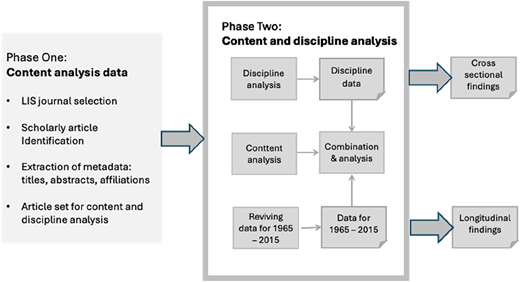
In addition to topicality, a number of other factors affect the publication-based conception of LIS. The genres of publications collected, their publication venues and potential authors, the methodologies and languages of text must be fitted to the purpose of analysis since they are likely to bias the findings. These are discussed briefly below. Figure 1 illustrates the present dataset construction process.
Genres of literature. Scholarly journal articles (Järvelin and Vakkari, 1990, 2022; Ma and Lund, 2021), academic dissertations (Prebor, 2010; Sugimoto, 2011) or serial publications (Urbano and Ardanuy, 2020) by scholars have represented LIS research.
Publication venues and potential authors may be set explicitly or implicitly, e.g. US thesis authors (Sugimoto, 2011).
Publication languages of text. English is the most widely distributed LIS publication language but not neutral for the results.
Publication timespan covered. Also, the volumes of journals included in the analysis affect the findings. The development of vocabulary and the field of study must be attended to in longitudinal studies (e.g. Järvelin and Vakkari, 2022), while in cross-sectional studies (e.g. Vakkari et al., 2022) it is more stable. Long timespans may bring birth, popularity and disappearance of LIS subfields, conferences and journals, concepts and terms. The year 2025 volumes became the sources of research articles due to the interval of 1 decade in the series of studies.
Journals as publication sources. Journal articles as texts deviate from other scholarly publications, which may be the first to propose new directions for a research area. Likewise, novel directions may turn up in non-primary journals of a research area. This would suggest the inclusion of technical reports, conference proceedings and secondary journals in the analysis. However, journals are less volatile regarding existence and orientation than other publication types, making data collection easier. The primary journals, again, sooner or later publish articles on important novelties. Many journals also publish a selection of (perhaps lightly edited) conference papers. This improves the status of journals as data sources while presenting further article harvesting problems. Therefore, we are convinced that journal data yields a valid picture of the development of a research area.
Choice of journals. Numerous liberal or tighter criteria have been used in selecting journals for analysis. Initially (Järvelin and Vakkari, 1990), we focused on LIS journals with wide distribution, international editorial board and publication policy – which had been assessed as primary journals by other researchers (e.g. by Feehan et al., 1987; Peritz, 1980; Tuomaala et al., 2014). To count as a LIS journal, a journal had to publish a significant share of articles on LIS topics. Therefore, we provide an operational definition of LIS, see next section.
In journal-based studies the number of journal titles has varied greatly: from 10 (Chang et al., 2015) at the low end to 170 at the high (Urbano and Ardanuy, 2020). We arrived at a set of ∼30 journals ( Appendix I). The exact number of journals fluctuates over the years, as journals cease to exist, new ones are born, and others change orientation. Keeping the journal set stable serves comparability of the data across decades.
Identification of scholarly articles for analysis. Typically, as a formal criterion, only full research articles are collected, excluding editorials, book reviews, letters-to-the-editor, etc. The content criteria are discussed in the following section.
In summary, in the present study, we set the scope of the dataset as follows:
The genre of literature is English-language scholarly articles
The publication venues are selected international LIS journals ( Appendix 1)
The aim is cross-sectional (2025) and longitudinal analysis
The author set of articles is not limited (e.g. by number or degree).
3.3 Content classification
In the analysis, we use a faceted classification for topical and methodological aspects of (LIS) articles.
Faceted classification on LIS topics and methods has six facets for topic, scholarliness and methods ( Appendix II). The classification LIS topic has been used widely (e.g. Hider and Pymm, 2008; Järvelin and Vakkari, 1993; Ma and Lund, 2021) and contains 10 major classes:
- 000
LIS context (professions, history and publishing)
- 100
education in LIS
- 200
methodology
- 300
analysis of LIS
- 400
library and information-service (L&I) activities
- 500
information storage and retrieval
- 600
information-seeking
- 700
scientific and professional communication
- 800
other aspects of LIS
- 900
another discipline
Classes 400–700 also have sub-classes. Considering the development of LIS, the sub-classes were conservatively updated for the 2005 (Tuomaala et al., 2014) and 2015 (Järvelin and Vakkari, 2022) datasets. The main classes were not touched. Further minor changes for the 2025 dataset are marked with an asterisk in Appendix 2. These modifications help keep the classification up to date while serving comparability across the datasets.
The classification facet LIS topic provides an explicit operational definition of LIS as classifiability in its classes (excluding class 900). In this way, we can avoid inclusion of articles/journals belonging to other disciplines, like management information systems, following Abritzah et al. (2015) and Huang et al. (2019). While our operational notion of LIS may not satisfy the entire LIS community, it produces comparable results on the trends in LIS research.
Scholarliness is a binary variable indicating scholarly research. At least a somewhat systematic way to contribute new concepts, knowledge and ideas is required for scholarliness (Peritz, 1980). Therefore, some research question, some method, some prior literature and some results should be presented.
The methodological aspect was coded in four facets: Research strategy, Data-collection method, Type of analysis and Type of investigation. Research strategy is an overall approach to the study, e.g. historical, survey and qualitative strategy. The other main strategies are referred to as conceptual research strategy (e.g. concept analysis), mathematical or logical strategy and system and software analysis and design (Tuomaala et al., 2014).
Data-collection methods of empirical research are listed in the facet Data-collection method. The facet Type of analysis codes qualitative, quantitative or mixed type of empirical research or non-empirical. The Type of investigation shows the kind of contribution the article claims. Note that the present authors made no effort toward judging whether the claims were justified.
3.4 Classifying
For article content analysis, the unit of analysis was an article. Each article was classified to exactly one class of each facet mainly based on its abstract. If needed, the rest of the article was skimmed. Journals provided an intermediate step in reaching the articles. Therefore, the great productivity of some journals, e.g. JASIST, IP&M and Scientometrics, is a property of LIS research, not a bias issue.
Classifying interdisciplinary borderline articles. Some articles could be placed either within a LIS class or the class “other discipline”. Often their authors came from fields other than LIS. One might suggest that LIS articles could be identified through their authors' disciplinary backgrounds. We think that an article's “LISness” must be determined by its topic and methods – not by authors' background – due to interdisciplinarity of LIS. If the prominent features of a study rather suggested a field other than LIS, it was given the topic class “other discipline” (900), else some subclass of the facet LIS topic. For example, in IS&R, features suggesting computer science were focus/contribution on systems, algorithms, efficiency and test collection-based effectiveness. Similarly, focus on marketing non-information things/services suggested “other discipline” = business administration and marketing as the topic.
The total number of articles in the data for 2025 is 1839. We excluded from the analysis articles which were classified as non-LIS studies (A = 900) (n = 729) and non-scholarly articles (n = 65). The number of articles in the main analysis is thus 1,145.
3.5 Classification reliability
The articles were divided evenly between the two researchers for classification. For reliability analysis, the authors reclassified 100 articles independently. Reliability was calculated using Fleiss' Kappa (see Table 2). In addition, articles' scholarliness was classified consistently in 98 cases out of 100.
A plausible explanation for the moderate reliabilities is that classification of the methodology-related aspects based on article metadata often left much room for interpretation. Even scholarly articles in LIS core journals may be quite scarce in describing, in their metadata, the methods used in the study, and the body text does not always reveal the secret without serious effort unless the methods are well-established with a standard name tag.
4. Findings
4.1 Topics 2025
The proportion of research articles published in LIS journals not belonging to LIS has grown dramatically from 2005 (10%) and 2015 (12%) to 41% in 2025. During the past 10 years, LIS journals have reformed their policy toward increasingly publishing studies associated with other disciplines, often authored by scholars from those disciplines.
Scientific and professional publishing is the most popular major research topic (27.5%), followed by information storage and retrieval (24.0%), information seeking (19.7%) and L&I service activities (15.5%) (Table 3). These four major research topics covered 86.7%. Other major topics were considerably less popular with shares of a few percentages – among them professions the most popular (4.1%).
The most studied sub-topics within the major topics were other aspects of S&PC (9.9%) and scientific or professional publishing (9.3%) and other types of information seeking studies (7.6%) (Table 3).
Within information seeking, after other types of information seeking studies, the most popular sub-topic was the use of other information channels (than LIS-services) (4.3%). Within L&I service activities, user education (3.3%), other L&I service activities (3.2%) and administration and planning (2.8%) were the most studied topics.
Within IS&R, the research topics that lured most interest were social media retrieval (5.8%), classification and indexing (4.9%) and digital information resources (3.6%). The proportion of interactive, user-oriented IR was only 2.2%, and web retrieval methods were as small as 0.1% of all research articles.
4.2 Research strategies 2025
Empirical research strategy (74.2%) was the dominating strategy, while other strategy types like conceptual strategy (8.6%) or system analysis (10.3%) were clearly less popular (Table 4). Among empirical strategies, survey (24.9%) was the most common, followed by other bibliometric strategies (12.5%) and content analysis (8%).
Methodological preferences were notably differentiated between major topics. In L&I services, survey (42.1%) was the dominant strategy, followed by literature review (13.2%). In IS&R, system analysis (39%) and evaluation (11.2%) were the most popular strategies, while in information seeking, survey (50.2%) and qualitative strategy (13%) prevailed. In S&PC, other bibliographic methods (43.4%) and citation analysis (21.9%) were the most applied strategies. In all, in each major topic one research strategy dominated over all others with a share of 40–50%.
4.3 Methods of data collection 2025
The most common data collection technique was questionnaire or interview (23%), as implied by the most common research strategy, survey (Table 5). Harvesting log files (13.4%), several methods of collecting data (12.2%), and item collection for content analysis (10.4%) were also popular techniques. Observation, historical source analysis and thinking aloud were very seldom used techniques.
In studies on L&S services, survey (40.9%) and several data collection methods (15.7%) were the most used techniques. In IS&R, IR experiment (35.1%), combined (10%) and other (10%) data collection methods were most popular, while in information seeking, questionnaire or interview (51.7%) and several data collection methods (15.5%) were dominant. In studies on S&PC, data were mostly collected by harvesting databases (28.8%) or by collecting citation data (27.4%).
4.4 Type of analysis and type of investigation 2025
Quantitative analysis (58.9%) was the clearly dominant approach in the articles, while qualitative (17.6%) and mixed (7.8%) ones were minor approaches. Quantitative analysis was almost the sole approach in IS&R (63.7%) and in S&PC (90.3%), while the qualitative approach had gained footing in studies on LIS services (20.8%) and on information seeking (34.3%), in addition to quantitative analysis (39% and 43%). In information seeking (13.5%) and L&S services (16.4%), the combined use of quantitative and qualitative methods was relatively common. Thus, the research on major topics in LIS bifurcated into quantitative approaches favored in IS&R and S&PC and qualitative approaches in information seeking and LIS services, in addition to quantitative ones.
Empirical research (68.1%) was the most common type of investigation with an emphasis on descriptive studies (51.2%), while comparative (7.3%) and explanatory (9.6%) studies were a clear minority (Table 6). Among non-empirical investigations, constructive (11.3%), theoretical (6.1%) and methodological (6.4%) studies were most popular, although their share in all was modest.
The descriptive approach was most common in studies on L&S services (62.3%), information seeking (52.2%) and S&PC (66%), while system description dominated in IS&R (41.4%). In addition, in information seeking, explanatory studies (25.6%) were relatively popular and descriptive studies (23.1%) in IS&R.
4.5 Trends in LIS research 1965–2025
The proportion of research articles not belonging to LIS has grown dramatically from 10% in 2005 and 12% in 2015 to 41% in 2025. Two journals publishing most articles on external topics have notably increased the volume of articles between 2015 and 2025. The number of articles in ACM TOIS increased from 27 to 146 and in IP&M from 63 to 354. In terms of data, the share of ACM TOIS grew from 2% to 8% and IP&M from 5% to 20%. In 2015, non-LIS articles comprised 26% in ACM TOIS and 41% in IP&M. The respective figures in 2025 were 76% and 71%. Together, these journals cover half of non-LIS articles in 2025. Thus, the large growth in the number of articles published in these journals with extensive publication policies primarily explains the popularity of non-LIS articles, but not totally.
The source for the years before 2025 is Järvelin and Vakkari (2022) throughout the section, except for the year 1975, for which the data source is Järvelin and Vakkari (1993).
The proportion of research articles in journals grew strongly until 2015 from 30% to 91% (Table 7). The growth was notably rapid from 2005 to 2015, while during the last 10 years, it was modest from 91% to 94%, approaching a saturation point.
The trend reflects the maturation of LIS as a scholarly discipline. It seems that the division of labor between scholarly and professional journals has sharpened in the course of time and acceptance criteria have become more stringent.
In journals, the number of LIS research articles grew strongly until 2015, after which it dropped. The number of articles decreased from 1,210 in 2015 to 1,045 in 2025, signifying a drop of 14%. In part, this is due to the decrease in articles published in Scientometrics in this period from 344 to 276, covering 25% and 16% of the data, respectively. Excluding the change in Scientometrics, the decrease in the number of articles is 9%. It is difficult to assess whether this means that research activity in LIS reduced, but it is certain that at least it stabilized, as measured by research articles. There may have been growth in LIS research outside our journal set.
In the following, we focus on the characteristics of research articles in LIS.
4.6 Topic trends 1965–2025
The most striking change has been the rise of S&PC research during the period observed (Table 8). In a sense, the change is technical due to the inclusion of Scientometrics in 2005 in the journals analyzed. However, the inclusion reflects the popularity of S&PC within LIS from the 1990's (Vakkari, 2024). It has been the most popular major topic in LIS after its inclusion. However, during the last 10 years, its popularity has decreased considerably from 37.4% to 27.6%.
IS&R was the most popular major topic until S&PC displaced it to the second place in 2015 due to the inclusion of Scientometrics. Its proportion has decreased from 32.5% in 1965 to 24% in 2025. L&I services had their peak popularity in 1965–1985, being the second most popular research topic with a share of about one-fourth. The relative interest in L&I services as a research object has decreased in the 2000's to around one-sixth.
The interest in information seeking has increased steadily from 7.8% in 1965 to 19.8% in 2025. The increase has been strongest during the last ten years. The share of articles in the remaining major topics has been modest during the observed period, varying from 1% to 5%. They have lost their attraction mainly during the 21st century. Their proportion has decreased between 1965 and 2025, while the joint proportion of the four major topics – L&I services, IS&R, information seeking, and S&PC – has increased from 70.5% to 86.6%.
The differences in the popularity between the four major topics have become more even during the last ten years. S&PC fell from 37.4% in 2015 to 27.6% in 2025, while information seeking rose from 13.9% to 19.8%. Also, the proportion of IS&R increased from 22.9% to 24% and of L&I services from 13.9% to 15.2%. It seems that there is a moderate reorientation of research interest from S&PC to information seeking.
4.7 Most frequent topics 1965–2025
There are notable changes in the preferences of popular topics during the observed period (Table 9). The minor topics and the sub-topics of LIS services have lost their popularity, while topics within S&PC and IS&R have become more popular since 2005. However, in 2025, the popularity of IS&R topics has diminished, while the popularity of topics in information seeking has increased.
In 1965 there was a strong emphasis on classification and indexing (21.8%), but also automation and collections attracted attention. Interestingly, themes about the methodology and nature of LIS as a discipline were among the most popular topics. In 1985, problems of IS&R gained diversified footing with topics such as information retrieval (12.7%) and classification and indexing (5.6%). Also, L&I services were represented by two topics, collections (7.1%) and administration (5.8%), in the top six topics. In 2005, topics of S&PC have raised among the top six most popular topics by other scientific communication (10.4%) and citation structures (6.5%). Studies on IS&R had a strong representation in top six topics with interactive IR (7.7%), classification and indexing (7.1%) and Web retrieval (4.6%). In 2015, the top three positions were conquered by topics in S&PC – other scientific communication (14%), scientific publishing (12.9%) and citation structures (7.6%). Other three positions were held by topics in IS&R. In 2025, S&PC is still represented by the same three topics as in the previous period among the six most popular topics. Information seeking is in for the first time during the observed period among the top six topics with two sub-topics – other information seeking (7.6%) and use/users of information channels (4.3%). Social media retrieval (5.8%) is the only topic representing IS&R in the top six.
4.8 Research strategies 1965–2025
Empirical studies dominate research strategies in LIS. Their share is rising from about half in early years to about three-fourths in this century (Table 10). Of the other major strategies, conceptual strategy has, over the years, a declining trend from 28.9% to 8.6%. Mathematical strategy has minor popularity with a peak in 2025. Constructive, system-oriented articles are most popular in the beginning and end of the period observed. Interest in constructive studies increased again in 2025 at the level of 10.3%. This likely reflects the popularity of machine learning and data mining.
Within empirical strategies, the survey has been the dominant one throughout the years with a share of about one-fourth. Scientometric methods have gained footing in this century with a share around 15–16%, reflecting the popularity of studies on S&PC. Qualitative and content analytic strategies have a rising trend, although their share is modest. Content analysis has become increasingly popular in 2025. This reflects the growing use of machine learning for categorizing texts. Evaluation and experiment peaked in 2005 with a share of about 10%, after which it about halved in 2025. In part, the peak is an implication of adding data in the 2005 ACM TOIS, which at that time focused on IR.
4.9 Data collection methods 1965–2025
Questionnaires or interviews are continuously the most popular data collection methods, reflecting the popularity of the survey strategy (Table 11). There is an increase in their use from 11% in 1975 to 23% in 2025. In 2025, content item collection and harvesting databases became increasingly popular, while citation data collection saw a significant decline. This change is likely due to the increasing use of machine learning in studies on S&PC, which utilizes the two mentioned data types instead of citation data. The decline of citation collection also reflects the diminishing share of articles on S&PC. Mutatis mutandis, the same applies to IR experiments, which decline after 2005 and follow the decline in the proportion of articles on IS&R. The declining trend of studies with “does not apply” data collection methods is an implication of the increase of empirical studies.
4.10 Application of strategies in topics 1965–2025
Table 12 indicates the three most popular research strategies in the four main topical areas.
Survey has been, over the years, the most applied strategy in studies on L&S services together with the conceptual strategy. The latter has lost popularity in solving problems of L&I Services in 2025. Survey has also dominated studies on information seeking, although the trend is descending from two-thirds in 1985 to half in 2025, when the use of qualitative methods has somewhat enhanced. System analysis, evaluation and experiment have alternating dominance in studies on IS&R. System analysis was the most popular strategy in 1965 and 1985 and in 2025, while evaluation and experiment dominated in 2005 and 2015. This reflects the common view that evaluation is the hallmark of IR. Citation analysis, other bibliometric methods and surveys have dominated since 1985, increasingly becoming the fourth main topic in S&PC. Their proportion grows from 44% in 1985 to 84% in 2025.
The concentration of research strategies on the three most popular methods is mostly decreasing from 2005 to 2025 in topics other than S&PC. Depending on the topic, in 2005 the proportion of those methods varied from 71% to 86%, while in 2025 the corresponding figures were 60% and 70%. In S&PC, the use of methods concentrated from 71% to 84%. The findings imply that the use of research strategies within three major topics has become more many-sided during the last two decennia.
5. Discussion and conclusions
5.1 Changes in topics and methods
Scholarly articles. From 1965 until 2015, the proportion and absolute number of research articles in core journals of LIS grew rapidly – and then stabilized. The increase in the proportion of research articles compared to professional ones stabilized at about 95% from 30% 60 years ago. This suggests maturation of LIS as a discipline, and change of professional journals to more research-oriented ones with tightening acceptance criteria. However, the rapid growth in the number of research articles has stabilized or even slightly declined after 2015 from 1,215 to 1,045 in 2025. This decline partly reflects fewer articles in one journal, but likely indicates stabilization or a slight decrease, in research activity measured in the number of research articles.
Main topics 2025. In 2025, the most popular main research topic was S&PC with a share of 27.5%, followed by IS&R (24%), information seeking (19.8%) and L&I services (15.2%). Other main topics of the classification scheme, like professions or education in LIS, were modestly represented, covering a few percent each.
Major topics 1965–2025. There are substantial changes in the popularity of main topics in the period observed. The interest in L&I services as a research object has decreased in 60 years from 25.6% to 15.2%. Initially, it was the second most popular main topic, but in 2025, it was the fourth one. Also, IS&R has lost its top position of a proportion of around 30% from 1965 to 2005, after which its proportion has been about 23–24%. This appears to be a consequence of IS&R changing its focus toward computer science approaches (machine learning, large language models and AI), which are less accessible to LIS scholars and have plenty of publication venues outside LIS journals. Therefore, there may be a pull-and-push effect leaving space to other areas of LIS in LIS journals.
The popularity of S&PC increased greatly from 2005 onwards, ending the dominance of IS&R in 2015 with a proportion of 37.4%. Although its popularity decreased in 2025 to 27.6%, it still holds the top position among main topics. About half of this change can be explained by the reduction in the number of articles published in Scientometrics, the main source of S&PC articles in our data. Research interest in the fourth main topic, information seeking, has grown since 1985 up to one-fifth of scholarly articles. The findings concerning the largest research topics in LIS correspond to the findings in earlier studies (e.g. Chang et al., 2015; Figuerola et al., 2017; Han, 2020; Ma and Lund, 2021).
Subtopics 1965–2025. The changes in sub-topic popularity reflect the trends in main topics. In 1965–1985, the six most popular sub-topics included minor topics like methodology, analysis of LIS and professions, library automation, collections and administration belonging to L&I services. The sub-topics of IS&R grew from 1985 and those of S&PC from 2005, covering all top six popularity positions, excluding the year 2025. In 2025, two sub-topics of information seeking were included in the top six. This development reflects the greater change of focus from library and information services to information access and scientometrics.
The changes among sub-topics are revealing, too. In 1965–1985, library-oriented classification and indexing were popular. In 2005, abreast of classification and indexing, popular were interactive IR and web retrieval and, in 2015, digital information resources and text retrieval. In 2025, social media retrieval was the only sub-topic representing IS&R in top six. The pattern of sub-topics reflects the changing research interest from classification and indexing to interactive IR with humans as part of the system, web retrieval, and finally to social media retrieval in 2025. This topical patterning over time follows technological development in tools of information access.
The rise of information seeking. The rise of studies on information seeking in 2025 is associated with the increasing popularity of social media retrieval, and the declining interest in studies on web retrieval and interactive information retrieval in top LIS journals. The earlier favorite themes in IR have given way to social media retrieval. A part of the studies on social media focus on explaining the use of social media platforms, which means the use of various information channels. Social media interaction forms the closest focus extension to the social science tradition of information seeking research in LIS. There is room for this, as computer science IR research has turned toward machine learning and language modeling algorithms. Thus, the growing interest in social media has increased the volume and share of studies on information seeking.
Research strategies. The changes in the use of research strategies reflect the changes in the main research topics. The dominance of empirical strategies has increased, while the use of conceptual ones has diminished from the end of 20th century, when they belonged to the top three strategies in all main topics. Survey has continuously been the main method in almost all main topics. The use of other popular strategies differs between topics. Citation analysis and other bibliometric methods prevail in S&PC, while evaluation, experimentation and system analysis prevail in IS&R. Ma and Lund (2021) have reported corresponding results. The use of research strategies was most concentrated in 2005, when three strategies covered 71–86% of all strategies depending on the major topic. The heavy concentration has diminished in 2025, with 10–26% units in other topics except S&PC, where it has increased. This growing methodological versatility implies growth in the versatility of research questions, and conquering new research areas.
5.2 Growth in the volume of articles outside LIS
There is an essential change in the publication pattern of core LIS research journals during the last 10 years. The proportion of studies outside LIS topics in journals has grown from about 10% in 2005–2015 to 41% in 2025. Although the number of articles published in journals peaked in 2025 at 1839, the number of LIS research articles was smaller in 2025 (1,045) than in 2015 (1,210). This decline of LIS research is partly due to the growth in volume of non-LIS articles in two journals. Another explanation may be stabilized, or declined, research activity in LIS as measured by article counts.
LIS journals have extended their scope toward neighboring disciplines like computer science or management science (Castella et al., 2016). As our findings suggest, this may mean that external articles gradually displace LIS articles, reducing the publishing potential of LIS research. This would follow from the growing submission rate by authors from other disciplines and consequently tightening acceptance criteria. Another factor in the same direction is the pruning of journal scopes for some topics – directly reducing publication options in them. For example, in recent decades, some journals have excluded topics about L&I services. It is an open question to what extent LIS journals accept articles outside the scope of LIS. We'll survey these questions in the studies to come.
As a consequence, there is growing influence of other disciplines on LIS articles (Chang, 2018; Urbano and Ardanuy, 2020; Vakkari et al., 2023), and on the kind of research themes these articles bring to LIS journals (Vakkari et al., 2023). Vakkari et al. (2023) have shown that the proportion of LIS journal contributions representing other disciplines has increased from 33% to 64% between 1995 and 2015. Moreover, in 2025, as much as 41% of research articles were outside the scope of LIS. It therefore seems that LIS journals are conquered by scholars from other disciplines. First came external scholars with topics belonging to LIS, next with topics outside LIS. Currently, LIS authors form a minority, and in the future, LIS topics may also be a minority in LIS journals.
In 2015 external disciplinary contributions varied topically (Vakkari et al. 2022). They were largest in ISR (78%) and S&PC (76%), and smallest in L&I services (32%). Thus, scholars in LIS produced relatively more articles in established professional topics, while the representants of other disciplines focused on topics distant from professional practice. Vakkari and colleagues (2022, 2023) conjectured that LIS is under fragmentation, with ISR and S&PC on the road toward integration with their external contributing disciplines. Computer scientists produced the majority of articles on ISR in 2015 in LIS journals. It is evident that they do not think that they contribute to LIS but to computer science, because information retrieval has been conceived as a part of computer science since 1960's as indicated by the ACM Computer Science Classification. It is also likely that S&PC as scientometrics is developing into its own field of research with established social structures like journals and conferences.
If LIS journals increasingly publish articles representing other disciplines, it reduces the options to publish LIS research. When LIS journals increasingly include external topics, at the same time they likely exclude LIS topics. This may signify structural disintegration and diminishing of LIS as a field of research. At the end of this scenario, LIS journals have mostly become interdisciplinary ones, and LIS has withered as an insignificant field of research.
Another option is the redefinition of LIS so that it also includes topical elements of articles now excluded from the scope of LIS. This would require conceptual demarcation with other disciplines regarding what belongs to the scope of LIS and on what grounds. There have been some interesting characterizations of LIS during the last thirty years from Vakkari (1994) to Petras (2024). These treatises survey the features of LIS, arriving at general definitions of the field. A conceptual definition is a necessary condition for distinguishing a phenomenon from others, but not a sufficient one. In order to be able to empirically decide what belongs to the scope of a concept, one needs operational definitions, which translate conceptual content to measurement operations. Thus, in addition to general level theoretization, we need more precise analyses of LIS to claim what kind of topics belong to its scope. Our topical classification is an ostensive definition of LIS organizing topics that belong to its scope. If one wishes to redefine LIS to include also further topics in our classification, a good point of departure is to create one's own ostensive definition of LIS.
Institutionalizations. The institutionalization of disciplines is twofold: social and cognitive (Whitley, 1984). The former refers to social structures like university departments, journals, conferences and doctoral programs. The latter signifies shared and coherent understanding of principal research goals and questions, ways of conceptualizing research objects and fertile methodologies for studying them.
Social de-institutionalization has affected LIS recently. The core publication channels, journals, have eroded by extending their scope into adjacent fields, thus increasingly publishing studies outside the scope of traditional LIS, often authored by scholars from other disciplines. This is not necessarily disintegration. It diversifies in LIS the range of research problems and methods for solving them (Vakkari et al., 2022). Concurrently, it introduces to LIS cognitive ideals and tools of other disciplines. However, this increasing influence reduces the power of LIS scholars to define the rules of cognitive institutionalization, what LIS is about (Vakkari, 2024). Additionally, this essentially disintegrates LIS socially by reducing publication options in general and in some LIS topics in particular.
This all naturally raises the question what is LIS, what belongs to its scope? In this study, LIS is defined by our topical classification scheme. Should it currently also include some topics outside the faceted classification? We do not have a ready answer to that. To help respond to that question, we will in the future compare the methods and topical structure of articles within and outside LIS and disciplines contributing to both types of articles. This may bring some ideas for reflecting what LIS is.
The evolution of LIS. In short, LIS development has been reactive in relation to the development of information technology. LIS has today, compared to 1960′s, a radically changed environment. The revolution of technology affects every aspect of information production, storage, dissemination, interaction and use. Problems of 1960's – physical access to printed information objects, intellectual organization and access by experts – and later – developing a digital ecosystem to access virtually all digital information available for information search and interaction – have been solved. To retain its relevance, LIS has adapted to the changing technological information ecosystem.
The growing share of articles falling outside the faceted topic classification suggests an important result: the topical mismatch of the dataset and the classification indicates the great change of LIS in the range 1965–2025 – topically and methodologically. Currently, the whole spectrum of social interaction is under rapid transformation. Big players in government and commerce provide the platforms, define the interaction and set the agenda for development. As a minor player, LIS must continue to adapt to the changing environment and consider what it can offer to the collaborative disciplines. One scenario is that the major areas of LIS approach each a different, own bigger discipline and are finally swallowed by it. This would lead to an end of the cognitive and social institutionalization of LIS and new foci of research and new approaches. Another scenario supposes that the major areas of LIS succeed in setting a comprehensive integrated agenda for the study of information interaction from sociological, psychological and technological viewpoints. Bright ideas bring resources for research and resources foster bright ideas. Today the demand is in people's interaction with digital information in all aspects of life.
The application of a stable journal set – as far as possible – and a stable topical classification provides strengths and weaknesses. The latter include the inability to analyze what is not seen through the topical classes. The strengths include the ability to see – concretely – what changes in the datasets and how the facets of the content classifications – methods, data collection – relate to each other. This is not available in the use of data-driven approaches such as LDA and topic modeling (Ylikruuvi et al., 2025). Both approaches are needed.
5.3 Limitations
The limitations of the present type of study have been discussed in earlier articles using the 2015 dataset (e.g. Järvelin and Vakkari, 2022; Vakkari et al., 2022). Here is a short version:
The high proportion of the topic “Other discipline” reveals a mismatch between the dataset and the classification. True, but it is an important result, as discussed above, because it suggests a changing paradigm.
Journal articles, and the choice of journals, may give a biased picture. However, journal articles are a standard data source in the analysis of disciplines, are easier to collect, and the stable journal set fosters longitudinal comparability.
The articles were classified into one class for each facet. This may be a validity and reliability issue. To relieve the problem, the classification guide instructed the classifiers to identify the primary class among alternatives; the articles were also considered at the level of main classes, and the class “multiple x's” was offered.
Appendix 1
Appendix 2 Content Classes
RESEARCH TOPICS BY MAIN TOPIC
I Research on LIS context
010 the professions
020 history of L&I institutions
030 publishing
100 education in LIS
200 methodology
300 analysis of LIS
800 other aspects
II Research on L&I services
410 document delivery
420 collections
430 Information service
440 user education or literacy
450 L&I buildings
460 administration
470 digital libraries
480 other services
490 several interconnected activities
III Research on Information retrieval
510 metadata/cataloguing
520 classification and indexing
531 text retrieval
532 retrieval methods in other media
533 web retrieval methods
534 social media retrieval
535 recommender systems *
537 QA, expert finding *
540 digital resources
550 interactive IR
560 other aspects
IV Research on Information seeking
610 information dissemination
620 use/users of information channels
630 use of L&I services
641 task-based information seeking
642 other information seeking
650 information use
660 information management
V Research on scientific and professional comm
710 scientific/professional publishing
720 citation patterns
730 web-metrics
740 other aspects of communication
900 study in another discipline
SCHOLARLINESS
0 not research
1 research
RESEARCH STRATEGY
Empirical
11 historical
12 survey
13 qualitative
14 evaluation
15 case study or action research
16 content analysis
17 citation analysis
18 other bibliometric
21 secondary analysis
22 experiment
29 other empirical
Conceptual
31 verbal argumentation
32 concept analysis
Other non-empirical
40 mathematico-logical
50 system analysis
60 literature review
80 bibliographioc
90 other strategy
00 not applicable
DATA COLLECTION METHOD
10 questionnaire, interview (incl. structured and semi-structured)
15 harvesting databases or their log files (incl. social media sites)
20 observation (incl. eye-tracking, screen capture, wearable recorders)
30 thinking aloud
40 text/item collection for content analysis
50 citation data collection (e.g. co-authorship and co-citation data, altmetric data)
60 historical source analysis
70 several methods of collecting
80 use of data collected earlier
90 other method of collecting (diary; crowdsourcing; other test)
00 not applicable (if study is not empirical)
TYPE OF ANALYSIS
1 qualitative
2 quantitative
3 mixed types
0 not applicable (not empirical, not scholarly)
TYPE OF INVESTIGATION
10 Empirical
11 descriptive (incl. historical)
12 comparative
13 explanatory (building/testing theory)
20–50 non-empirical contribution
20 conceptual (incl. terminological)
30 theoretical (without direct data collection)
40 methodological
50 system design (constructive)
90–00 for other empirical, non-empirical and no contributions
90 other type (examples: review; plan/design)
00 not applicable, not a research article
* = new class.