One of the four tours on the second day of the British Dam Society conference in Leeds in September 2012 visited Agden and Dale Dike dams.
On 14 September Tour C, one of four technical visits for this year's BDS conference, took a small band of delegates to two dam sites: Agden and Dale Dike impounding reservoirs. Clifford Harrison of Jacobs and the inspecting engineer Henry Hewlett, acted as guides for the tour, ably assisted by representatives from Yorkshire water, both old and new.
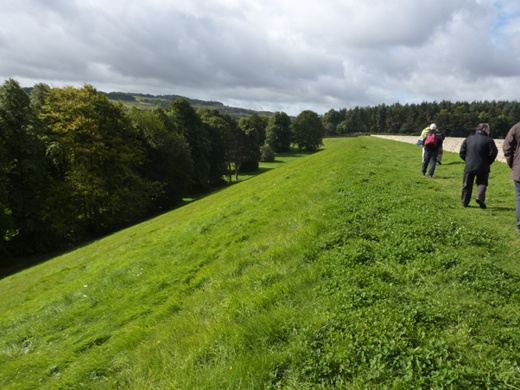
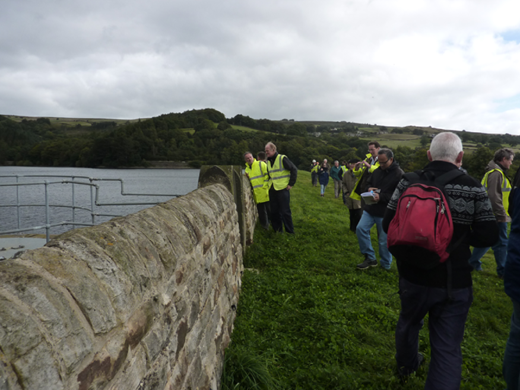
The first dam visited was Adgen (Figure 1). This Pennine type earth embankment dam with puddle clay is 460 m in length and 27·5 m at maximum height and was constructed between 1864 and 1869. The failure of the nearby Dale Dike reservoir, early in the construction of this dam, led to a change of designer from J. Leather to T. Hawksley, who had been responsible for Dale Dike. Some of the changes to the original design, presumably instigated as a result of the failure, included the sealing of the original lowest draw-off and scour with concrete, the lengthening of the overflow weir from 18·3 m to 29·6 m, provision of a masonry wave wall (Figure 2) and re-design of drawoff arrangements.
Recent improvements include the modification of the overflow and waste water channel to enable safe passage of the probable maximum flood. Peak Park planning restrictions apply at this site so the new spillway channel modifications, using form liner finish, were made to look like masonry!
After a lovely lunch at the Old Horns Inn, where we discovered that the Yorkshire version of a well-balanced vegetarian lunch comprised a chip butty with chips on the side, we headed for Dale Dike. This dam is 275 m in length and 22 m in height and of similar construction to Adgen, founded on Millstone Grit with a cut-off trench to rock but with an additional berm. This dam is perhaps the most infamous of the Yorkshire dams built during this period with its failure during construction in 1864, leading to the Great Sheffield Flood resulting in 244 fatalities. This fact is commemorated with a plaque at the dam and was a poignant reminder of the very real risks associated with these structures. The current dam was rebuilt in 1875.
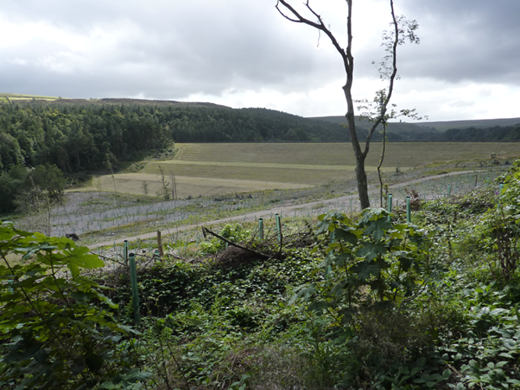
Recent works on the dam include the construction of a new wave wall comprising precast units clad with masonry and in situ concrete, tied to the core. Additionally, vast areas of trees downstream of the dam have been cleared, creating a rather barren landscape (Figure 3). Clifford noted that while this was rather sad he could at least find his way to the dam now!
It was an enjoyable day, made better by both the superb and knowledgeable company and the fact that the rain which had been threatening for much of the day, failed to make an appearance.