The 11th British Dam Society supervising engineers’ forum was successfully held at the National Motorcycle Museum in Solihull, West Midlands on 17 April 2013. This paper summarises the experiences and feedback received relating to the event and highlights where learning has been gained that may be of use for the next forum.
1. Introduction
The 11th British Dam Society (BDS) supervising engineers’ forum was successfully held at the National Motorcycle Museum in Solihull, West Midlands on 17 April 2013. This was the second time that the venue was used. The decision to return to the venue followed generally positive feedback from the previous event in 2011.
This paper does not aim to provide a detailed summary of the presentations and open discussion session on the day. Instead, it summarises the experiences and feedback received relating to the event and highlights where learning has been gained that may be of use for the next forum.
2. Delegate attendance
A total of 231 delegates attended on the day. This is a larger number than had attended previous forums and also more than at the last BDS biennial conference in 2012. Details of the attendance are shown in Tables 1 and 2.
It is not possible to determine the numbers of BDS members attending as compared with non-members as this distinction was not asked for on the event registration form.
3. Venue
Once again, the choice of venue was well received. Some delegates expressed a preference for Manchester as a venue and there were a few comments, particularly from those based in Scotland, that journey times to the West Midlands can be long. An attempt is made to select venues that are relatively easy to access by as many people as possible. It is appreciated that the venue location, whichever is chosen, may not suit everyone. Before the event, the Joining Instructions issued included improved information as to how to travel to the venue and details of nearby accommodation. This appeared to alleviate some of the problems experienced previously.
As with the previous forum, comments were received regarding the seating arrangements. Some delegates expressed a preference for a formal lecture-theatre style seating arrangement for the presentations. There were also comments regarding the apparent limited seating in both the main presentation room and during lunch. The numbers of delegates had been confirmed with the venue up to one week before the event and assurances given that sufficient seating would be provided. It is recognised that additional seating would help delegates circulate and meet up with their colleagues. Therefore, the BDS will ask for additional spare seating capacity for the next event.
4. Forum programme
This followed a similar format to previous events and comprised four presentation sessions followed by an open discussion session. A copy of the programme was included in the delegate pack.
Some delegates suggested it would have been useful to see the programme in advance. An appreciation of the topics to be covered could then be gained and this may aid the preparation of questions. However, as the programme was not finalised until very late owing to issues with confirming presenters, the decision was made to issue it on the day. The suggestion is noted and the BDS will aim to provide the programme on their website at least 1 week prior to the next forum.
5. Presentations
The presentation sessions followed a similar format to previous years.
Session 1 concentrated on legislative matters as they affect supervising engineers. Due to the differing changes in legislation being proposed throughout the UK, an attempt was made to clarify as much of the variation as possible. Delegates raised much concern as to the lack of a presentation on the English legislation changes in this session. While a request to present was made to the Department for Environment, Food and Rural Affairs (Defra), they were unwilling to attend on the same terms as the other presenters. As a result, it was decided to progress with the presentations already confirmed. The Environment Agency was encouraged to take part in the open discussion session so that matters concerning the legislation in England could be addressed. The session included a presentation from the National Farmers’ Union (NFU) to gain a perspective from the farming community. This was generally well received and not nearly as controversial as it could have been!
Session 2 covered the role of the supervising engineer and session 3 dealt with the monitoring and examination of reservoirs. Numerous presentations were submitted for these sessions. In selecting the final presentations, the aim was to cover as wide a variety of topics as possible and to provide opportunity for the newer generation to present.
Session 4 concentrated on matters concerning undertakers. Undertakers perform a vital role in the management and supervision of reservoirs and this is an important area that has been a little lacking in previous forums. However, only a relatively small number of presentations were submitted for this session. Based on the attendance record, there is obviously an interest by undertakers in the forum and it is hoped participation can be expanded in subsequent events.
The delegate pack included presentations that had been held in reserve but, in the end, were not required on the day.
Following the forum, there has been a request for presentations to be placed on the BDS website. The various presenters have subsequently been contacted regarding this and copies of the presentations should now be available.
6. Open discussion session
To enable questions from the floor to be effectively answered, the panel for the open discussion session (Section 5) comprised the following
a representative from the enforcement authority (in this case the Environment Agency)
a representative from an undertaker
an ‘all reservoirs’ panel engineer
a supervising engineer.
Many of the questions received related to proposed reservoir legislation changes as was expected. There was feedback that the responses by the enforcement authority’s representative were not as clear as anticipated. The presence of Defra would have improved matters.
Much of the feedback on this session included suggestions that some questions for the discussion panel should be prepared in advance. This will be taken on board for future events.
There were also some suggestions to divide the session into smaller groups to encourage more participation by delegates. This raises a number of issues that need to be considered in more detail. For example, how could this be effectively managed within the venue; what happens if one topic is considerably more popular than the others; and would some delegates prefer to have an understanding of all the topics being covered? As a result, dividing the session into smaller groups is unlikely to be practical within the constraints of a 1-day forum. Methods to improve delegate participation, perhaps even including a restructuring of the session itself, will be considered for the next event.
7. Exhibitors
There were two exhibitors at the event. Although it would have been preferable to see a larger number of exhibitors, it is appreciated that the time available for delegates to attend them is more limited than at the biennial conference. Nevertheless, the exhibitors present still found the day useful and productive.
8. Feedback
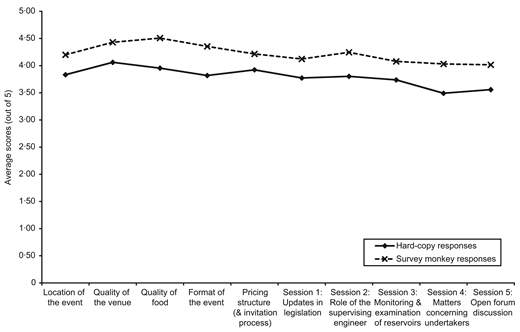
Feedback on the event was gained by both a hard-copy questionnaire on the day and a ‘Survey monkey’ electronic survey following the event. Delegates were asked to respond by only one of the survey methods. A total of 131 responses were received although, as a number of duplicate responses were received, it is difficult to make a detailed direct comparison of the survey methods. Interestingly, the scores were higher for the electronic survey, although the overall trend in the two sets of results is similar (Figure 1). Perhaps delegates are more positive about the event once they have had time to reflect on it.
A single survey method will be used for future forums.
BDS chairman’s footnote
I would like to place on record my thanks and appreciation to Peter for all the hard work that he put in to make this conference such a success. His diligence is further reflected in the above summary which establishes a firm foundation to our next supervising engineers’ forum in 2015.
Ian Hope
BDS chairman
Overall, the BDS supervising engineers’ forum 2013 ran smoothly and the author, as organiser of the event, would like to thank the following for making it a success
the presenters on the day and all those who submitted presentations for consideration
the BDS committee
Tim Fuller, ICE
the National Motorcycle Museum (especially Richard Busz and Steve Gifford).