

EA responds to Pitt review
Twelve months after extreme rain flooded homes and businesses across England and Wales, Sir Michael Pitt launched his final report into the 2007 summer floods on 25 June 2008. The report is the culmination of a year-long inquiry which examined the emergency response to the flooding and investigated how we can reduce the risk and impact of floods in the future. It is a comprehensive report which has sought views from those involved in the floods, including affected residents, the emergency services, business and professional associations.
The Environment Agency warmly welcomed Sir Michael Pitt's final review into last year's summer floods as a significant contribution to managing the future flood risk in England and Wales. ‘Sir Michael's report puts the spotlight back on the need for the country to be prepared and able to respond to the devastating impacts of flooding. He covers a wide range of topics – many directly related to our work – and all of which are essential to better protecting people and the environment from flooding into the future’, EA chief executive Dr Paul Leinster said in response to the report.
One of the areas Sir Michael Pitt highlighted is the potential flood risk from reservoirs. Encouragingly, Sir Michael recognised that, while ‘good progress’ is being made on reservoir safety, some measures could further give assurance that dams and reservoirs stay intact. The EA has also made progress over the past 12 months in this area by promoting recommended improvements for reservoir safety and legislation. Sir Michael Pitt noted that, while in many cases the current legislation system has been effective in avoiding loss of life from reservoir breaches, there is scope for improvement in a number of areas. He cited the EA's recommendations for reservoir safety legislation to be reviewed in his report, as measures that the government should take to up the safety of our reservoirs. All of these take the impacts of climate change and ageing reservoirs into account and are discussed below.
Legislative changes that the EA has proposed include introducing risk-based definitions of a reservoir within the Act. At present the definition is purely volumetric, based on a minimum capacity of 25 000 m3 of water above ground level. We wish to see a definition of reservoirs falling within the Act that takes into account the presence of a downstream community, property and critical infrastructure, together with the consequences of a reservoir failure or dam breach. Such a definition would help to identify the scale of the risk faced at certain dams, as Sir Michael Pitt pointed out, and help prioritise safety actions.
Sir Michael Pitt recommended that government provide ‘local resilience forums’, made up of local authorities, emergency services and utility companies, with such reservoir inundation maps. This information is to help them assess flood risk and prepare a plan for contingency, warning and evacuation. Work is underway by the EA to make flood plans available to emergency planners about the flood risk from dam failures.
To ensure continuous reservoir safety we need funded powers to act at reservoirs with no owner. At present there is a gap in the law, so that reservoirs that are situated on land that is disclaimed following business failures have no legal owner and therefore no legally responsible reservoir undertaker, unless the Crown chooses to exercise its right as ‘keeper of last resort’. The Crown does not always choose to take ownership in these circumstances. This is unacceptable and needs to be resolved. We are aware of at least two reservoirs in England that currently fall within this category. There could be more in the future, particularly as we move toward a risk-based approach. The Pitt report supports this concern and urges the Department for Environment, Food and Rural Affairs (Defra) to address the issue.
There is truth in the adage that ‘Hindsight explains the accident that foresight would have prevented’. The EA has called for mandatory post-incident reporting. At present the system we are operating is voluntary. Defra have charged us with keeping a database of post-incident reports, so that lessons can be learned and disseminated to the reservoir industry. By providing bulletins to the industry we spread that essential learning. Unfortunately, reservoir undertakers do not always choose to inform us about incidents at their reservoirs, for commercial or other reasons.
As Sir Michael Pitt's report pointed out, anonymous reporting and information sharing is an important part of raising risk awareness. ‘A voluntary system does not provide for this comprehensively and a mandatory rule should be instituted’, he added. We believe that it would be in the public interest for it to be made mandatory for reservoir undertakers to report their emergency incidents to the EA.
To influence compliance better, for example to ensure that reservoir safety measures are implemented, we want more flexible enforcement powers. At present our enforcement options following expiry of notice are prosecution, formal caution or warning letter. The Macrory review is bringing in a variety of alternative intermediate enforcement penalties, such as administrative fines and reputational sanctions for all regulatory regimes. We believe that applying these options to reservoir safety will make us more efficient and effective in our enforcement activities.
We also want better enforcement powers for reservoir flood plans. At present there is no specific statutory requirement for a panel engineer to sign off a reservoir (emergency) flood plan. Neither is there a specific power for the enforcement authority to serve notice on a reservoir undertaker to prepare a reservoir flood plan, nor to exercise reserve powers to prepare one on behalf of an undertaker and recover the costs of doing so. We believe that these are omissions from the Act that need to be addressed.
We are seeking all panel engineers' inspection reports and statements, principally for future reference purposes. We also believe that there should be some sort of review process for inspection reports and statements, managed by a professional and technical body such as the Institution of Civil Engineers (ICE). The ICE reservoirs committee already has a role in interviewing and recommending to the secretary of state which engineers are appropriate to appoint to the various reservoir panels under the Act. Sir Michael Pitt also suggested that ICE, which appoints dam engineers for five years, should perform a quality review of reservoir inspections.
Dr Paul Leinster has pointed out the importance of Sir Michael Pitt's acknowledgement of the real risks of climate change. The above recommendations will help us increase reservoir safety in light of these. Sir Michael Pitt's review gives us the support to implement these recommendations and endorses many of our proposed changes towards this goal. But it is up to the industry to deliver these safety measures and changes as a team. We will have to work together to further reduce risks to downstream communities and make our reservoirs cope with the increased risk of flooding from climate change.
To read full comments from the EA on the Pitt Review and lessons learned from the summer 2007 floods, visit http://www.environment-agency.gov.uk/subjects/flood/1867303/1883039/1867421/1916977/1932162/. For Pitt's full review on the ‘Effective management of dams and reservoirs’ go to chapter 19 of http://www.cabinetoffice.gov.uk/~/media/assets/www.cabinetoffice.gov.uk/flooding_review/pitt_review_section_5%20pdf.ashx.
Maich dam overtopped
A dam on Maich Water overtopped and was close to collapse recently. Homes were evacuated and roads closed. Strathclyde police called in Faber Maunsell AR panel engineer Robert Mann to advise on measures to minimise the risk to the public.
The dam is a small earthfill embankment with a central clay core. It is located in the valley of the Maich Water on the border of Renfrewshire and North Ayrshire, north-east of Kilbirnie, Scotland. Its capacity is about 24 000 m3, so it does not come under the Reservoirs Act. It is in private ownership and was used by a fishery for angling.
The dam was very badly damaged by overtopping during a flood in the early hours of Friday 1 August 2008. A large part of the downstream face was eroded away, leaving a vertical face at the crest of the dam at the back of the central clay core. The edge of the eroded down-stream face advanced about 150 mm upstream over the weekend, leaving only about 1 m of crest between the vertical face and the water line. There was concern that complete failure of the dam would take place shortly. About four houses were potentially at risk and were evacuated, and the two roads crossing the Maich Water were closed.
The dam originally had a substantial bypass channel diverting the Maich Water around the reservoir. A 25 m long section had collapsed a few years ago and a rudimentary repair made using gabions had also washed away some time ago. The overflow had been obstructed by fine screens to retain fish and there were unconfirmed reports that sluices had also been installed on the overflow. The screens had been taken down and any sluices removed before the first visit by engineering staff on the Friday.
Outlet arrangements were by inclined penstocks operated by rods on the upstream face of the dam, on a 150 mm pipe through the dam. They were opened at the weekend but no discharge was achieved from the outlets.
Emergency works started on site on Monday morning, 4 August, and involved staff and direct labour from Renfrewshire and North Ayrshire council, contractors, and Strathclyde fire and rescue services.
A temporary bund was made to reinstate the collapsed length of bypass channel wall and divert the river around the reservoir. Pumps were set up to lower the water level, and take the load off the dam. By Tuesday morning the water level had been lowered by about 3·5 m and this had substantially reduced the danger. Residents were allowed home and the roads were reopened, although arrangements were kept in readiness to re-evacuate. Arrangements for demolition of the embankment were commenced.
On Wednesday night a further major rainfall event washed out the temporary repair to the bypass channel and refilled the reservoir. Evacuation and road closure were carried out again. On Thursday work to reinstate the bypass channel using large diameter plastic pipes was started and completed by midnight. Pumping recommenced and had lowered the water level by about 3·5 m by Friday morning.
Weather forecasting predicted dry conditions until early Saturday morning with rainfall rising to severe at Saturday noon. Contractors for the owner had been mobilised and prepared to excavate the dam. Excavation began at 11 am Friday and had lowered the embankment to a level platform at 3·5 m depth by late afternoon that was widened until work stopped after dusk. Excavation work recommenced at 6 am Saturday to widen the platform further and install a rockarmoured toe using reused pitching stone. This provided a low overtoppable bank retaining a small pond of water and silt, about 2·5 m maximum depth, pending construction of an outlet channel from the pond and restoring the original watercourse into the upstream end of the pond.
The platform and armoured toe were completed in increasingly wet conditions at noon on Saturday and the public emergency was declared over. The emergency services and council staff stood down and the role of monitoring the situation and permanent works by the owner was passed to the Scottish Environment Protection Agency (SEPA).
Rainfall slackened off early on Saturday afternoon but severe rain fell later on Saturday and leakage from the reinstated bypass caused undercutting and collapse of the channel floor and the pipes, releasing the full river flow into the pond and over the platform. The platform suffered scour damage to the downstream toe but no release of the contents of the small pond.
Heavy rain continued at times during the following week and the channel scoured as the platform stabilised. The owner's contractors strengthened the channel and platform using large stone armouring, and were discussing with SEPA the proposal to restore the original watercourse into the upstream end of the pond.
The works carried out during the public emergency stage achieved the immediate objective of removing the danger to the public from likely breach of the dam, despite repeated severe rainfall events.
Clunie dam ground engineering awards 2008
The recently completed Scottish and Southern Energy renewable generation project at Clunie dam to install post-tensioned rock anchors has been nationally recognised as winner of the best geotechnical/geoenvironmental private sector project under £1 million as part of the ground engineering awards 2008. The installation project was managed by SSE's civil project engineer Andy Gregory who dealt with all the potential safety and environmental issues of coring vertically up to 40 m in depth through the dam and into the underlying rock. All of which, along with installing multiple strand anchors stressed up to 250 t, was completed by contractor Ritchies.
The works followed the last statutory inspection by Andy Hughes, who along with Paul Nowak of Atkins was responsible for the initial site investigation works and subsequent ground anchor tender design.
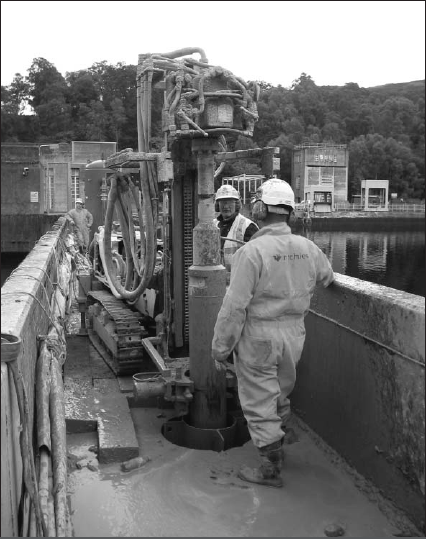
The judges' commendation noted: ‘This is a demonstration of lateral thinking to deliver an innovative solution. Work at the top of the dam with its restricted access had previously used helicopters. But Ritchies' decision to use a high-powered mini-rig for drilling, and floating plant for coiled anchors without pre-grouted fixed lengths, meant the solution lowered costs and environmental impact’ (Fig. 1). Kenny Dempster, Generation civil asset manager added: ‘The award reflects the effort throughout the project to engineer an appropriate solution to what is a very high level of safety case for the dam, the worst conceivable rainfall and snowmelt conditions in the Tummel Valley Scheme. All of which had to consider the very tight physical restrictions of the dam itself’.
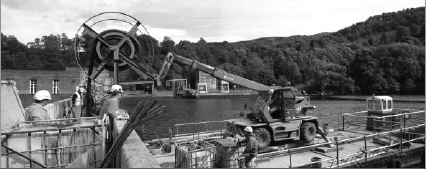
Access at the dam was particularly challenging with no access for traditional crainage, so rather than adopting a helicopter option Ritchies used a derated 360-degree telehandler mounted on a work barge operating on Loch Tummel (Fig. 2). Anchors were delivered to site precoiled. Each anchor was loaded on to a bespoke anchor wheel which could be attached to the telehandler. The work barge then transported the anchor to the borehole location, where it was uncoiled down the borehole using a hydraulic winch on the telehandler mounted anchor wheel. This method was successfully and safely utilised for all of the anchors installed over water.
Proposed changes to reservoir legislation
The panel engineers consultative group (PECG) was set up at the Inspecting Engineers Forum on 26 November 2007. The group has since attended the following meetings
7 February 2008: meeting of PECG with EA and Defra
18 March 2008: attendance by Martin Airey at meeting of Reservoir Safety Consultative Group (RSCG)
23 April 2008: attendance by Jonathan Hinks at RSCG meeting.
In May 2008, the Chairman of the PECG, Jonathan Hinks, sent the following paper to all panel engineers to inform them of developments to date.
1. Representation
PECG were elected by the inspecting engineers and have no mandate to represent supervising engineers. Nevertheless we have attempted to look after the interests of supervising engineers as well and will be reporting to all panel engineers at the Warwick conference in September 2008.
2. Risk-based criteria
PECG support the principle of risk-based criteria (more accurately described as consequence-based) whereby some reservoirs holding less than 25 000 m3 will be inspected and some holding more than 25 000 m3 will be made exempt.
The sensible way to go about this is for the secretary of state to instruct the inspection of high consequence reservoirs holding less than 25 000 m3. However the EA want to minimise their costs and therefore prefer to try to define in the Act which reservoirs should be inspected and then invoke the criminal law if undertakers fail to register them. This will be highly complicated, although detailed proposals have still to be seen by the PECG. Our concern is that it may be unworkable.
Our suggestion is that the EA retain consultants to identify high consequence reservoirs, secure the opinion of an AR panel engineer that they should be inspected and then ask the secretary of state to make the necessary order.
For low consequence reservoirs larger than 25 000 m3 an AR panel engineer will only need to issue a certificate to say that the reservoir need not be inspected again and that no supervising engineer is needed. If houses are subsequently built downstream, the secretary of state can bring it back within the ambit of the Act.
3. Canals
It is proposed that canals and canalised rivers be brought within the ambit of legislation (although not necessarily reservoirs legislation). PECG are aware that British Waterways (BW) already have an inspection regime and their specialists know more about canal safety than most panel engineers are likely to. Nevertheless PECG do not oppose bringing high consequence canal structures within the ambit of legislation. Again we suggest that the EA identify high consequence embankments and that the secretary of state then orders their inspection. With the help of BW, we believe that BDS will be happy to arrange training sessions in canal inspection for panel engineers.
Some non-tidal river embankments will also be included but coastal defences will not.
4. Charging for enforcement
PECG oppose charging reservoir owners for the cost incurred in acting as enforcement authority under the Act. We are concerned that such a scheme would impact on all owners and be particularly difficult for private owners, many of whose reservoirs are only retained for amenity purposes and which provide the benefit to the environment which the EA are keen to promote. PECG are also concerned that any charging scheme may divert money from direct actions needed to maintain reservoir safety at a site.
5. Quality assurance of S10 reports and S12 statements
PECG support the proposal to ensure that all S10 reports and S12 statements are sent to the EA. We also support giving the EA the right to refer any report which they consider to be seriously deficient to an ICE committee which would then carry out a proper investigation (including site visits, etc.) and, if appropriate, have the panel engineer struck off the panel. There has, however, been an attempt to omit the word ‘seriously’ from the RSCG report raising fears that the EA will refer relatively trivial matters to the independent committee. We shall be strongly resisting any attempt to lower the threshold of perceived failings to be referred to the committee.
PECG do not like the term ‘quality assurance’ and, as noted above, will not support anything that involves sniping at the efforts of panel engineers such that report authors are constantly under threat of challenge from a third party body. We are also concerned about the possible costs panel engineers may have to incur in defending themselves, their liability to their clients (the reservoir owners), and the impact undue criticism would have on the number of people wishing to apply (or reapply) for panel membership. PECG are also concerned that reference of reports to an ICE committee could lead to a professional conduct investigation. Clearly this might be appropriate if the failings were sufficiently serious but not for minor deficiencies. The EA have still to explain their proposals but the tone of the meeting on 23 April was encouraging so there is reason to hope that they will come up with a scheme that PECG can accept.
The future of flood risk management in Scotland
On 13 February, the Scottish government launched a flooding bill consultation aiming to modernise the flood risk management system in Scotland. The draft bill includes provision for the enforcement authority role under the Reservoirs Act 1975 to be transferred from local authorities to a single body. The consultation period is now complete and the report on the consultation responses can be found at http://www.scotland.gov.uk/Publications/2008/08/07162000/0. Section 3·4 covers reservoir safety.
Defra and EA reservoir safety R&D strategy
In 2007, following competitive tender, Defra commissioned Atkins to carry out a project which would determine the strategic direction for reservoir safety research and development in the UK for the next 5–15 years.
A key part of the project remit was to consult with the reservoir safety profession to ensure that all areas where there was a perceived need for future reservoir safety R&D work were considered as part of the study. Reservoir safety R&D needs were identified and debated at a two-day workshop in early 2008. Following an open invitation to the industry, participants at the workshop included a number of panel engineers, reservoir owners, academics and other prominent members of the profession. The attendees were asked to vote to prioritise the projects that would deliver the R&D work.
The (draft) reservoir safety research and development strategy is now available for industry review and comment at http://www.environment-agency.gov.uk/subjects/flood/1217883/1217968/907848/2109167/?lang=_e.
Responsibility for delivering reservoir safety R&D for England and Wales has recently transferred to the EA from Defra. Where appropriate, the projects recommended by the strategy will be delivered by the EA's flood risk science team as part of the joint Defra/EA flood and coastal erosion risk management R&D programme.
The EA will be assisted in this task by the ICE reservoir safety advisory group (RSAG). The group, which draws on expertise from government, industry and academia, will provide expert technical advice and peer review. RSAG's overview and guidance will be vital in ensuring that the projects deliver what is required to meet the needs of reservoir owners and the reservoir safety profession.
ICOLD committee on global climate change and dams, reservoirs and the associated water resources
A new committee entitled ‘Committee on global climate change and dams, reservoirs and the associated water resources’ has been formed with a term of office covering the period 2008–2012.
The terms of reference are as follows.
Collect and review the guidance and policies currently used in planning for the impacts of global climate change on dams, reservoirs and the associated water resources.
Assess the role of dams and reservoirs in adapting to the effects of global climate change, and determine the threat posed by global climate change to existing dams and reservoirs.
Recommend measures designed to mitigate against or adapt to the effects of global climate change on water storage facilities. Such recommendations would be developed in light of
increased or decreased precipitation
a change in the rate of evapotranspiration
water quality, erosion and siltation
prolonged drought
flooding.
Publish an ICOLD position paper and guidelines for ‘climate change and dams, reservoirs and the associated water resources’. These documents would be used by the ICOLD membership, governments, the United Nations, the World Bank and other organisations in need of guidance with respect to water resource protection and development.
If you are interested in joining a new committee, please contact Jonathan Hinks (HinksJL@halcrow.com) or Andy Hughes (andy.hughes@atkinsglobal.com).
Upcoming events
The site for the 77th ICOLD Annual Meeting and the 23rd Congress, www.icoldbrasilia2009.org, is now available.
We welcome submissions from readers. Please send contributions (up to 250 words) to the Editor, e-mail: debbie.hay-smith@fabermaunsell.com

