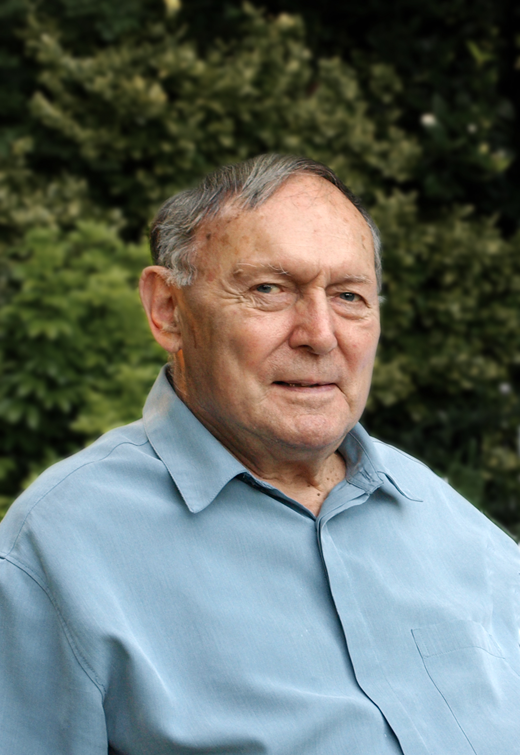
Ted Haws, who died on 24 April 2010 after a long and courageous battle with cancer, was born on 19 January 1927 and brought up in Southend. He graduated in 1947 from St John's College, Cambridge with a cross-country running blue and a first class honours degree in the Mechanical sciences tripos in only 2 years. Ted's first job was with Sir Alexander Gibb and Partners and he was posted to Scotland to work on the Tummel/Garry Hydroelectric scheme where he met and married Moira and where his first son Gordon was born. Later he moved to the Conon Basin scheme where Linda was born.
The next move was to New Zealand as engineer for Sir Alexander Gibb and Partners on the 84 MW Atiamuri hydroelectric project. This was followed by a role as chief engineer responsible for feasibility investigations and design for the Tongariro River power development, also in New Zealand.
On return from New Zealand he became involved in work for Gibb in their role looking after the World Bank's interests in the successful Mangla Dam project in Pakistan.
In 1963 he joined Soil Mechanics Limited, then a subsidiary of Mowlem, and helped to set up an engineering subsidiary called Ercon, of which he became managing director. Ercon provided consultancy services in the fields of geotechnical engineering, water resources and irrigation. In this role he was responsible for the design of Grovehurst Dock dam in Kent and Roding Wid earthfill dam in Essex and later on the proposed Chowilla Dam in South Australia. Other work in this period included the design of the massive foundation for the Natwest Tower in London, investigation into the tunnel portal collapse at Dinorwic pumped storage project in North Wales and numerous water resources and irrigation projects in Afghanistan and the Persian Gulf as well as ash lagoons for coal fired power stations.
Appointed to the All Reservoirs Panel under the UK Reservoirs Act 1975 (he had been appointed to Panel 1 in 1971 under the previous act) Ted carried out numerous reservoir inspections over the ensuing decades. In 1971 he diagnosed alkali–silica reaction in the Val de la Mare concrete gravity dam in Jersey and advised on its remedial works, following which he carried out regular inspections until 2005. Much later he served as chairman of the review board for the design of the Queen's Valley Dam, a bituminous core dam for water supply, also in Jersey.
In 1978 Mowlem decided to scale down the activities of Ercon and Ted joined Rendel Palmer and Tritton (RPT) as a partner responsible for water resources work. In the following 11 years he was responsible for all water-related work done by that firm. This included a flood warning system for the Zambesi River in Mozambique, several ash disposal projects in the UK, design and construction of a major irrigation scheme in Indonesia and studies for a multi-purpose irrigation/hydro-power scheme in the same country. A major landslide at the Ok Tedi mine in Papua New Guinea caused the loss of a tailings dam and Ted was called in as an expert witness into the cause of the failure.
This was followed by leadership of feasibility studies for a proposed 700 MW tidal energy barrage in the Mersey Estuary. Following his retirement from RPT in 1989 Ted continued in private practice as an independent consultant. The expert witness work at Ok Tedi led to him being called in for a similar role following an intake gate failure which wrecked a turbine-generator at Dartmouth Hydroelectric power station in Victoria, Australia. Work on the Mersey Barrage continued and he also carried out numerous reservoir inspections and related work. As regards new reservoirs, he was responsible for some 15 farm reservoirs in East Anglia.
Recognised as an expert in his field Ted held many prestigious appointments. In the early 1980s he was chairman of the British Hydromechanics Research Association. This was followed by chairmanship of the British National Committee on Large Dams (forerunner of the British Dam Society) and chairmanship of the International Commission on Large Dams (ICOLD) Environment Committee. It was in this role that he was asked to lead an international team to review the environmental assessment of the impacts of the Three Gorges Dam in China. From 1993 to 1996 he was vice president of ICOLD. In 1989 he was made a fellow of the Royal Academy of Engineering, an honour of which he was justifiably proud.
Ted has been the author or joint author of some 45 technical papers and book chapters. In 1996 he presented the Parsons Memorial lecture on the subject of tidal energy at the Institution of Civil Engineers in London, a subject he had studied extensively and greatly helped to advance.
As a boss and colleague, Ted was unfailingly courteous although he did not suffer fools gladly. He was Churchillian in style with tremendous drive, energy and a great sense of humour. A keen photographer, he was rarely seen on site without his trusty Leica film camera but he embraced personal computing from its very early days.
Although diagnosed with cancer in 2000 Ted continued working almost to the end, such was his restless energy. He remained unfailingly positive despite bewildering, humiliating and distressing indignities, often saying they were better than the alternative. He was greatly appreciative of the doctors, nurses and hospital staff who cared for him as well as the visiting district nurse team who made it possible for him to remain at home during his final days in Marlow.
Always a family man, Ted leaves a wife, Moira, a son Gordon and daughter Linda plus five grandchildren; three boys in UK and two girls in New Zealand. A second son named Tony worked at the Institute of Hydrology but sadly died in 1995. Ted was greatly looking forward to his and Moira's diamond wedding anniversary in August this year but sadly did not make it. The family all thought the world of him and he will be sadly missed. They kindly supplied me with much information about his early life.