

The tenth Supervising Engineers Forum was held at the National Motorcycle Museum in Birmingham on 6 April. First held 18 years ago, this year the forum attracted more than 200 delegates including 26 new BDS members and six student members.
The forum commenced with an introduction by Julian Welbank of Wessex Water. Julian explained the new non-profit fee structure for the event and the resulting need for the new, larger venue. In his capacity as chairman of the BDS, Martin Airey of Mott MacDonald welcomed delegates to the forum (Figure 1). Martin extended thanks on behalf of those present to Julian and his team for organising the event and highlighted the key role the Supervising Engineers Forum plays in the BDS’s strategy.
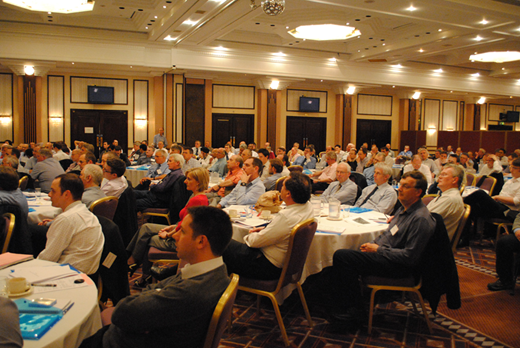
The first session of the day, chaired by Martin Airey, focussed on forthcoming changes to reservoir safety legislation with emphasis on the impact this will have on the role of the supervising engineer. Liana Hamilton-King of the Environment Agency gave an update on the changes planned for England and Wales while Fiona Quinn of the Scottish government ran through the changes proposed north of the border. In both cases the legislation will introduce a hazard-based approach with the degree of regulation varying accordingly. Other common aspects include the minimum reservoir capacity to fall under the coverage of the legislation being 10 000 m3, a single enforcement authority and the retention of panels of engineers. The legislation will differ with two hazard categories in England and Wales but three in Scotland. The one-off grants proposed in Scotland to bring reservoirs not previously covered by legislation up to standard, a proposal not adopted in England and Wales, was an interesting discussion point. To conclude the first session, Peter Mason of MWH presented on the UK Reservoirs Research and Development Strategy and the role of the Reservoir Safety Advisory Group (RSAG) in assisting Defra, the Environment Agency, the Scottish Executive and the Welsh Assembly government in the governance of reservoir safety research and development.
The ‘A team’ – Andy Hughes, Aled Hughes and Andy Rowland presenting with Andy Pepper in the chair – hosted the second session of the day. Atkins’ Andy Hughes gave an enlightening presentation on some of the challenges that a supervising engineer may face in the course of their work. Andy concluded with a call to those present to do more to raise the status of the supervising engineer, recognise the need to train the next generation of dam engineers and value the services the supervising engineer provides and the responsibilities they accept more appropriately. The entirely unrelated Aled Hughes of MWH described the important part that instrumentation can play in the monitoring of the behaviour of dams and the role of the supervising engineer in reviewing the resulting data on a regular basis. The need to plot data to identify trends and reporting any significant departures from these established trends to the Inspecting Engineer was emphasised. Andy Rowland of Black & Veatch ran through some of the issues facing supervising engineers responsible for the supervision of small and historic lakes. With the introduction of the Flood and Water Management Act 2010 (2010) more such reservoirs and lakes will be subject to regulation. Andy highlighted some of the particular problems the supervising engineer may need to address including the owners’ ignorance of the Act and its intentions, the absence of records and lack of money to bring reservoirs up to standard or indeed for general maintenance. Other aspects the supervising engineer would need to take into consideration at such reservoirs would include heritage and conservation.
After lunch and a brief opportunity to explore the motorbike museum the third session comprised a presentation of the new BDS website and a series of case studies from supervising engineers. David Littlemore (BDS Webmaster) from Stillwater Associates demonstrated the recent developments to the BDS website, particularly the resources available in the members’ area, and the planned further improvements in the pipeline. David called on all BDS members to keep their accounts up to date so that the e-news facility is as effective as possible in communicating with members.
The case study presented by Tony Jackson of Mott MacDonald Bentley was entitled ‘Fishing club reservoir – an undertaker without funds’. Tony explained the timeline of events at a small reservoir in West Yorkshire over a period of 6 years from 2005 to the present and the role the supervising engineer has in liaising with the undertaker, the inspecting engineer and the enforcement authority when the undertaker has insufficient money to carry out works required in the interests of safety. Halcrow’s Jonathan Hinks (tongue in cheek) explained how he earned his company Rolls Royce dealing with problems of rapid drawdown. Jonathan illustrated the issues with reference to several reservoirs from Yeovil to Macedonia and Florida. The third case study, presented by Philip Laws and Ian Kirkpatrick of Anglian Water, showed some of the challenges facing undertakers in testing reservoir scour valves and discussed the changing perception of risk within Anglian Water and how this has impacted on valve operations in recent years. Tony Bruggemann of Jacobs ran through the final case study of the afternoon showing the problems that can be caused by badgers burrowing within an embankment dam.
The final session of the day was a panel discussion with Ian Hope of Severn Trent Water, Andy Hughes, Alastair Elder from Jacobs and Tony Deakin of the Environment Agency taking questions from the floor (Figure 2). Most of the lively discussion that followed focussed on the challenges that will follow the forthcoming changes in legislation and particularly the demands this will place on smaller reservoir owners.
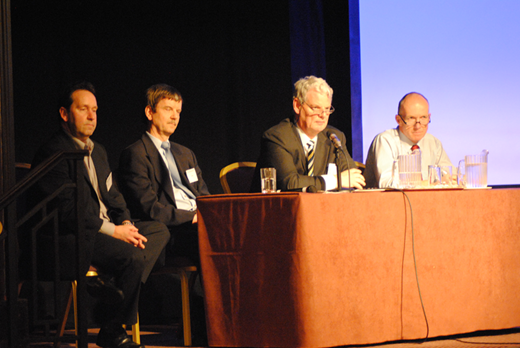
The discussion panel awaiting awkward questions from the floor
The discussion panel awaiting awkward questions from the floor
Julian Welbank closed proceedings at the end of a successful and informative forum. Thanks were extended on behalf of all those present to Julian and his team for their hard work in organising the event.
Analysis of the feedback questionnaires showed overwhelming support for the venue and format of the event. At the committee meeting on 16 May it was agreed to book the same venue for the next forum in 2013. Hopefully by then the commencement orders for the Flood and Water Management Act 2010 will have been enacted!

