

For the majority of us, our only encounters with extreme heights and mountainous regions occur when embarking on a skiing holiday. In the Alps, these extreme elevations are being employed for hydro generation and pump storage schemes. While the statistics are truly mind-boggling, such schemes bring with them massive challenges as demonstrated on a visit to the Emosson arch dam.
1. Introduction
For the majority of us our only encounter with extreme heights and mountainous regions occurs when embarking on a skiing holiday. In the Alps, these extreme elevations are being employed for hydro generation and latterly pumped storage schemes. While the statistics are truly mind boggling, they bring with them massive challenges – as our visit to the Emosson Arch dam was to demonstrate.
2. A brief history of the dams forming the Nant de Drance scheme
The progressive development of hydro generation schemes in the Swiss Alps witnessed a number of major dam building projects in the last century. In 1925 the Barberine dam became the fifth highest dam (at 1888 m above sea level) in south-west Switzerland adjoining the border with France. The role of this dam was superseded in 1975 when the Emosson dam was constructed 1 km downstream, raising the retained water level by 42 m and increasing storage capacity to 225 million m3 (see Figure 1).
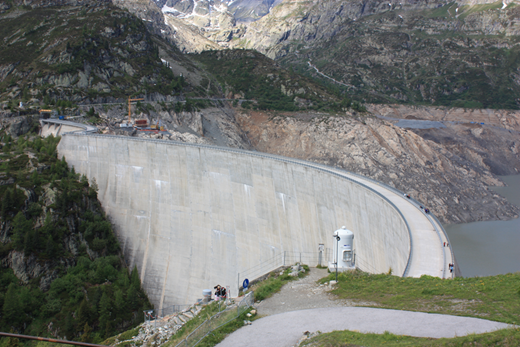
Emosson dam with monitoring station in the foreground and the higher Vieux Emosson dam in the upper valley beyond
Emosson dam with monitoring station in the foreground and the higher Vieux Emosson dam in the upper valley beyond
An adjoining valley was flooded following the construction of the higher Vieux Emosson dam in 1955. The elevation of each of these concrete dams leaves them inaccessible in the winter months between November and April, being wholly snow bound.
Catchment areas are comparatively limited. To overcome this, an extensive network of tunnels acts as massive collector drains from the adjoining valleys supplementing water available from the Emosson dam. This then feeds two hydro generating plants operated by Nant de Drance SA. The first plant being 805 m lower in the sheltered valley at Centrale de Vallorcine before a further drop of 660 m to the plant at Centrale de La Bataiz.
3. Increased versatility by incorporating a pumped storage scheme
The need for increased flexibility in the power generating network has justified the need for a pumped storage scheme. Energy is stored at times of low demand and generated at times of peak demand when electricity prices are significantly higher. Effectively acting as a battery, we learnt that schemes can be engineered to achieve combined efficiencies of between 80–85% by employing variable, high-speed turbines.
Conventional hydropower generation using water from Emosson dam will continue. However, from 2016, the more elevated Vieux Emosson dam will receive and discharge water daily to Emosson dam. Head differences vary from 250 to 395 m depending upon reservoir levels.
The pumped storage scheme is to be housed in a massive powerhouse cavern 52 m high, 117 m long by 33 m wide beneath the Emosson reservoir. This gallery will be accessed by a 5·6 km tunnel from the lower hydro generating plant in the sheltered valley at Centrale de Vallorcine.
A further scheme to raise the Vieux Emosson dam by 20 m has recently been consented. The combined 1·5 billion Euro scheme is so extensive that even the border between France and Switzerland has been realigned for regulation and administrative purposes.
The focus of our visit was on the potential impact of the prodigious tunnelling project on the Emosson dam.
4. Learning from experience
Analogous to a Swiss cheese, the Alps are increasingly being riddled with tunnels. In 1978, the construction of a highway tunnel 1·5 km away from the Zeuzier dam was found to be the cause of major deformation which led to serious cracking and joint opening at the dam. Settlement was caused by drainage from the tunnel which significantly reduced ground water levels.
This event alerted engineers to the need to design for the impact of tunnels adjoining and in the vicinity of dams.
5. Monitoring of Emossom arch dam
The concrete arch dam is 554 m long, 180 m high and retains water up to an elevation of 1930 m. The planned gallery and tunnels for the new plant lie beneath the reservoir, but only 800 m away from the dam structure itself.
Historic records principally using 30 years of pendulum movements have been used to build up a picture of dam deformation both seasonally and under varying load conditions. A comprehensive monitoring network was established in 2007 to build up a more accurate picture of the behaviour of the dam prior to construction of the underlying tunnels and gallery.
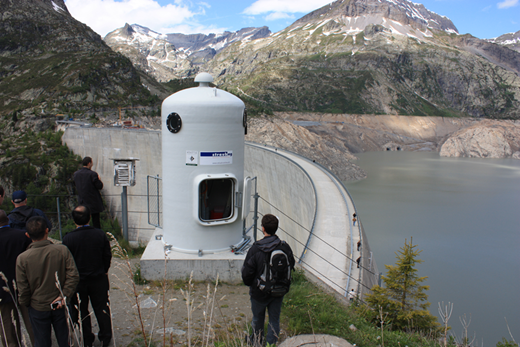
Two automatic total stations have been established taking readings ten times a night (to minimise thermal effects; Figure 2). Accuracy is reported to be +/− 7 mm horizontally and +/−13 mm vertically. Monitoring of the behaviour of the dam is supplemented by periodic manual readings. Survey points on the mountainside have been carefully selected both to monitor geological movements and avoid the impact from avalanches. The two automatic stations can only be accessed by helicopter in the winter.
Designers are seeking to ensure that deformation is within acceptable limits. In 2008 the valley sides were recorded to move by 10 mm following filling of the reservoir.
6. Early challenges arising from the tunnelling project
At the time of our visit only 1·9 km of tunnel had been completed. Late last year progress on the 5·6 km tunnel was hampered after 1·5 km of boring. Fractured rock yielded high volumes of water at 30 bar pressure. While the water could have been drained away, the potential impact of prolonged drainage could have provoked settlement of the dam by reducing the water table. A less stable rock formation has also been encountered after further boring. Clearly challenges continue as the tunnel approaches the reservoir.
7. Regulation and projected deflection of Emosson dam
Dam safety regulation differs significantly from Great Britain with the regulator taking an active role in engineering decision-making, acting as a supervising authority and issuing construction consents. For operating structures this extends to an active involvement in the 5-yearly statutory inspection process.
Having reviewed all the loading scenarios including the impact of the estimated drop in groundwater level of 115 m during operation, it is predicted that the dam will deflect by 8–10 mm. This will be the subject of close scrutiny by the regulator. As the project develops it will be intriguing to witness the accuracy of predicted deflections against actual.
8. Environmental considerations
A project of this size inevitably brings with it a large carbon footprint during construction. However, instead of using locally won river gravels for concrete manufacture, part of the massive production of aggregate produced from the tunnel excavations is being used for this purpose. The remaining spoil will form an access embankment.
The project attracted comparatively few objections which were reportably resolved by increasing compensation flows.
9. Further information and appreciation of hosting visit
Thanks are due to the comprehensive approach of the consortium formed by Nant de Drance SA in arranging our visit and the openness and patience of their staff in responding to the many questions during the conducted visit.
The many interesting facets and statistics to these projects including details of the prefabrication of the new intake structure can be found in this year's ICOLD special issue of Hydropower and Dams (volume 18, issue 3) and on the company's website (http://www.nant-de-drance.ch/home.htm).

