

This paper summarises the technical tours, committee meetings, symposium sessions and workshops attended by a member of the British Dam Society in the international group of International Committee on Large Dams (ICOLD) 2013 attendees.
1. Introduction
International Committee on Large Dams (ICOLD) 2013 was held in Seattle, USA in the Sheraton Seattle Hotel with registration commencing on Sunday 11 August, followed by a 5-day programme of technical tours, technical committee meetings, executive meetings, national and regional meetings, symposium sessions, poster sessions and workshops. An exhibition was held in the hall alongside providing useful and interesting information from a range of suppliers, contractors and consultants.
2. City tour
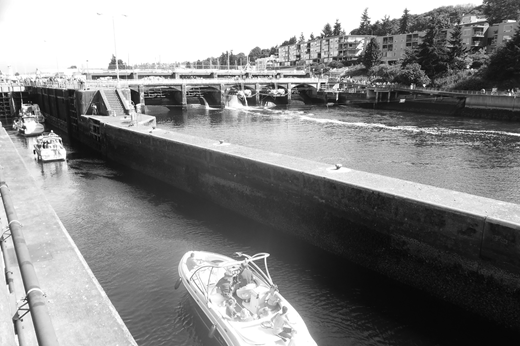
The author of this report joined the city tour on the afternoon of Sunday 11th August. This included an informative tour of the Hiram M. Chittenden locks in Washington Lake (see Figure 1). The locks maintain the water level of the fresh water at 6ṡ1 m to 6ṡ7 m above sea level and prevent the mixing of seawater from Puget Sound with the fresh water of the lakes, as well as moving boats from the water level of the lakes to the water level of Puget Sound and vice versa. A fish ladder is integrated into the locks for migration of fish, notably salmon. This can be viewed in an underwater observation area, which was re-built by the Corps of Engineers in 1976 using 21 steps (weirs). This replaced the ladder that was built in 1917 with just 10 steps, thus reducing the distance that fish need to jump. The Corps also increased the amount of water going through the ladder, called ‘attraction water’. As salmon know instinctively to swim upstream, this movement of water downstream attracts them to the ladder, as does the ‘smell’ of the water from the salmon's upstream birthplace.
3. Environment Technical Committee meetings
Committee meetings were held over 2 days on Monday and Tuesday, 12 and 13 August. The committee has nine country members. Six other countries have applied for membership.
The committee's terms of reference (TOR), as approved in Kyoto in 2012, are as follows.
Examples of environmental good practice in dam planning and design: (a) taking into account environmental aspects in strategic planning related to dams, (b) improved methods in environmental assessment for dams and (c) mitigation of negative impacts of dams and water management.
Environmental aspects of hydro-electric power production: run of river, peaking production, pumped storage.
Socio-economic benefits achieved from dams: some case histories.
Japan will lead a task group for TOR (1) also composed of Australia, Sweden and USA to provide a position paper aimed at assisting the planning process for water resources infrastructure.
New Zealand will lead on TOR (2) including Slovenia and Sweden. Case histories will be researched in several countries to obtain examples of how the environmental impacts of run-of-river, ramping rates, control of discharges and peaking hydro-power production have been dealt with and mitigated. It is foreseen that the first draft of a document on this subject should be ready for discussion at the 2014 annual meeting.
A task force on TOR (3) will be led by Canada and will include the United Kingdom and France.
Seven countries have identified case histories and provided data about the local socio-economic impacts several years after impoundment, namely Brazil (Itaipu dam), Canada (James Bay dams), France (Nam Theun 2 dam in Laos), Morocco (Mansour Eddahbi dam), Japan (Miyagase dam and the three Kizugawa dams), United Kingdom (Elan Valley dams) and Slovak Republic (Gabcikovo dam). A work plan was drafted, which includes the gathering of new information, the definition of a format for the report and the production of a first draft of this document for discussion at the 2014 annual meeting.
4. Symposium sessions
4.1 Introduction
The theme of the symposium was ‘Changing times: infrastructure development to infrastructure management’, which recognises the challenges of managing ageing dams during a time when sustainability, safety and security concerns are vital.
As many of the symposium sessions ran concurrently, the following is a summary of two of the six sessions that ran on Wednesday, 14 August
innovative surveillance and monitoring systems
decommissioning dams at completion of their useful service life.
4.2 Innovative surveillance and monitoring systems
A wide variety of papers were presented covering topics on innovative monitoring technologies, fibre optic sensors, pilotless drones, monitoring geohazards, synthetic aperture radar monitoring, global positioning system (GPS) monitoring systems, real-time monitoring, ambient vibration measurement techniques, dam foundation grout monitoring systems and anchor performance testing methodologies, among other things.
One of the presentations given by R. Rocha of Brazil described the installation of a fibre optic-based monitoring system in Peti dam for measuring continuous expansion of the structure owing to alkali aggregate reaction. This was undertaken by installing cables in boreholes to a variety of depths from 3 m to 30 m down to the rock foundation.
One of the most interesting presentations was given by L. Guinot of France, who described the use of pilotless drones for inspecting inaccessible parts of hydraulic structures such as large concrete dam walls. Unmanned aerial vehicles (UAVs) at a cost of about £40 k to £50 k can reach elevations of up to 200 m with up to 2 h battery life. The images received from these surveys can be more accurate than those achieved by using photogrammetric and light detection and ranging (LiDAR) surveys.
4.3 Decommissioning dams at completion of their useful service life
Papers in this session included
a preliminary study of methods of evaluation of dam and reservoir decommissioning in China
case study of Namuk Tailing dam closure in Indonesia
a non-structural model to predict and to plan for a dam's useful service life
Kabokweni dam: the first government owned dam to be decommissioned in South Africa
decommissioning of the Benamarias dam: a case study.
5. Workshops
5.1 State-of-the-art technologies for monitoring dams and levees
On Friday 16 August, there was a workshop on ‘State-of-the-art technologies for monitoring dams and levees’ in the morning.
This workshop included some interesting discussions on the need for systematic monitoring of the structural behaviour of dams to ensure early detection of defects and changes. The types of monitoring on embankment dams including water level, pore water pressures and leakage rates, and methodologies for measuring these accurately were discussed; as well as the requirement for timely analysis and proper interpretation of the results.
5.2 Decommissioning dams at completion of their useful service life
In the afternoon of 16 August, there was a workshop on ‘Decommissioning dams at completion of their useful service life’. This rolled out the newly prepared United States Society on Dams (USSD) ‘Guidelines for dam commissioning projects’ and featured an overview of the document by the two authors. Case histories were presented for a series of small dam removal projects completed in the USA, followed by discussions of the two largest dam removal projects – the Elwha River Restoration Project and the Condit Dam Removal Project. The presentations included the reasons for dam removal, methods used for river diversion and demolition, sediment management issues and project costs.
The reasons for the dam removal projects were grouped into the three categories
environmental (e.g. improving fish passage)
dam safety (e.g. reduce or eliminate liabilities)
economic (e.g. reduce or eliminate long-term costs when the dam no longer serves its original purpose).
Challenges included cultural and historical issues, loss of benefits, funding, and the technical issues of structural integrity, restoration of the site and sedimentation.
The presenters informed the audience that 63 dams were removed in 2012 in the USA. As detailed in the USSD Guidelines, the following points should be considered during such a project
public safety
stakeholder identification
environmental compliance and permitting regulations
evaluation of alternatives: quantification of benefits, placing value on recreation, fishing and so on, and consideration of operational and legislation costs
hazardous materials, waste disposal and the nature of the sediments trapped in the reservoir
performance and risk mitigation monitoring following the dam removal, including monitoring the river erosion.
The USSD Guidelines will be available soon. More information can be requested by contacting the committee chairperson, with details on the USSD website (http://www.ussdams.org/c_decom.html).
6. Summary
ICOLD 2013 was an excellent opportunity to learn and share knowledge with dam experts from all around the world. In addition to all the meetings, sessions and tours, the social events encouraged networking and discussions on dam engineering practices, projects and experiences with the various international delegates. The benefits of attending this conference are indeed numerous.

