


The integration of blockchain technology and artificial intelligence (AI) is reshaping the financial services industry, offering transformative solutions in areas such as risk management, fraud detection, regulatory compliance and operational efficiency.
This paper presents a systematic literature review of over 100 peer-reviewed studies published between 2020 and 2024, analyzing the benefits, challenges and future directions of blockchain-AI applications in financial services. Our findings reveal that while blockchain enhances data integrity, security and transparency, AI drives predictive analytics, automation and decision-making efficiency.
The synergy of these technologies holds significant potential yet faces critical challenges related to scalability, interoperability, regulatory compliance and ethical AI governance. We identify key research gaps, including the lack of standardized regulatory frameworks, limited real-world case studies and technical barriers to integration. To address these gaps, we propose a comprehensive theoretical framework linking technological advancements to regulatory and ethical considerations. This study contributes to both academic discourse and industry practice, offering actionable insights for financial institutions, technology developers and policymakers navigating the rapidly evolving FinTech landscape.
The rapidly evolving nature of blockchain and AI technologies may limit the long-term applicability of some findings. The study primarily focuses on published academic literature, potentially overlooking some industry-specific developments. Future research should address the identified gaps, particularly in cross-chain interoperability, ethical AI frameworks, and long-term economic impacts. Empirical studies and case analyses could further validate the theoretical insights presented in this review.
This study provides a novel, comprehensive synthesis of blockchain and AI applications in financial services, offering valuable insights for both academics and practitioners. By critically examining the synergies and challenges of these technologies, it presents a unique perspective on their transformative potential in FinTech. The proposed research agenda addresses crucial gaps in current knowledge, guiding future investigations. The findings contribute to a deeper understanding of the complex interplay between technological innovation, regulatory frameworks and ethical considerations in the evolving landscape of financial services.
1. Introduction
The convergence of blockchain technology and artificial intelligence (AI) has emerged as a transformative force in the financial services industry, driving innovation in areas such as risk management, fraud detection, regulatory compliance and operational efficiency. These disruptive technologies are reshaping traditional financial ecosystems, offering solutions that enhance efficiency, security and transparency. Blockchain ensures tamper-proof data integrity through decentralized ledgers, while AI optimizes decision-making processes with predictive analytics and automation. Despite their rapid evolution, there remains a pressing need to understand the complexities of their combined application, especially in the face of increasing regulatory demands and evolving market dynamics.
Through an extensive review of the literature, we have identified several key research gaps that highlight the need for further investigation. First, there are significant integration challenges: while theoretical models are abundant, there is a scarcity of empirical studies showcasing successful blockchain-AI integrations in real-world financial contexts. The lack of standardized protocols hinders seamless data exchange between blockchain networks and AI systems, and both technologies face scalability concerns, especially in high-frequency trading environments. Additionally, systematic challenges such as regulatory ambiguities and operational complexities pose barriers, particularly for smaller financial institutions lacking the computational resources needed to implement advanced AI models within blockchain frameworks. Moreover, the global nature of blockchain conflicts with fragmented national regulations, complicating compliance in cross-border financial operations, while current guidelines inadequately address the ethical implications of AI-driven decisions, such as algorithmic bias and data privacy. Finally, existing studies often address isolated aspects of blockchain or AI without considering their combined impact on financial services, revealing the need for a comprehensive framework that systematically analyzes the interplay between technological, regulatory and operational factors influencing blockchain-AI adoption.
This paper aims to fill these gaps by analyzing the synergistic potential of blockchain-AI integration in financial services, exploring regulatory, ethical and technical barriers to adoption and proposing a structured framework for evaluating and addressing these challenges. By synthesizing over 100 peer-reviewed studies from 2020 to 2024, this research contributes actionable insights for policymakers, industry practitioners and academics navigating the rapidly evolving FinTech landscape. In doing so, we seek to advance both theoretical understanding and practical applications, offering theoretically grounded future research directions that address current limitations and guide the responsible implementation of these transformative technologies.
2. Methodology
This study employs a systematic literature review (SLR) approach to comprehensively analyze the current state of blockchain and AI applications in financial services. We followed the guidelines proposed by Kitchenham and Charters (2007) for conducting systematic reviews in software engineering, adapting them to the context of financial technology. We conducted a comprehensive search of academic databases from Google Scholar. The search terms included combinations of keywords such as “blockchain,” “artificial intelligence,” “machine learning,” “financial services,” “FinTech” and related variants. We focused on peer-reviewed journal articles, conference proceedings and high-quality industry reports published between 2015 and 2023.
To ensure a comprehensive and systematic evaluation of blockchain and AI applications in financial services, we employed a SLR approach, guided by the Preferred Reporting Items for Systematic Reviews and Meta-Analyses (PRISMA) framework. This method allows for a rigorous, transparent and replicable process, enhancing the reliability of our findings.
We conducted an extensive search across multiple academic databases to ensure broad coverage:
Databases: Web of Science, Scopus, IEEE Xplore and Google Scholar
Keywords: “Blockchain,” “Artificial Intelligence,” “FinTech,” “financial services,” “regulatory technology,” “systemic risk” and “algorithmic bias”:
Publication range: 2020–2024 (with key foundational papers from earlier years)
This search yielded over 500 initial articles, which were screened for relevance based on titles and abstracts.
The methodology for this systematic review followed a rigorous protocol to ensure comprehensive coverage and quality of included studies. Our inclusion criteria focused on peer-reviewed journal articles and high-quality conference papers that examined blockchain applications in financial services, specifically requiring publications in English that provided empirical evidence, theoretical frameworks or critical analysis. We excluded non-peer-reviewed sources, studies focused solely on technical algorithms without financial applications and articles lacking sufficient methodological rigor.
Following the PRISMA framework, our selection process began with the identification of over 500 potentially relevant records through systematic database searches. Initial screening based on titles and abstracts eliminated 300 articles that did not meet our inclusion criteria. A subsequent eligibility assessment of 150 full-text articles led to the final inclusion of 100+ studies that met all quality criteria. Quality assessment was conducted using four key metrics: relevance to research objectives, methodological rigor, publication impact factor and recency of publication, with particular emphasis on works published from 2020 onward to ensure currency of findings.
The data extraction and synthesis process focused on key themes including technological applications in financial services, documented benefits such as efficiency and security improvements, implementation challenges including scalability and regulatory issues and future research directions. Using a thematic analysis approach, we systematically identified patterns and trends across the literature, enabling a comprehensive understanding of the current state of research and emerging themes in the field. This structured approach to data analysis ensured the identification of significant gaps in current knowledge while providing a foundation for future research directions in financial technology applications.
3. Result and discussion
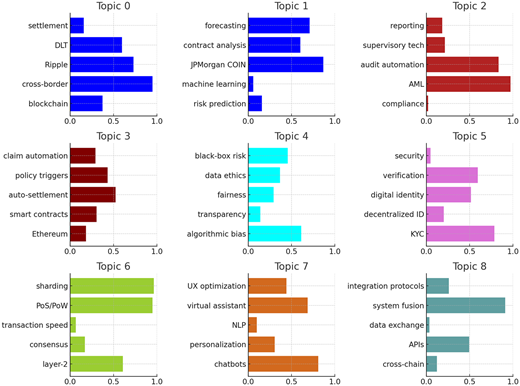
In the hierarchical clustering dendrogram of the nine topics in Figures 1 and 2, we can observe the relationships and similarities among various fintech-related themes. Notably, “Artificial Intelligence in Risk Management” is closely clustered with “Ethical Implications of Algorithmic Bias,” indicating a strong connection in research focus, particularly around AI decision-making transparency and ethical risks. Similarly, “Blockchain Applications in Financial Services” is tightly linked with “Smart Contracts and Automation,” reflecting the pivotal role of blockchain technology in driving financial process automation. In contrast, “Data Privacy and Security in Digital Finance” appears more isolated, suggesting its distinct position as an independent research area. The clustering reveals the intersections and divergences between AI and blockchain technologies within the fintech ecosystem, providing insights into their potential synergies and emerging research trends.
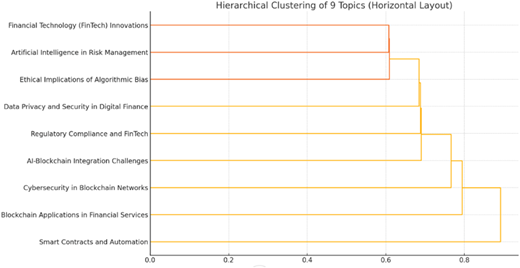
Clustering of the nine topics. (The authors)
Clustering of the nine topics. (The authors)
3.1 Blockchain applications in financial services
Advantages of blockchain technology
Blockchain technology offers unprecedented levels of transparency and immutability in transaction records through distributed ledger technology (DLT), addressing trust issues inherent in traditional financial systems. Its applications in financial services offer significant advantages; Table 1 succinctly summarizes the four main advantages of blockchain technology in financial services, with each advantage accompanied by a brief description and corresponding references. This presentation makes the information clear and highlights the key points of each advantage in Table 1.
Specific applications of blockchain in financial services
Advantages of blockchain technology in financial services
| Advantage | Description | Reference |
|---|---|---|
| Reduced transaction costs | By eliminating intermediaries and automating processes, blockchain significantly reduces operational costs | Chang et al. (2020) |
| Increased transaction speed | Real-time settlement capabilities of blockchain enhance transaction efficiency | Javaid, Haleem, Singh, Suman, and Khan (2022) |
| Enhanced security | The decentralized nature and cryptographic foundations of blockchain provide robust security against fraud and cyber attacks | Pan, Pan, Song, Ai, and Ming (2020) |
| Smart contract automation | Self-executing smart contracts enable automated, intermediary-free transaction processes, further enhancing the efficiency of financial services | Khan et al. (2022), Cong and He (2019) |
Source(s): The authors
Blockchain technology has found wide-ranging applications across various domains of financial services. Table 2 summarizes these applications, highlighting how blockchain is transforming different aspects of the financial industry, from payments and trading to supply chain finance and identity management.
Challenges and limitations of blockchain technology
Applications of blockchain technology in financial services
| Application domain | Description | Example/Key benefit | Reference |
|---|---|---|---|
| Payments and remittances | Blockchain-based systems offer faster, cheaper, and more transparent cross-border transactions | Ripple’s network adopted by banks for real-time gross settlement, currency exchange, and remittance | Chang et al. (2020) |
| Securities trading | Decentralized exchanges (DEX) enhance transparency and efficiency in securities trading | Reduced intermediary costs and 24/7 trading capabilities | Javaid et al. (2022) |
| Supply chain finance | Improves transparency and traceability of supply chain transactions | IBM’s TradeLens platform, developed with Maersk, for efficient and secure supply chain financing | Pan et al. (2020) |
| Smart contracts in insurance | Automate insurance claims processing, reducing fraud and improving efficiency | AXA’s fizzy product uses Ethereum smart contracts to automate compensation for flight delays | Khan et al. (2022) |
| Identity management and KYC processes | Revolutionizes identity management and Know Your Customer (KYC) processes | Decentralized identity systems provide more secure, efficient, and user-centric identity verification | Kuperberg (2019), Liu et al. (2020) |
Source(s): The authors
Despite its potential, blockchain technology faces several significant challenges in practical implementation. Table 3 summarizes these challenges, highlighting the key hurdles that need to be addressed for widespread adoption of blockchain in the financial sector.
Challenges in practical implementation of blockchain technology
| Challenge | Description | Reference |
|---|---|---|
| Scalability issues | Current blockchain systems face bottlenecks in transaction processing speed and network scale. Bitcoin and Ethereum have relatively slow transaction speeds, limiting large-scale application | Feng et al. (2021) |
| Regulatory uncertainties | The decentralized nature of blockchain complicates its regulation. Lack of unified legal frameworks across countries increases uncertainty in technology application | Didenko (2020) |
| Interoperability challenges | Achieving seamless data exchange and smart contract recognition between different blockchain platforms remains a significant hurdle | Paik, Xu, Bandara, Lee, and Lo (2019) |
| Energy consumption | Proof-of-Work consensus mechanisms, used by many blockchain networks, are energy-intensive, raising sustainability concerns | Politou, Casino, Alepis, and Patsakis (2019) |
| Privacy concerns | While blockchain offers transparency, it also raises questions about data privacy, especially in financial transactions where confidentiality is crucial | El Haddouti and El Kettani (2019) |
| Blockchain mutability | Certain scenarios can lead to changes in the blockchain, raising concerns about long-term data integrity and the potential for manipulation, despite blockchain often being touted as immutable | Politou et al. (2019) |
Source(s): The authors
3.2 Applications of artificial intelligence in financial services
Advantages of AI technology
AI offers significant advantages in the realm of financial services. Table 4 summarizes these key benefits, demonstrating how AI is enhancing data analysis, forecasting, operational efficiency and customer experience in the financial sector.
Specific applications of AI in financial services
Advantages of AI in financial services
| Advantage | Description | Reference |
|---|---|---|
| Enhanced data processing | AI can analyze vast amounts of structured and unstructured data at high speeds, enabling real-time insights | Giudici (2018) |
| Predictive analytics | Machine learning algorithms can identify patterns and trends in financial data, enabling more accurate forecasting and risk assessment | Xie (2019) |
| Automation of routine tasks | AI can automate repetitive tasks, freeing up human resources for more complex decision-making processes | Al-Shabandar et al. (2019) |
| Personalization | AI enables the delivery of highly personalized financial services and products based on individual customer data and behavior | Kumar, Lim, Sivarajah, and Kaur (2023) |
Source(s): The authors
AI has found diverse applications across various domains of financial services. Table 5 summarizes these applications, highlighting how AI is transforming different aspects of the financial industry, from risk management and fraud detection to customer service and credit scoring.
Ethical considerations and potential biases of AI algorithms
Applications of AI in financial services
| Application | Description | Example/Key benefit | Reference |
|---|---|---|---|
| Risk management | AI algorithms analyze market data in real-time to predict potential risks | JPMorgan’s COIN platform analyzes complex contracts, reducing time spent on risk assessment | Giudici (2018) |
| Fraud detection | AI-powered systems quickly identify abnormal transactions and prevent fraud | PayPal’s AI-driven system has significantly reduced fraud losses, analyzing millions of transactions in real-time | Xie (2019) |
| Customer service | AI-driven chatbots and virtual assistants provide 24/7 customer support | Bank of America’s virtual assistant, Erica, uses natural language processing for various banking tasks | Al-Shabandar et al. (2019) |
| Algorithmic trading | AI algorithms are used in high-frequency trading, analyzing market trends and executing trades rapidly | Renaissance Technologies' Medallion Fund, relying on AI and ML, has consistently outperformed the market | Kumar et al. (2023) |
| Credit scoring | AI models analyze a wider range of data points for fairer and more accurate credit assessments | Lenddo uses AI to analyze non-traditional data sources for credit scoring in emerging markets | Citron and Pasquale (2014) |
Source(s): The authors
While AI offers numerous benefits to the financial services sector, its application also raises several ethical concerns and potential biases that need to be carefully addressed. Table 6 summarizes these key issues, highlighting the challenges that financial institutions, regulators and policymakers must navigate to ensure the responsible and equitable use of AI in finance.
Ethical concerns and potential biases of AI in financial services
| Concern/Bias | Description | Reference |
|---|---|---|
| Data privacy | AI systems rely on large amounts of user data, raising concerns about data collection, storage, and usage practices | Janssen, Brous, Estevez, Barbosa, and Janowski (2020) |
| Algorithmic bias | AI algorithms may reflect and amplify existing societal biases, leading to unfair financial decisions (e.g. biased credit scoring against certain demographic groups) | Citron and Pasquale (2014) |
| Lack of transparency | The “black box” nature of many AI decision-making processes makes it difficult for users and regulators to understand and trust AI-driven financial decisions | Falco et al. (2021) |
| Job displacement | The automation of financial tasks through AI may lead to job losses in certain sectors of the financial industry | Dellermann, Ebel, Söllner, and Leimeister (2019) |
| Systemic risk | The widespread adoption of similar AI models across financial institutions could potentially increase systemic risk in the financial system | Giudici (2018) |
Source(s): The authors
3.3 The potential of blockchain and AI integration
Synergies between blockchain and AI
The integration of blockchain and AI technologies offers significant potential for enhancing financial services. Table 7 summarizes the key synergies between these two technologies, demonstrating how their combination can address some of the individual limitations of each technology while amplifying their benefits in the financial sector.
Successful integration cases
Synergies between blockchain and AI in financial services
| Synergy | Description | Reference |
|---|---|---|
| Enhanced data quality | Blockchain can provide AI systems with high-quality, tamper-proof data, improving the accuracy of AI models | Salah, Rehman, Nizamuddin, and Al-Fuqaha (2019) |
| Improved transparency | Blockchain can record the decision-making processes of AI algorithms, addressing the “black box” problem and enhancing transparency | Nassar, Salah, Rehman, and Svetinovic (2020) |
| Decentralized AI | Blockchain can enable the creation of decentralized AI systems, reducing the concentration of power in the hands of a few large tech companies | Kumar et al. (2023) |
| Smart contract optimization | AI can optimize the performance and security of blockchain smart contracts | Rane, Choudhary, and Rane (2023) |
Source(s): The authors
The integration of blockchain and AI technologies in financial services presents both promising opportunities and significant challenges. Table 8 summarizes key successful integration cases as well as the technical and operational challenges that need to be addressed for the widespread adoption of these combined technologies in the financial sector.
Blockchain and AI integration in financial services – successful cases and challenges
| Category | Area/Challenge | Description | Reference |
|---|---|---|---|
| Successful integration cases | Credit Scoring | Blockchain records user credit data while AI algorithms perform credit scoring, improving accuracy and transparency of credit evaluations | Kumar et al. (2023) |
| Supply Chain Finance | Blockchain ensures authenticity of transaction records, AI optimizes supply chain finance services (e.g., IBM and Maersk’s TradeLens platform) | Pan et al. (2020) | |
| Algorithmic Trading | Blockchain enables automated transactions via smart contracts, AI optimizes trading strategies in real-time | Hu, Liang, Xiong, and Niyato. (2021) | |
| Technical and operational challenges | Data Quality and Integrity | Ensuring authenticity, completeness, and timeliness of data in blockchain systems is crucial for AI algorithm accuracy | Paik et al. (2019) |
| Computational Resources | Efficiently utilizing substantial computational resources required by both technologies | Hu et al. (2021) | |
| Interoperability | Ensuring compatibility between blockchain and AI systems for seamless integration | Salah et al. (2019) | |
| Regulatory Compliance | Addressing complex regulatory questions regarding data privacy, algorithmic transparency, and compliance with existing financial regulations | Didenko (2020), Zetzsche, Buckley, Arner, and Barberis (2017), Anagnostopoulos (2018) | |
| Skill Gap | Shortage of professionals with expertise in both blockchain and AI technologies | Kumar et al. (2023) |
Source(s): The authors
3.4 Future research directions
Based on our analysis of the current state of blockchain and AI in financial services, we propose several key areas for future research. Table 9 summarizes these research directions, covering technological advancements, integration and interoperability challenges, regulatory and ethical considerations, economic and social impacts and sustainable finance applications. This research agenda aims to address critical gaps in our understanding and to drive the responsible and effective integration of blockchain and AI technologies in the financial sector.
Future research directions for blockchain and AI in financial services
| Research area | Specific topic | Description | Reference |
|---|---|---|---|
| Technological advancements | Scalability Solutions | Research into innovative consensus mechanisms and layer-2 solutions to address blockchain scalability issues | Feng et al. (2021) |
| Quantum-Resistant Cryptography | Developing quantum-resistant cryptographic algorithms for blockchain to ensure long-term security | Politou et al. (2019) | |
| Explainable AI | Advancing research in explainable AI (XAI) techniques to enhance transparency and interpretability of AI decision-making | Falco et al. (2021) | |
| Integration and interoperability | Cross-Chain Communication | Developing efficient and secure protocols for communication between different blockchain networks | Paik et al. (2019) |
| AI-Blockchain Fusion | Exploring novel architectures for seamless integration of AI and blockchain technologies | Kumar et al. (2023) | |
| Standardization | Researching and developing standards for blockchain-AI integration to ensure interoperability | Salah et al. (2019) | |
| Regulatory and ethical frameworks | Regulatory Sandboxes | Studying the effectiveness of regulatory sandboxes in fostering innovation while ensuring consumer protection | Didenko (2020) |
| Ethical AI Guidelines | Developing comprehensive ethical guidelines for AI use in financial decision-making | Janssen et al. (2020) | |
| Privacy-Preserving Techniques | Advancing research in privacy-enhancing technologies for blockchain and AI applications | El Haddouti and El Kettani (2019) | |
| Compliance Automation | Investigating the potential of AI and blockchain in automating compliance processes | Burdon and Sorour (2020) | |
| Economic and social impact | Financial Inclusion | Investigating the potential of blockchain and AI in promoting financial inclusion in developing economies | Chang et al. (2020) |
| Systemic Risk Assessment | Studying the impact of widespread adoption of blockchain and AI on systemic risk | Giudici (2018) | |
| Labor Market Dynamics | Analyzing long-term effects of AI and blockchain adoption on employment patterns | Dellermann et al. (2019) | |
| Sustainable finance | Green FinTech | Exploring blockchain and AI applications in sustainable finance and ESG investing | Pan et al. (2020) |
| Energy-Efficient Consensus | Researching energy-efficient consensus mechanisms for blockchain networks | Politou et al. (2019) | |
| AI for Climate Risk | Developing AI models for assessing and mitigating climate-related financial risks | Giudici (2018) |
Source(s): The authors
This section outlines the theoretical and practical implications of integrating blockchain and AI in financial services. By linking our findings to identified research gaps, we provide a foundation for future studies and practical applications in the financial sector.
4. Theoretical implications
Our research contributes to the academic discourse in several key areas:
Our study makes several significant theoretical and practical contributions to the understanding of blockchain and AI integration in financial services. First, we develop a comprehensive, multi-layered framework that systematically integrates technological, regulatory and ethical dimensions of blockchain-AI applications. This framework uniquely demonstrates how the synergistic relationship between blockchain’s inherent data integrity and AI’s analytical capabilities can effectively address critical industry challenges, including fraud detection, risk management and compliance automation.
Second, while previous research has predominantly examined blockchain and AI technologies in isolation, our review synthesizes these perspectives to provide a holistic understanding of their combined impact on financial services. This integrated approach reveals previously underexplored areas such as cross-chain interoperability, ethical AI governance and the potential systemic risks associated with widespread AI adoption in blockchain-based financial systems. By bridging these literature gaps, we establish a foundation for future research that considers the interconnected nature of these technologies.
Third, our study advances the theoretical discourse on ethical and regulatory dimensions of financial technology integration. Through a detailed examination of critical issues including algorithmic bias, data privacy concerns and regulatory compliance challenges, we contribute to emerging discussions on “responsible AI” and blockchain governance in financial services. Furthermore, we propose new theoretical models that specifically address the complexities of global regulatory fragmentation and the challenges inherent in cross-border financial transactions. This contribution is particularly significant as it provides a framework for understanding how technological integration can be achieved while maintaining ethical standards and regulatory compliance in an increasingly complex global financial landscape.
Our findings highlight significant practical implications across three key stakeholder groups in the financial technology ecosystem. For financial institutions, the integration of blockchain and AI presents transformative opportunities in risk management, operational efficiency and compliance. The combination of blockchain’s transparency with AI’s predictive analytics enables enhanced fraud detection and anti-money laundering (AML) processes, while smart contracts and AI automation streamline operations, reduce costs and improve customer service quality. Financial firms can further benefit from AI-driven RegTech solutions integrated with blockchain for more efficient regulatory reporting and reduced compliance risks. For technology developers, we identify two critical priorities: developing interoperable solutions that enable seamless data flow between blockchain networks and AI platforms and addressing blockchain’s high energy consumption through sustainable consensus mechanisms optimized by AI algorithms. For policymakers and regulators, our research emphasizes the need for adaptive regulatory frameworks that can evolve with technological advancement, including the implementation of regulatory sandboxes for testing FinTech innovations and establishing ethical standards for AI applications focusing on transparency, fairness and accountability. Given the global nature of these technologies, enhanced international regulatory cooperation is essential to address jurisdictional inconsistencies and create a harmonized oversight environment that promotes innovation while maintaining adequate regulatory control.
Our study systematically addresses the three critical research gaps identified in the literature. First, regarding integration challenges, we provide comprehensive case studies and theoretical frameworks that explore effective combinations of blockchain and AI technologies in financial services. Second, we analyze existing regulatory framework inadequacies and propose future research directions for developing adaptive compliance models that can evolve with technological advancement. Third, by identifying operational bottlenecks in implementation, we offer practical strategies for overcoming key challenges in scalability, interoperability and security issues. These contributions provide a foundation for understanding both the theoretical and practical aspects of blockchain-AI integration in financial services.
Building on these findings, we propose several critical directions for future research across three key dimensions. In the realm of ethical and regulatory frameworks, researchers should investigate how explainable AI (XAI) models can be integrated with blockchain to enhance transparency in financial decision-making and examine the role of regulatory sandboxes in fostering innovation while ensuring consumer protection. Technical innovation research should focus on developing effective interoperability protocols for cross-chain communication in blockchain networks and designing quantum-resistant cryptographic algorithms to secure blockchain-AI systems. Finally, research on economic and social impacts should examine the long-term implications of blockchain-AI integration on the global financial workforce and explore how these technologies can promote financial inclusion in underbanked regions, thereby addressing broader societal challenges in the financial sector.
5. Conclusion
This systematic review synthesizes the current state and future trajectories of blockchain and AI integration in financial services, revealing both transformative opportunities and significant challenges. Our analysis demonstrates that while blockchain technology enhances financial systems through decentralization and immutable data records, and AI enables advanced predictive analytics and process automation, their synergistic integration presents complex technical, regulatory and ethical challenges. Through comprehensive examination of implementation cases and regulatory frameworks across major financial markets, we identify critical gaps in scalability solutions, cross-border regulatory coordination and standardized governance frameworks that must be addressed for widespread adoption in the financial sector.
Our findings contribute to both theoretical understanding and practical implementation strategies in three key areas. First, we develop a structured framework for analyzing the technological and regulatory dimensions of integrated financial systems, particularly focusing on operational efficiency and risk management. Second, we identify specific pathways for regulatory evolution, emphasizing the need for adaptive frameworks that balance innovation with consumer protection across jurisdictions. Third, we establish a research agenda addressing critical areas including sustainable technical solutions, standardized governance protocols and socioeconomic impact assessment. These contributions provide a foundation for future research while offering actionable insights for financial institutions, regulatory bodies and technology developers in creating more efficient, transparent and resilient financial systems.

