


This research aims to investigate the factors influencing entrepreneurial intentions among the Indigenous Bisaya individuals, focusing on the interplay between subjective norms, attitude toward entrepreneurship and the moderating effect of start-up capital.
This research uses a quantitative approach for data collection and analysis. Data were collected from 205 Bisaya individuals residing in four cities in Sarawak through a questionnaire survey. The data were then analyzed using the partial least squares path modeling technique.
The findings reveal a positive relationship between subjective norms and both attitude toward entrepreneurship and entrepreneurial intention. Furthermore, the study establishes a positive relationship between attitude toward entrepreneurship and entrepreneurial intention. Notably, start-up capital is found to moderate these relationships, specifically by negatively moderating the relationship between subjective norms and entrepreneurial intention. This indicates that the influence of subjective norms on entrepreneurial intention is stronger when start-up capital is modest.
The findings highlight the importance of cultural and economic factors in shaping entrepreneurial behavior within indigenous communities, providing valuable insights for policymakers and support programs aimed at fostering entrepreneurship among the Bisaya people.
This research is one of the first studies to focus on the entrepreneurial intention of the Indigenous Bisaya people in Sarawak, Malaysia. It also contributes to the literature by examining the moderating role of start-up capital in the relationship between entrepreneurial intention and its key predictors.
Introduction
Entrepreneurial activities appear to have driven businesses to succeed in the 21st century despite enormous economic and social challenges. Consequently, many countries prioritize this promotion, aiming to spark interest in entrepreneurship at all levels of society. There is evidence that entrepreneurship and economic growth are closely intertwined (Bird, 1988; Delmar and Davidsson, 2000). As a result, researchers began to focus on identifying the predictors of individuals’ inclination to engage in entrepreneurship and acknowledging entrepreneurial activities as a component of economic growth (Vamvaka etal., 2020). However, the realization of entrepreneurial activity depends on individuals who are willing to pursue it as a career. Scholars have shown a great deal of interest in this topic, and its advancement has been noteworthy in the field of research (Pruett etal., 2009).
To advance socioeconomic sustainability, particularly within a market economy, scholars also emphasize the importance of community involvement in entrepreneurial activities (Schmidt etal., 2013). Accordingly, greater participation in entrepreneurial activities is essential, as they serve as crucial instruments for long-term economic and national growth (Engle etal., 2010). Singh and DeNoble (2003) and Walker and Webster (2007) found that engaging in entrepreneurial activities enables individuals to maintain their current lifestyle and remain economically relevant, particularly in aging societies. However, the interest in becoming an entrepreneur depends on several factors, including individual entrepreneurial intention and other push and pull factors. In fact, entrepreneurial activities are directly linked to the United Nations Sustainable Development Goals (SDG) 2030 Agenda, which emphasized achieving a balance between environmental, social and economic development. This integration of business and societal interactions aims to provide value for stakeholders while advancing sustainable development goals (Pascucci etal., 2022). To subscribe to this entrepreneurial agenda, stakeholders should include all levels of society, including indigenous and minority communities.
To achieve the nation’s economic sustainability, one strategy is to encourage and promote indigenous entrepreneurship. As part of this effort, the Malaysian Government has introduced and implemented numerous policies and initiatives. Similarly, the Sarawak Government has implemented various policies and activities through the Bumiputera Small and Medium Enterprise unit of the Ministry of Industrial and Entrepreneurial Development (MIED) Sarawak, aimed at boosting entrepreneurial interest and performance (Keling and Entebang, 2015). Additionally, indigenous Dayaks in Sarawak have been encouraged to participate in entrepreneurial activities to improve economic dependency (Keling and Entebang, 2017). Moreover, in recent years, scholars and authorities have shown growing interest in indigenous entrepreneurship as a field of investigation.
The Bisaya community in Sarawak, one of the 28 indigenous ethnic groups, comprises approximately 12,000 individuals, mainly residing in the flat and rolling hills of the Limbang plains, covering an area of 300 square kilometers (Ritchie, 2006; Blandoi, 2004: Bewsher, 1958: St. John, 1863). The Bisaya are part of the Dusunic group and share similar linguistic traits, physical characteristics and mannerisms with the Kadazandusuns of Sabah – another state of Malaysia in the Northern Borneo, particularly the Tatana (Bewsher, 1958). Despite this, the Bisaya in Sarawak are classified under the generic term “Orang Ulu,” along with other minority non-Muslim groups such as the Kayan, Kenyah, Lun Bawang, who are neither Iban nor Bidayuh. However, this classification is reluctantly accepted by the Bisaya (Blandoi, 2004) as they do not share linguistic and cultural similarities with the other groups (Alas, 2004; St. John, 1863; Bewsher, 1958).
Similar to most indigenous people in Sarawak, entrepreneurial activities are new to the Bisaya community. The Bisaya community was previously subsistence farmers, planting both wetland and dry-land rice as their principal subsistence crops, and sago as their second staple food (Blandoi, 2004). Cash crops including rubber, fruit trees and vegetables were also planted for cash incomes along with buffalo herding, pigs and chicken rearing (Blandoi, 2004). To uplift their living standard today, the Bisaya have moved out of the subsistence economy and only plant rice and rear buffaloes for recreational purposes and traditional requirements to a more sustainable economy through participation in entrepreneurial activities. From a mere 50 small businesses owned by Bisaya in the early 2000s (Ritchie, 2006; Blandoi, 2004), there are now hundreds of small businesses operating in Limbang, Miri, Bintulu and Kuching under their names (Blandoi, 2004). Based on the trend, the community’s decision to get involved in entrepreneurship is relevant but still insignificant. Participating in the nation’s growth through entrepreneurship is, in fact, a major undertaking for the Bisaya community itself. As a result, it is crucial to understand the variables or reasoned actions that may ignite these interests, as well as the viewpoints of community entrepreneurial intention. Schmidt etal. (2013) believe that the relationship between value orientations and entrepreneurial intention is well established using a reasoned action approach that includes self-direction autonomy.
To enhance the economic standing of indigenous people, particularly the Dayak group, Keling and Entebang (2017) propose that conducting a comprehensive investigation into Indigenous entrepreneurship performance is a wise move. In reality, there is minimal, if any, research focused on entrepreneurship within the Bisaya community (Blandoi, 2004). A more thorough analysis of different social levels and a multifaceted exploration of entrepreneurial goals will expand and improve perspectives on the theory of reasoned action (TRA). Consequently, this investigation is particularly valuable from the perspective of the Indigenous Bisaya community. Therefore, the objective of this study is to examine the entrepreneurial intentions of the Indigenous Bisaya people and identify the predictors of their business aspiration using the TRA framework. This research serves as one of the first studies to focus on the entrepreneurial intention of the indigenous Bisaya people in Sarawak, Malaysia. It also contributes to the literature by examining the moderating role of start-up capital in the relationship between entrepreneurial intention and its key predictors using the TRA.
The structure of this paper unfolds in the following sequence: an in-depth literature review to cultivate insights into entrepreneurial intention, particularly within the framework of the TRA; subsequent sections encompass the study methodology and results. This is followed by a comprehensive discussion, implications and conclusion.
Literature review
Individual entrepreneurial intention is influenced by various factors, including familial environment, education, job experience and economic opportunities (Pascucci etal., 2022). Additionally, personality, entrepreneurial experience and sense of community play a crucial role in driving Indigenous entrepreneurship (Hanafiah etal., 2024). Mishra and Gupta (2024) further highlight that economic and contextual factors have a greater impact on the entrepreneurial intentions of tribal youth than psychological factors. As Bird (1988) and Boyd and Vozikis (1994) emphasized, entrepreneurial intention directs and guides individuals toward the implementation of entrepreneurial behavior. Similarly, Vamvaka etal. (2020) highlighted that entrepreneurial intention focuses individuals’ attention on transforming intention into action, serving as a bridge between entrepreneurial thought and behavior. Entrepreneurial thinking encompasses managing risk, fostering innovation and seizing opportunities (Barringer and Ireland, 2019), requiring individuals capable of overcoming these challenges.
Research has also explored gender-specific dynamics in entrepreneurship. Dinc and Budic (2016) investigated key factors affecting women’s intentions to start their own business, emphasizing the role of supportive cultures and challenging social conventions. Their findings suggest that cultivating environments that support female entrepreneurship can inspire more women to pursue entrepreneurial ventures. This offers valuable insights for policymakers and organizations striving to empower women entrepreneurs, significantly enhancing our understanding of gender dynamics in entrepreneurship.
Moreover, education has been recognized as a critical moderator in the development of entrepreneurial intentions. Entrialgo and Iglesias (2016) explored the moderating effects of entrepreneurship education on factors influencing entrepreneurial inclinations. Their research demonstrated how educational programs can strengthen the relationship between antecedents – such as personal attitudes, subjective norms and perceived behavioral control – and the intention to pursue entrepreneurship. This suggests that entrepreneurship education not only equips individuals with essential skills but also shifts attitudes and perceptions, enabling them to pursue entrepreneurial goals with greater confidence. The findings imply that educational institutions and the relevant authorities should concentrate on incorporating real-world experiences and mentorship into educational curricula to cultivate a more entrepreneurial mindset.
Ultimately, entrepreneurship begins with an individual’s intentional purpose. Research on entrepreneurial intention is particularly compelling when examining individuals who are culturally less exposed to entrepreneurial activities, such as the Indigenous Bisaya community. Understanding the drivers behind entrepreneurial intention is key to fostering an entrepreneurial mindset, which involves the development of competencies, personal characteristics and both internal and external motivations that inspire individuals to take purposeful action.
The theory of reasoned action
The TRA, originally introduced by Fishbein and Ajzen (1975), posits that an individual’s behavior is primarily driven by behavioral intentions, which in turn are shaped by two key factors: attitude toward the behavior and the subjective norms surrounding it. According to this model, an individual’s intention to perform a particular behavior is determined by personal attitude toward that action and the perceived social pressure (Fishbein and Ajzen, 1980).
The application of TRA in predicting human behavior has been well-established, especially in studies examining how individual attitude and subjective norms influence decisions (Wibowo and Indarti, 2020). This theory suggests that individuals make rational choices based on their personal beliefs and the social influences they perceive. In essence, the TRA identifies two major determinants of behavioral intentions: the person’s attitude toward the behavior and subjective norms associated with it (Fishbein and Ajzen, 2010; Wibowo and Indarti, 2020). Recent studies continue to affirm the relevance of the TRA in understanding a range of behaviors, including entrepreneurship, health behavior and technology adoption, underscoring its robustness across diverse contexts (Yzer, 2017; Montano and Kasprzyk, 2015).
Rather than addressing “attitude toward the act of behavior” in general, this study focusses on specific attitudes relevant to the Indigenous Bisaya community to provide more targeted insights. For instance, we examine attitude in terms of risk aversion, analyzing how individuals’ perception of risk influences their entrepreneurial intentions, as well as the perceived value of entrepreneurship, which reflects how entrepreneurship is viewed as a viable and respected career path within Bisaya culture.
Conversely, this study examines subjective norms in terms of family expectations in the Bisaya context, investigating and how familial and relative pressures and support shape individual decisions to pursue entrepreneurship. The analysis highlights distinct subjective norms that impact entrepreneurial ambitions. Furthermore, examining community support may reveal how cultural beliefs – such as peer pressure or the stigma associated with failure – affect individuals’ aspirations to pursue entrepreneurship. By incorporating these specific attitudes and subjective norms, our investigation provides a more nuanced, localized perspective on the unique social and cultural dynamics of the Indigenous Bisaya community. This approach not only enhances the clarity of our findings but also increases the validity and relevance of the research, making it a more accurate reflection of the Bisaya entrepreneurial landscape.
To reinforce the theoretical underpinnings, the TPB was also incorporated into our research framework. The TPB provides a structured framework for understanding how attitudes, subjective norms and perceived behavioral control influence entrepreneurial intentions. By applying TPB, we were able to explore how these control factors interact with the unique cultural and social dynamics of the indigenous Bisaya community, offering deeper insights into the drivers of entrepreneurial behavior within this context.
The theory of planned behavior
Building on the preceding TRA, Ajzen (1991) introduced the TPB, which expands the model by incorporating perceived behavioral control, along with the concepts of attitudes and subjective norms. This enhancement is particularly relevant to the study of EI, as it addresses the factors affecting an individual’s ability and motivation to act on their intentions. Integrating the TRA with the TPB to crucial for reinforcing the theoretical underpinnings of this research. While the TRA provides a basic understanding of how Bisaya’s attitudes and subjective norms shape their intentions, the TPB’s inclusion of perceived behavioral control offers deeper insight into the factor that influence the Bisaya community’s entrepreneurial intentions.
In fact, studies consistently demonstrate that the TPB provides a more complete model for predicting EI because it takes into consideration elements that are crucial in entrepreneurial contexts, such as individual confidence and resource availability. In the realm of entrepreneurship, where access to resource and self-assurance play a significant role in decision-making, perceived behavioral control pertains to an individual’s assessment of their ability to successfully carry out entrepreneurial activities (Kautonen etal., 2015). For instance, their long-term research with college students showed that intentions are influenced by perceived behavioral control, which also converts intents into real entrepreneurial acts. The literature also emphasizes the importance of both internal control (psychological) and external control factors in supporting entrepreneurship. Specifically in this study, the TPB’s inclusion enables a more thorough investigation of the ways in which external control factors, such as start-up capital, influence entrepreneurial aspirations, leading to a deeper comprehension of the relevant dynamics. To improve the rigor of our analysis and to be in line with the current body of knowledge in the subject, it is imperative that this study incorporates the TPB into the research framework.
The theory’s adaptability was demonstrated by Liñán and Chen (2009), who modified the TPB to develop a particular tool for gauging entrepreneurial ambitions in various cultural contexts. Their results highlight the TPB’s adaptability in a variety of contexts by showing that its dimensions successfully predict entrepreneurial inclinations. By comparing several models of entrepreneurial ambitions, Krueger, Reilly, and Carsrud (2000) established the validity of the TPB framework. The TPB’s applicability in this domain is empirically supported by their study, which highlighted how attitudes toward entrepreneurship, subjective norms and perceived behavioral control all work together to form entrepreneurial ambitions.
Individual entrepreneurial intent was further examined by Thompson (2009), who also emphasized how the TPB’s structures affect the formulation of intentions. This study not only supports the TPB’s importance in predicting EI, but it also raises the possibility that interventions meant to improve perceived behavioral control may have a beneficial impact on the outcomes of entrepreneurship. Nielsen and Sjoberg’s (2020) investigation into the function of social norms within the TPB framework also showed how perceived behavioral control and subjective norms interact to shape entrepreneurial inclinations. According to their research, social environment has a significant influence on whether or not an individual decides to pursue entrepreneurship, which is consistent with the TPB’s emphasis on the interaction between social and individual elements.
A recent meta-analytic study by Liao etal. (2022) integrated the TPB with social cognitive career theory to predict entrepreneurial intention. They modeled entrepreneurial knowledge as the cognitive antecedent of personal attitude, social norms, self-efficacy and entrepreneurial intention, drawing support from 89 studies. Additionally, the findings indicated that personal characteristics – such as gender, age and educational background – significantly moderate the relationship between the cognitive antecedents and entrepreneurial intention.
In conclusion, the TPB’s incorporation into this research on entrepreneurial intentions of Bisaya community offers a solid theoretical framework that effectively conveys the intricacies involved in intention formation as well as the wide range of variables affecting entrepreneurial behavior. By investigating the interplay between attitudes toward entrepreneurship, subjective norms and perceived behavioral control (specifically through start-up capital in this study), scholars can gain valuable insights into fostering and promoting entrepreneurship. Considering the significance of these theories, adding the TPB to the examination of the Bisaya people’s entrepreneurial aspirations can help us comprehend the underlying dynamics better and provide useful advice for encouraging entrepreneurial activities in this community.
The conceptual framework
The conceptual framework for this study is grounded in the TRA and the TPB. These theories provide a robust foundation for understanding the factors influencing EI. Below is a detailed explanation of each variable within the framework:
Entrepreneurial Intention:
As the dependent variable, entrepreneurial intention represents an individual’s willingness or commitment to engage in entrepreneurial activities. It is a critical predictor of actual entrepreneurial behavior, encompassing the desire to start a new venture, pursue innovative ideas or engage in self-employment. Understanding the factors that influence EI is essential for fostering entrepreneurship, particularly within specific cultural or community contexts.
Attitude toward Entrepreneurship:
Attitude toward entrepreneurship refers to the individual’s evaluation of starting and managing a business. This variable encompasses personal beliefs about the benefits and challenges of entrepreneurship. A positive attitude often stems from factors such as previous experiences, exposure to successful entrepreneurs and perceived social support. According to the TRA and the TPB, a favorable attitude enhances the likelihood of forming intentions to engage in entrepreneurial behavior.
Subjective Norms:
Subjective norms capture the perceived social pressures that influence an individual’s decision to pursue entrepreneurship. These norms are shaped by significant others, including family, friends and mentors, who either support or discourage entrepreneurial endeavors. Both the TRA and the TPB posit that when individuals perceive strong support from their social networks, they are more likely to develop positive attitudes toward entrepreneurship and, consequently, higher entrepreneurial intentions.
Start-up Capital:
Start-up capital serves as a moderating variable in this framework. It is conceptualized as the external factor of perceived behavioral control in this study and represents the financial resources required to initiate a new venture. The availability of start-up capital can influence the relationship between subjective norms and entrepreneurial intention, as well as the relationship between attitude toward entrepreneurship and entrepreneurial intention. Adequate start-up capital can enhance confidence and reduce perceived risks, ultimately encouraging individuals to pursue their entrepreneurial aspirations.
Development of the research hypotheses
Based on the conceptual framework presented in Figure 1, five hypotheses have been developed for this research. The variables used in the hypotheses include entrepreneurial intention as the dependent variable, attitude toward entrepreneurship and subjective norms as the independent variables, and start-up capital as the moderating variable.
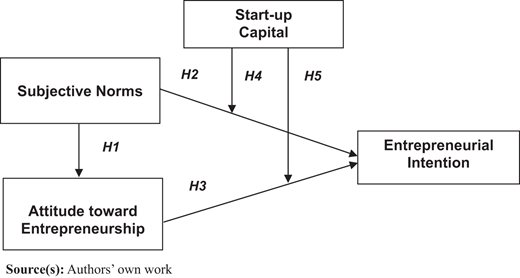
The five hypotheses developed for this research are as follows:
Subjective norms and attitude toward entrepreneurship
In both the TRA and the TPB, subjective norms represent the perceived social pressures to engage in certain behaviors. These norms play a significant role in shaping individuals’ attitudes toward entrepreneurship. When individuals believe that their peers, family members or close associates support entrepreneurial activities, they are more likely to develop a favorable attitude toward entrepreneurship (Ajzen, 1991; Kim and Hunter, 1993). Social validation, in this context, strengthens feelings of encouragement and acceptance, which in turn positively influences attitudes toward business creation.
This study explores how individuals’ mindsets are shaped by observing successful entrepreneurs, such as family members, mentors or other influential figures (Liu and Wang, 2018). Positive examples from these figures can strongly influence people’s views on entrepreneurship, inspiring them to view it as a viable and rewarding career path. This social influence is particularly powerful in cultures or communities where entrepreneurship is celebrated as an integral part of economic development (Jack, 2005; Gupta etal., 2022).
Moreover, subjective norms exert a pronounced influence in societies that emphasize innovation, risk-taking and entrepreneurial initiatives. In such settings, positive social norms reinforce attitudes that favor entrepreneurial endeavors by cultivating a culture of support and validation for taking initiative (Heuer and Kolvereid, 2014). This is especially relevant in emerging economies where entrepreneurial activities are seen as key drivers of economic growth and development.
Existing literature supports the idea that an individual’s attitude toward entrepreneurship is shaped by the influence of significant figures in their life. Those raised in entrepreneurial families, or who are exposed to entrepreneurial relatives and friends, tend to develop a positive attitude toward business creation (Ali and Jabeen, 2022; Al Mamun etal., 2017; Mustapha and Selvaraju, 2015). These relationships foster a nurturing environment that shapes individuals’ entrepreneurial attitudes through exposure and encouragement (Altinay etal., 2012).
Therefore, this study hypothesizes that:
Subjective norms are positively related to attitude toward entrepreneurship.
Subjective norms and entrepreneurial intentions
Subjective norms, as outlined in the TRA and the TPB, significantly influence not only attitudes but also entrepreneurial intentions. The social environment, particularly through support networks, provides essential resources, information and motivation, contributing to the development of entrepreneurial intentions (Hite and Hesterly, 2001). Access to dependable networks of mentors, peers and successful entrepreneurs plays a key role in shaping entrepreneurial behavior, offering both practical resources and emotional support (Hoang and Antoncic, 2003; Buli and Yesuf, 2015). As individuals receive encouragement and validation from these networks, their confidence in pursuing entrepreneurial ventures is bolstered, increasing their likelihood of starting a business.
When individuals perceive that their social circles, such as family and friends, endorse and support entrepreneurship, they are more likely to develop the intention to start a business (Mazzarol and Reboud, 2020). Social validation, an expression of subjective norms, reinforces the idea that entrepreneurial endeavors are acceptable and encouraged within their community. This external support helps shape positive attitudes, reducing perceived risks and bolstering confidence in entrepreneurial success (Heuer and Kolvereid, 2014).
Research consistently demonstrates that individuals absorb the expectations and behaviors of those around them. Mazzarol and Reboud (2020) argue that individuals are more inclined to engage in entrepreneurial activities when these behaviors align with the prevailing norms of their social circles. The desire to conform to the entrepreneurial aspirations of one’s community further strengthens the individual’s intention to pursue a business venture (Urban and Ratsimanetrimanana, 2019). This underscores the critical role of social dynamics in shaping entrepreneurial behavior by influencing both attitudes and intentions.
Subjective norms have been found to be powerful predictors of entrepreneurial intentions across different contexts, including technology adoption, consumer behavior and health-related decision-making. In entrepreneurial research, this influence is particularly evident in the Asian context, where collectivist cultures often emphasize the importance of social networks and communal support (Zaremohzzabieh etal., 2019). In Malaysia, for instance, research has shown that subjective norms significantly impact entrepreneurial intentions, shopping behaviors and green product purchases (Hasbullah etal., 2016; Saraih etal., 2020; Yeow and Loo, 2022). This suggests that the endorsement of entrepreneurship by important social groups can be a driving force in shaping entrepreneurial aspirations and decisions.
Therefore, this study hypothesizes that:
Subjective norms are positively related to entrepreneurial intention.
Attitude toward entrepreneurship and entrepreneurial intentions
In both the TRA and the TPB, attitude is considered a key determinant of behavior, including entrepreneurial intentions. Attitude, defined as an individual’s positive or negative evaluation of engaging in entrepreneurship, plays a crucial role in shaping one’s intention to pursue a business venture. In this research context, rather than treating “attitude” as a broad construct, this study delves into specific aspects such as self-efficacy, risk tolerance and personal values, which are particularly relevant in influencing entrepreneurial intentions. Exploring these distinct elements can provide deeper insights into entrepreneurial behavior, yielding more nuanced findings (Schlaegel and Koenig, 2014; Nowiński and Haddoud, 2019).
Self-efficacy, or the belief in one’s ability to successfully perform entrepreneurial tasks, has consistently been linked to entrepreneurial intentions (Hsu etal., 2019). Similarly, risk tolerance – a willingness to take on business-related uncertainties – is another key driver of entrepreneurial pursuits. Individuals with higher risk tolerance are more inclined to venture into entrepreneurship despite uncertainties (Liñán and Fayolle, 2015). These specific components of attitude likely play a pivotal role in explaining variations in entrepreneurial intentions across different contexts, such as indigenous communities or specific cultural groups, where entrepreneurial behavior may be influenced by unique socio-economic conditions.
Despite the intuitive correlation between a positive attitude toward entrepreneurship and the decision to pursue it, empirical research has often reported inconsistent results due to varying social, cultural and economic factors (Ajzen, 1991). For instance, attitudes toward entrepreneurship may be shaped differently in emerging economies compared to more established ones, or in collectivist societies versus individualist ones. A more granular understanding of the dynamics at play in specific populations, such as indigenous communities, is critical for identifying how attitudes can translate into entrepreneurial action (Ratten and Dana, 2019; Liguori etal., 2020).
Additionally, by investigating the relationship between attitudes and entrepreneurial intentions, this study aims to uncover underlying mechanisms, such as the role of perceived risk, external influences and self-confidence. Perceived risk is often cited as a major barrier to entrepreneurship, particularly in contexts where economic instability or limited resources are present (Urban, 2020). Understanding how individuals with high self-efficacy or positive attitudes toward entrepreneurship perceive and manage these risks could provide valuable insights for policy interventions designed to foster entrepreneurial activity in marginalized communities (Nowiński etal., 2020).
Recent research has continued to affirm the critical role of attitude in entrepreneurial intentions. For instance, Caputo etal. (2025) and Gomes etal. (2022) identify attitude toward entrepreneurship as the strongest predictor of entrepreneurial intention and the subsequent behavior. Similarly, García-Rodríguez etal. (2017) emphasize the influence of cultural factors in shaping entrepreneurial attitudes while Tsai etal. (2016) highlight the mediating role of attitude in translating perceived opportunities into entrepreneurial action. These findings underscore the need for a comprehensive examination of how attitudes shape intentions within specific social and economic contexts, further justifying the relevance of studying indigenous communities.
In summary, while there is a consensus that a positive attitude toward entrepreneurship is strongly correlated with entrepreneurial intentions, further exploration is necessary to understand how specific attitudinal components, such as self-efficacy and risk tolerance, influence these intentions within different populations. By doing so, this study aims to contribute valuable insights to both the literature and practical applications in entrepreneurship education and policy development.
Therefore, this study hypothesizes that:
Attitude toward entrepreneurship is positively related to entrepreneurial intention.
Start-up capital, subjective norms and entrepreneurial intention
This study also explores the moderating role of start-up capital in the relationship between subjective norms and entrepreneurial intention, a relatively under-researched area in entrepreneurial behavior. Investigating this interaction may yield valuable insights into how financial resources influence the entrepreneurial decision-making process.
Start-up capital is widely recognized as one of the key predictors in determining the likelihood of launching a new venture. Previous studies, such as those by Kristiansen and Indarti (2004), Nguyen (2020) and Rusu etal. (2022), highlight its importance in shaping entrepreneurial intentions. However, this study posits that the relationship between subjective norms and entrepreneurial intentions may vary depending on the amount of start-up capital available. From the perspective of the TPB, start-up capital can be conceptualized as an external factor of perceived behavioral control. When required start-up capital is relatively modest, subjective norms – such as the influence of family, friends and mentors – may play a more significant role in shaping entrepreneurial intentions. In such cases, individuals may lean heavily on social validation to mitigate perceived risks and uncertainty. On the contrary, when the required start-up capital is substantial, the relationship between subjective norms and entrepreneurial intention may weaken, as individuals must consider other critical factors such as business risk, market conditions and personal business acumen (Nguyen etal., 2021).
This study hypothesizes that start-up capital negatively moderates the relationship between subjective norms and entrepreneurial intention, which can be understood through several theoretical lenses. First, the complacency effect suggests that having access to large amounts of start-up capital can lead to a false sense of security. Entrepreneurs with substantial capital may feel less compelled to seek advice, support or validation from others, reducing the influence of social norms on their decision to pursue entrepreneurship (Tushman and O'Reilly, 2013). Second, overconfidence may arise in entrepreneurs with significant funding. As noted by Hayward etal. (2010), these individuals may overestimate their abilities and undervalue the advice of peers or mentors, weakening the role of social expectations in shaping their entrepreneurial intentions.
Moreover, the diminished reliance on social pressure can occur when entrepreneurs have access to ample financial resources. Dakhli and De Clercq (2020) argue that financial independence may reduce an individual’s perceived need to adhere to societal standards or gain social acceptance, thereby weakening the influence of subjective norms on entrepreneurial decision-making. Finally, Bakkeli and Lien (2020) suggest that entrepreneurs with sufficient capital may not feel the same urgency to engage with their social networks for guidance or support, further reducing the impact of subjective norms on their intentions to start a business.
Recent studies have corroborated these findings, emphasizing the negative moderating role of start-up capital in various entrepreneurial contexts. For instance, Al Halbusi etal. (2024) found that entrepreneurs with higher financial resources exhibited less reliance on social validation, while Ebbers and Wijnberg (2012) reported a similar pattern among high-net-worth entrepreneurs who were more insulated from societal expectations.
Thus, the negative moderating effect of start-up capital suggests that while financial resources are crucial for entrepreneurship, they may inadvertently diminish the importance of social support and subjective norms in shaping entrepreneurial aspirations. Entrepreneurs with substantial financial backing may feel less compelled to seek social validation, potentially reducing the impact of societal influences on their intentions to pursue entrepreneurial ventures.
Therefore, this study hypothesizes that:
Start-up capital negatively moderates the relationship between subjective norms and entrepreneurial intention.
Start-up capital, attitude toward entrepreneurship and entrepreneurial intention
This study further posits that start-up capital plays a critical role in moderating the relationship between attitude toward entrepreneurship and entrepreneurial intention. When an entrepreneurial venture requires substantial start-up capital, the relationship between an individual’s positive attitude toward entrepreneurship and their intention to pursue it strengthens. In such cases, individuals with a favorable attitude are more likely to commit to entrepreneurship, as they recognize the significant financial and personal investment required. On the other hand, when the required start-up capital is modest, the relationship between attitude and entrepreneurial intention may weaken. Individuals may still express entrepreneurial intent even if they do not hold a particularly positive attitude toward entrepreneurship, as the lower financial commitment reduces perceived risk. This phenomenon may be attributed to the notion of “trial and error,” where individuals are willing to experiment with entrepreneurship in anticipation that their perceptions will evolve based on hands-on experience.
Recent studies underscore the importance of financial resources in shaping entrepreneurial intentions. For instance, Brännback and Carsrud (2018) argue that access to start-up capital bolsters entrepreneurs’ self-confidence, which in turn strengthens the relationship between their attitude toward entrepreneurship and their intention to pursue it. Individuals who feel financially secure are more likely to hold favorable attitudes toward entrepreneurship and exhibit greater determination to act on their intentions. Additionally, sufficient funding reduces perceived risks associated with launching a venture. Riquelme and Romero (2016) find that this reduction in perceived risk further reinforces positive attitudes toward entrepreneurship, making it easier for individuals to transition from intention to action.
Furthermore, the availability of start-up capital provides entrepreneurs with the flexibility to experiment with novel ideas, business models and growth strategies. Liu and Wang (2018) highlight that financial resources not only support the execution of entrepreneurial activities but also contribute to a positive feedback loop, where successful experiences reinforce favorable attitudes, leading to increased entrepreneurial engagement. This idea aligns with the work of Kuckertz and Wagner (2010), who suggest that entrepreneurs’ attitudes toward entrepreneurship are likely to improve as they gain confidence through action, creating a cycle where positive attitudes lead to further entrepreneurial pursuits.
Moreover, having access to start-up capital facilitates participation in entrepreneurial ecosystems, including networking events, workshops and mentorship opportunities. Bakkeli and Lien (2020) suggest that these interactions serve as valuable platforms for entrepreneurs to strengthen their goals and refine their business strategies. Financial resources enable entrepreneurs to explore opportunities in these ecosystems, which not only fosters skill development but also further reinforces their entrepreneurial attitudes.
Overall, the availability of start-up capital can act as a catalyst, enhancing the relationship between favorable attitudes toward entrepreneurship and the intention to pursue entrepreneurial ventures. It provides the financial security and flexibility needed to mitigate perceived risks and reinforces the likelihood of turning entrepreneurial aspirations into concrete actions.
Therefore, this study hypothesizes that:
Start-up capital positively moderates the relationship between attitude toward entrepreneurship and entrepreneurial intention.
Method
This research is empirical in nature because it aims to examine the applicability of TRA in predicting entrepreneurial intention among the Bisaya of Sarawak. The unit of analysis is individual Bisaya aged 18 and above who are not entrepreneurs. The study is cross-sectional, with data collected at four different locations during the Sarawak Bisaya Association’s annual dinner, held in towns where large populations of ethnic Bisaya reside. Prior to the start of each dinner, the chairman of the organizing committee, following the researchers’ instructions, briefed the attendees on the community’s economic potential, the level of business engagement within the community and the available support from government agencies and the private sector, such as business network development and source of capital. Additionally, the briefings highlighted opportunities, particularly those involving indigenous culture and resources in the tourism and agriculture sectors.
Research instrument
A self-administered questionnaire is the most effective method for obtaining feedback concerning entrepreneurial intention of the Bisaya. The questionnaires were distributed to the selected sample and were collected immediately after they had been completed. The questionnaire was administered in both English and Bahasa Malaysia, incorporating measurement items adapted from established research. Specifically, items measuring attitude toward entrepreneurship, subjective norms and entrepreneurial intention were adapted from Ajzen (2006), while the measurement of start-up capital was developed from Cassar (2004), ensuring relevance and contextual appropriateness for this study. The survey questionnaire comprised two sections: demographic information and research variables, including attitude, subjective norms, entrepreneurial intention and start-up capital. Section A collected data on respondents’ demographic information, including their age, marital status, occupation, highest educational level, work experience and whether any close relatives were currently involved in business. Section B inquired about attitude toward entrepreneurship (questions 1–5), subjective norms (questions 6–10), entrepreneurial intentions (questions 11–15) and start-up capital (questions 16–18). Each question in this section was measured using a seven-point Likert scale, ranging from 1 (strongly disagree) to 7 (strongly agree).
Sampling procedures
The samples for this research were Bisaya individuals residing in four cities in Sarawak – Limbang, Miri, Bintulu and Kuching – who are aged 18 and above and are not currently entrepreneurs. To assess entrepreneurial intention, potential survey respondents must be individuals who are not currently entrepreneurs. This acts as a screening question before they are provided with the survey form. A total of 250 questionnaires were distributed using convenience sampling procedures. Of these, 205 completed forms were received, resulting in a response rate of 82%. The sample profile is presented in Table 1.
Sample profile (n = 205)
| Demographic variables | Frequency | % |
|---|---|---|
| Gender | ||
| Male | 64 | 31.2 |
| Female | 141 | 68.8 |
| Age group | ||
| 18–20 years | 38 | 18.5 |
| 21–25 years | 47 | 22.9 |
| 26–30 years | 29 | 14.1 |
| 31–35 years | 18 | 8.8 |
| Above 35 years | 73 | 35.6 |
| Marital status | ||
| Single | 102 | 49.8 |
| Married | 94 | 45.9 |
| Others | 9 | 4.3 |
| Occupation | ||
| Student | 68 | 33.2 |
| Public | 47 | 22.9 |
| Private | 46 | 22.4 |
| Homemaker | 32 | 15.6 |
| Retired | 7 | 3.4 |
| Others | 5 | 2.5 |
| Highest educational level | ||
| Primary | 18 | 8.8 |
| Secondary | 90 | 44.1 |
| Diploma | 54 | 26.5 |
| first degree | 38 | 18.6 |
| postgraduate degree | 4 | 2.0 |
| Work experience | ||
| None | 80 | 39.0 |
| 1 – five years | 62 | 30.2 |
| 6–10 years | 26 | 12.7 |
| 11–15 years | 9 | 4.4 |
| Above 15 years | 28 | 13.7 |
| Involvement of close relative in business | ||
| Yes | 62 | 30.2 |
| No | 143 | 69.8 |
| Entrepreneurial intention mean | ||
| 1 to below 3 | 20 | 9.8 |
| 3 to below 4 | 29 | 14.1 |
| 4 to below 5 | 44 | 21.5 |
| 5 to below 6 | 47 | 22.9 |
| 6 to below 7 | 34 | 16.6 |
| 7 | 31 | 15.1 |
Data analysis techniques
The data collected were analyzed using the Statistical Package for Social Science (SPSS) version 22. Descriptive analysis, including mean, minimum, maximum and standard deviation was used to obtain descriptive measures of the variables. Frequency and mean were also calculated for the demographic background.
Partial least squares path modeling (PLS-PM) using R (Sanchez, 2013) was used to test the hypothesized relationships in the conceptual framework. PLS-PM involves the assessment of measurement (outer) model and structural (inner) model. The measurement model assesses the reliability and validity at both the item and construct levels. The structural model evaluates the significance of the relationships between variables, the effect size and the direction of the relationships. PLS-PM can produce consistent results compared to co-variance based structural equation modeling, especially when the data are not normally distributed, and the sample size is relatively smaller.
Results
Descriptive analysis of entrepreneurial intention
On a seven-point Likert scale across five items, 49 respondents (23.9%) expressed disagreement with the intention to start their entrepreneurial venture, with a mean score below 4.00, indicating a lack of entrepreneurial intent among nearly a quarter of the sample. Conversely, 31 respondents (15.1%) expressed strong agreement with the intention to start their own business, demonstrating high entrepreneurial intent. Refer to Table 1 for further details on the descriptive analysis of entrepreneurial intention.
Assessment of the measurement model
Assessment of the measurement model involves reliability and validity at both the item and construct levels. The reliability score of each construct is obtained using Cronbach’s alpha and composite reliability. As shown in Table 2, the Cronbach’s alpha coefficients range from 0.790–0.944, and the composite reliability scores range from 0.880–0.958, signifying good reliability. As shown in Table 3, all but one factor loadings of the items are loaded strongly on the respective constructs, exceeding the threshold of 0.700 and are loaded lower with other constructs, signifying convergent and discriminant validity at the item level. The scores of average variance extracted (AVE) for each construct range from 0.713–0.818, indicating that at least half of the variance of each construct can be explained by the respective items. Thus, it fulfills the requirement of convergent validity at the construct level. The squared root of AVEs is larger than the correlation coefficients between the constructs, signifying that the constructs are more strongly correlated with their own items than with items of other constructs in the model. Thus, it fulfills the requirement of discriminant validity at the construct level. As the results, since the data meet the requirements of reliability and validity at both the item and construct levels, the analysis proceeds with evaluating the structural model.
Descriptive statistics and correlation matrix
| Variables | M | SD | α | CR | 1. | 2. | 3. | 4. |
|---|---|---|---|---|---|---|---|---|
| 1. Subjective Norms | 4.389 | 1.517 | 0.926 | 0.944 | 0.879 | |||
| 2. Attitude | 5.187 | 1.550 | 0.940 | 0.954 | 0.607 | 0.898 | ||
| 3. Start-up Capital | 4.820 | 1.519 | 0.790 | 0.880 | 0.565 | 0.547 | 0.844 | |
| 4. Entrepreneurial Intention | 4.905 | 1.582 | 0.944 | 0.958 | 0.662 | 0.652 | 0.788 | 0.904 |
α = Cronbach’s alpha, CR = composite reliability; Squared roots of AVE are reported in italic on the diagonal line. All correlations are significant at p < 0.001
Factor loadings and cross-loadings
| Items | Subjective norms | Attitude | Start-up capital | Entrepreneurial intention |
|---|---|---|---|---|
| SN1 | 0.887 | 0.557 | 0.533 | 0.586 |
| SN2 | 0.862 | 0.585 | 0.468 | 0.606 |
| SN3 | 0.902 | 0.525 | 0.483 | 0.593 |
| SN4 | 0.883 | 0.504 | 0.529 | 0.606 |
| SN5 | 0.859 | 0.486 | 0.467 | 0.511 |
| AT1 | 0.429 | 0.854 | 0.392 | 0.477 |
| AT2 | 0.537 | 0.906 | 0.502 | 0.623 |
| AT3 | 0.558 | 0.923 | 0.526 | 0.609 |
| AT4 | 0.576 | 0.928 | 0.492 | 0.602 |
| AT5 | 0.602 | 0.879 | 0.528 | 0.596 |
| SC1 | 0.491 | 0.530 | 0.928 | 0.756 |
| SC2 | 0.487 | 0.523 | 0.928 | 0.732 |
| SC3 | 0.476 | 0.294 | 0.647 | 0.468 |
| EI1 | 0.546 | 0.615 | 0.713 | 0.903 |
| EI2 | 0.601 | 0.630 | 0.750 | 0.936 |
| EI3 | 0.573 | 0.533 | 0.753 | 0.889 |
| EI4 | 0.604 | 0.566 | 0.657 | 0.905 |
| EI5 | 0.668 | 0.599 | 0.691 | 0.890 |
Assessment of the structural model
The structural model consists of two antecedents – subjective norms and attitude, a moderator – start-up capital and an outcome variable – entrepreneurial intention. All the five research hypotheses are supported by the data. The model explains 73.2% of the variance for entrepreneurial intention, which is considered a respected model. Table 4 presents the analysis results based on the 2-stage PLS-PM approach:
Results of 2-stage partial least squares path modeling approach
| Predictor | Model 1 | Model 2 |
|---|---|---|
| Main effects | ||
| Subjective norms | 0.223*** (0.050) | 0.268*** (0.053) |
| Attitude | 0.220*** (0.050) | 0.216*** (0.050) |
| Start-up capital | 0.542*** (0.048) | 0.523*** (0.047) |
| Interaction effects | ||
| Start-up capital × subjective norms | −0.128** (0.046) | |
| Start-up capital × attitude | 0.142** (0.050) | |
| R2 | 0.718 | 0.732 |
Figures in parentheses are the standard errors of the coefficients;
*p < 0.05;
**p < 0.01;
***p < 0.001
Subjective norms are positively related to attitude toward entrepreneurship.
The relationship between subjective norms and attitude toward entrepreneurship is found to be statistically significant and positive (β = 0.607, t = 10.873, p < 0.001). Thus, H1 is supported by the data:
Subjective norms are positively related to entrepreneurial intention.
The relationship between subjective norms and entrepreneurial intention is also found to be statistically significant and positive (β = 0.268, t = 5.041, p < 0.001). Thus, H2 is supported by the data:
Attitude toward entrepreneurship is positively related to entrepreneurial intention.
In addition, attitude toward entrepreneurship is found to be significantly and positively related to entrepreneurial intention (β = 0.216, t = 4.368, p < 0.001). Thus, H3 is supported by the data:
Start-up capital moderates the relationship between subjective norms and entrepreneurial intention.
Start-up capital is found to negatively moderate the relationship between subjective norms and entrepreneurial intention (β = −0.128, t = −2.774, p = 0.006). Specifically, the relationship between subjective norms and entrepreneurial intention is stronger when start-up capital is modest. Thus, H4 is supported by the data:
Start-up capital moderates the relationship between attitude toward entrepreneurship and entrepreneurial intention.
Start-up capital is found to positively moderate the relationship between attitude toward entrepreneurship and entrepreneurial intention (β = 0.142, t = 2.858, p = 0.005). Specifically, the relationship between attitude and entrepreneurial intention is stronger when start-up capital is high. Thus, H5 is also supported by the data.
Discussion
This study aims to contribute to and advance our understanding of why individuals commence their acts, particularly within Indigenous societies about their entrepreneurial intentions. As a result, the confirmation of the TRA model about the Indigenous Bisaya entrepreneurial intention is discussed. The applicability of the TRA model was tested on the indigenous Bisaya community in four locations: Kuching, Limbang, Bintulu and Miri, with a total of 205 respondents.
Entrepreneurs Data (2022) reported that the entrepreneurial intention rate in Malaysia was 43%, indicating a significant portion of the population expressed the desire to start a business, surpassing the regional average for Southeast Asia, which stood at 37%. In this survey, combining responses for general and strong agreement, 31.7% of the respondents expressed entrepreneurial intent, which is comparatively lower than the national population. This lower percentage aligns with existing literature on the low entrepreneurial intention among indigenous people. Nonetheless, this gap could be narrowed through targeted government interventions, such as providing networking opportunities (AlMehrzi etal., 2024) and enhancing the start-up ecosystem by improving access to government assistance (Liñán etal., 2013).
The first hypothesis confirmed that subjective norms are positively related to attitude toward entrepreneurship. The outcome validates our hypothesis that subjective norms have a direct impact on attitude, which leads to the formation of individual entrepreneurial intention. According to Wibowo and Indarti (2020), the results give a clear indication that societal pressure would contribute to individual attitude essential in creating individual entrepreneurial intentions. This finding is consistent with previous research and theoretical speculation on the TRA model, in which subjective norms are constituted of two components, injunctive and descriptive, in predicting intention (Vamvaka etal., 2020). The Bisaya community also has an instrumental attitude toward self-employment or a desire to become self-employed, and it is about time for the community to get involved in business, similar to the view by Souitaris etal. (2007) of the individual attitude toward entrepreneurship because of the desire to be independent, or a positive or negative appraisal of becoming an entrepreneur (Liñán and Chen, 2009). While subjective norms and socio-cultural perspectives of the Bisaya community are thought to exert influence, particularly through the individual surroundings, in making a choice decision to get involved in the business. Thus, society’s perspective on entrepreneurship may suggest more advantages than negatives, with the opportunities and resources accessible (Liñán and Chen, 2009) from the government or private sector also influencing the individual’s attitude. As argued by Maes etal. (2014), entrepreneurship would provide more positive than negative opportunities for society to participate in economic growth. Accordingly, this finding is not stand-alone; it is founded on previous empirical investigations that show a significant relationship between subjective norms, attitude toward entrepreneurship and the establishment of individual entrepreneurship in the Bisaya community. Furthermore, while supporting entrepreneurship, it is critical to consider the socio-cultural viewpoint as well as social pressure.
The second hypothesis of the study has revealed that subjective norms have a direct impact on their entrepreneurial intention. The revelation is hardly surprising considering the community’s recent involvement in several businesses, notably in the tourism industry. This study, which agreed with the findings of Cavazos-Arroyo etal. (2017) and Utami (2017), illustrates that subjective norms and attitude toward behavior positively related to the entrepreneurial intention which was conducted among individuals who are not currently actively involved in entrepreneurial activities. Many groups of societies emphasizing economic progress, according to Moriano etal. (2012), have embraced entrepreneurial intentions and behaviors. Because the Bisaya people are a minority group in nature, they are under pressure to demonstrate their abilities and the influence of others may be the catalyst for their decision. The choice to become an entrepreneur necessitates a significant investment of time and effort. As indicated by Baron (2004), being engaged in business involves extensive preparation and a degree of cognitive processing. Nonetheless, Moriano etal. (2012) discovered that, from a cross-cultural perspective, subjective norms resulted in different outcomes in predicting entrepreneurial intention in collectivist and individualistic societies. Thus, this study cannot rule out variations in the economic environment as an alternate reason for the findings. Another factor that may have influenced the outcome is that some participants had no other options. According to Autio etal. (2001), some groups such as students make entrepreneurial career selections based on personal factors such as self-efficacy rather than societal or subjective norms.
The third hypothesis is to evaluate the concept that entrepreneurial attitude is positively related to entrepreneurial intentions. The statistical technique revealed no evidence of a breach of the assumption. As a result, this study supports the idea that the connection of TRA components is equally essential. As argued by Moriano etal. (2012), an investigation of a cross-cultural approach to understanding entrepreneurial intention revealed that attitude toward entrepreneurship were the strongest predictor of individual entrepreneurial intention even within cultural variations. Nonetheless, we cannot dismiss differences in our respondents’ demographics because all of them are not currently involved in business or because the majority of them may have other career options and may be dissatisfied with the environment as an alternative explanation for the positive result, as Moriano etal. (2012) caution on differences in demographics may have some influence, particularly differences from a cultural background perspective. Alternatively, according to Arshad etal. (2015), endorsement and support of society are necessary for the promotion of entrepreneurial intention especially among females. Conversely, even an individual with the right attitude and a strong entrepreneurial intention may not guarantee success in setting up a new business without proper entrepreneurial competencies (Youssef etal., 2021). Although the respondents in the study may have the appropriate attitude and intention, various business handicaps among the communities themselves, such as a lack of entrepreneurial skills, may limit their aim in the long run and should be included in our contention.
The fourth hypothesis tests whether start-up capital moderates the relationship between subjective norms and entrepreneurial intention. The projected result fits well, demonstrating that the availability of start-up capital has a considerable influence on the moderated relationship between subjective norms and entrepreneurial intention. Because entrepreneurship is usually connected with risk and failure, the availability of start-up capital is ultimately vital for the non-entrepreneur (Ekore and Okekeocha, 2012).
The study’s findings also show the importance of start-up capital availability in regulating the connection between subjective norms and entrepreneurial intention and this concluded with Baluku etal. (2016) and further emphasizes the critical role that financial resources play in defining how individual aspirations to engage in entrepreneurship. Thus, the moderating effect in this study implies that the influence of subjective norms on entrepreneurial intention varies depending on the level of start-up capital availability (Baluku etal., 2016). Subsequently, the provision of high start-up funding tends to improve or weaken the strength of the link between societal pressures and individual inclinations to pursue entrepreneurship.
This finding is consistent with prior empirical evidence emphasizing the relevance of financial resources in the entrepreneurial process (Zarrouk etal., 2020). It implies that, within the examined community or environment, the availability of financial capital for start-ups is an important element in determining the influence of subjective norms on entrepreneurial intentions. On the other hand, entrepreneurs may interpret society’s expectations differently based on the level of financial assistance they receive, which influences their decision-making on embarking on entrepreneurial activity (Frid, 2014).
In summary, the projected result supports the idea that start-up capital availability significantly moderates the relationship between subjective norms and entrepreneurial intention, shedding light on the nuanced dynamics at work in the entrepreneurial decision-making process within the specific context under consideration for instance under the Indigenous entrepreneurship.
The fifth hypothesis is to test if start-up capital influences the relationship between attitude toward entrepreneurship and entrepreneurial intention. Similarly, this study yielded no surprising results; even though the Bisaya community is new to entrepreneurial activity, the findings are closely related to previous empirical findings, for instance, Asoba and Mefi (2022) highlighted that financial support is crucial for the start-up enterprise to avoid business failure in the early establishment. The findings lend support to the research hypothesis that start-up funding affected the association between attitude toward entrepreneurship and entrepreneurial intention. The Bisaya community has a good attitude toward entrepreneurship, with views, sentiments and assessments about engaging in entrepreneurial activities impacted by recent economic possibilities and business developments. Thus, the availability of start-up capital indicates the financial resources that an individual requires and helps to launch and establish a new business (Adomako, and Ahsan, 2022). Beyond that, it can lessen the risk and stress of funding their first operations, which is an important part of launching a business (Nofsinger and Wang, 2011). Therefore, a Bisaya with a favorable attitude toward entrepreneurship is more likely to develop an intention to start a business. Furthermore, the availability of venture capital has a significant impact on turning this attitude into an ambition as argued by Kanniainen and Keuschnigg (2004). Individuals who believe they have adequate financial resources or assistance may feel more confident and be more committed to continuing their entrepreneurial activity (Kanniainen and Keuschnigg, 2004).
To summarize, the availability of start-up financing within the Bisaya community may serve as a catalyst for transforming their attitude into intention. It is crucial to provide considerable financial assistance, as risk-taking support is required for the community to progress in its entrepreneurial activities. The combination of financial support and entrepreneurial motivation plays a crucial role in the start-up and innovation ecosystem.
Implications and conclusion
Implications for theory
From the theoretical perspective, this study provides an understanding of the entrepreneurial behavior within the indigenous Bisaya communities. The findings contributed to the theory by highlighting the indigenous entrepreneurial approach, particularly in terms of cultural sensitivity and the formation of individual attitudes. Another contribution is the understanding of indigenous people’s behavior in relation to cultural values, customs and community expectations, which shape their views toward entrepreneurship. This is especially significant as the Bisaya community has not traditionally been exposed to entrepreneurial culture. This research also incorporates the moderating role of start-up capital into the research model, enhancing the understanding of how it influences the relationship between entrepreneurial intentions and its predictors.
In the context of indigenous entrepreneurship, cultivating a favorable attitude toward entrepreneurship and gaining community support might have a beneficial influence on individuals’ intentions to participate in entrepreneurial activities. This study also identified a community environment that fosters and supports entrepreneurship, increasing the likelihood that people will explore starting their own businesses. This study also highlighted some programs or interventions aiming at boosting indigenous entrepreneurship which should consider the community’s favorable subjective norms. Indigenous entrepreneurship programs should emphasize the cultural context when creating interventions. Using traditional knowledge, cultural values and community institutions can improve the efficacy of entrepreneurial efforts. This is consistent with the TRA’s emphasis on studying the social and cultural influences that shape individual behavior. Recognizing that subjective norms in TRA include the impact of important people, interventions should not just focus on individuals but also on developing a community-wide entrepreneurial mentality. Long-term community development measures involving education, awareness and empowerment can help develop positive attitudes toward entrepreneurship. Recognizing the environment of Indigenous entrepreneurship is critical for establishing effective strategies and interventions that are consistent with the cultural values and aspirations of these people.
Implications for practice
This study offers practitioners a foundation for designing interventions, programs and policies aimed at promoting indigenous entrepreneurship. Based on the findings, practitioners can develop culturally sensitive entrepreneurship programs that reflect the beliefs, traditions and unique context of Indigenous Bisaya community. Understanding local cultural nuances is critical for developing programs that reflect the community’s uniqueness.
The increased participation of the Bisaya people in entrepreneurship may also enable them to integrate cultural customs and traditional knowledge into their business ventures, leading to unique products and services that reflect their cultural heritage. This not only preserves and promotes Indigenous culture but also fosters social cohesion by providing meaningful projects that address key social challenges.
Indigenous Bisaya entrepreneurship also contributes to the development of valuable skills in areas such as financial literacy, marketing and business management. This empowerment leads to a more capable workforce and strengthens economic resilience by reducing dependency on traditional income sources, such as subsistence farming, and diversifying the economic base.
Moreover, encouraging Indigenous Bisaya entrepreneurship plays a role in addressing historical injustices and ensuring that Indigenous perspectives are represented in the business sector. This effort promotes greater equity and inclusiveness in both the Bisaya community and the broader economy.
To ensure the success of entrepreneurial efforts, practitioners should collaborate closely with community leaders, elders and other respected individuals to build trust and align initiatives with the community’s values. Involving community members in program planning and decision-making enhances relevance and acceptability. Positive attitudes toward entrepreneurship within the community can be achieved by recognizing successful Indigenous entrepreneurs as role models, highlighting the positive impact of entrepreneurship on community development, and underscoring the cultural and economic significance of entrepreneurial ventures.
Fostering positive subjective norms is also key to promoting entrepreneurship. This can be done by demonstrating strong community support for entrepreneurial activities through events, testimonies and storytelling that celebrate communal backing of entrepreneurial initiatives. Such efforts not only encourage participation but also reinforce the cultural importance of entrepreneurship within the community.
Practitioners must recognize the importance of financial resources and provide tools and guidance to help individuals overcome barriers to entrepreneurship. The findings of this study may assist practitioners in developing a mentoring program, leveraging existing entrepreneurs who have access to and understanding of financial resources, to help new entrepreneurs feel more confident about establishing and operating their businesses. Another key effort resulting from this finding is for practitioners, particularly government agencies or relevant business sectors, to develop outreach programs that are suitable in both language and culture for the indigenous community. Use culturally appropriate examples, languages and communication strategies to ensure successful communication and engagement with the target audience.
Another benefit for practitioners is the ability to execute long-term actions that go beyond immediate entrepreneurial assistance. Thus, attempts to achieve total community development by addressing education, infrastructure and other socioeconomic variables. Activities that promote sustainable development contribute to the creation of an entrepreneur-friendly environment. For practitioners, it is important to have strong monitoring and evaluation methods to determine the efficacy of entrepreneurship programs. On the other hand, the key performance indicators, and change methods are based on continuous evaluations to ensure that interventions are responsive to the community’s changing needs and may need to be implemented and made available, especially to the policymaker for review.
Thus, it is critical to advocate for regional and national policies that recognize and encourage indigenous entrepreneurship. To achieve sustainability, it is critical to create an enabling environment that eliminates legislative barriers, provides financial incentives and promotes economic inclusiveness. It is crucial to enhance the capacity of local institutions by strengthening and supporting organizations that can assist entrepreneurs. By increasing the capabilities of local entrepreneurial support organizations, cooperatives and educational institutions, a long-term environment for sustainable indigenous entrepreneurship can be established. When implementing initiatives to promote indigenous entrepreneurship, practitioners should use a comprehensive and culturally informed strategy based on the concepts of the TRA and the TPB. This entails understanding and respecting cultural backgrounds, imparting knowledge and positive attitudes, capitalizing on societal norms, empowering individuals and contributing to long-term community development.
In conclusion, the entrepreneurial activities of the Indigenous Bisaya community offer significant contributions with practical implications across economics, social work, culture and policy. By encouraging and supporting their entrepreneurial efforts, Indigenous Bisaya communities can achieve more equitable and sustainable economic development while also addressing historical injustices and ensuring greater equity and inclusiveness in the economic system.
Limitation of the study
This study may not sufficiently compensate for cultural differences in attitudes and individual preferences since the respondents are indigenous people with a very limited number of respondents. Further, cultural and economic differences may influence how people create attitudes and respond to social influences, limiting this study’s applicability across different cultural contexts. On the other hand, assessing personal norms can be challenging because individuals may not correctly describe or be completely aware of the social pressures they encounter. In the case of the indigenous community, biases may arise, particularly since they are new to entrepreneurial activities. Additionally, the responses may also be influenced by social desirability bias, particularly due to participants’ limited involvement in entrepreneurial activities, which could diminish the reliability of individual responses. Another limitation of this study is that it presupposes a high level of rationality in decision-making, overlooking the significance of emotions, habits and other non-cognitive elements. In other cases, people may act hastily or irrationally, which this study does not account for.
Despite these limitations, this study provides an important theoretical framework for understanding and predicting specific behaviors, particularly from the perspective of the indigenous community. Nonetheless, researchers and practitioners should be mindful of these limitations and consider complementary theories or models to gain a more comprehensive understanding of human behavior, as illustrated in this study.
Recommendations for future research
Recognizing the limitations of this study, it is recommended that more cross-cultural investigations be conducted to compare the applicability and effectiveness of the related model in other indigenous contexts. Understanding how attitude, subjective norms and perceived behavioral control change across cultures might help researchers design more culturally responsive theories. Future studies may delve into the significance of traditional knowledge and cultural capital in creating attitude toward entrepreneurship. Understanding how indigenous knowledge systems and cultural assets impact entrepreneurial intention and activities can help guide focused initiatives that build on cultural strengths. It is advised that a long-term economic and social outcomes assessment be conducted to evaluate the long-term economic and social consequences of indigenous entrepreneurship initiatives. Beyond immediate intentions and actions, investigations should look at the larger implications for community growth, economic sustainability and cultural heritage preservation. On the other hand, future researchers may adopt participatory action research methodologies that engage indigenous community members in the study process. Collaborative research helps ensure that findings are relevant, culturally sensitive and practically applicable to the community, encouraging a more inclusive research approach. Finally, since this research is quantitative, it is best to reinforce it with in-depth qualitative queries. Qualitative research methods, such as interviews, focus groups and case studies, can provide more extensive information on indigenous entrepreneurs’ life experiences, motivations and challenges.

