Channel is a fundamental construct in the circular economy business model (CEBM) canvas. Hence, this study aims to uncover the channels in CEBMs for construction organisations, enabling construction firms to effectively communicate and deliver circular value propositions to different client segments.
This study adopted an exploratory sequential mixed-methods approach. First, qualitative data were collected until saturation was achieved and analysed. Thereafter, the findings guided a subsequent quantitative phase. A well-structured questionnaire was used to collect data, and the data was analysed using descriptive statistics, Kruskal–Wallis and confirmatory factor analysis.
The qualitative findings reveal 13 channels of CEBM for construction organisations. However, the findings from the quantitative study confirmed the significant influence of five channels : electronic learning, video conferences, newsletters, web advertisements and directories/listings. In addition, the results show that all estimated model parameters met the required fit indexes.
The findings offer a structured approach for construction organisations to communicate and deliver circular value propositions to different client segments, enhancing circularity in construction practices.
To the best of the authors’ knowledge, this study is the first to examine the channel construct in the CEBM for construction organisations using the exploratory sequential mixed-methods approach. Hence, its findings help reduce the existing knowledge gap in this area.
1. Introduction
The construction industry significantly impacts the environment due to its high resource consumption and waste generation. According to Abdullahi et al. (2023), the sector is responsible for large amounts of raw material extraction, energy use, and greenhouse gas emissions. Lu et al. (2017) posit that construction and demolition waste accounts for approximately 35% of global waste. These environmental impacts have raised concerns, increasing interest in adopting circular economy (CE) principles in the industry. CE offers an alternative to the linear “take-make-dispose” approach by promoting resource efficiency, material reuse, and waste reduction (Geissdoerfer et al., 2018; Otasowie et al., 2023a, 2023b, 2023c). In the construction sector, CE adoption involves designing buildings for disassembly, using recycled materials, and implementing take-back systems (Adams et al., 2017). It reduces the demand for virgin resources and lowers construction waste generation (Ghisellini et al., 2018). Furthermore, CE strategies, such as modular construction, extend building lifespans and reduce demolition waste (Osobajo et al., 2022; Adekunle et al., 2024). In addition, studies (Leising et al., 2018) have shown that implementing material passports can help track and recover valuable materials, ensuring continuous reuse in new construction projects. Thus, these strategies can contribute to lower carbon emissions and improved sustainability.
Nevertheless, circular economy business models (CEBMs) are central to adopting CE principles in construction organisations (Otasowie et al., 2024), and channels are a fundamental component of the circular economy business model canvas (Lüdeke‐Freund et al., 2019; Lewandowski, 2016). Channels are crucial in business models because they help organisations deliver customer/client value propositions. According to Osterwalder and Pigneur (2010), channels act as the bridge between an organisation and its clients, ensuring that products and services reach the right client efficiently. Also, well-designed channels enhance client experience by providing convenience and accessibility (Richardson, 2008). Furthermore, channels facilitate communication between businesses and their clients. Keller and Kotler (2022) opine that they allow companies to share product information, receive feedback, and build strong relationships. Hence, channels can facilitate the flow of materials, information, and value between construction organisations and their clients. Also, they can help construction organisations connect with clients, suppliers, and regulators to promote circular practices (Lüdeke‐Freund et al., 2019). In addition, channels are essential for construction organisations to engage with business-to-business (B2B) clients and suppliers in the CE and even support direct engagement with business-to-client (B2C) clients, helping them access circular products and services more efficiently.
Several studies (Lüdeke‐Freund et al., 2019; Lewandowski, 2016) have explored the role of channels in business models. However, research on CEBM channels for construction organisations remains limited. These studies focus on general business sectors, such as manufacturing and retail, rather than construction. Thus, the construction industry requires tailored research on effective channel strategies since projects involve multiple stakeholders, including suppliers, contractors, and regulatory bodies. This is because construction organisations might struggle to implement CEBM effectively without specific guidance on the channels. Hence, this study aims to uncover the attributes constituting the channels construct in the CEBM for construction organisations. The study will also determine the influence of the construct on CEBM in construction organisations. This study is important because it provides insights into how construction organisations can adopt CEBM. It highlights the role of the channel construct in facilitating the transition to circular practices. Thus, understanding the impact of channels will help construction firms develop effective communication, distribution, and client engagement strategies. In addition, this study contributes to academic knowledge by filling research gaps that exist in the literature on CEBM channel construct for construction organisations.
2. Circular economy business model for construction organisations
The CEBM in the construction industry is an approach that aims to make construction more sustainable by reusing resources, reducing waste, and protecting the environment. Unlike traditional business models that primarily focus on making profit for clients, the CEBM sustainably creates value. It focuses on social benefits, environmental protection, and stakeholder collaboration in the value chain (Huovila and Westerholm, 2022; Piispanen et al., 2022). However, to adopt CE, construction organisations must develop new business models. These models should include circular design methods, better systems for bringing used materials back into use (reverse cycles), and supportive policies (Pollard et al., 2023). Although the construction industry already creates many jobs and adds value to the economy, it also has a significant environmental impact. Thus, applying circular strategies at every phase, from planning and design to building, can help reduce pollution and make construction practices more responsible (Poolsawad et al., 2023).
According to Pekuri et al. (2013), business models in construction should be developed based on experience at the operational level. This would improve understanding of how value is created in different construction projects. It could also help construction organisations develop business models that give them a competitive edge and meet specific client needs. Carra and Magdani (2017) argue that construction organisations must adopt systemic thinking to understand the full lifecycle of buildings and the construction value chain. They recommend building models showing how different CEBM components interact to influence circular practices. This would support better policy and planning for CE adoption in the construction industry (Wuni, 2023). Hence, Lewandowski (2016) proposed a CEBM framework that aligns different components with lifecycle stages and stakeholder roles. These components include value proposition, client segment, channels, client relationship, key resources, key activities, key partnership, cost structure, and revenue streams. However, this study focuses on the channel construct and its attributes for construction organisations.
3. Channels in circular economy business model in construction organisations
TeeceChannel is a fundamental construct of the CEBM. It represents how products, services, and information move between a business and its client (Lewandowski, 2016). In developing a CEBM for construction organisations, channels are critical because they will help deliver circular solutions such as recycled materials, reused components, and product-as-a-service offerings (Bocken and Short, 2021; Geissdoerfer et al., 2018). Thus, new types of channels are required as the construction industry shifts from a linear to a CE. Traditional channels often focus on delivering new materials or products. However, in CEBM, channels must also support material take-back, refurbishment, recycling, and redistribution (Antikainen and Valkokari, 2016). This implies that construction organisations must set up systems to collect used materials from building sites and deliver them to reuse or recycling centres. Different types of channels can support this transition. Physical channels, like material recovery hubs and reverse logistics systems, will allow for the return and redistribution of construction products (Bressanelli et al., 2018; Chileshe et al., 2018). Digital channels, such as online platforms, can help track materials, connect suppliers with users, and share information about recycled or reclaimed items (Antikainen and Valkokari, 2016). These tools can make circular products more accessible and improve client engagement.
In addition, using a combination of physical and digital (hybrid) channels can make it easier to manage circular flows in the construction process (Pieroni et al., 2019). Channels can also help construction firms communicate their circular value propositions (Geissdoerfer et al., 2018). They will allow construction organisations to show clients how they are reducing waste, using sustainable materials, and lowering environmental impact. This builds trust and encourages more clients to choose circular options. Hence, effective communication channels are essential for collaboration among construction clients, contractors, consultants and suppliers. These channels can help to share accurate information, make decisions, and coordinate tasks across the project lifecycle (Ejohwomu et al., 2017; Ishaq et al., 2019; Olanrewaju et al., 2024). For example, face-to-face communication is common in the construction industry because it allows for immediate feedback and better understanding. Also, digital tools like Building Information Modelling (BIM) can support circular practices by improving data sharing and coordination (Amusan Lekan et al., 2018; Olanrewaju et al., 2024). Mobile phones and emails are widely used in the industry for quick communication, especially in remote project sites (Oke et al., 2024). This means that the channel component of the CEBM can play a fundamental role in the construction industry’s move towards circularity. It supports the flow of materials and information, improves the delivery of circular services, and helps engage customers in sustainable practices (Olanrewaju et al., 2024).
4. Methodology
This study used an exploratory sequential mixed-methods approach to examine the channels construct in CEBM for construction organisations. This approach was chosen because quantitative and qualitative methods complement each other (Jack and Raturi, 2006). Thus, using both methods provides deeper insights that would not be possible if used separately. Also, combining these approaches offers a broader perspective on the subject. iIt leads to a more comprehensive understanding and accurate analysis (Mangan et al., 2004; Takona, 2024). In the qualitative phase, the study sought to gather in-depth insights into expert experiences, perceptions on channels of CEBM in construction. However, the quantitative phase aimed to collect measurable data for validation on the specific channels of CEBM in construction. Hence, the qualitative phase was conducted first. The findings from this phase guided the subsequent quantitative phase. In the qualitative phase, purposive sampling was used to select participants with expertise in CE. The recruitment process began with email invitations sent to potential participants. The study’s purpose was also summarised in the initial email. Those who expressed interest received a detailed explanation of the study. In addition, participants were asked to submit their curricula vitae to verify their qualifications. This step ensured that all selected experts met the study’s criteria. Invitations were sent to 30 construction professionals. However, only 15 invitees responded, and 13 experts agreed to participate. Based on previous studies, this number was considered adequate for data saturation (Patton, 2022; Guest et al., 2013). Furthermore, all participants held senior or chief executive officer roles in construction organisations. This confirms that the study aligned with real-world CE practices. Table 1 presents the demographic details of the experts.
Interviews were conducted to explore the channels that construction organisations can adopt to deliver circular value propositions to clients. The purpose was to gain insights from industry professionals on the most effective ways to communicate and deliver circular solutions. Semi-structured interview type was utilised because it provides flexibility. They also allowed researchers to explore unexpected insights (Kallio et al., 2016). The interviews lasted between 30 and 45 min and took place via Zoom. All interviews were audio-recorded with participant consent. Then, they were transcribed verbatim using Microsoft Office Word. Hence, this ensured data accuracy (Braun and Clarke, 2022). Once transcribed, the text was imported into Atlas.Ti. This software helped in analysing the transcripts. Content analysis was adopted to analyse the qualitative data. Furthermore, findings and channels identified from the qualitative phase guided the survey design. A questionnaire was then used to capture participants’ perceptions. The survey was piloted with five experts to check for clarity and relevance (Hirshfield and Fowler, 2020). The survey targeted construction professionals from different construction firms. A stratified random sampling technique was used to ensure proper representation, and a total of 208 survey responses were collected using questionnaires. Furthermore, the study analysed respondents’ background information using percentages. In addition, the data set on the channel construct in CEBM for construction organisations was examined using the relative importance index (RII), Kruskal–Wallis test, and confirmatory factor analysis (CFA). The RII ranked channels based on their significance. Also, the Kruskal–Wallis test assessed whether respondents’ views varied significantly based on their professional roles. This test was chosen because it is a non-parametric method that examines variations in opinions among multiple respondent groups (Pallant, 2020; Otasowie et al., 2023a, 2023b, 2023c). When the p-value exceeds 0.05, it indicates no significant difference in opinions. However, when the p-value is less than 0.05, it implies a significant difference in views. Furthermore, CFA was used to check the measurement equivalency of the identified constructs. This analysis was performed using EQation software (EQS) version 6.4. The study followed a multi-dimensional approach to assess the model’s fit. Thus, the following indices were used: root mean square error of approximation, Satorra-Bentler scaled chi-square, standardised root mean square residual, goodness-of-fit index, RMSEA with 95% or 90% confidence interval, and Bentler comparative fit index.
5. Results and discussion
5.1 Channels construct in the circular economy business model for construction organisations
Channels are important in CEBMs for construction organisations because they can help deliver circular products, services, and information between organisations and clients. In construction, where projects are often complex and client needs vary, effective channels can support better communication, trust, and understanding. This is fundamental to promoting new circular practices that may not yet be widely accepted. Hence, this study identified direct personal selling as an essential channel for delivering circular value in construction organisations (P2, P3, P4, P7). P2 noted, “Direct personal selling can be a strategic channel […] It allows for strong, trust-based relationships with clients.” Similarly, P4 stated that this channel “helps build credibility and strengthen collaboration,” which is essential in construction projects that often require customised solutions and coordination among multiple stakeholders. These views show that direct selling is not just about promoting products. It supports project-specific dialogue, which can help in explaining the benefits of circular solutions like reuse, recyclability or long-term cost efficiency. Unlike mass marketing, face-to-face contact enables tailored communication. This makes it suitable for construction, where decisions often involve multiple stakeholders and large investments. Also, the findings corroborate Pratama et al. (2023), who found that direct selling influences purchasing decisions in construction. Other studies (Bocken et al., 2014; Lüdeke‐Freund et al., 2019) note that trust, value co-creation, and personal relationships are important in CEBM, particularly in industries like construction that rely on networks and partnerships. Hence, direct personal selling is a channel in construction CEBMs. It supports long-term collaboration and will help construction organisations explain unfamiliar circular offerings. It will also encourage collaboration across the value chain, which is essential for implementing circular practices like design for disassembly, material reuse and reverse logistics.
Furthermore, several participants (P1, P5, P6, P8, P9, P11 and P13) mentioned wholesalers, retailers, and social media as important channels for construction organisations to deliver circular value propositions. These channels were seen as mechanisms to support the circular flow of materials within the construction industry. P1 stated:
Wholesalers can be important because they can help distribute refurbished or recycled construction components at scale. They can manage inventory and make circular products accessible to firms across different regions.
This aligns with Derks et al. (2024), who posit that wholesalers can act as intermediaries between producers and users. In construction, they can distribute large volumes of reclaimed materials to contractors and ease access to sustainable materials. Their role can also include balancing supply and demand, helping stabilise prices, and reducing material waste through bulk logistics. Thus, wholesalers can support the reuse and redistribution of materials, which are essential in a circular supply chain for construction projects. P6 added that “retailers can play a more direct role in reaching small contractors. They can promote eco-friendly materials and educate clients on reuse or recycling.” This shows how retailers can connect with end-users like subcontractors, private developers, and small construction organisations. Retailers often deal in smaller quantities and can showcase sustainable materials in physical or digital stores. For this reason, Nwabekee et al. (2021) opine that retailers can influence buyer preferences and promote behavioural change by offering choices and information. Hence, they can help create demand for circular products and encourage responsible purchasing decisions at a project level. Similarly, P13 highlighted that “social media is a powerful channel for awareness, engagement, and direct sales. Companies can use it to showcase recycled materials and connect with sustainable suppliers and clients.” This corroborates Zhang et al. (2023), who argue that social media can support new business models by improving visibility and interaction. In the construction industry, construction organisations can use platforms like LinkedIn to promote green products, share circular project case studies, and announce partnerships with recycling companies. These digital channels can help construction organisations engage clients, get feedback, and adapt their circular strategies. This implies that wholesalers, retailers, and social media are not just general communication channels. They can be beneficial in the construction industry’s shift to CE. These channels can help construction organisations deliver circular value more effectively and encourage widespread adoption of circular practices by improving access, awareness, and education. Also, emails, web advertisements, newsletters, and directories/listings were identified as important channels for delivering circular value propositions in construction organisations. These were mentioned by several experts (P1, P2, P4, P5, P6, P8, P9, P11, P12). These tools can help communicate circular practices, such as reuse, refurbishment, and take-back programs, to specific client segments in the construction industry. P4 noted that:
[…] emails can be an effective channel of communicating circular value propositions to clients. This will allow construction firms to maintain consistent, direct communication with clients and stakeholders, especially when promoting circular solutions like material reuse or take-back programs.
In the construction industry, this can be useful for updating project stakeholders, clients, and suppliers about new sustainability initiatives during or after project execution. P8 further explained that “web advertisements can help create awareness about sustainable construction products and services to a broader audience.” These can be particularly relevant when construction organisations launch green-certified products or promote recycled building materials. Compared to face-to-face meetings, web advertisements can reach a wider range of construction clients, including developers and government agencies interested in green construction. P9 added that “newsletters can be great for building long-term engagement. They can help share updates about new circular initiatives, case studies, or organisational innovations.” For construction organisations, newsletters can highlight the success of pilot projects involving deconstruction or reuse. They can also serve as educational tools to influence client decisions during the planning and design stages. P12 suggested that:
[…] directories and listings can be channels of communication as they provide visibility. This means they can help circular-focused construction organisations get found by green-conscious clients, suppliers, and other businesses looking for sustainable solutions.
In practice, some clients use these platforms when selecting contractors, consultants, or product suppliers who offer eco-friendly solutions. Other experts expressed similar views. According to the findings, these channels can help target different client segments in the construction industry. Also, these findings align with Paulo et al. (2022), who noted that emails and newsletters can help sustain client engagement. Wuisan and Handra (2023) further emphasised the role of digital advertisements in promoting circular ideas. Thus, these findings show that channels can be used for visibility, education, and engagement. They are practical tools for construction organisations promoting CE practices and attracting sustainability-focused clients.
Similarly, P10, P12 and P13 identified word-of-mouth, electronic learning and video conferencing as important channels that support circular value delivery in the construction industry. P10 explained:
Word of mouth can play a vital role in supporting the circular economy business model in the construction industry. It is powerful because the industry is built on trust and relationships. When clients hear positive feedback about circular practices like reuse or take-back schemes, it builds credibility. This makes others more open to trying circular solutions.
This perspective is supported by Robledo et al. (2023), who found that word-of-mouth is one of the most influential marketing tools in sectors that rely on networks and trust. In construction, where referrals are common, word-of-mouth can become more than just a promotional tool; it becomes a driver for change. Unlike digital marketing, it relies on peer influence and shared experiences. This makes it especially useful for promoting circular practices, which are still unfamiliar to many clients and stakeholders. P12 further highlighted electronic learning as an important channel. He stated:
This channel is essential for capacity building. Many construction professionals are still unfamiliar with how circular principles apply to their day-to-day work. E-learning platforms will provide a flexible and accessible way to upskill teams, raise awareness about sustainable practices, and align different departments with circular goals.
This aligns with findings by Ferreira et al. (2024), who argued that digital learning platforms are increasingly vital for bridging knowledge gaps in green construction. In fragmented project environments, e-learning can offer a low-cost and scalable way to train workers, consultants, and clients on circular solutions. Also, P13 emphasised video conferencing:
It allows real-time collaboration from suppliers to designers to contractors. In circular construction, decisions like reuse or design for disassembly need input from different experts. Video conferencing makes this possible and fast,
he explained. This reflects studies by Li et al. (2025), who opine that digital communication channels can help improve transparency and speed in green construction projects. In the construction industry, where delays are costly, video conferencing can reduce downtime and make coordinating circular strategies easier. Hence, these findings show that these channels are suitable for circular value delivery. This is highly relevant to the realities and constraints of the construction industry.
Finally, participants P10, P11, P12 and P13 identified distributors and websites as important channels for communicating and delivering circular value propositions in construction organisations. P11 noted that “distributors are especially important because they are a physical link between the organisation and the end users of circular construction materials or products.” This shows that distributors can help construction-related organisations to distribute reuse, refurbish, or recycle materials to the right markets. P10 also shared this sentiment. P12 added that “websites offer a powerful digital platform for showcasing circular value propositions.” For construction organisations, websites can do more than provide information; they can support digital sales, project marketing, and client engagement. These findings reflect industry-specific needs, where physical and digital channels can support adopting circular practices. Also, distributors can handle the logistics of bulky or specialised materials, which is important in construction. Similarly, websites can display case studies, product certifications, and sustainability performance, helping clients make informed choices. These results are consistent with Bouwman et al. (2019), who stressed the need for channels to match sector-specific requirements. This shows that in construction, the choice of channels must fit both material and informational needs of circular delivery.
5.2 Quantitative respondents’ demographic information
From the responses, 3% of respondents have a doctoral degree as their highest qualification, while 24% have master’s degrees. Furthermore, 28% of the respondents have honour’s degrees, whereas 24% have bachelor’s degrees. In addition, 19% of the respondents have post-matric certificates, while 2% have matric certification as their highest qualification. Also, a total of 1.9% of respondents have less than one year of experience in the construction industry, 6.7% of respondents have between one and two years of experience, 10.6% of respondents have between three and five years of experience, 17.3% of respondents have between six and ten years of experience, 23.1% of respondents have between 11 and 15 years of experience, 12.5% of respondents have between 16 and 20 years of experience, 4.8% of respondents have between 21 and 25 years of experience, and 23.1% of respondents have more than 25 years of experience in the construction industry. Hence, the research includes both entry-level professionals and experienced construction experts. Similarly, 19.2% of respondents are engineers, 17.3% are construction managers, 39.7% are architects, 19.2% are quantity surveyors, and 3.9% are project managers. Thus, the research covers a diverse range of professionals within the construction industry.
5.3 Descriptive statistics and Kruskal-Wallis test
The descriptive statistics in Table 2 show that channelss play a significant role in the CEBM for construction organisations. According to the Relative Importance Index (RII), word of mouth and direct personal selling ranked highest. These channels are important for building trust and maintaining close client relationships. However, their Kruskal-Wallis p-values were less than 0.001. This indicates that their significance varies significantly across the respondent groups. Thus, construction organisations could invest in strengthening personal networks and client interactions to drive CE adoption. Furthermore, social media and electronic learning followed closely, with an RII of 0.82. While social media had a p-value (0.218) indicating no significant difference in respondents’ opinions, electronic learning was statistically significant (p < 0.001). This implies that digital education platforms can be an important channels for spreading awareness about circular practices. Digital tools offer scalable and cost-effective ways to engage stakeholders. Also, distributors (RII = 0.81) and websites (RII = 0.80) ranked high. However, websites had a significant p-value that shows a statistically significant difference in respondents’ opinions. Hence, there is no agreement on websites as an attribute of CEBM channel. Nevertheless, there is an agreement for distributors as an attribute. Distributors can help with logistics, product return and delivery, which are essential for circular supply chains. In addition, wholesalers, video conferences, and retailers have RII values of 0.78. Wholesalers and retailers had significant p-values (0.008 and 0.088, respectively). This suggests that their roles as channels in CEBM for construction organisations differ among the respondent groups. Other channels ranked include newsletters, web advertisements, emails, and directories/listings. They had lower RII, ranging from 0.77 to 0.74. The results suggest that human-centred and digitally supported channels are crucial for implementing CEBM in construction organisations. Hence, construction organisations should combine personal, digital and distribution channels to enhance communication and value delivery. Finally, the Cronbach’s alpha value for the channel construct was 0.908. This indicates that the reliability test for the construct variables for this study values is above the 0.7 threshold. The result demonstrates that the questionnaire’s consistency was acceptable for the study’s aim.
5.4 Confirmatory factor analysis
The construct was originally made up of thirteen measurement variables. However, only five variables had acceptable values before running the CFA. Thus, the five variables, CH4, CH8, CH10, CH11, and CH13, were selected for further analysis. According to Byrne (2006), the residual covariance distribution should be symmetrical and centred around zero. Hence, a latent construct with these features suits CFA (Boomsma, 2000). Also, Gao et al. (2008) pointed out that such characteristics help manage multicollinearity and high correlations, which could otherwise affect the model’s accuracy. Also, the analysis of the residual covariance for the model with the five selected variables shows that the residual matrix meets the necessary standards. Thus, this suggests that the model shows signs of convergence. As Bentler (2005) noted, a good residual matrix should have values between −1.00 and +1.00, ideally close to zero. Thus, these results indicate a strong model fit. In addition, the residual values fall within the expected range of −1.00 to +1.00. The average unstandardised off-diagonal residual is 0.0376. Considering that values over 2.58 are too high (Byrne, 2013), this finding suggests that the measurement model fits well. However, the results from the goodness-of-fit test will further confirm how appropriate the model is and help validate the fit indices.
The estimated parameters of a model help determine whether to accept or reject a proposed model (Lei and Wu, 2007). Also, the model fitness for a data set is assessed by evaluating some parameter estimates such as reliability, validity, and statistical significance (Lei and Wu, 2007; Hair et al., 2013). Furthermore, Hair et al. (2013) suggest that model fit should be evaluated using various criteria, including incremental and absolute fit indices and the chi-square test. Table 3 presents the results of the fit indices and related estimates. The findings show that the GFI and CFI have values of 0.944 and 0.953, respectively. According to Iacobucci (2010), a GFI or CFI value of 0.95 or higher indicates a good fit, while values above 0.90 are still acceptable. Hence, this study’s GFI and CFI values confirm a good model fit. In addition, the SRMR and RMSEA values are 0.042 and 0.036, respectively. A SRMR or RMSEA value of 0.05 or lower indicates a good fit, while values up to 0.08 are still acceptable. Thus, the results confirm that the model meets the good fit criteria. Furthermore, the model analysis produced an S-Bχ2 value of 24.297 with 5 degrees of freedom and a p-value of 0.000. However, Zhong and Yuan (2011) highlight that the chi-square test is highly sensitive to sample size and data normality, making it sometimes less reliable. Kline (2005) recommends using a normed chi-square instead. This is calculated by dividing the chi-square value by its degrees of freedom. As a result, the normed chi-square from this study is 4.859. According to Byrne (2013), a normed chi-square value between 3.00 and 5.00 indicates a good fit. Hence, the findings confirm that the model is appropriate.
Furthermore, Table 3 displays the analysis’s correlation coefficients, standard errors, and test statistics. The coefficient of determination (R2) and z-values help in understanding the significance and impact of the model’s parameters (Bentler, 2005). The results show that all correlation coefficients are below 1.00, while the z-statistics are above 1.96, confirming the appropriate measurement variables. The z-statistics indicate the significance level of the path coefficients in the inner model. According to Hair et al. (2014), a z-value greater than 1.96 in a two-tailed test at a 5% confidence level is considered significant. Meanwhile, the R2 value measures the predictive accuracy of the model. A value closer to 1.00 suggests strong predictive accuracy (Kline, 2010). The analysis results show that the R2 values for the measurement variables are above 0.5. Hence, this suggests that the channels account for a significant portion of the variance in the indicator variables. The measurement variables effectively predict and define the model.
In addition, the internal reliability and consistency of the channel underwent further testing. These tests included factor loadings, Cronbach’s alpha, and the Rho coefficient. Also, these parameters provided enough information to evaluate the data set’s validity, reliability and consistency (Hair et al., 2014). The reliability coefficient should fall between 0 and 1.00, with values closer to 1.00 being more desirable (Kline, 2005). Table 3 presents the results of the reliability and validity tests. The Cronbach’s alpha and Rho coefficient values were 0.875 and 0.877, respectively. These values confirm that the indicator variables are consistent and reliable. Furthermore, the factor loadings of the measurement variables helped determine the construct validity’s strength and appropriateness. The coefficients showed a strong relationship between the measurement variables and the construct, indicating that they converged towards a common point. Also, coefficients higher than 0.5 suggest a close link between a measurement variable and the construct. The results in Table 3 reveal that all indicator variables have coefficients above 0.70 or approximately 0.70, which is the recommended value. Kline (2005) suggested that 0.7 is the required factor loading coefficient for convergent validity. Likewise, each construct’s average variance extracted (AVE) should be above 0.5. Hence, these results confirm that the measurement variables have good convergent validity.
5.5 Implication of findings
Channel is one of the major components of the CEBM. It shows how organisations can deliver value propositions to the right client segments (Lewandowski, 2016). In the construction industry, the results of a descriptive analysis reveal that specific channel are more effective than others, although they are all considered important by the interview experts for this study. For instance, word-of-mouth and direct personal selling ranked high. Similarly, social media, electronic learning, and distributors followed thereafter. Thus, construction professionals who participated in the quantitative aspect of the study consider these channels the most relevant for communicating CE value propositions in the construction industry. This supports Amusan Lekan et al. (2018) and Olanrewaju et al. (2024), who suggest that digital tools can support circular practices in construction organisations. However, directories/listings suggested by the interview experts ranked the lowest. This finding shows that construction professionals do not find these channel effective in communicating CE value propositions in the industry. Indeed, this aligns with some arguments that traditional listings may not suit the nature of the construction industry, which often requires physical interaction and explanation. Also, construction products are not delivered virtually, unlike products in other industries. As a result, construction organisations adopting CEBM could adopt alternative channels identified in this study that reflect their operational realities to communicate and deliver circular value propositions to different client segments.
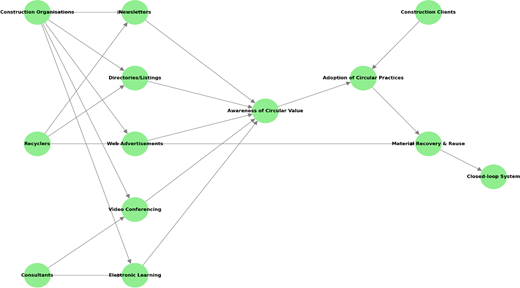
Also, although these channels are mainly considered for forward distribution by communicating and delivering circular value propositions to construction clients, they hold potential to support reverse logistics and circular flows. For example, social media and emails (Oke et al., 2024) can be used to educate construction clients on returning used materials or products. Retailers and distributors can act as collection points for reusable construction components. Word-of-mouth and personal selling (Olanrewaju et al., 2024) can be used to raise awareness of take-back schemes. Electronic learning and newsletters can be used to promote closed-loop practices and engage construction stakeholders. Web advertisements and directories (Amusan Lekan et al., 2018) can be used to list services that accept returned or refurbished construction items. Hence, by using these channels in both directions (forward to deliver circular value and reverse to collect used resources), construction organisations can enhance circular distribution and support the circular flow of materials and value. This dual use of the channels can help close the loop and support the industry’s transition to CE principles.
However, the findings show that only five of the thirteen measurement variables suggested by the interview experts met the required standards before conducting CFA. This suggests that not all variables initially considered from the interview were relevant for defining channel construct in the CEBM for construction organisations. The interfactor relationship’s results imply that the channels were significantly correlated with the latent variables. Evaluating the variation explained by the construct showed that all values were statistically significant at the 5% level. Thus, these findings indicate this latent component’s direct and statistically significant effect on adopting CE business models in construction organisations. The findings also suggest that multicollinearity and high correlations were addressed by selecting variables that meet the required residual covariance distribution. Since multicollinearity can distort decision-making models, this implies that the selected variables provide a reliable basis for construction organisations adopting CEBM to communicate and deliver circular value propositions to different client segments. Hence, construction organisations can use these insights to develop channels for promoting CE initiatives.
In addition, the results show that the channel with the highest causality was newsletters, which was closely followed by directories/listings. Web advertisements and video conferences were the least causative channels. Despite not being considered high in the RII ranking, newsletters are considered the most influential in supporting the delivery of circular value propositions for construction organisations. Newsletters can be effective because they offer consistent, informative communication tailored to client needs. They can help maintain long-term relationships by providing updates on sustainable practices, new materials, and circular project outcomes. Furthermore, directories/listings could help potential clients and stakeholders find circular construction services and products more efficiently. They can support visibility and access within specific industry networks, making them useful for business-to-business (B2B) and business-to-client (B2C) relationships. However, web advertisements and video conferencing, which showed the lowest levels of causality, might imply that these channels are less effective in engaging clients or delivering circular value propositions in construction organisations. It is then imperative that construction organisations seeking to adopt CEBM should prioritise channels such as newsletters and directories/listings to reach their target client segments and communicate the benefits of circular practices more effectively. These findings corroborate Achar et al. (2021), Ejohwomu et al. (2017), and Ishaq et al. (2019) that these communication channels can be effective in reducing waste in construction activities while maintaining clear and understandable information. Figure 1 shows a diagram that illustrates how construction organisations and consultants can engage through specific channels to drive CE outcomes in the construction industry to ensure a closed loop.
Furthermore, the findings of this study have important social and economic implications. Socially, using these channels in CEBM can improve communication and collaboration among construction stakeholders (Olanrewaju et al., 2024). This can lead to better awareness of sustainable practices, stronger relationships, and increased trust between clients, contractors, and suppliers. By promoting reuse, recycling, and take-back schemes through these channels, the construction industry can contribute to environmental responsibility, which benefits communities and future generations. Economically, using the right channels can reduce waste, save costs on raw materials, and create new business opportunities (Otasowie et al., 2024). For example, collecting and reusing materials can lower the cost of construction. Channels that support reverse logistics, like distributors and retailers, can help construction firms recover value from used products. Digital platforms such as emails, e-learning, and web advertisements (Olanrewaju et al., 2024) also offer low-cost ways to reach and educate construction clients. Thus, these channels can help construction organisations improve efficiency, reduce costs, and increase competitiveness while supporting CE.
Construction organisations sometimes prefer to downplay the significance of the channels because research in this area is limited. As a result, construction organisations might not fully understand the potential impact of well-structured communication and delivery channels on client engagement, awareness, and the adoption of circular practices. Nevertheless, the construction industry is changing rapidly due to growing pressures for sustainability, waste reduction, and climate resilience. As such, construction organisations can no longer afford to neglect the importance of effective channel strategies. CEBM adoption depends heavily on how circular value is communicated and delivered to different client segments. Channels are the link between circular products or services and the market. Hence, ignoring this aspect could hinder the success of CEBM adoption. Finally, these results suggest that the channels directly affect the CE business model and that the CE business model for construction organisations may be improved by improving the channels. The assessment of channels yielded noteworthy results, and the construction industry’s CE business model will experience the much-desired adoption of the CE when consideration is given to the channels that contribute to it. Since the channel is a significant component in business models, having a well-defined channel model will help construction firms build stronger stakeholder relationships and improve the uptake of CEBM. In addition, construction firms can use these insights to stay competitive, align with sustainability goals and contribute meaningfully to the circular transition.
6. Conclusion
This study explores the attributes that define channels in construction organisations transitioning to CEBM. It adopted an exploratory sequential mixed-methods approach to examine channels in the CEBM for construction firms. First, a semi-structured interview revealed 13 channels relevant to CEBM. Thereafter, a quantitative approach was used to assess these channels by asking respondents to rate their influence. The collected quantitative data went through a four-stage analysis, which included testing the validity and reliability of the instrument, descriptive statistics, the Kruskal–Wallis test, and confirmatory factor analysis (CFA). The descriptive statistics showed that word of mouth, direct personal selling, social media, electronic learning, and distributors are the most significant channels. However, construction professionals had different opinions on all channels based on their professional affiliation, except for social media, distributors, video conferences, and retailers, where there was general agreement. In addition, the CFA results confirmed the significant influence of five channels: electronic learning, video conferences, newsletters, web advertisements, and directories/listings.
This study provides valuable insights into the channels influencing the transition of construction organisations to a CEBM. This study fills an important research gap by providing an empirical basis for understanding channel construct in the CEBM transition of construction organisations. Previous studies have focused broadly on CE adoption, but limited research has examined how the channel construct influences the shift towards CEBM. Hence, this study addresses this gap by enhancing knowledge of how construction organisations can build stronger stakeholder relationships and improve the uptake of circular solutions. Furthermore, the study has practical, social, and economic implications for construction firms and industry stakeholders. Practically, the findings offer a structured approach for construction organisations to communicate and deliver circular value propositions to different client segments. Socially, the use of the identified channels in CEBM can improve communication and collaboration among construction stakeholders. This can raise awareness about sustainable practices and build trust between clients, contractors, and suppliers. Also, promoting reuse, recycling, and take-back schemes through these channels can also support environmental responsibility and benefit future generations. Economically, using these channels can reduce waste and lower costs by supporting material recovery and reuse. This creates new business opportunities and helps construction organisations become more efficient and competitive. Finally, the findings of this study provide a theoretical foundation for future research on CEBM in construction organisations. However, it is important to note that this study was conducted in South Africa. Therefore, future research can focus on other developing countries to compare the results with the current study. In addition, future studies could explore the role of channels in CEBM in consulting organisations, considering this study focused on contracting organisations.