Although research on the relationship between leadership and safety has progressed substantially, the effectiveness of leadership behaviors that are firmly rooted in bureaucracy on safety has been limited, especially in safety-critical organizations. Therefore, complexity science principles (CSPs) have been proposed to address the limitation of conventional leadership behaviors in improving safety participation at the workplace. This paper aims to examine the interactions of safety leadership and CSPs on the level of safety participation in oil and gas companies.
A total of 173 questionnaire responses were gathered and analyzed using the structural equation modeling method.
The results of this study showed that there are statistically significant and positive correlations between each dimension of safety leadership (i.e. empowering and engaging, modeling and reinforcing and promoting and enabling) and safety participation; and positive effects of safety leadership dimensions on safety participation are partially mediated by various CSPs. The results support that more effective safety leadership behaviors via one or more CSPs entail higher levels of safety participation.
The findings of this study enrich our understanding of the mechanisms by which leadership behaviors enhance employees’ participation in safety behaviors at the workplace. It offers a new perspective for company leaders, site managers and supervisors to develop their appropriate leadership skills and practices for promoting safety behaviors in the oil and gas industry.
1. Introduction
The oil and gas industry experiences an inordinate number of accidents as a result of hostile work environments, flammable fuels, production pressures, heavy equipment, confined spaces and heights that employees frequently encounter (Pinheiro et al., 2011). Therefore, the need for examining various strategies to improve safety performance in oil and gas companies is essential.
Although a process or management system in the industry may be highly automated, it is important to note that people are still heavily involved in the process. As such, safety research and strategies should also focus on the human side of safety (e.g. motivation, behavior, culture and leadership) to achieve further safety performance improvements (Reason, 2000). Within such a research theme, the notion and concept of safety leadership has attracted increasing attention in both academia and industry. Safety leadership refers to the ability, skills and art of leaders to shape the awareness and behavior of their team members to achieve shared safety objectives (Fang et al., 2020). Safety leadership has been widely known as an essential antecedent of safety culture and safety behaviors of employees (Griffin and Hu, 2013); and safety literature has demonstrated a clear positive link between leadership and safety performance (Muchiri et al., 2019).
Nonetheless, a recent review by Baltaci and Balcı (2017) indicated that most leadership studies and practices have been developed based on strict control mechanisms within the framework of the bureaucratic structure. These control mechanisms, included in the concept of formal leadership, instinctively contribute to the inability to move beyond formal control inherent in traditional bureaucratic mindsets, thereby restricting the applicability of mainstream leadership theories to safety management research (Ojuola et al., 2020). Built upon traditional bureaucratic mindsets, conventional leadership behaviors largely involve rigid adherence to safety rules and procedures, which stifle creativity and responsiveness to new safety challenges, thereby limiting the ability to adapt to changing and unforeseen shapes of risks. Moreover, conventional leadership behaviors tend to overemphasize safety rules and procedures, making employees undervalued and unmotivated. As a result, employees might not actively engage and participate in safety activities, as they might feel like mere cogs in a machine rather than valued contributors to the organization. Lichtenstein et al. (2006) argued that available conventional leadership concepts are not dynamic enough to be adapted for centralized organizations and the leadership requirements in safety-critical organizations. Consequently, although research on the relationship between leadership and safety has progressed substantially, the effectiveness of leadership behaviors that are firmly rooted in bureaucracy on safety has been limited, especially in safety-critical organizations such as those operating in the oil and gas industry.
Complexity leadership theory and complexity science principles (CSPs) can be used to provide a different and improved way of leading in organizations (Weberg, 2012). Complexity leadership theory is a framework that enables the learning, creative and adaptive capacity of complex adaptive systems. The scientific principles of complexity, therefore, view leadership as a process that involves many individuals and emphasize the adaptability, creativity and flexibility of leadership, not as a set of values existing in any one individual. The five principles of complexity science are Connectivity (CON), Interdependence (INT), Feedback (FBK), exploration-of-the-space-of-possibilities (i.e. creative exploration [EXP]) and co-evolution (i.e. mutual adaptation and development [MAD]) (Mitleton-Kelly, 2003). CSPs primarily focus on the relationships between parts, patterns of behavior and the interdependencies within a dynamic system, thereby providing an unorthodox leadership approach that would help managers understand and develop their leadership skills (Ojuola, 2020). Therefore, complexity leadership theory and CSPs may address the limitation of conventional leadership behaviors in improving safety at the workplace. Unfortunately, only few studies investigated leadership behaviors in light of CSPs in safety research (Carrillo, 2011). Consequently, the specific complexity science mechanisms by which leadership improves workplace safety remain unclear in safety-critical organizations.
Employees’ non-participation is known as one of the major causes of accidents (Liu et al., 2020). When employees do not actively participate in safety, potential hazards and unsafe conditions may not be addressed. Therefore, employees’ participation in safety is crucial for maintaining workplace safety, reducing accidents and injuries and enhancing the quality of leader-member relationships (Kath et al., 2010). Safety participation entails workers’ involvement and participation in safety production-related activities, including helping colleagues and proactive demonstrations. Voluntary in nature, safety participation fosters an environment that promotes safety and improves the work situation for a broader set of employees than merely the individual enacting the behaviors.
Leadership is widely acknowledged as pivotal to workplace safety and numerous studies explored how differing leadership styles influence employees’ voluntary safety participation (Bin Saeed et al., 2019; Griffin and Hu, 2013). However, methodological shortcomings leave the causal link between safety leadership and participation weakly validated. Prior research typically examines the single-level effects of safety leadership behaviors on safety participation, without exploring the underlying mechanisms that explain how leaders inspire employees to actively engage in safety-related activities. Consequently, the literature offers limited insight into the pathways connecting leadership behavior and safety participation. Clarifying these pathways is essential because it equips executives, site managers and supervisors with actionable knowledge for refining their leadership practices and improving organizational safety performance.
This paper addresses this gap by situating safety participation within the interplay between leadership and CSPs. We argue that CSPs help to explain how leaders promote safety participation in a way that is both distinct and effective within safety-critical organizations. Accordingly, the aim of this study is to empirically examine the interactions of safety leadership and CSPs on the level of safety participation in the oil and gas industry. By integrating CSPs into the safety-leadership paradigm, this study extends theory and furnishes a practical blueprint for enhancing leadership capability alongside safety outcomes. The resulting insights can guide targeted leadership development programs, enrich safety management systems and assist policymakers in organizations where operational complexity and hazard potential are high.
2. Literature review and hypotheses
2.1 Safety leadership
Safety leadership refers to the process by which an individual directs and motivates others to achieve safety objectives while performing organizational tasks (Li et al., 2020). There has been a continuing effort to describe leadership behaviors, explore different styles of leadership (e.g. adaptive, active, stable-moderate, passive-avoidant, inconsistent, paternalistic, etc.) and examine their impact on safety outcomes (Liu et al., 2022; Zheng et al., 2022).
According to the Full Range Leadership model, leadership behaviors can be categorized into two main types: transformational and transactional (Avolio et al., 1999). Transactional leadership, also known as task-oriented leadership, focuses on monitoring and rewarding, whereas transformational leadership, also known as relationship-oriented leadership, focuses on inspiring and motivating the workforce (Oswald et al., 2022). Based on the Full Range Leadership model, many studies on safety leadership have addressed both types of leadership behaviors and constructed specific dimensions of safety leadership to better measure it. A recent review of 37 empirical studies of safety leadership confirms that safety leadership is inherently multidimensional, meaning leaders qualify as safety leaders only when these behaviors explicitly target safety goals (Adra et al., 2024).
Based on a review of the pertinent literature (Amundsen and Martinsen, 2014; Barling et al., 2002; Hoffmeister et al., 2014; Mullen et al., 2011), this study develops a safety leadership scale, taking into account both transformational and transactional leadership sets of behavior. As a result, three safety leadership dimensions are developed:
Empowering and engaging leadership behavior (EELB) refers to a process of sharing power and allocating more autonomy and responsibilities to followers through a specific set of enhancing the meaningfulness of work, fostering participation in decision-making, expressing confidence in high-performance and providing autonomy from bureaucratic constraints (Amundsen and Martinsen, 2014). The concept of EELB has been developed alongside the research stream of supportive, coaching, employee involvement, participative, situational and individualized leadership, specifying the support of followers’ self-worth (Cui and Mo, 2025; Grill et al., 2023; Yuan et al., 2019).
Modeling and reinforcing leadership behavior (MRLB) refers to providing a blueprint for others to follow (Williams, 2010). In other words, the leaders do what they expect the followers to do. Leadership behaviors should be clearly stated, and every leader should be held accountable for modeling them. As a result, most employees look to their leader to determine how to behave in the organization.
Promoting and enabling leadership behavior (PELB) reflects leadership that specifically encourages and develops a safe work environment (Barling et al., 2002). When leaders engage in promoting and enabling behaviors, employees perceive a positive safety climate and engage in more safety behaviors themselves, thus avoiding more injuries and pain because of an increased awareness of and focus on safety (Liu et al., 2024).
2.2 Complexity science principles
Complexity science challenges the conventional linear approach to implementation, where systems have traditionally been studied by examining separate components (e.g. people, interventions and outcomes) with the assumption that their interactions are straightforward and additive, making it possible to predictably link causes to effects (Sturmberg, 2009). Conventional linear approach aimed to control “extraneous” or “confounding” variables, enabling generalization of findings across contexts based on the belief that well-controlled effects in one setting would manifest similarly in others. In contrast, complexity science shifts focus to the relationships within systems, where agents and their artifacts interact dynamically, often surpassing the importance of individual components themselves (Braithwaite et al., 2017). This creates a system capable of self-organizing, adapting, learning from experience and evolving in unpredictable ways (Paina and Peters, 2012).
Complexity science theory offers an enhanced approach to leadership within the organization. It proposes three distinct leadership functions, namely, adaptive, administrative and enabling (Uhl-Bien, 2021). Adaptive leadership refers to adaptive, creative and learning actions that emerge from the interactions of complex adaptive systems as they strive to adjust to tension (e.g. constraints or perturbations). Adaptive activity can occur in workgroups of line workers and is an informal emergent dynamic that occurs among interactive agents. Administrative leadership refers to the actions of individuals and groups in formal managerial roles, who plan and coordinate activities to accomplish organizationally prescribed outcomes in an efficient and effective manner. It structures tasks, engages in planning, builds vision, allocates resources to achieve goals, manages crises and conflicts and manages organizational strategy. Enabling leadership works to create conditions where adaptive leadership can thrive and manage the entanglement between the administrative leadership and adaptive leadership functions of the organization. Enabling leadership occurs at all levels of the organization, but the nature of this role varies by hierarchical level and position (Uhl-Bien, 2021).
According to Mitleton-Kelly (2003), there are five principles of complexity science grouped into three areas: relationships between agents (i.e. CON, INT and FBK), patterns of behavior (i.e. EXP) and enabling functions (i.e. MAD). Relationships between agents, entail ways that leaders can foster relationships, build trust and promote effective FBK to solve organizational issues based on the principles of CON, INT and FBK in complex systems. Patterns of behavior indicate how leaders can encourage team members to try new strategies based on the EXP principle. Accordingly, instead of relying heavily on pinpoint forecasting, top-down planning or elaborate controls, the leaders recognize various strategies through exploration. Finally, enabling functions show how a leader may be an agent of change within an organization premised on the principle of MAD. Leadership is influenced by unique factors because of the specific tasks, professional affiliations and roles in the organization. Analyzing how such MAD change can provide insight into the best fit and collective leadership capacity (Mitleton-Kelly, 2003).
2.3 Linking safety leadership, complexity science principles and safety participation
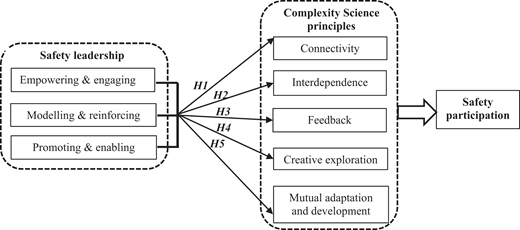
Safety leadership is operationalized in this study through three behavioral dimensions: EELB, MRLB and PELB. Each has the potential to enhance the level of safety participation. A review of complexity science theory enhances the theory of leadership by proposing five principles (i.e. CON, INT, FBK, EXP and MAD) for the improvement of leadership behaviors. In safety management, it is implied that managers and supervisors displaying better safety leadership behaviors via CSPs may entail a higher level of safety participation. We conceptualize CSPs as proximal psychological and social conditions that translate leadership actions into employee motivation to participate in safety initiatives. Accordingly, safety leadership is treated as the antecedent, safety participation as the outcome and each CSP as an intervening mechanism. Hence, the model shown in Figure 1 predicts that every CSP will mediate the relationships between the three dimensions of safety leadership and safety participation. Therefore, the following hypotheses are set out:
Connectivity mediates the relationships between safety leadership dimensions and safety participation.
Connectivity mediates the relationships between empowering and engaging leadership behavior and safety participation.
Connectivity mediates the relationships between modeling and reinforcing leadership behavior and safety participation.
Connectivity mediates the relationships between promoting and enabling leadership behavior and safety participation.
Interdependence mediates the relationships between safety leadership dimensions and safety participation.
Interdependence mediates the relationships between empowering and engaging leadership behavior and safety participation.
Interdependence mediates the relationships between modeling and reinforcing leadership behavior and safety participation.
Interdependence mediates the relationships between promoting and enabling leadership behavior and safety participation.
Feedback mediates the relationships between safety leadership dimensions and safety participation.
Feedback mediates the relationships between empowering and engaging leadership behavior and safety participation.
Feedback mediates the relationships between modeling and reinforcing leadership behavior and safety participation.
Feedback mediates the relationships between promoting and enabling leadership behavior and safety participation.
Creative exploration mediates the relationships between safety leadership dimensions and safety participation.
Creative exploration mediates the relationships between empowering and engaging leadership behavior and safety participation.
Creative exploration mediates the relationships between modeling and reinforcing leadership behavior and safety participation.
Creative exploration mediates the relationships between promoting and enabling leadership behavior and safety participation.
Mutual adaptation and development mediates the relationships between safety leadership dimensions and safety participation.
Mutual adaptation and development mediates the relationships between empowering and engaging leadership behavior and safety participation.
Mutual adaptation and development mediates the relationships between modeling and reinforcing leadership behavior and safety participation.
Mutual adaptation and development mediates the relationships between promoting and enabling leadership behavior and safety participation.
Figure 1 depicts the research hypotheses proposed in this study.
3. Research methodology
3.1 Design
This study adopted a positivist approach to epistemology and an objectivist perspective in ontology. The research objective and hypotheses indicate that this study seeks to discover the relationships between three main research variables (i.e. safety leadership, CSPs and safety participation). Therefore, a quantitative approach and a survey research design were considered the most appropriate to achieve the research objective.
3.2 Data collection instrument
The questionnaire included four main sections. Section 1 aimed to collect the general details on the characteristics of the respondents and their organizations. The remaining three sections aimed to measure three major research variables incorporated in this study.
To measure the three dimensions of safety leadership, the questionnaire contained 13 measurement items. The questionnaire was developed based on a review of previous studies (Amundsen and Martinsen, 2014; Barling et al., 2002; Hoffmeister et al., 2014; Mullen et al., 2011). Accordingly, the leadership questionnaire used a five-point Likert scale, ranging from strongly disagree to strongly agree.
To measure the five principles of complexity science, the questionnaire contained 28 measurement items. It was based on a review of previous studies (Carrillo, 2011; Grady, 2016; Uhl-Bien et al., 2007; Weberg, 2012). Respondents were required to rate the impact of leadership actions in their organization using a five-point Likert scale, ranging from very low to very high.
To measure safety participation, the questionnaire contained six measurement items. It was based on a review of previous studies (Clarke, 2013; Clarke and Ward, 2006). Respondents were, therefore, required to indicate their level of agreement regarding employees’ engagement and participation in safety activities using a five-point Likert scale, ranging from strongly disagree to strongly agree.
The validity and reliability of the questionnaire in this study were addressed by following a three-step process: only relevant items from previously published questionnaires were selected; only “descriptive” not “evaluative” questions were selected, and overlapping measurement items were omitted to the possibility of the confounding effects of common method variance; and the five-point Likert scale was used as it was more understandable to the respondents, offered more detailed information and, thus, was more reliable than other scales (e.g. Guttman and Thurstone) (Bernard and Bernard, 2013). In addition, a total of four academics and industry experts working in the field were invited to review the questionnaire to ensure that questions effectively measured the intended construct, and questions were worded appropriately unambiguous and easy to understand. The questionnaire was then amended and finalized based on the experts’ FBK.
3.3 Data collection and sample
Sampling is the process of selecting a subgroup (or a sample) from a bigger group (or a sampling frame) as the basis for estimating the prevalence of an unknown piece of information relating to the bigger group (Kumar, 2005). Sampling techniques are broadly classified into two types: random sampling and non-random sampling. The research objective suggested a project-level analysis, with the target population was all oil and gas projects worldwide. However, random sampling proved challenging because of the difficulty in determining the exact population of these projects. Therefore, to obtain the research data, judgmental sampling was used in this study as recommended by Sekaran and Bougie (2016). Judgmental sampling is a non-probability sampling technique wherein the sample members are chosen only based on the researcher’s knowledge and professional judgment. In this study, two selection criteria were strictly followed: the main form of business must be oil and gas, and the project must have at least 50 site staff members. In addition, because of the highly technical and specialized nature of the survey, the “key informant” approach was used for selecting potential respondents in the survey. The key informant approach is suitable when respondents can be identified who, because of their role within the organization, can offer opinions and insights that accurately represent the views of other key decision-makers within the organization (Phillips, 1981). In this study, these knowledgeable respondents were professionals working with safety responsibilities and were, therefore, targeted for data collection. In addition, the minimum sample size of 70 was considered adequate for the modeling purposes in this study as suggested by Aibinu et al. (2008).
Ethical approval was granted by the Griffith University Human Research Ethics Committee. The data collection procedure involved three steps. Step 1 was to reach out to the participants. Accordingly, an online survey administered via EnergyPeople was used as the means of survey questionnaire delivery for this research because EnergyPeople is an online platform for oil and gas professionals with a network of over 3 million and over 1 million visitors monthly, and it is responsible for oil and gas marketing and recruitment and provides information, industry news and membership to oil, gas and energy professionals globally (Energy People Group, 2023). In the second step, potential respondents were contacted via email to invite them to participate in this study. In the third and final step, respondents were asked to read the cover letter and the Participation Information Sheet and provide consent and complete the survey based on the implemented safety practices and archival records of their projects. During such a data collection procedure, misinformation, evasions, lies and fronts are recognized as four types of threads to the accuracy of the research data. In this study, to ensure the reliability of the collected data, these potential threads were controlled by the following precautions: careful selection of suitable participants, the data collection procedure guarantees voluntary participation, maintain participants’ anonymity to prevent intended lies and deceptions and assuring the data collection instrument is thorough and clear in its instructions, statements and questions to prevent unintended error by respondents when completing the survey.
After four months of collecting data, 255 completed responses were received from the prospective participants. All received responses were filtered to eliminate having multiple responses coming from the same project location or projects with fewer than 50 staff members. Through this process, the authors eliminated 82 invalid responses from 255 responses received. Finally, 173 responses were considered valid for final data analysis, representing 67.84% of the total collected number. Most respondents were project managers (73%) with more than five years of experience (78%). The organizations’ profiles indicate that most of the sample organizations were well-grounded as they have been in existence for more than 11 years (89%). The projects’ profiles also show that most projects were privately owned (95%). In terms of the projects’ staffing level, most projects had 50–100 staff (74%). Because the validity of the research is associated with the participants and their responses, their position in the well-founded organizations and extensive experience may enhance the validity and reliability of the gathered research data.
3.4 Data analysis
Structural equation modeling (SEM) was used to test the measurement and structural components of the research model. SEM unifies confirmatory factor analysis, path analysis and multiple regression, enabling simultaneous estimation of latent constructs and their interrelationships (Bowen and Guo, 2011). The SEM analysis followed a two-stage procedure. First, confirmatory factor analysis assessed the validity and reliability of the latent variables underpinning safety leadership, complexity-science principles and safety participation. Second, the structural model evaluated the hypothesized paths among these constructs. IBM SPSS AMOS (Version 26) was used to execute all necessary algorithms and techniques related to the specified SEM models in this study.
4. Results
4.1 Confirmatory factor analysis
Before structural model analysis, confirmatory factor analysis was performed to examine the reliability and validity of the measurement items that form model constructs (Hair et al., 2016). The confirmatory factor analysis results can provide compelling evidence of the convergent and discriminant validity of theoretical constructs. The assessment of convergent validity is based on the standardized factor loadings and their significance level. As suggested by Hair et al. (2016), indicators with low loadings (below 0.5) should be removed from the construct. A significant t-values on its own indicator should suffice to prove convergent validity, and indicators should have adequate reliability that can be assessed through R2 value. The convergent validity of the measured constructs in this study was further assessed via composite reliability scores and average variance extracted (AVE) scores. The assessment of discriminant validity can be based on an examination of the correlation coefficient between each pair of variables. In this study, discriminant validity can be assessed by comparing the square root of the AVE scores and correlation coefficients between the latent constructs.
The results of validity and reliability analyses are reported in Table 1. After removal of inconsistent items, all factor loadings are above 0.5 (p < 0.001), indicating the high level of convergent validity. All R2 values of measurement items are greater than 0.50, showing that the indicator reliability was acceptable. The results also show that all composite reliability scores of the constructs were higher than 0.7 and AVE scores exceeded 0.5. Thus, the measurement items were appropriate for their respective constructs.
In addition, the measurement models specified in this study were further assessed via the degree to which model’s factors represent the data using indices of the model fit as suggested by Hoyle (1995). Maximum likelihood method was used to measure the measurement model parameters and fit indices (Hoyle, 1995). Accordingly, a measurement model is considered acceptable when its fit indices meet the following criteria: , GFI, TLI, CFI and IFI > 0.9 and RMSEA < 0.08 (Hoyle, 1995). The results shown in Table 2 indicate that the measurement models were reliable and valid for structural model evaluation.
4.2 Structural model analysis
Mediation can be defined as a phenomenon, whereby the relationship between an independent variable and a dependent variable is fully or partially explained by their relationship to one or more additional variables known as mediators. A mediator explains why and how the independent variable affects the dependent variable. Mediation presumes a temporal and causal sequence wherein change in the independent variable causes a change in the mediator, then finally a change in the dependent variable (Hayes, 2018).
In this study, the hypotheses propose that the dependent variable (i.e. SP) is influenced by three independent variables (i.e. EELB, MRLB and PELB) through a set of mediators (i.e. CON, INT, FBK, EXP and MAD). Therefore, several SEM models were developed to test the research hypotheses. For example, two SEM models are developed to examine the mediating effect of CON on the relationship between EELB and SP (H1.1). Accordingly, the total effect of EELB on SP must first be examined via a non-mediated SEM model. If such an effect was significant, thereby confirming that the first condition of the mediating effect was achieved, then another structural model was developed to examine the three remaining conditions to test whether the effect of EELB on SP is mediated/transmitted by CON.
The total effects of each dimension of safety leadership on safety participation were tested using a non-mediated SEM model. The results show that there are statistically significant and positive correlations between EELB and SP (β = 0.191, t-values = 1.943 and p = 0.052), MRLB and SP (β = 0.176, t-values = 2.139 and p = 0.032) and PELB and SP (β = 0.202, t-values = 1.864 and p = 0.062). The results provide evidence that each dimension of safety leadership positively and directly predicts safety participation, thereby creating a basis to examine whether and how various CSPs mediate these effects. The mediating effects of five CSPs on the relationships between safety leadership dimensions and safety participation are reported in the next sections.
Mediating effects of CON on the relationships between safety leadership dimensions and safety participation were examined by their corresponding SEM models and reported in Block 1 of Table 3. The results show that there are statistically significant and positive correlations between each dimension of safety leadership and CON, CON and SP and each dimension of safety leadership and SP. These results indicate that CON partially mediates the relationships between EELB and SP, MRLB and SP and PELB and SP. This provides empirical evidence to support H1.1, H1.2 and H1.3.
Mediating effects of INT on the relationships between safety leadership dimensions and safety participation were investigated by their corresponding SEM models and reported in Block 2 of Table 3. The results show that there are statistically significant and positive correlations between each dimension of safety leadership and INT, INT and SP and each dimension of safety leadership and SP. These results indicate that INT partially mediates the relationships between EELB and SP, MRLB and SP and PELB and SP. Therefore, H2.1, H2.2 and H2.3 are supported.
Mediating effects of FBK on the relationships between safety leadership dimensions and safety participation were examined by their corresponding SEM models and shown in Block 3 of Table 3. The results show that there are statistically significant and positive correlations between each dimension of safety leadership and FBK, FBK and SP and each dimension of safety leadership and SP. These results indicate that FBK partially mediates the relationships between EELB and SP, MRLB and SP and PELB and SP. This provides empirical evidence to support H3.1, H3.2 and H3.3.
Mediating effects of EXP on the relationships between safety leadership dimensions and safety participation were tested by its corresponding SEM models and shown in Block 4 of Table 3. The results show that there are statistically significant and positive correlations between each dimension of safety leadership and EXP, EXP and SP and each dimension of safety leadership and SP. These results indicate that EXP partially mediates the relationships between EELB and SP, MRLB and SP and PELB and SP. Thus, H4.1., H4.2 and H4.3 are supported.
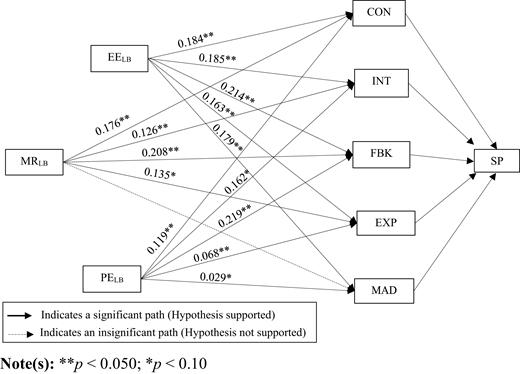
Mediating effects of MAD on the relationships between safety leadership dimensions and safety participation were investigated by its corresponding SEM models and shown in Block 5 of Table 3. The results show that, while there are statistically significant and positive correlations between EELB and MAD and PELB and MAD, no significant relationship was found between MRLB and MAD. In addition, statistically significant correlations were found between MAD and SP and each dimension of safety leadership and SP. This provides empirical evidence to support H5.1 and H5.3.
Based on the results, a total of 14 of 15 proposed paths are found to be statistically significant, supporting the hypothesized relationships among constructs in this research. The paths are statistically significant at p < 0.1 level or less. The statistical significance for 14 statistically significant paths is integrated into a final model of mediating effects (Figure 2). The statistical results and the mediating effects of various CSPs are discussed in the next section.
5. Discussion of findings
5.1 Mediating role of connectivity, interdependence and feedback
The results of this study confirmed that the effects of safety leadership dimensions on safety participation are partially mediated by the level of CON, INT and FBK principles (Blocks 1, 2 and 3 of Table 3). These results indicate that some of the effects of safety leadership dimensions (i.e. EELB, MRLB and PELB) on safety participation are direct, while some are indirect. In other words, selective safety leadership behaviors may not produce a direct impact on the level of safety participation, while they contribute to the cultivation of CON, INT and FBK in an organization, all of which then transmit the effects of such safety leadership behaviors to staff’s safety participation. This process could be explained by the Self-Determination Theory (Deci and Ryan, 2004). This theory suggests that human motivation and performance are largely driven by an innate need for autonomy, competence and relatedness. Accordingly, employees are more likely to perform well and engage in positive behaviors when they feel a sense of control over their work, are able to develop their skills and abilities and feel a sense of connection to their leaders, co-workers and organization. Based on this theory, a possible explanation of the observed mediated effects of safety leadership behaviors on safety participation could be that some leadership behaviors may not have a direct impact on employees’ safety participation if employees do not feel a sense of intrinsic motivation. According to Grady (2016), leaders are influential in fostering relationships in organizations, although with varying degrees of success. Schein (2010) also noted that some of the largest obstacles to improving safety performance are failed communication, lack of trust and poor CON. Therefore, safety leadership behaviors were found to have its impact on safety participation levels by partly going through mediators, namely, CON, INT and FBK principles. Based on this finding, those CSPs are recommended for company leaders, site managers and supervisors to make employees feel more empowered, engaged and connected, thereby putting more effort into promoting safety activities and program.
5.2 Mediating role of creative exploration
The effects of safety leadership dimensions on safety participation are partially mediated by EXP (Block 4 of Table 3). These results suggest that more effective safety leadership behaviors foster the level of EXP in an organization, which then promotes staff’s safety participation at the workplace. This process could be explained by Cognitive Evaluation Theory (Deci et al., 1985). The Cognitive Evaluation Theory focuses on the role of extrinsic motivation and how it can affect intrinsic motivation. Accordingly, when extrinsic rewards are perceived as controlling, they can undermine intrinsic motivation and lead individuals to become less interested in an activity. Conversely, when extrinsic rewards are perceived as supportive, they can enhance intrinsic motivation and lead individuals to become more interested in an activity. The Cognitive Evaluation Theory implies that, because employees typically evaluate the external context to support their behaviors, leaders can serve as a supportive situational factor which has the potential to enhance the employees’ engagement and participation in an activity. Based on this theory, a possible explanation of the observed mediated effects could be that safety leadership behaviors enable employees to feel that they are in a psychological state of safety and a supportive and non-evaluative working environment through the EXP principle, thereby making employees more involved in safety participation. The finding of this study can also be supported by previous studies (Bin Saeed et al., 2019; Nabi and Akter, 2023). A study by Nabi and Akter (2023) indicated that leader and supervisor support for creativity reinforces the role of leadership behaviors in establishing a psychologically safe environment to engage the followers in the creative process (e.g. problem recognition, knowledge-seeking and concept generation). Bin Saeed et al. (2019) also recognized that a better psychologically safe environment enables people to engage more in the creative process, thereby spending a greater deal of time creating noble and valuable solutions to the established problem. Based on this finding, the EXP principle is suggested to be integrated into leadership behaviors because it makes employees feel that their company leaders, site managers and supervisors welcome and encourage their innovative safety-related behaviors.
5.3 Mediating role of mutual adaptation and development
The results of this study support that EELB and PELB could promote safety participation through MAD (Block 5 of Table 3). In other words, both EELB and PELB enhance the level of Mutual adaption and development in an organization, which in turn promotes the level of safety participation. This finding can be explained and supported by previous studies (Casey et al., 2017; Henrich and McElreath, 2003). The Cultural Evolution Theory developed by Henrich and McElreath (2003) seeks to explain how cultural traits and practices change over time and proposes that culture evolves through the transmission and modification of cultural traits over time. Based on this theory, organizational culture is seen as the evolved way in which an organization deals with the fundamental challenge of adapting to the environment and dealing with its changes. The Cultural Evolution Theory posits that there are two types of employees in the organization. The first type is those individuals, who always experiment around the established blueprints to see whether they can find better responses or solutions to allow them to respond to changing requirements. The second type is those individuals, who use previous solutions, gleaned from colleagues, with small modifications that may achieve slightly better outcomes or small improvements upon previous practices. These employees do not spend time exploring new methods or solutions but copy previously used approaches and practices from other employees in the organization. As a result, over time cultural traits and practices will build on top of inherited ones through a process of cultural accumulation. The Cultural Evolution Theory implies that employees inherently drive cultural evolution by introducing and solidifying innovative practices in their organization, thereby helping the organization meet its challenges and attain its goals. Such required cultural evolution is essential to reducing workplace accidents and illnesses, more particularly in a changing environment where technology and the complex interconnection of systems create emerging risks with unpredictable consequences for employee well-being and organizational productivity (Miño-Terrancle et al., 2023). To promote such required cultural evolution, a study by Casey et al. (2017) further pointed out the crucial role played by leaders and managers in exemplifying and shaping employees’ behaviors. Therefore, this study expands the theories of safety leadership and organizational culture by confirming that leadership behaviors (i.e. EELB and PELB) stimulate cultural change and evolution within an organization through mutual adaption and development principle, thereby encouraging employees to participate in the organization’s safety programs and improvement. Based on this finding, mutual adaption and development principle may be suggested to encourage employees to raise new safety concerns and provide suggestions for improvement, which enable organizations to adapt and thrive in a dynamic environment.
However, H5.2 failed the test (Block 5 of Table 3). This result indicates that MRLB does not effectively promote employees’ safety participation through MAD. One possible explanation for this result is that MRLB primarily involves leaders’ leading by example, which reinforces employees’ commitment to safety by ensuring that leaders consistently adhere to safety protocols and procedures. In contrast, based on MAD principle, leaders act as an agent of change, focusing on driving safety improvements through modifications and innovations within an organization. The misalignment between these two contrasting leadership approaches, where MRLB emphasizes stable adherence to safety practices and MAD encourages transformative safety changes, likely undermines the integration of both strategies, thereby limiting their effectiveness in encouraging employees’ participation in safety activities.
5.4 Research implications
Employees who regularly encounter hazardous situations and are at the sharp edge of accidents, play a critical role in determining their own safety by the way they perceive risk, make decisions about safety-related actions, then how they might behave. It is important to note that employees’ perceptions, attitudes toward safety and behaviors are influenced by their leaders and managers. In this context, this study promotes the discussions and understanding of the underlying mechanisms by which leadership behaviors promote employees’ safety participation. This study makes a significant contribution to the academic discourse on workplace safety in three ways:
(1) Theoretical advancement of safety leadership research.
By empirically validating a three-dimensional structure comprising empowering and engaging, modeling and reinforcing and promoting and enabling behaviors, this study refines the theoretical framing of safety leadership. These dimensions offer specific, operationalized constructs that support a behavior-based conceptualization of leadership influence. This contribution moves beyond the traditional transformational and transactional binary, advancing a more nuanced understanding of how leadership supports safety outcomes.
(2) Integration of complexity science into safety research.
The incorporation of five principles from complexity science as mediating variables (CON, INT, FBK, EXP and MAD) positions leadership as embedded within dynamic systems rather than as a linear driver of change. This interdisciplinary approach enhances theoretical interchange between safety management and complexity theory, while also providing a mechanism-based explanation of how leadership influences safety behaviors in complex operational contexts.
(3) Methodological contribution and measurement validation.
This study introduces two validated instruments: an eight-item scale for measuring safety leadership and a 22-item scale for complexity science practices. Confirmatory factor analysis and SEM confirm their reliability and construct validity. In addition, the use of judgmental sampling across an international population of oil and gas projects illustrates the viability of key informant approaches in safety research. It offers a model for future data collection in similarly specialized domains.
These contributions suggest several directions for future research. Further studies may examine moderating contextual variables such as ownership structure, regulatory environment or technological complexity, that could influence the relationships among leadership, complexity principles and safety participation. Longitudinal and mixed-methods approaches could further unpack causal relationships and trace the evolution of complexity-informed practices over time. Comparative research across industries would also help assess the generalizability of the proposed framework and the robustness of its theoretical constructs.
6. Conclusion
This study examined the interactive effects of safety leadership and CSPs on safety participation in the oil and gas industry. The findings of this study highlight the positive impacts of safety leadership behaviors on safety participation and the mediating roles played by various CSPs. This study has addressed the deficiency in existing safety literature by:
developing and validating five specific complexity science mechanisms by which leadership improves workplace safety in safety-critical organizations; and
elucidating the different roles of CSPs that have not been investigated in previous studies, in enhancing the levels of safety participation.
From a practical perspective, the CSPs and its practices are determined and recommended for company leaders, site managers and supervisors to assess and develop their leadership skills and behaviors. In addition, oil and gas companies should consider incorporating theory and practices of CSPs into their existing leadership training and development programs. This would help equip leaders with the tools and frameworks needed to drive greater employee participation.
Acknowledgements
This research was undertaken as part of John Ojuola’s PhD at Griffith University and was supported by a Griffith University International Postgraduate Research Scholarship (GUIPRS). The funder had no role in the study design, data collection and analysis, decision to publish, or preparation of the manuscript.