Traditional construction progress monitoring (CPM) has been widely used as a project management technique in the construction industry. However, the absence of modern CPM techniques can lead to delayed decision-making, inaccurate progress tracking, inefficient resource allocation and limited collaboration and communication. Extended reality (XR) has been identified as a solution for CPM, combining various technologies such as augmented reality, mixed reality and virtual reality to address specific challenges. It allows stakeholders to explore multiple dimensions of a project, offering limitless opportunities to develop a unique, innovative approach to tracking the construction project’s status at any point in time. Therefore, this paper aims to develop a framework for integrating XR in CPM within the Sri Lankan construction industry.
This study adopts an interpretivism stance and uses a qualitative research approach. Data were collected through ten semi-structured interviews with experts with experience and knowledge of integrated CPM and Building Information Modelling (BIM)-XR projects. To analyse the data, a code-based content analysis approach was used using NVivo 12 software, while Microsoft Visio was used to develop a framework.
This study revealed benefits, including real-time automated updates and the ability to measure both physical and financial progress, as well as barriers to integrating XR technology into CPM, primarily a lack of financial capabilities to afford an XR system and top management’s reluctance to adopt new technology. The developed framework can be used to devise strategies for overcoming barriers to the current implementation of the XR system. Through it, XR technology demonstrates its effectiveness in resolving issues associated with existing CPM methods.
This research contributes value to the construction industry by providing a practical framework to guide Sri Lankan professionals in effectively implementing XR within CPM. In addition, this study will guide academic researchers, industry professionals and government institutions in developing countries with similar socio-economic, demographic or cultural characteristics to those of Sri Lanka, aiding the implementation of XR technology and extending existing knowledge on XR. Furthermore, this study could be particularly useful for industry professionals seeking to implement the XR framework in BIM-integrated projects.
To the best of the authors’ knowledge, this study will be the first of its kind in the Sri Lankan construction industry, contributing to a deeper understanding of “XR” technology for CPM.
1. Introduction
The construction industry is starting to realise the possibilities of digitisation technology that can meet the challenges in construction progress monitoring (CPM) (Alaloul et al., 2021). Numerous technical solutions have been tested by industry people combining different technologies to overcome those challenges, including Unmanned Aerial Systems (UAS) and 4D Building Information Modelling (BIM) (Álvares and Costa, 2019), Inverse photogrammetry and BIM (Braun and Borrmann, 2019), Light Detection and Ranging (LiDAR) technology (Puri and Turkan, 2020) and CCTV cameras (Martinez et al., 2021). However, Kopsida et al. (2023) reviewed that none of these solutions have achieved the performance of progress monitoring due to the barriers that encompass them, such as 3D laser scanning: high expensive equipment, greater warm-up time, requires high technical knowledge and reduces the accuracy of the data; LiDAR: requires expert operators, loss of information and reduce the accuracy of data processing; photogrammetry: affect the resolution, object edge detection and accuracy of progress estimation may be affected, needs more software knowledge, labour intensive and error prone; radio frequency identification tags: limited flexibility and blind spots may be occurred (Dilaksha et al., 2024; Qureshi et al., 2022; Weinmann et al., 2021).
To overcome these barriers, a modern CPM solution has been developed, known as extended reality (XR) (Khairadeen Ali et al., 2021). XR is a collective term for fully immersive technologies, including virtual ones such as virtual reality (VR), augmented reality (AR) and mixed reality (MR) (Çöltekin et al., 2020). XR provides an immersive experience in a real-scaled 3D environment. XR systems offer numerous benefits to the CPM, including the ability to remotely monitor multiple tasks simultaneously, reduce the number of progress inspectors required to monitor progress (Ali et al., 2020) and achieve better accuracy, time and cost efficiency (Seyman-Guray and Kismet, 2024). XR facilitates the proper and timely implementation of corrective actions and prevents cost and schedule deviations (Alizadehsalehi and Yitmen, 2023; Kopsida et al., 2023). Therefore, the XR concept is popular in the industry nowadays. Moreover, all digital data that is captured and generated must be visualised at a real world scale for stakeholders at various stages of the construction project. Accordingly, XR allows stakeholders to explore multiple dimensions of a project, offering limitless opportunities to create a unique and innovative practice of the project status at any point in time (Alizadehsalehi and Yitmen, 2023). As the core benefit of XR, it provides direct visualisation of results, enabling progress assessment of many tasks with easy understanding (Rauschnabel et al., 2022). However, implementing XR is challenging but feasible for the construction industry.
Key barriers to implementing XR in the construction industry can be identified as high initial cost (Afolabi et al., 2022), lack of suitable software (Ozcan-Deniz, 2019), lack of technical support (Delgado et al., 2020), lack of knowledge of expertise, resistance to organisational change, lack of management support and lack of knowledge and training (Seyman-Guray and Kismet, 2024). Although the implementation of XR poses challenges for the industry, it would benefit the architectural, engineering, construction (AEC) industry in many ways, including the CPM. Therefore, an implementable framework needs to be developed to reap these benefits for the industry. Patel et al. (2022) stated that the evolution of research confirms that CPM-related studies focused on fundamental and traditional CPM research topics before 2007. Between 2007 and 2020, there was a movement in research priorities towards digitalisation and automation (Patel et al., 2022). Researchers worldwide have investigated XR from the CPM perspective. For example, researchers have integrated XR with several other techniques to develop models for CPM, such as digital twin (Alizadehsalehi and Yitmen, 2023), laser scanning (Ali et al., 2020) and BIM and point cloud models (Khairadeen Ali et al., 2021). Researchers further focused on the technical environment/individual components of XR and CPM integrated project delivery in case studies. Nevertheless, they have failed to address the potential for implementing the already existing XR for CPM. Furthermore, the integration of XR technologies in the construction sector is a novel subject that requires exploring both its possibilities and limitations to enhance its efficacy in the future (Seyman-Guray and Kismet, 2024). Existing studies do not provide a comprehensive framework that considers how the benefits of XR can help overcome the challenges of CPM, and how the barriers within XR in CPM can be addressed through the strategies
The role of XR technologies in CPM on-site and the issues associated with technology adoption have not been well-documented, especially in a developing country like Sri Lanka’s construction industry. Studies related to XR have considered various aspects of the construction industry, including building maintenance (Coupry et al., 2021) and construction safety and productivity (Abdeen et al., 2024). As each sector is unique, there is no evidence in the research on the application of XR technologies in CPM within the Sri Lankan context, particularly regarding an implementable framework to derive benefits from XR for the industry. Furthermore, current studies rarely incorporate cultural, socio-economic and demographic characteristics, consequently constraining the generalisability of their findings. Moreover, the adoption of innovative technologies in the construction sector has progressed more slowly compared to other sectors. Construction projects in Sri Lanka face specific challenges, such as limited technology adoption, workforce training and financial and resource constraints, which are underrepresented in the existing literature. Although XR implementation in Sri Lanka is still in its early stages, it helps address CPM challenges, primarily time delays and cost overruns (Dilaksha et al., 2024; Senanayake et al., 2024). Accordingly, the research proposes a scalable framework specifically designed for Sri Lanka, presenting guidance for XR integration and generating theoretical knowledge on the benefits, barriers and strategies of integrating XR for CPM (both study and literature derived) to policymakers and academic and industry practitioners in other developing countries with similar socio-economic, demographic or cultural characteristics to Sri Lanka. Therefore, the objectives of this research are to identify the benefits of integrating XR into CPM, investigate the barriers to its integration and propose strategies for effective integration. Accordingly, the research problem has been identified as: How to integrate XR for CPM in Sri Lanka? This paper aims to fill the research gap by developing a framework for integrating XR in CPM within the construction industry and extending existing knowledge on XR to developing countries with similar socio-economic, demographic or cultural characteristics to Sri Lanka.
The initial section of this research provides a review of the literature on XR, including its benefits, integration with CPM, barriers and strategies for implementing XR in CPM. Following the literature review, the next section outlines the chosen research methodology, followed by the research findings, including the benefits of implementing XR-integrated CPM, the barriers to its implementation and strategies to overcome them. Finally, a framework for integrating XR in CPM has been developed for the construction industry.
2. Literature review
2.1 Challenges in automated construction progress monitoring techniques
Automated CPM continues to face difficulties due to the challenges associated with using numerous data collection techniques, as outlined in Supplementary Table 1.
To address these challenges, a modern approach called XR has been introduced. Moreover, with notable benefits from XR, including real and virtual references for users, a real-world scale for stakeholders at various stages of the construction project, time and cost efficiency, better accuracy and the facilitation of proper and timely corrective actions, which help overcome the challenges of CPM systems.
2.2 Extended reality
All real and virtual blended environments, as well as human–machine interactions, generated by computer technology and wearable devices, are collectively referred to as XR (Ratcliffe et al., 2021). XR is an umbrella term that incorporates AR, VR and MR. The ability of this technology to retrieve virtual models and other related built environment data from real-world environments and overlay them onto existing building structures can improve inspection quality (Al-Adhami et al., 2019). XR applications have been tested and integrated into various aspects of the construction industry, such as CPM (Ali et al., 2020), visualisation/simulation (Han and Leite, 2022), communication/collaboration, quality control (Al-Adhami et al., 2019), information modelling (Safikhani et al., 2022), education or training (Zwoliński et al., 2022) and safety or inspection (Liu et al., 2022).
Ali et al. (2020) and Khairadeen Ali et al. (2021) have conducted case studies to demonstrate the potential of 3D BIM integration with XR. In that case, as-built data have been captured to develop a 3D mesh geometry model using point clouds from the 3D laser scanner. The 3D mesh geometry model has been compared with a 3D BIM model. Finally, the progress data has been attached to the AR visualisation. Alizadehsalehi and Yitmen (2023) developed a CPM model by integrating the digital twin with XR. However, recent research approaches have been developed based on BIM translator software that can be used to develop AR, VR and MR to compare the built conditions with the design model by visualising through output/wearable devices in real time at the site (Alaloul et al., 2021; Alizadehsalehi et al., 2020; Alizadehsalehi and Yitmen, 2023). Progress monitoring can be achieved successfully using BIM translator software and wearable devices (Boton, 2018). XR systems provide a 3D immersive environment for users, allowing them to freely navigate, inspect and interact with a 1:1 scale 3D BIM model (Johansson and Roupé, 2019). In this process, a 3D BIM model is converted into a 4D BIM model by integrating a project timeline from a project scheduling software. After the integration process, the XR model is generated from the 4D BIM model. Finally, this XR model was imported into the XR device to monitor progress (Alizadehsalehi et al., 2020).
2.2.1 Benefits of integrating extended reality into the construction progress monitoring.
XR integration benefits construction projects at the design, construction and post-construction stages. Figure 1 and Supplementary Table 2 represent the benefits of XR integration at the construction stage in CPM. It highlights the key benefits of adopting AR, MR and VR for progress monitoring and tracking.
 The diagram is divided into three main sections. On the left, a panel titled Benefits of integrating X R into the C P M lists advantages such as visual assistance, reduced errors, improved efficiency, collaboration, user-friendly interface, accurate scale, faster decision making, cost reduction, portability, and enhanced B I M information retrieval. In the centre, a workflow diagram shows As Design Model and Project Schedule feeding into a four-dimensional Model, connected to Cloud Software. Reality Capturing Technology links to a V R Model, while Device in Built Camera links to an A R or M R Model, both connected through the cloud. Below, a box titled Strategies to Implement X R in C P M includes low-cost hardware use, training and development programmes, evaluation of B I M knowledge, and system analysis. On the right, a panel titled Barriers to implementing X R into the C P M lists challenges such as data loss in cloud systems, additional costs, limited field of view, rapid process changes, difficulty with irregular objects, safety issues with head mounted devices, setup time, lack of expertise, handling large data, preparation requirements, training difficulties, rendering issues, and limited mobile device capacity.
Conceptual framework for implementing XR for CPM
Source: Authors’ own creation
The diagram is divided into three main sections. On the left, a panel titled Benefits of integrating X R into the C P M lists advantages such as visual assistance, reduced errors, improved efficiency, collaboration, user-friendly interface, accurate scale, faster decision making, cost reduction, portability, and enhanced B I M information retrieval. In the centre, a workflow diagram shows As Design Model and Project Schedule feeding into a four-dimensional Model, connected to Cloud Software. Reality Capturing Technology links to a V R Model, while Device in Built Camera links to an A R or M R Model, both connected through the cloud. Below, a box titled Strategies to Implement X R in C P M includes low-cost hardware use, training and development programmes, evaluation of B I M knowledge, and system analysis. On the right, a panel titled Barriers to implementing X R into the C P M lists challenges such as data loss in cloud systems, additional costs, limited field of view, rapid process changes, difficulty with irregular objects, safety issues with head mounted devices, setup time, lack of expertise, handling large data, preparation requirements, training difficulties, rendering issues, and limited mobile device capacity.Conceptual framework for implementing XR for CPM
Source: Authors’ own creation
XR is not a standalone technology that needs to be integrated with other construction-related technologies, such as BIM. Therefore, this system integration will benefit all areas of a construction project, including design, construction and maintenance. XR integration for progress monitoring offers benefits beyond progress monitoring, extending to other construction-related activities. Accordingly, Figure 1 presents the direct and indirect benefits that can be achieved for the AEC industry by adopting XR for progress monitoring, including productivity improvement, reduced error risk, realistic training, shortened design periods and comparison of multiple design solutions. However, most researchers emphasise that visual assistance facilitates task performance and reduces errors during construction as the primary benefits of XR (Rauschnabel et al., 2022; Seyman-Guray and Kismet, 2024). Whereas, only a few studies have highlighted benefits such as lower cost solutions, improved efficiency, real and virtual references for users, accurate scale and size, location-specific data, reduced overall costs and realistic training (Alizadehsalehi and Yitmen, 2019; Delgado et al., 2020). XR can be considered an innovative tool that drives benefits for a construction project.
2.2.2 Barriers to implementing extended reality into the construction progress monitoring.
CPM is quite a challenging task (Spencer et al., 2019). Numerous challenges arise in implementing XR technology (Al-Adhami et al., 2019). Therefore, it is essential to understand the barriers to integrating XR with CPM, as presented in Figure 1 and Supplementary Table 3. Common barriers to implementing XR for progress monitoring include a lack of expert knowledge and advice (Han and Leite, 2022) and the high initial capital required due to the cost of hardware and software, which may be unaffordable for construction companies (Han and Leite, 2024). Although AR, VR and MR are relatively simple technologies that can be used on even mobile devices, people are often unaware of these technologies. On the other hand, the client will not allocate an additional budget for XR implementation on construction projects, as it is not a value-added service from the client’s perspective. Furthermore, Ozcan-Deniz (2019) stated that although BIM is widely used in the industry, there is no standard for connecting 3D models to XR systems. To overcome these challenges, researchers have stated several strategies, which are further discussed.
2.2.3 Strategies to implement extended reality in construction progress monitoring.
Implementing XR in the construction industry is a significant challenge due to barriers. However, some common barriers can be eliminated by implementing alternative solutions. For example, hardware and software costs can be eliminated by using low-cost devices and software. For that, proper system analysis should be done to identify the capability of existing resource utilisation in an organisation. Google Cardboard can be easily applied as a VR wearable device, eliminating the need for expensive standalone devices like the HTC Vive and Focus (Tromp et al., 2020). Ozcan-Deniz (2019) stated that a lack of expert knowledge and advice poses a threat to the implementation of XR, which needs to be addressed through training and development programmes. One of the challenges is creating a proper 3D model, as developing it to the required level of detail by various stakeholders is the first step in implementing VR. A virtual tour is impossible without a detailed 3D model, which is one of the qualities that distinguish VR from AR. Therefore, before implementing XR, the knowledge of BIM among industry stakeholders should be evaluated (Ozcan-Deniz, 2019). A summary of strategies for implementing XR in CPM is presented in Figure 1.
Integrating XR technologies can offer numerous benefits to CPM. However, there is a lack of research on the application of XR technologies in CPM within the Sri Lankan context, especially regarding an implementable framework to acquire the advantages of XR for the industry. Therefore, this paper aims to address this gap by developing a framework for integrating XR into CPM within the construction industry.
2.2.4 Conceptual framework for implementing XR for construction progress monitoring.
The research aims to develop a framework for integrating XR into CPM within the Sri Lankan construction industry. Accordingly, based on the existing literature, a conceptual framework was developed, which is presented in Figure 1.
The conceptual framework provides a brief overview of the XR implementation. XR is a link to the computer vision-based CPM techniques and BIM is the foundation of XR-based CPM. In the proposed AR and MR models, schedule data have been integrated with the BIM models, and BIM-translating software converts the BIM model into the XR model. Then the built-in camera in the device or head mounted display (HMD) device extracts the as-built data. The inspector at the site can determine real-time progress, considering deviations, which are indicated by a separate colour code that shows the overlap between the as-designed model and the actual as-built environment. However, VR systems must model the as-built state using reality capture technologies, as they cannot capture real-time site data. In that case, the inspector at the site office will compare the point cloud model or 3D mesh geometry to identify discrepancies in the project. Moreover, XR offers numerous benefits for construction projects, particularly for progress monitoring and management. However, most researchers have indicated that barriers such as the initial cost of hardware and software devices have restricted industry adoption. Therefore, strategies must be identified to implement XR in the industry. Low-cost alternatives to HMD devices, such as Google Cardboard, can be used. BIM integration is the other requirement for construction projects to implement XR-based CPM. However, prior training and development are necessary for implementing such strategies.
3. Research methodology
Initially, the study conducted a critical review aimed to identify relevant papers on XR-integrated CPM. The review included papers published in the Scopus and Web of Science databases. The study places great importance on encouraging and valuing the opinions, perspectives and open exchange of ideas and experiences among individuals within the research environment and in human interactions. Consequently, the study embraced the ontological premise that “reality is not predetermined but socially constructed” and the epistemological assumption that “knowledge is acquired by exploring the perspectives of individuals”, as recommended by Saunders et al. (2019). Similarly, in terms of axiology, the study adopts a value-laden stance, recognising the potential for researchers to contribute value that influences the study. Thus, the research adopted an interpretivism stance for the study.
The strategy for selecting a suitable approach was determined by the nature of the research problem (Chih-Pei and Chang, 2017). Three research approaches can be identified for conducting research: qualitative, quantitative and mixed methods (Creswell, 2014). The qualitative method is applied to compare people’s views, experiences, attitudes, behaviour and interactions, which produces non-numeric data. The goal of qualitative research is to explore the meaning and experience components of people’s lives and social situations (Fossey et al., 2002). Given the exploratory nature of the study and the need for an in-depth investigation of the phenomenon in its real-world context, it has been argued that a qualitative approach is better suited to the research.
3.1 Data collection
3.1.1 Semi-structured interviews with experts.
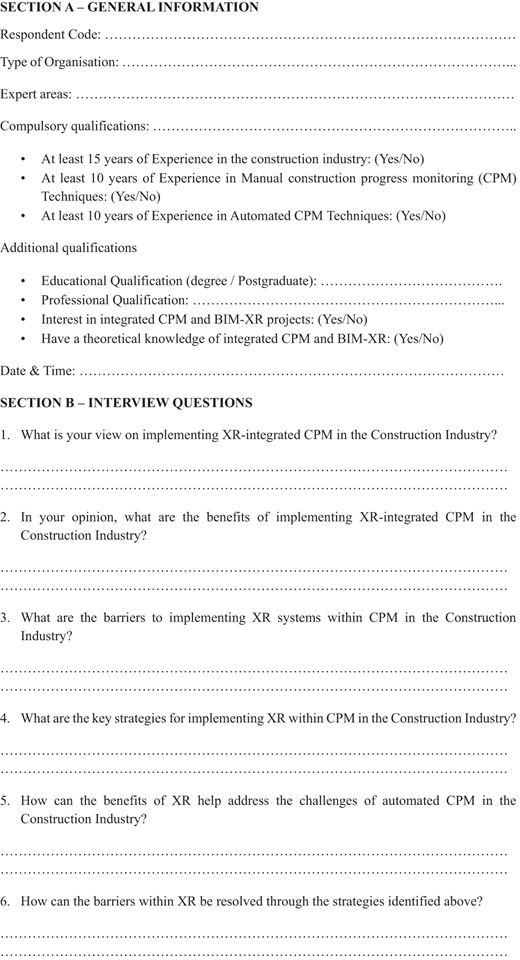
Relevant information for the research can be effectively obtained through interviews, as they are considered one of the most reliable tools for gathering insights into participants’ attitudes, behaviours and opinions on the research topic (Saunders et al., 2019). Semi-structured interviews were selected for this study as they allowed both the interviewer and the interviewee to engage in an in-depth discussion through a series of open-ended questions (Basias and Pollalis, 2018). A semi-structured interview guide was used to provide the necessary flexibility for in-depth exploration while also maintaining control over the interview process to address all objectives. The guide was divided into two main sections, as shown in Appendix. The first section focused on gathering general information about the experts. The second section aimed to gather information on the benefits, barriers and strategies for implementing XR-integrated CPM to achieve all three research objectives. After developing the interview guidelines, a pilot test was conducted as recommended by Kallio et al. (2016).
3.1.2 Profile of interview respondents.
The empirical data collection technique used in this study involved conducting semi-structured interviews with ten experts selected using purposive sampling. Purposive sampling, as emphasised by Campbell et al. (2020), is a method for gathering data on a particular subject from individuals with knowledge or extensive experience in that area. The participants for the semi-structured interviews were chosen based on their knowledge, experience and involvement in both XR and CPM techniques. The experts for semi-structured interviews were selected using purposive sampling. Therefore, one of the criteria for selecting the sample was the participants’ years of experience, along with their knowledge and interest in integrated CPM and BIM-XR projects, both locally and internationally, to ensure adequate expertise. The sample comprised Sri Lankan professionals with international experience in automated CPM, who were qualified to offer expertise in the effective local implementation of the technology. The semi-structured interviews were conducted via online platforms, including Zoom/Teams. Each session lasted approximately 60–90 min. Interviews were conducted until the tenth, as data saturation was reached at the eighth interviewee, meaning that no new themes or codes emerged thereafter, as suggested by Saunders et al. (2018). To confirm saturation, two additional interviews were conducted. Although no new themes or codes emerged, this does not mean that experts were excluded from the discussion. Instead, it indicates that further expert interviews did not provide new perspectives or information, consistent with the concept of data saturation in a qualitative study. Table 1 shows the profile of the experts.
Profile of the experts
| Experts | Designation | Type of organisation | Expert areas | Compulsory qualifications | Additional qualifications (possess at least three of the following qualifications) | ||||||
|---|---|---|---|---|---|---|---|---|---|---|---|
| At least 15 years of experience in the construction industry | At least 10 years of experience in manual CPM techniques | At least 10 years of experience in automated CPM techniques | Possess a degree in built environment | Possess a postgraduate in built environment | Possess a professional affiliation related to the built environment field | Interest in integrated CPM and BIM-XR projects | Have a theoretical knowledge of integrated CPM and BIM-XR | ||||
| P01 | QS/BIM specialist | Contractor | BIM/XR | √ | √ | √ | √ | √ | √ | √ | |
| P02 | QS/BIM consultant | Consultancy and educational | BIM/research on XR | √ | √ | √ | √ | √ | √ | √ | √ |
| P03 | Senior QS consultant | Consultancy | BIM/XR | √ | √ | √ | √ | √ | √ | √ | √ |
| P04 | BIM manager | Contractor | BIM/ XR | √ | √ | √ | √ | √ | √ | √ | √ |
| P05 | QS | Contractor and educational | BIM/research on XR | √ | √ | √ | √ | √ | √ | √ | √ |
| P06 | QS | Contractor | Research on XR | √ | √ | √ | √ | √ | √ | √ | |
| P07 | Engineer | Contractor | BIM | √ | √ | √ | √ | √ | √ | √ | |
| P08 | Senior engineer | Consultancy | BIM | √ | √ | √ | √ | √ | √ | √ | √ |
| P09 | Engineer | Contractor | BIM/ XR | √ | √ | √ | √ | √ | √ | √ | |
| P10 | Senior engineer | Contractor and educational | BIM/research on AR/VR/XR | √ | √ | √ | √ | √ | √ | √ | √ |
The interviewees had working experience and knowledge of CPM in various regions, beyond the local context. Therefore, practical knowledge of BIM-XR-integrated project delivery could have been acquired. The selected sample comprised different age categories, enabling them to gather opinions across varying levels of experience. Table 1 indicates that each respondent had experienced both manual and automated CPM techniques in their career.
3.2 Data analysis
The semi-structured interview was successfully conducted with ten interviewees. Consequently, the subjective data received from the interviewee has been analysed using a code-based content analysis technique in NVivo 12. The coding process adhered to the principles of open, axial and selective coding, as recommended by Williams and Moser (2019). Subsequently, the data collected from the expert interviews were transcribed, and the transcripts underwent a process called “open coding”, where they were thoroughly analysed to identify key concepts and patterns for categorisation. In addition, these themes were sifted, tagged and categorised. The functionality of NVivo 12 enabled the development of nodes representing specific concepts/themes. Following this, axial codes derived from both deductive and inductive coding were assigned to the themes. This process was repeated in multiple cycles until no new codes could be identified from the data, at which point the final codes were designated selective codes. This approach was chosen for the study as it supported the development of a comprehensive list of themes for qualitative content analysis. After analysing the collected data, an interactive data visualisation framework was developed and presented for the study, using Microsoft Visio software.
Data triangulation was performed to ensure the validity and reliability of the collected data. Data were gathered from multiple sources, including experts from various disciplines, to obtain diverse perspectives from both local and international experts. The identified themes and codes were developed and cross-checked against existing literature and previous studies through pattern matching. In addition, inter-rater reliability was used, where multiple researchers coded the same data to assess their level of agreement, followed by discussions on any areas of disagreement and more (Natow, 2020).
4. Research findings
4.1 Benefits of implementing XR-integrated CPM
Respondents had similar opinions on several factors when considering the benefits of implementing XR-integrated CPM. The study revealed 12 benefits associated with implementing XR-integrated CPM, as shown in Supplementary Table 4.
Most respondents highlighted “reducing errors, mistakes and clashes” as the main benefit of XR implementation, with seven participants agreeing. Accordingly, P01 mentioned that, “through this technology, mistakes and errors that could happen in the future can be eliminated”. Moreover, P04 and P10 mentioned that a scanned model of a steel building can be compared with the planned model. Then, construction defects can be easily detected before damage occurs. After that, an engineering solution for the defect will be proposed. Then, “complex things are easy to understand” was identified as the second key benefit of XR implementation, with most respondents emphasising that the XR system will provide a better understanding of progress to individuals lacking construction knowledge, as the system offers a visual representation of progress. The Client will get a better experience through the visualisation and stimulation of construction. Similarly, P05 stated that “it will be easy to explain the progress to the client. Furthermore, XR systems can visually capture progress while comparing it with the final view. Thus, construction activities can be easily understood by computer vision systems rather than people”.
The experts highlighted “Automated real-time updates, physical and financial progress” as another benefit of XR-integrated CPM. A BIM-XR-integrated project can fully automate the CPM process with the support of internet of things and digital twin technology. In addition, real-time progress monitoring is feasible, as respondents noted that XR enables CPM during ongoing construction activities. Furthermore, real-time quantity calculations are also possible in BIM-XR-integrated projects, as the system was developed using 3D modelling software. The respondents noted that financial progress can be measured using an XR system by linking the bill of quantities (BOQ) to the XR model. This enables the BOQ to be updated in real-time. However, P04 pointed out the limitation, stating that “Due to current conditions, budget proposals and time schedules can be linked to BIM models to some extent only”.
Furthermore, respondents emphasised that data consistency is more reliable than human judgement, as personal biases can influence human decision-making, whereas the XR system operates based on algorithms. However, it was noted that current AR measurements may not be highly accurate but are expected to improve as AR technology continues to develop. P09 also mentioned, “Accuracy will be higher since manual methods require professionals and can introduce errors due to personal judgment”. Similarly, P01 agreed, stating that “using technologies for progress monitoring can eliminate the risk of incorrect data entry into the systems”. All participants agreed that a BIM-XR-integrated progress monitoring system would be a more effective solution than conventional methods. Moreover, with notable benefits from XR, including real and virtual references for users, a real-world scale for stakeholders at various stages of the construction project, time and cost efficiency, better accuracy and the facilitation of proper and timely corrective actions, which help overcome the challenges of CPM systems. However, respondents argued that to fully realise the benefits, existing barriers to XR implementation in the construction industry must be addressed first.
4.2 Barriers to implementing XR-integrated CPM
The study identified nine barriers that hinder the implementation of XR-integrated CPM, as shown in Supplementary Table 4. Respondents noted that smaller-scale companies should avoid testing the implementation of XR due to the high costs associated with hardware, software and hiring experts. This financial burden could result in significant losses and potentially harm their position in the industry. Although VR, scanners and other equipment are very expensive, AR is more accessible because it requires only a mobile device. Moreover, the lack of technology and experienced experts in the local context was highlighted as a barrier to implementing an XR system for CPM in a developing country like Sri Lanka. Many respondents noted a shortage of experienced professionals in XR technologies, hindering the training of existing workers in Sri Lanka. As a result, if an XR system were implemented, there would be limited technical support available. The lack of competent professionals in the local context was attributed to several factors, including Sri Lanka’s traditional education system, which does not produce professionals with the necessary expertise for the industry.
Furthermore, there are only a few software engineers and professionals proficient in 4D technologies and industry professionals are generally unaware of continuing professional development (CPD), seminars and short courses. This leads to a lack of technological awareness and a lack of interest in learning, which presents a significant barrier to progress. Furthermore, respondents stated that implementing such technology may not be suitable during an economic crisis, especially when the construction industry is experiencing a downturn. Firms considering the adoption of XR may face initial losses, and recovering from these losses could take time. If planning is not carefully executed, the project could be negatively impacted, and, in the worst case, abandoned, given the current economic situation in the country.
Most respondents noted that reluctance to change and fear of technology are significant barriers to implementing an XR system. Traditional professionals expect significant resistance when transitioning from a conventional CPM system to an XR system. In addition, the reluctance to change is exacerbated by the generation gap between top management and younger staff. Many current professionals are reluctant to abandon certain job responsibilities to the XR system. Because XR is a relatively new and underused technology in the construction industry, integrating it with existing software, such as BIM, project management and scheduling software, can be challenging. Therefore, respondents remarked that “Improvements would be needed in the integrated system. For example, if the current system operates on manual Ethernet cables, it would need to be upgraded to a cloud-based network to support the next level of integration”.
Although the literature review identified 14 barriers to implementing XR technologies in the construction industry, the study revealed seven barriers to implementing XR systems in CPM, based on interviewees’ responses, as shown in Supplementary Table 4. Accordingly, most respondents stated that the lack of financial resources and the reluctance to change among existing staff and management are the primary barriers to implementing XR technologies in the construction industry.
4.3 Strategies to implement XR-integrated CPM
Strategies are essential to overcome barriers and ensure the effective use of technology and resources to maximise the benefits of XR systems. To identify these strategies, the interview guidelines included questions about key strategies for implementing XR within the context of CPM. As a result, the research identified 13 strategies designed to facilitate the implementation of XR-integrated CPM, as described in Supplementary Table 4.
The majority of respondents highlighted seven key strategies for implementing the integration of XR and CPM, listed in order as follows: promoting integrated BIM projects, using XR and construction knowledgeable professionals, participation by leading bodies, convincing value and benefits, training, market analyses and purchasing software and hardware.
Promotion of integrated BIM projects.
All respondents agreed that promoting BIM-integrated projects is a key strategy for implementing XR in CPM. They noted that executing a BIM project with XR offers additional benefits beyond CPM, including real-time quantity takeoffs and quality control. Starting with a BIM-integrated project is easier and carries lower risk than a traditional project. The P04 respondent mentioned: “Out of 100 projects, only one or two may be BIM-integrated, and XR systems should be tested on those projects”.
XR and construction professionals.
The respondents noted that the arrival of experts from abroad poses a higher risk and emphasised the need for quantity surveyors and civil engineers to enhance their software development skills. However, they pointed out that educational institutions do not prioritise producing technically competent professionals for the industry. As a result, the education system should be reviewed, with lecturers replaced by industry practitioners rather than researchers. This would allow students to gain more practical knowledge, become familiar with the technology and apply it more effectively in the industry. In addition, there were suggestions to outsource experts, establish training programmes in Sri Lanka and conduct workshops to address these challenges.
Convince the benefits
Although there are not many technical difficulties with this technology, the main challenge lies in raising awareness. It is essential to educate people about the benefits of XR and the drawbacks of traditional systems, with top management also involved in this awareness process.
Involvement of leading bodies
The participation of leading bodies in implementing XR is vital, as emphasised by seven respondents. They suggested that promotion should come from higher levels of government. For instance, if the government, architectural boards, engineering councils and quantity surveyors’ committees collaborate on a unified proposal for industry practitioners, it could facilitate implementation. Some respondents had a different perspective on the role of regulatory bodies, stating that “If these XR technologies are implemented in government projects as pilot projects, they could set an example for others to follow”. Also, it was proposed that a “pilot project” be launched to test the technology’s applicability and suitability in the Sri Lankan context. Moreover, it was suggested that legal provisions could be introduced to mandate the adoption of XR technologies for projects exceeding certain contract amounts, in line with strategies implemented in other countries. On the matter of regulatory bodies, P03 noted that “Smaller firms cannot implement XR, but larger companies can afford these technologies”.
Create an information hub
The respondents highlighted the importance of establishing an expert-powered information hub to address the issues identified by the XR system. However, some respondents disagreed with the idea of creating an information centre staffed by foreign employees with experience in these technologies from other regions.
Market analysis
Another key factor is conducting a market analysis before implementing XR in construction. All respondents emphasised that the high initial cost of XR systems and firms’ economic status significantly affect the implementation process. Before adopting XR, it is crucial to assess the return on investment, accounting for the client’s budget constraints and the technology’s potential benefits. If the return on investment cannot be recovered, implementing such technology would be a waste of resources. A market analysis would help identify industry competitiveness and prevent projects from being lost due to the high costs of XR systems.
Purchase software and hardware
To operate an XR system, a significant amount of hardware and software is required. However, most respondents did not view purchasing or upgrading hardware and software as a primary strategy for implementing XR.
Digitising the site
The respondents emphasised that to implement XR, the entire site would need to be digitised and all staff on the site would need to agree with the technology. However, partnering with a company that already has XR facilities and hiring them could help reduce the initial costs. In addition, they highlighted the importance of improving general computer skills across the entire staff. Developing such a system would result in all data being stored digitally, allowing everyone to read, check and handle the 3D model, as well as filter the data. However, P02 argued that the process should begin with the use of BIM technology for CPM, as 3D visualisation and monitoring systems are essential. It is further suggested that it would be better to first use BIM software, such as Navisworks and BIM Manager, before integrating XR applications.
Process, protocol and guidelines preparation
The respondents indicated that XR-based CPM has never been implemented in the Sri Lankan context, meaning there are no established processes or guidelines to follow. As a result, implementing XR in a single project would be a risky endeavour. They suggested that after starting a pilot project, the issues within the system should be thoroughly investigated.
5. Framework to integrate extended reality for construction progress monitoring
This study seeks to address the existing research gap by investigating the framework for integrating XR into CPM in the context of the Sri Lankan construction industry and in developing countries with socio-economic, demographic or cultural characteristics similar to those of Sri Lanka, thereby supporting the implementation of XR technology. This research focuses on developing a framework for integrating XR into CPM, as shown in Figure 2. This framework demonstrates how the benefits of XR can help overcome the challenges of CPM and how the barriers within XR in CPM can be addressed through the strategies proposed in this study.
 The figure combines a Sankey diagram with a central system workflow. On the left, automated C P M techniques such as three-dimensional laser scanning, C C T V camera, G I S, L I D A R, photogrammetry, Q R codes, R F I D, time-lapse camera, and videogrammetry are shown. These connect to challenges, including high technical knowledge, expensive equipment, low accuracy, data clashes, need for developers, environmental difficulty, unorganised point clouds, processing issues, software requirements, resolution problems, noisy data, labour intensity, tracking difficulty, environmental damage, limited flexibility, blind spots, high energy use, complex analysis, and occlusions. Flows then connect to X R benefits such as a user-friendly interface, easier understanding, cost saving, accurate scale, data consistency, real and virtual reference, reduced errors, collaboration, quick decisions, location-specific data, real-world experience, automation, visual assistance, multiple choices, walkthroughs, improved productivity, and virtual interaction. In the centre, a workflow shows As Design Model and Project Schedule feeding into a Four-dimensional Model linked to Cloud Software, with Reality Capturing Technology producing a V R Model and a device camera producing an A R or M R Model. On the right, barriers such as additional cost, data loss, handling complex geometry, interoperability issues, lack of finance, lack of human touch, limited knowledge, device limitations, low management support, infeasibility for small firms, setup requirements, training needs, resistance to change, rendering issues, and slow industry growth connect to strategies including low cost hardware, convincing value, hardware rental, market analysis, training programmes, B I M integration, digitalisation, protocols, software purchase, system analysis, workshops, knowledge improvement, pilot projects, and involvement of leading bodies.
Development of a framework to integrate XR for CPM in the Sri Lankan construction industry
Source: Authors’ own creation
The figure combines a Sankey diagram with a central system workflow. On the left, automated C P M techniques such as three-dimensional laser scanning, C C T V camera, G I S, L I D A R, photogrammetry, Q R codes, R F I D, time-lapse camera, and videogrammetry are shown. These connect to challenges, including high technical knowledge, expensive equipment, low accuracy, data clashes, need for developers, environmental difficulty, unorganised point clouds, processing issues, software requirements, resolution problems, noisy data, labour intensity, tracking difficulty, environmental damage, limited flexibility, blind spots, high energy use, complex analysis, and occlusions. Flows then connect to X R benefits such as a user-friendly interface, easier understanding, cost saving, accurate scale, data consistency, real and virtual reference, reduced errors, collaboration, quick decisions, location-specific data, real-world experience, automation, visual assistance, multiple choices, walkthroughs, improved productivity, and virtual interaction. In the centre, a workflow shows As Design Model and Project Schedule feeding into a Four-dimensional Model linked to Cloud Software, with Reality Capturing Technology producing a V R Model and a device camera producing an A R or M R Model. On the right, barriers such as additional cost, data loss, handling complex geometry, interoperability issues, lack of finance, lack of human touch, limited knowledge, device limitations, low management support, infeasibility for small firms, setup requirements, training needs, resistance to change, rendering issues, and slow industry growth connect to strategies including low cost hardware, convincing value, hardware rental, market analysis, training programmes, B I M integration, digitalisation, protocols, software purchase, system analysis, workshops, knowledge improvement, pilot projects, and involvement of leading bodies.Development of a framework to integrate XR for CPM in the Sri Lankan construction industry
Source: Authors’ own creation
A total of 12 benefits were identified from the responses received from the participants. However, the literature review identified 19 benefits of implementing XR, summarised in Figure 1. Consequently, the literature findings on the benefits of real-world experience (Alizadehsalehi et al., 2020), time and cost savings (Ozcan-Deniz, 2019), reduction of errors and clashes (Chu et al., 2018; Hou et al., 2017) and easy understanding (Baek et al., 2019; Kopsida, 2018) are consistent with the responses. In addition to these responses, the respondents expressed several other benefits. Among the most frequently mentioned benefits were real-time automated updates and the ability to measure both physical and financial progress. Since the baseline of technological transformation maturity is lower than in developed countries, the benefits are more noticeable and easier to observe. However, most respondents were unable to express their opinions on technical environment-related questions. Compared to Figure 2, the benefits identified in the findings were weighted towards technical benefits, as most of the benefits were derived from research on case studies. Therefore, exclusive benefits in both can still be considered as benefits to the XR implementation.
Furthermore, the study identified nine barriers to implementing XR systems in CPM, as revealed by interviewees’ responses. Accordingly, most respondents stated that the lack of financial resources and the reluctance to change among existing staff and management are the primary barriers to implementing XR technologies in the construction industry, due to economic, cultural and institutional conditions. However, the literature review identified 14 obstacles to the implementation of XR technologies in the construction industry and indicated that the lack of expert knowledge and advice (Al-Adhami et al., 2019) was the barrier identified by most researchers, while financial capacity (Lee et al., 2020) and a limited field of view (Al-Adhami et al., 2019; Alizadehsalehi et al., 2020) were the second most identified barriers to the implementation of XR in CPM. However, the study revealed that the lack of financial capabilities to afford an XR system and the reluctance of top management to adopt new technology are the most recognised barriers by the respondents, resulting from policy gaps and limitations in the developing economy, which are unique to developing countries like Sri Lanka. Both the literature and the interviews highlighted that financial constraints significantly affect the implementation of XR.
Similarly, four strategies for implementing XR have been identified in the literature review, including the use of low-cost hardware devices (Tromp et al., 2020), prior system analysis, implementing training and development programs and evaluating BIM knowledge among team members (Ozcan-Deniz, 2019). However, the study empirically demonstrated 13 strategies for implementing XR in the construction industry, which can be realistic and feasible with local resources and capacities. Most respondents stated that BIM-integrated project promotion and the development of professionals with XR and construction knowledge can be considered strategies to improve implementation.
Furthermore, Figure 2 illustrates two main findings:
How the benefits of XR can help address the challenges of automated CPM and
How the barriers within XR can be resolved through strategies identified in this study.
Firstly, for instance, one of the key challenges in automated CPM is data clashes, which can be addressed by integrating XR, as its features help reduce such errors, mistakes and clashes. Similarly, challenges related to resolution in CPM can be resolved through XR’s ability to provide design walkthrough and replicate real-world conditions. Moreover, in terms of accuracy, which is a primary concern in CPM, XR provides improvements through accurate scaling and linking of real and virtual environments. Overall, as shown in Figure 2, XR implementation effectively addresses the various challenges in CPM.
Although XR offers numerous benefits, it also presents its own set of challenges. Accordingly, Figure 2 illustrates how these barriers can be overcome through strategies identified in this research. For example, the financial limitations of using XR technologies in CPM can be addressed by adopting cost-effective devices, partnering with hardware rental companies, conducting thorough market analysis, integrating BIM and engaging with leading industry bodies. These strategies also support the practical implementation of XR in small-scale projects, making it more feasible and accessible. Likewise, interoperability issues can be addressed through initiatives such as training and development programmes, transferring the entire site to digitalisation, implementing pilot projects, conducting workshops and training sessions and system analysis. Accordingly, as shown in Figure 2, these strategies effectively address the barriers to implementing XR in CPM. This framework paves the way for researchers and industry professionals to overcome barriers, ensure proper implementation and strengthen its theoretical impact on XR in CPM.
6. Conclusions
Integrating XR technologies can provide several benefits to CPM. Considering the research outcome, significant benefits can be identified. Primarily, XR technology can provide real-time data on a construction project’s progress, enabling quicker and more accurate decision-making. Furthermore, XR can offer a more immersive, interactive experience for stakeholders, thereby enhancing communication and collaboration. Integrating XR technologies into CPM can improve efficiency, communication and collaboration, ultimately yielding better outcomes for construction projects. XR can exclusively aid in improving understanding, convincing and visualising construction progress.
On the other hand, the study identified several barriers that must be addressed for successful implementation. One of the primary barriers is the high cost of implementing XR technology, encompassing hardware, software and training expenses. Another barrier is the need for specialised skills and knowledge to operate and maintain XR systems, which may not be readily available within the construction industry. The physical limitations of XR technology, such as the limited field of view, should be considered when implementing XR in CPM. Addressing these barriers will be critical for the successful integration of XR technology into CPM, ultimately leading to more efficient and effective construction project management.
Integrating XR technologies into CPM can provide numerous benefits, but requires a comprehensive plan and effective strategies. Strategies for the successful integration of XR technology include identifying the importance of BIM-integrated project promotion, training stakeholders, ensuring compatibility with existing project management software and technologies, facilitating communication and collaboration among project stakeholders through workshops and CPD programmes and convincing stakeholders of the value. In addition, developing process protocols and guidelines to establish a standardised method for XR implementation is a major strategy to pursue at the XR implementation stage. By implementing these strategies, construction companies can successfully integrate XR technology into their CPM and other aspects of project monitoring, leading to improved efficiency, productivity and overall project outcomes. Finally, the study developed a framework that can help to overcome barriers to XR implementation through identified strategies. In addition, the framework provides the pathway to address the challenges of automated CPM through the benefits of XR implementation in the construction industry.
6.1 Contribution to industry
The results and findings have been used to develop an XR-integrated CPM framework to assist industry professionals in maximising the optimal benefits of XR use in CPM. The developed framework paves the way for researchers and industry professionals to overcome barriers, ensure proper implementation and strengthen its theoretical impact on XR in CPM. Moreover, it provides guidance to construction industry professionals aiming to implement XR in their projects. It further provides the pathway to address the challenges of automated CPM by demonstrating the benefits of XR implementation in the construction industry. Furthermore, as an implication of these research findings, industry practitioners are advised to be familiarised with computerised applications such as 4D modelling software and project modelling software before taking steps to the modern XR technologies for the CPM, as the research found that most of the professionals are not aware of the uses of such technical applications. Besides, this research guide enhances the construction industry’s overall performance by employing an appropriate CPM method. Developing countries like Sri Lanka are still struggling to gain the benefits of XR implementation in the construction industry due to similar barriers, such as a lack of financial capabilities to afford an XR system and the reluctance of top management to adopt new technology. Therefore, the research contributes to theoretical knowledge by identifying the benefits and barriers to XR implementation and by proposing strategies to overcome these barriers. With the scarcity of studies exploring the benefits and barriers of XR implementation and strategies to overcome these barriers in the construction industry, this study’s findings provide a foundational benchmark for future research. In addition, the study will serve as a guide for academic researchers, industry professionals and government institutions in the international community, particularly in developing countries with socio-economic, demographic or cultural characteristics similar to those of Sri Lanka, to support the implementation of XR technology.
6.2 Recommendations for industry practitioners and further research
Develop a clear understanding of the benefits and barriers of XR technology in CPM. Identify the most suitable XR technology for specific tasks and project requirements. Invest in high-quality hardware and software that can be customised to meet specific project needs. Ensure that project stakeholders receive sufficient training and support to use XR technology effectively. Develop standard operating procedures for the use of XR technology and establish protocols for data management, data sharing and data security to ensure optimal utilisation and protection. Foster a culture of innovation and collaboration within the organisation to facilitate the integration of XR technology into project management processes. Continuously evaluate the effectiveness of XR technology use and identify areas for improvement. The findings will pave the way for future researchers to explore how construction organisations can develop the necessary capabilities to effectively implement XR technology in CPM, which will be the central focus of the research’s next phase.
References
Further reading
Supplementary material
The supplementary material for this article can be found online.
Appendix