This study aims to examine the impact of external debt on economic growth in Bangladesh within a broader macroeconomic scenario.
In the process of doing so, it assesses the empirical cointegration, long-run and short-run dynamics of the concerned variables for the period of 1980–2017 applying the autoregressive distributed lag (ARDL) bounds testing approach to cointegration. First, debt-gross domestic product linkage explores the impact of external debt impact on economic growth using a set of macro and country risk variables, and then this linkage is also analyzed along with a newly formed macroeconomic policy (MEP) variable using principal component analysis.
The study results reveal the negative impact of external debt on GDP growth, but the larger positive impact of MEP index indicates that this adverse effect of debt can be mitigated or even nullified by sound MEP and appropriate human resource policy.
The dynamic effects of different shocks (external debt and macro policy variable) on economic growth by vector autoregression impulse response function also confirm our ARDL findings.
1. Introduction
The prime objective of any economic policy of developing country such as Bangladesh is to attain sustainable economic growth with infrastructural development and poverty reduction. However, when the government fails to meet their growth needs, they oblige to welcome financial assistance from the external sector, mostly in the form of debt. Bangladesh had to rely on debt and is still relying on external debt to manage the saving-investment gap and fiscal deficit since its independence.
External borrowing is not a negative issue for a country until it can generate higher returns than the cost of borrowing, but it becomes vicious if it is not used properly and prudently. External borrowing would be enhancing capacity and output growth hence, making the debt productive and justifiable (Poirson et al. (2002) and Pattillo et al. (2004)). On the contrary, this debt can create fiscal imbalances and excessive foreign borrowing that may make the country more vulnerable to different shocks and crises. It reduces the effectiveness of fiscal policies and limits the ability of the monetary authority to raise interest rates for monetary policy purposes, due to its effect on the budget deficit and debt (Beetsma and Bovenberg, 2003).
Although probable effects of large public debts on output growth are a major challenge for policymakers and public opinion in general, the empirical research addressing the debt-growth nexus in the context of Bangladesh is considerably scanty. Our study begins to highlight this issue through its investigation of the dynamic association between growth and external debt.
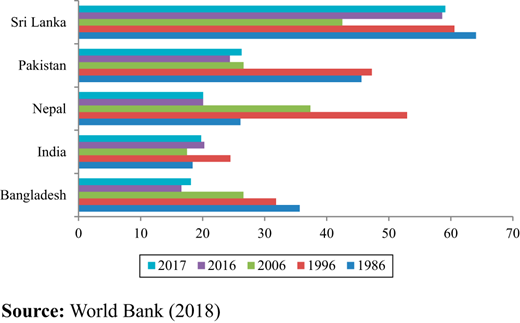
Given the fact, Bangladesh is still having a low debt-gross domestic product (GDP) ratio (Figure 1) and even the lowest per capita external debt in the South Asian region. So, it would be quite interesting to look into the debt-GDP nexus and how MEP affects this nexus in the context of Bangladesh throughout 1980–2017.
The objective of this study is to explore the impact of external debt on growth and how the MEP index can soothe to some extent or nullify the negative effect of external debt. Unlike any other studies on Bangladesh, this paper is significantly different as it analyses the external debt-growth relationship in a macroeconomic context taking the interactive term of external debt and policy in the model. Moreover, external debt is disaggregated to sketch their respective effects on growth independently. Vector autoregression (VAR) impulse response function (IRF) has been used to illustrate the dynamic effects of external debt shocks on growth and the shocks of the macro variable on economic growth.
This paper is organized into eight sections: starting with the introduction, Section 2 contains a review of the available empirical literature. Section 3 contains a brief discussion of the trends in external debt and growth in Bangladesh over the study period. Model specification and data are discussed in Section 4 while Section 5 contains the econometric methodology. Section 6 analyses the empirical results of the study and Section 7 presents the IRF. Conclusions with policy recommendations are described in Section 8.
2. Literature review
Overabundances of studies have examined the effect of public debt on economic growth, whereas most of them have focused on external debt issues of developing countries generally. The results of the empirical studies are mixed and inconclusive; differing not only upon the country or group of countries investigated but also upon the study period, the model specification and estimation techniques, the set of control variables including the debt indicator variable. While the general conclusion of external debt studies is that external debt has an insignificant or negative relationship with economic growth. Though the studies on external debt issues across countries are innumerable, the studies that dwell on this topic relating to Bangladesh are scanty. For the reason of parsimony, we attempt to compile a brief summary of the recent contributions to the external debt perspective in Table 1.
The existence of a negative relationship between external debt and growth is revealed by a good number of the studies. Even focusing on Bangladesh, we can state that majority of them exert a negative impact of external debt on growth. On the contrary, Saifuddin (2016) found an indirect positive effect on growth analyzing public debt, which is combined with external and domestic debt. So, the debate on the effect of external debt on economic growth, however, remains unresolved because of discrepancies in the results of extant studies.
3. Overview of an external debt scenario of Bangladesh
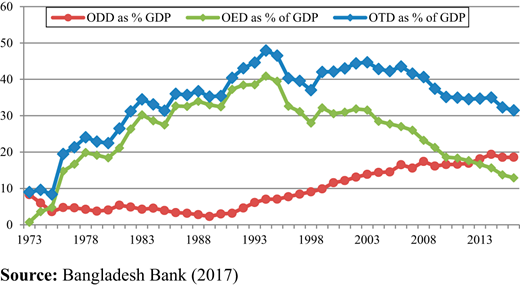
The inception of the debt demand is the inability to meet up the deficit financing of the budget. There is a clear indication in the “Public Money and Budget Management Act 2009” to keep the budget deficit to a sustainable level. Therefore, the Bangladesh government is continuously trying to keep the fiscal deficit within 5% of GDP over the years. The Government borrows both from domestic and external sources to meet the budget deficit caused by the social welfare expenditure, unexpected expenditure in emergencies, development planning expenditure and increased investment. The budget of recent years shows a trend of the steady decline of dependence on external assistance. However, the principal and interest repayment for received loans by Bangladesh are gradually increasing (Finance Division, M. of F, 2017) (Figure 2).
The sound management of public debt can be judged by looking at debt to GDP ratio and the per capita debt liability. Then the next criterion is the status of servicing of the debt and the history of debt servicing. Bangladesh experiences success in the debt management policy. According to debt sustainability analysis of The International Monetary Fund (IMF), Bangladesh’s risks of external debt distress and overall debt distress continue to be assessed as low. Until now Bangladesh never defaulted to service the debt nor ask for a rescheduling of debt. The debt-GDP ratio is the lowest in the South-Asian region, which is below 30% from 2004 like our neighboring countries India and Pakistan, whereas the external debt-GDP ratio of Sri Lanka is around 55%.
Also, Table 2 provides the detail of the external debt composition of Bangladesh. As of end-FY16, total outstanding external debt is estimated to be US$26.306bn (11.88% of GDP). External debt consists of medium to long term loans from multilateral and bilateral creditors, short term debt and borrowings of the state-owned enterprises. Multilateral creditors account for a large share of the external debt, with the World Bank and the Asian Development Bank being the largest creditors while The Organization for Economic Co-operation and Development (OECD) countries are the largest bilateral creditors.
Bangladesh government is truly aware of institutional strengthening and capacity building to deal with this external debt issue. So, historically the fiscal policy should set in a way that it can keep the budget deficit low or below 5% of GDP.
4. Model specification and data
To evaluate the impact of external debt on economic growth, our targeted main variables are GDP and external debt to GDP ratio (EDG). However, few more variables are included as well in the model, namely, budget deficit to GDP ratio (BDG), inflation, secondary enrollment ratio and trade openness along with the above mentioned two variables. The population is taken as a control variable to avoid the variable specification bias.
Here are the justifications for using the above-discussed variables in the growth equation. Firstly, the fiscal management of government is a key determinant of growth. Studies of Fischer (1993) and Easterly and Rebelo (1993) examined the role of fiscal policy in determining the growth of output. They found that large and consistent budget deficits are negatively correlated with growth. Thus, a relatively low BDG should have a positive effect on reflecting macroeconomic stability.
Prices play a vital role in an economy to allocate resources efficiently, but high and rapidly increasing prices can distort economic stability. Thus, a high level of inflation may be inimical to growth by adversely affecting the decision-making effort of agents [Barro (1996) and Khan and Ssnhadji (2001) for details]. So, we expect inflation (INF) to adversely affect growth.
In the present growth theory, human capital is another core variable in explaining growth. Our growth model has taken the secondary school enrollment ratio (SER) as a proxy of human capital. The positive impact of human capital on growth is expected because educated and skilled people tend to be more productive.
Trade openness (TO), measured by total trade as a ratio to GDP reflects what extent an economy is linked to the rest of the world. An economy with a more open trade can quickly adopt newly developed ideas and equipment and is particularly important for developing countries. Gallup et al. (1998) showed that open economies are generally in a better position to import new technologies and new ideas from the rest of the world as compared to closed economies. Therefore, and following Barro (1996), Easterly and Levine (1997) and Collier and Gunning (1999), thus we expect to have a positive effect of TO on growth.
Because of being a labor abundant economy, the population (P) is a major component of economic growth which has a positive impact on growth.
The functional form of the model to satisfy the prime objective of the study is as follows:
The endeavor of our study is to spot the external debt and growth association in Bangladesh within a broader macroeconomic set-up. According to Fischer (1993), economic growth positively responds to the influence of sound MEP and causation runs from good MEP towards economic growth. He argues that growth is negatively associated with high inflation, large budget deficits and distorted foreign exchange market [1]. Thus, following the above direction, we construct an MEP index incorporating the monetary, fiscal and trade variables to study the impact of this new MEP variable on growth and external debt. The above equation can be modified as follows:
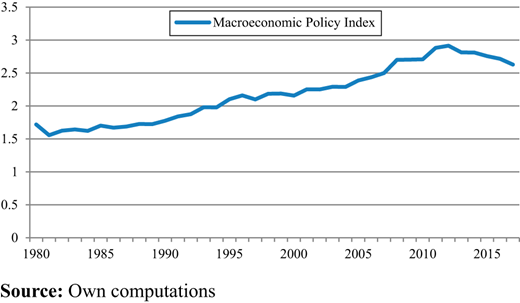
where all the variables are discussed above, except MEPt and MDt, where the first one is the newly formed MEP index and the second one is the multilateral debt to total debt ratio [2]. Following Burnside and Dollar (1997, 2000, 2004), the MEP is constructed as a weighted average of three macroeconomic policies i.e. monetary policy, fiscal policy and trade policy. The three policies are captured by the inflation rate [3], budget deficit and TO. For the obvious reasons, these variables are not included separately in the modified growth equation since they are already embedded in the MEP variable (Figure 3).
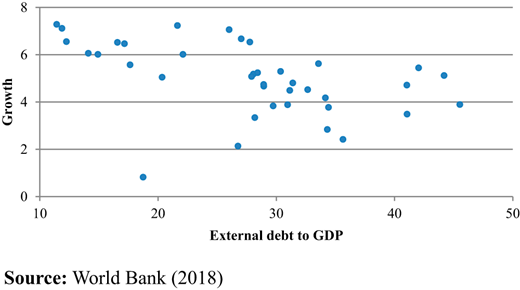
Annual data on studied variables are covering the time period of 1980–2017 and collected from the economic relations division of Bangladesh, IMF world economic outlook and World development indicators of World Bank. All data are in real and in natural logarithm form. The historical data of GDP and EDG ratio for Bangladesh are depicted below (Figure 4).
Table 3 provides the data definition and descriptive statistics of the studied variables.
Various methodologies are available to construct the indices, such as the subjective method (weighted average), least-square regression model, and finally, the principal component method. The principal component analysis (PCA) method is adopted in this study. The ordinary least squares (OLS) method was deliberately ignored because the determined weights of the policy index along with other variables will be somewhat redundant, as well as weights may be unstable due to multicollinearities.
PCA is a method that allows reducing of a system of highly correlated variables into a smaller number of dimensions; whose correlation is minimized. It is probably the most widely used and well-known of the standard multivariate methods. The main objective of a PCA is to reduce the number of dimensions in the data without losing too much information. Thus, the policy index is based on the formula:
where α1, α2, α3 represents the normalized weights of the first principle component. Table 4 shows the estimated normalized weights that are used in constructing a policy variable.
5. Econometric methodology
Autoregressive distributed lag (ARDL) “bound test” approach introduced by Pesaran et al. (2001) is used to analyze the long-run relationship between the external debt and growth in a multivariate framework[4]. Appropriate modification of the orders of ARDL model is enough to simultaneously correct for residual serial correlation and problem of endogenous variables Pesaran and Shin (1999). The econometric form of the first model relating to external debt and GDP, once stationarity or cointegration are verified:
where all the variables are discussed above, α is the intercept, β1-β6 are the coefficients of explanatory variables and ε is the error term. Expected signs of the equation variables are: .
Although unit root pre-testing is not necessary to proceed with the ARDL bounds testing approach. Just to avoid the risk of invalid estimation[5], it is, therefore, essential to test the stationarity properties of each variable before proceeding to the econometric analyses. Augmented Dickey-Fuller (ADF) and Phillips-Perron (PP) tests are used for testing unit root properties of the variables under study.
In the ARDL cointegration technique, the existence of cointegration or possession of long-run relationship among the variables is primarily determined. Then the short and long-run parameters extraction is done in the second step. The bound test approach is mainly based on an estimate of the unrestricted error-correction model (UECM) by using OLS estimation procedure. The bound testing approach to cointegration involves investigating the presence of a long-run equilibrium relationship using the error-correction model (UECM) frameworks:
For equation (1),
For equation (2),
where Δ is the difference operator, the existence of a long-run equilibrium relationship is tested by restricting the lagged level variables. Decisions of the bound test are made based on the F-statistic value that helps to draw conclusions[6] about the long-run relationship of the variables.
In this study, the identification of the structural shocks of external debt and GDP is based on the identification scheme suggested by Blanchard and Perotti (2002). In this regard, the appropriate order of the variables to meet the assumption of the lack of a contemporaneous relationship is embedded in the estimated model. The targeted variables of our model were entered into the VAR model as follows: log of GDP (LGDP), MEP, log of external debt to GDP ratio (LEDG) and log of secondary enrollment ratio (LSER).
This ordering implies that GDP growth, MEP and secondary enrollment ratio, respond contemporaneously to changes in external debt but debt responds to changes in these endogenous variables only with a lag. Similarly, output growth is assumed to be contemporaneously influenced by changes in external debt, MEP, and secondary enrollment ratio, but these variables respond to shocks to output growth only with a lag. Then, we compute the IRF that are used to assess and trace out the time path of the effect of structural shocks on the variables under investigation.
6. Empirical results
In this section, we present the empirical results from different methodologies. Table 5 shows that all the variables are non-stationary at levels but become stationary after first differencing and the results are summarized below.
It can be inferred that both ADF and PP (Table 5) test results reveal that the variables are non-stationary at a level at a 5% level of significance, but they became stationary at first difference level. Thus, all the variables are integrated of order one i.e. I(1), respectively [7], where both possibilities with intercept, as well as with intercept and trend are considered.
As our variables are integrated of order one, so it is needed to find whether the variables are cointegrated. To investigate the long-run relationship between external debt and GDP, the ARDL model to cointegration and error correction is applied. The existence of a cointegration of our main model [equation (1)] is confirmed by the bound test approach to cointegration (Table 6).
The cointegration test in Table 6 ensured the presence of a long-run relationship between the variables and the results are presented in Table 7. The computed F-statistic of the above two models’ equations exceeded the upper bounds at a 1% level of significance. As per the rule, the higher F-statistic value supports the rejection of the null hypothesis that confirms the long-run relationship between the variables which implies that the variables will move together. Then the cointegration results lead us to argue that external debt and GDP have a long-run association.
The Akaike information criterion (AIC) lag length criterion statistic indicates that ARDL (1, 2, 0, 0, 2, 1, 2) model and ARDL (2, 0, 1, 1, 0, 0) model are the best two lag orders combination and the estimation results are reported in Table 7. From the left panel of Table 7, it can be written that the coefficient of external debt is statistically significant and negative in the long run. A similar finding is also obtained from studies by Borensztein (1990a, 1990b), Yeasmin et al. (2015), Farhana and Chowdhury (2014) and Onafowora and Owoye (2017), where they found that external debt shocks have a negative impact on output growth. The negative relationship between external debt and growth is also consistent with the findings of Iqbal and Zahid (1998) and Ramzan and Ahmad (2014) for Pakistan.
Though inflation could have a negative impact in the short run, it may have a positive impact in the long run. It makes sense in the case of Bangladesh’s economy; because inflation harms growth by money devaluation, discouraging investment, savings and efficiency of productive factors but this tolerable level of inflation also contributes to creating employment opportunities in the long run. The TO has negative and budget deficit has a positive insignificant effect on economic growth in the long run. The secondary SER is revealing a positive significant effect on real GDP in the long run.
While from the right panel of Table 7, it is evident that the negative impact of the long-run coefficient of external debt becomes insignificant in the presence of MEP. The MEP variable has a positive sign and greater impact in terms of coefficient than external debt. The ratio of the multilateral debt to total external debt is significantly negative in the long run for the Bangladesh’s economy. Because the bilateral partners of Bangladesh sometimes exempt the debt amount of long-term debt.
The values of CointEq (−1)* coefficients (also known as error correction term [ECT]) in two model equations are −0.12 and 0.18 (negative and significant as expected in the case of the first model). This finding implies that the GDP growth adjusts toward its long-run about 12% and 18% of this adjustment taking place within around 9th year. It also can be said that holding other factors constant, the estimated ECT indicates that if the GDP of Bangladesh is exposed to a shock, it will converge/diverge to the long-run equilibrium at a tolerable pace (e.g. approximately around 9th and 6th years, respectively).
The possible justification for the neutralized effect of external debt on growth in the presence of good MEP is that countries with stable macroeconomic policies are more attractive for investment in physical and human capital. High inflation, high budget deficit and restricted trade may cause macroeconomic instability, which discourages investment. In case of a high budget deficit, external debt may be used to increase government consumption instead of increasing investment. This finding is in line with The World Bank (1990) [8] and Burnside and Dollar (2004) [9].
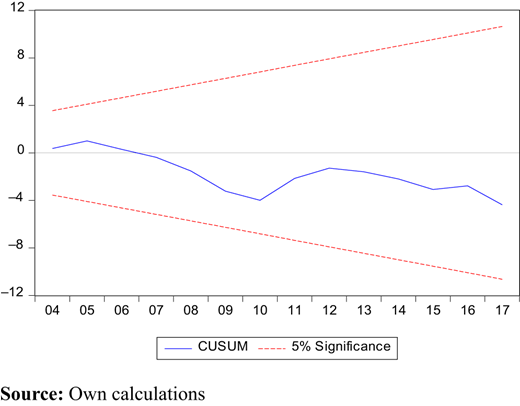
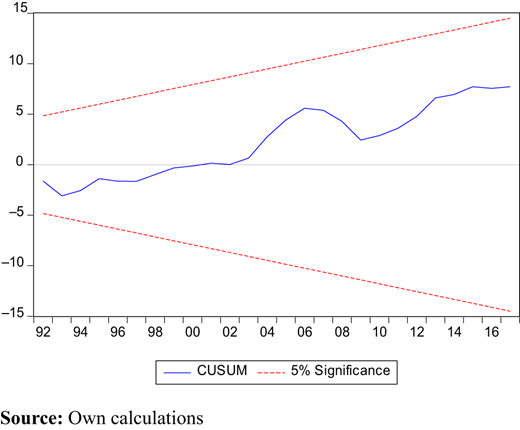
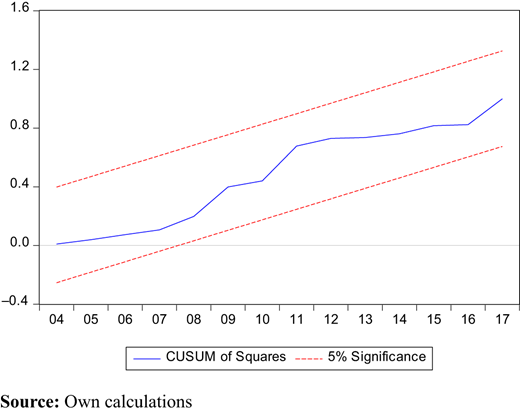
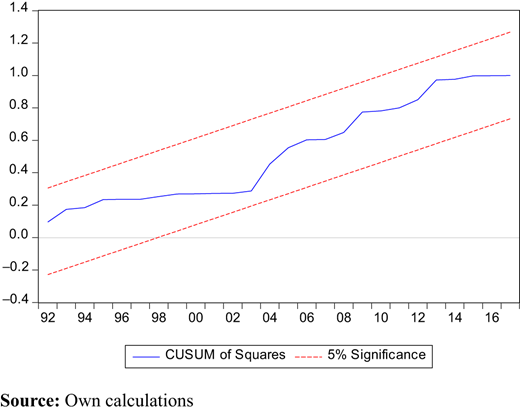
A series of diagnostic tests were conducted on the ARDL models (Table 8) and the models are found to be robust against residual correlation and the autoregressive conditional heteroscedasticity (ARCH) test confirms the homoskedasticity of the residuals. At the same time, the Jarque–Bera normality test ensured that estimated residuals are normal and the CUSUM and CUSUM of sq. tests of both models also confirmed the correct functional form of the models (Figures 5 to 8).
7. Impulse response functions
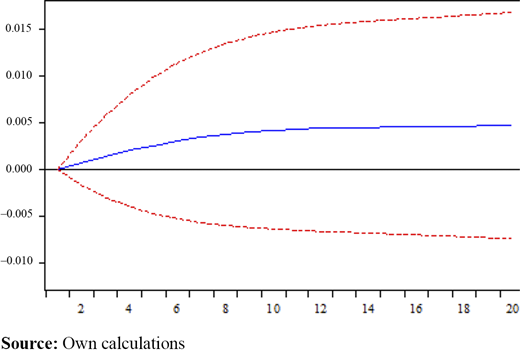
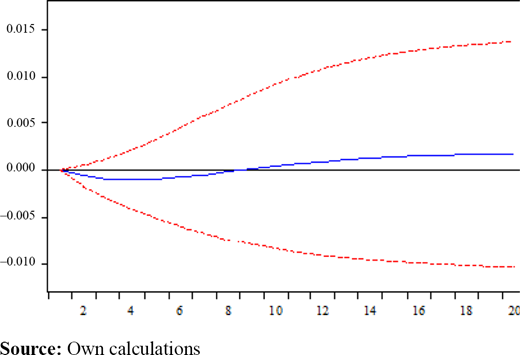
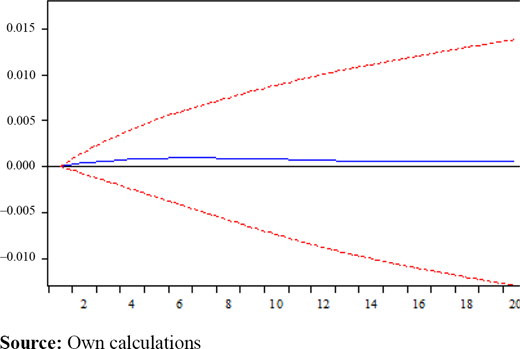
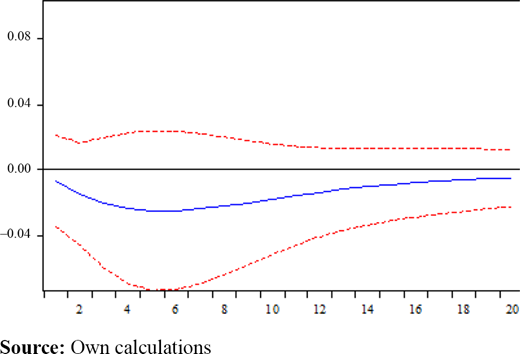
The IRF help us to know how a variable responds to a shock in the other variable initially and whether the effect of the shocks persists or dies out rapidly. Our IRF of the four endogenous variables to their own-shock and to the other variables’ shock is depicted in Figures 9–12. In the graphs, the solid lines represent the function, while the dashed lines represent the confidence bands. They are two standard errors wide, in other words, they are approximately 95% confidence bands.
The IRF of LGDP following a positive shock to MEP increases after the impact and rises continuously upward. While a positive shock to MEP has a lasting and negative impact on external debt over the forecast horizon. Similarly, LGDP in response to secondary SER shocks increase onwards in a consistent manner. On the other hand, the IRF of LGDP following a positive shock of LEDG falls to zero after the first six periods, it then rises upward.
So, it appears that external debt has unfavorable consequences on economic growth as a large share of a country’s revenue is used to repay foreign loans. Though the methodologies are different, our study result also is consistent with studies as Ajayi and Oke (2012) for Nigeria, Were (2001) for Kenya, Hameed et al. (2008) for Pakistan, who find that an increase in external debt stocks has a negative effect on output growth. Finally, due to the positive shock of MEP on external debt, the external debt decreases after the impact and then falling constantly downward.
8. Conclusions
The foremost focus of this study is to analyze the impact of external debt on the economic growth of Bangladesh, within the purview of MEP. Earlier different studies have explored the impact of external debt on growth in Bangladesh in different directions. However, there is barely any study that concentrates on the role of MEP in the context of debt-growth relationships. The ARDL approach to cointegration is used for the empirical estimation of external debt growth for Bangladesh over the period of 1980-2017. The composition of external debt is taken into account to investigate the debt growth nexus as well.
Like some other studies on a similar issue including Bangladesh’s perspective, we find a negative relationship between external debt and economic growth when only external debt is concentrated in the model.
The key aspect of the study is that it permits us to see the impact of external debt on growth considering the economic policy, which is approximated by an MEP. This MEP is comprised of monetary policy, fiscal policy and trade policy. Our constructed MEP using principal component analysis helps us to analyze the effectiveness of economic policies in using external debts. Therefore, external debt exhibits a negative but insignificant relationship with growth in the long run when this policy index is incorporated in the growth equation.
However, the estimated MEP variable has a positive and significant effect on economic growth, which indicates that stable MEP leads to higher economic growth. The IRF under the VAR framework is also consistent with our findings from the estimated ARDL equations. This finding specifies that there is no alternative of sound MEP for neutralizing the retarded influence of external debt on economic growth.
In the context of Bangladesh, the overall good MEP (with the aberration for two or three years) over the study period has softened and to some extent might have nullified the negative impact of debt and created a positive impact on growth. So, sound MEP and right human resource policy is the key to offset the adverse impact of debt and to propel the growth dynamics of Bangladesh on a higher trajectory of growth plane.
Notes
High inflation creates uncertainty which reduces incentives for investment and thus growth. Budget deficit also reduces both capital accumulation and productivity growth.
According to Workie Tiruneh (2004), the total external debt should be decomposed into bilateral and multilateral components for capturing their separate impact because the nature of their (bilateral and multilateral external debt) behavior is quite different in promoting economic growth.
Inflation might be caused by a host of different variable and policy factors but no doubt, it is largely an outcome of monetary phenomena and best represented by the monetary policy.
The ARDL approach has several advantages over other previous and traditional methods. The first is that it is flexible as it allows the analysis with I(0), I(1) or a combination of both data. The second is that the ARDL test is relatively more proficient in the case of small and finite sample data. Additionally, issues of serial correlation and endogeneity are taken care of during the ARDL estimation.
Suppose, if any variable comes out as integrated of order two or I(2).
If the F-statistic value is greater than the upper critical value bounds, then the variables are cointegrated, and if the F-statistic value is lower than the lower critical value bounds, then the variables are not cointegrated. Finally, if the F-statistic value is between the upper critical value bounds and lower critical value bounds, then the decision is inconclusive.
A variable Y is said to be integrated of order d, [I(d)] if it attains stationarity after differencing d times (Engle and Granger, 1987).
They conclude that capital inflows will be more effective in the countries that have stable macroeconomic policies and few distortions.
He found that capital inflows are ineffective if sound macroeconomic policies are absent in the aid-recipient countries. There is also a possibility that external debt has a detrimental effect due to the absence of sound macroeconomic policies.