Sustainable progress in higher education depends on collaboration between faculty and administrators. Approaches that emphasize shared vision and joint responsibility are far more effective than isolated efforts. One-sided interventions, whether driven by faculty or administration, rarely succeed, while collaborative initiatives foster mutual trust and lasting impact. Change in higher education is most effective when faculty and administration work together as partners. Forward-looking leadership, grounded in academic understanding and administrative experience, provides the foundation for resilient institutions. This partnership fosters relevance, shared governance, innovation and a collaborative culture that promotes sustainable and meaningful improvement.
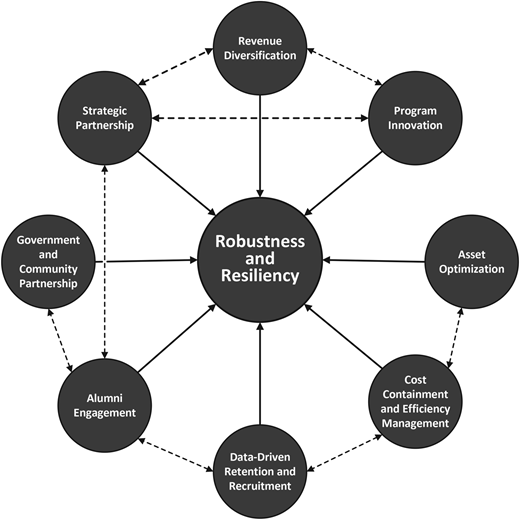
Disruptions such as a shrinking enrollment pool, pandemics and the recent devaluation of college education have led to the closure or merger of many higher education institutions. We propose a comprehensive model that can help stem the tide and address the community's workforce needs. It is essential to establish interdisciplinary programs at the undergraduate and graduate levels to increase enrollment across the university and support the region by providing workforce-ready graduates. The model has eight distinct but interrelated components. Figure 1 presents the proposed Cherish or Perish framework and illustrates how these eight strategies work together to strengthen institutional resilience and long-term sustainability. Many institutions fail to diversify and rely heavily on undergraduate residential students to maintain fiscal health. Diversifying revenue streams is one of the most effective strategies for growing enrollment and ensuring long-term success. Revenue diversification can include expanding into graduate, certificate and badging programs that directly meet workforce needs, as well as increasing the population of international students in graduate programs, with a focus on real industry demands rather than solely academic perspectives. Diversification can also take the form of program innovation by building on lessons from the recent pandemic and offering synchronous and asynchronous curricular pathways. Students pursue pathways aligned with their strengths, while institutions structure graduate degrees by layering internships or thesis experiences onto two or more stacked certificates. These program innovations provide cost-effective means to build successful graduate degree programs for students that meet businesses' needs. The stacked certificate graduate degree does not require delivery by a single institution. Higher education institutions must consider strategic partnerships and utilize cross-institutional certificates to foster international relationships and establish a global reputation and brand.
Asset optimization in education involves a comprehensive approach to managing and using resources to maximize their effectiveness in support of the institution's mission and goals. An institution of higher education can optimize its assets through effective facility management strategies, such as optimizing space utilization, investing in energy-efficient systems, deploying proactive and preventive maintenance programs and strategic partnering with local governments (e.g. employment zones in urban settings) to enhance its residential footprint and provide field opportunities for students. Human capital optimization strategies encompass professional development, workforce planning and a robust performance management system that recognizes and rewards high performance while also identifying areas for improvement. Other approaches involve upgrading technological infrastructure and IT systems to streamline operations and data management. Asset optimization enhances the learning experience, operational efficiency, sustainability and financial health.
The flip side to revenue diversification and program innovation is cost containment. Many institutions approach cost containment with a broad brush when they should use a surgical approach. A 10% across-the-board budget decrease will affect critical aspects of programs and the people who can make effective changes. Cost containment requires two significant efforts: academic and administrative. Cross-institutional partnerships and outsourcing are effective strategies for containing administrative costs. Many institutions form health insurance consortia to help manage costs. Educational systems can leverage fiscal strength by sharing payroll and human resources services. The ability to outsource enrollment marketing has significantly helped mitigate enrollment declines. At the same time, forward-thinking administrations can re-evaluate organizational structures to optimize effectiveness and ensure resources are directed to areas with the greatest student impact. Moreover, entrepreneurial leadership, when aligned with faculty collaboration, strengthens the institution's ability to provide students with transformative experiences such as internships, research, study abroad and service learning.
Institutions need to identify low-performing programs (based on metrics such as return on investment or direct contribution margin, rather than credit-hour production) and provide them with the tools needed to improve. An essential tool is balancing faculty workload across a department while setting expectations for teaching, scholarship and service. With a balanced workload, a program may find that it can reduce the number of adjunct faculty members. Another innovative approach is the curricular pathway, where first- and second-year students are grouped into the same class to accommodate larger class sizes and reduce dependence on adjunct instructors. These approaches increase the frequency of interaction between core faculty and students, which aids in data-driven retention and recruitment.
The keys to recruitment and retention are relationships, relationships and relationships. When academic and student affairs work together, institutions create integrated retention models that increase opportunities for engagement and improve outcomes. Creating relationships beyond the admission team, between potential students and faculty, as well as current students, will increase enrollment yield. Some relationships can be generated through business-to-business marketing. Institutions that can leverage corporate partners can improve recruitment. Corporate partners become natural partners, bridging the gap between institutions and their corporate employees. Institutions may begin to develop these corporate engagements through their alumni networks.
Higher education institutions need to increase engagement in friend and fund development. Business-to-business marketing for recruitment is one avenue for increased engagement. Alum engagement can grow through several other approaches. Alum mentors and guest lecturers are two of the most successful strategies. Creating a board of advocates (not advisors) can help a program leverage alumni networks to improve recruitment and retention and to provide opportunities to increase community engagement and interaction with the government without overtaxing faculty and staff.
Institutions must consider incentive models for government grants. A buyout of teaching from a grant can free a faculty member to undertake other work that enhances the institution's reputation. If the grant increases faculty-student interaction, the loss of core classroom interaction will not adversely affect retention. However, the practice or policy that adds grant work to the existing workload may signal to the faculty member that they should consider other institutions with a more balanced workload.
We believe these eight interrelated strategies can help higher education weather disruptions and deliver high-quality, fiscally responsible programs that meet the institution's mission and goals. The most effective way forward is through institutional task forces that bring faculty and administrators together as true partners, ensuring robust and resilient strategies that strengthen the entire academic community.
About the authors