

Chalcopyrite copper indium gallium (di)selenide (Cu(In, Ga)Se2 (CIGS)) thin film has been examined as an absorber layer for solar cells because of its suitable absorption value, stability and economy in manufacture. CIGS thin films belong to the I–III–VI2 group of the periodic table with the appropriate direct bandgap (1.5 eV). In this study, CIGS thin films were annealed at ∼200°C for four different annealing times (15, 30, 45 and 60 min) to investigate the effect of the annealing time on the crystalline structure and optical properties of CIGS thin films prepared by using the sol–gel dip-coating technique. CIGS thin films annealed at ∼200°C for 60 min were found to have the best structural and optical properties in this study. As the crystallite size increased with the rise in the annealing time, the lattice strain decreased, indicating the elimination of crystallite defects in the CIGS thin-film structure. Hence, the structural changes affected the optical properties slightly and the rise in the optical absorbance (A%) resulted in a decrease in the optical transmittance (T%).
Notation
1 Introduction
Chalcopyrite copper indium gallium (di)selenide (Cu(In, Ga)Se2 (CIGS)) thin film is a well-known p-type flexible absorber layer for thin-film solar cell applications due to its high absorption coefficient (>105 cm−1), and its optimum energy bandgap is 1.5 eV.1 CIGS thin films have a tunable direct energy bandgap that can be changed from 1.04 eV (CIS)2 to 2.4 eV (CuGaSe)3 by increasing the gallium (Ga) amount. CIGS thin-film solar cells have high conversion efficiency among all thin-film polycrystalline solar cells. An efficiency of 23.35% has been reported for CIGS4 and cadmium telluride (CdTe).5 CIGS thin films were produced by many different methods, such as high vacuum thermal evaporation,6 pulsed electron growth,7 metal–organic chemical vapor deposition,8 molecular beam epitaxy9 and pulsed laser magnification.10 CIGS chalcopyrite is well known for being more resistant to radiation damage than other common semiconductor thin films, such as silicon (Si), gallium arsenide (GaAs), cadmium sulfide (CdS) and gallium nitride (GaN),11 which makes CIGS thin film a good candidate for usage in satellite applications. There were some research studies about the effect of ionizing radiation12–16 and annealing. However, these are not enough yet for explaining the details of the structural and optical properties of CIGS thin films.
In this study, CIGS thin films were deposited by the sol–gel dip-coating technique using a different and unique recipe, which is economical and easily applicable.17–19 CIGS thin films were annealed at ∼200°C for four different durations (15, 30, 45 and 60 min) to investigate the effect of the annealing time on the crystalline structure and optical properties of CIGS thin films. The thin films annealed in air atmosphere show low values of transmission and suitable absorption in the wavelength range of interest. The increase in annealing time enhanced the structural and optical properties of the CIGS thin films. The high absorption coefficient and radiation hardness make CIGS thin films good candidates for space application.20
2 Experimental procedure
The precursor solution for depositing CIGS films by the sol–gel dip-coating method was prepared from copper (II) nitrate trihydrate (Cu(NO3)2·3H2O; 99.999%), indium nitrate trihydrate (In(NO3)2·3H2O; 99.999%) and gallium nitrate hydrate (Ga(NO3)3·H2O; 99.9%), and ethanol, diethanolamine (HN(CH2CH2OH)2) and hydrochloric acid (HCl) were added to the solution as a solvent and a stabilizer.12 The cleaned substrates were withdrawn in the solution by employing a computer-controlled dip coater (KSV LMX2), and in every withdrawing process, the films were preheated on a hot plate at 100°C in air for 10 min; this process was repeated five times and then the films were annealed at 200°C for 15, 30, 45 and 60 min in a fan-assisted oven.21,22
3 Results and discussion
3.1 Changes in the structural properties of CIGS thin films at different annealing times
The CIGS thin films were grown through the sol–gel dip-coating technique. The CIGS thin films coated with five layers were withdrawn at the same speed (60 mm/min) and then exposed to four different annealing times in under atmospheric conditions, 15, 30, 45 and 60 min, at 200°C. The changes in the structural characterization of CIGS thin films annealed at different annealing times were examined by X-ray diffraction (XRD) analysis. The full width at half maximum (FWHM) (β) values of samples were determined by using the Fityk program,23 and the average crystal size (D) was calculated using the Debye–Scherrer formula (Equation).24 The lattice strain (ϵ) was calculated by using the Williamson and Hall method (Equation 2).25
where λ is the wavelength of the X-ray radiation (1.5405 Å); θ B is the Bragg’s angle of the related peak; β is the FWHM in radians; and k is the constant related to the crystallite shape and is taken as 0.94. Lattice strain is a measure of the distribution of lattice constants resulting from crystal defects such as lattice displacements. The crystallite size and the lattice strain affect the Bragg peak depending on the increase in peak width and intensity, which changes the peak value of 2θ.26
The XRD analysis indicates that the gallium selenide (Ga2Se3) crystalline structure has a diffraction plane at the (004) diffraction plane and the copper gallium selenide (CuGaSe2) crystalline structure has a diffraction plane at the (200) diffraction plane.27 Figures 1–4 show the XRD analysis results of CIGS thin films annealed at four different temperatures (15, 30, 45 and 60 min). Moreover, all annealed samples show the diffraction peaks corresponding to the crystal structure of chalcopyrite-type CIGS. There is an increase in the crystalline size with the rise in the annealing time, and the crystalline size was determined by using the Debye–Scherrer formula. For the (004) diffraction plane, the rise in the crystalline size was determined at D 15 min = 80.58 nm as a result of the 15 min annealing time. Furthermore, the annealing time at 30 min resulted in an increase in the crystalline size at D 30 min = 107.45 nm. When the annealing time increased to 45 min, the crystalline size reached D 45 min = 108.85 nm. The annealing time at 60 min led to an increase in the crystalline size at D 60 min = 111.75 nm.
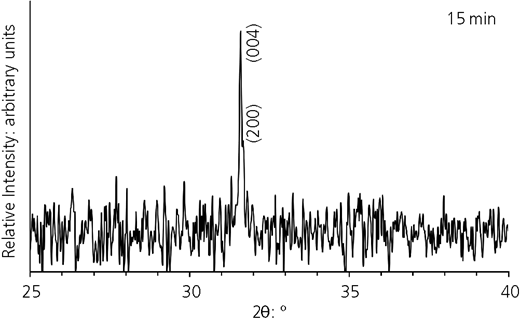
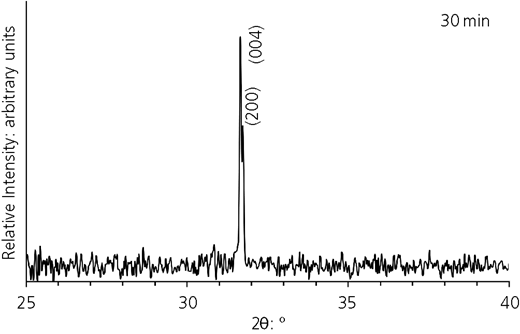
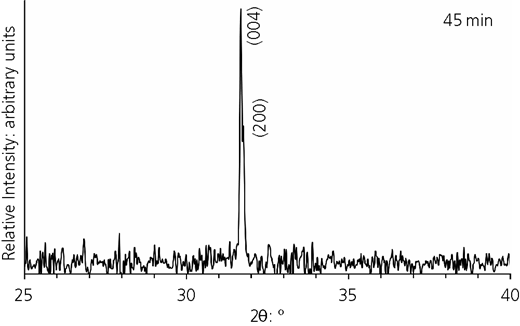
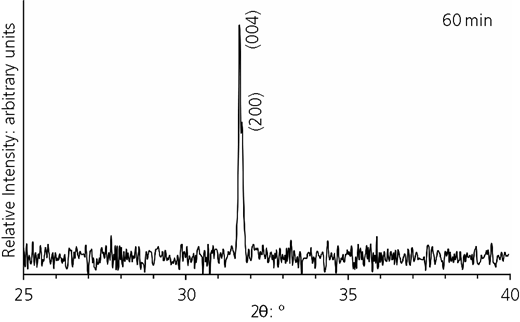
Analysis of the changes in strain broadening was performed by using the Williamson and Hall method. The lattice strain on the peak broadening indicated a rise with the increase in the annealing temperature. The lattice strain decreased from 0.0033 to 0.0024 when the annealing time rose from 15 to 30 min. There was a saturation range for the lattice strain (at ϵ = 0.0024) when the annealing time rose from 30 to 60 min. For the different annealing times, the lattice strain was determined as ϵ 15 min = 0.0033, ϵ 30 min = 0.0024, ϵ 45 min = 0.0024 and ϵ 60 min = 0.0024 by using the Williamson and Hall method.
The intensity of the orientation in the diffraction plane (004; 200) and the crystallite size increased with the rise in the annealing time. The XRD patterns of CIGS thin films annealed for 60 min reached the highest diffraction peak intensity. The XRD analysis indicated that the increase in annealing time caused the crystalline growth and improvement in the structural formation of the triplet (CuGaSe2), binary (Ga2Se3) and chalcopyrite CIGS compounds.
Figure 5 presents the XRD diffraction patterns of the CIGS thin films at four different annealing times to compare the variations in FWHM and the changes in peak position.
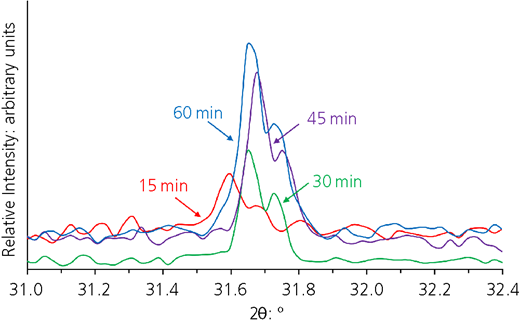
The increase in the annealing time improved the crystalline properties of the films.28 The additional weak shoulder peak at 2θ = 31.72° was related to the presence of the CuGaSe2 (200) phase.29,30 The first and the second strongest diffraction peaks (in Figure 5) are located at 2θ = 31.64° (at the (004) diffraction plane) and 2θ = 31.72° (at the (200) diffraction plane) indicating the CIGS crystal structure (annealed for 60 min). The peak position (in Figure 5) has changed slightly, and the peak intensity has increased clearly with the increase in the annealing time. When the annealing time reached 60 min, the Ga2Se3 (at the 004 diffraction plane) and CuGaSe2 (at the 200 diffraction plane) peaks become more intense and the crystallinity rose from 80.58 to 111.75 nm. The CIGS thin film annealed at 200°C exhibited a strong peak and an additional weak shoulder peak at 2θ = 31.72°. It was assumed that this shoulder peak is related to the existence of the CuGaSe2 secondary phase, with the symmetry of lattice vibrations different from that of chalcopyrite.29 The increase in the annealing time led to an increase in peak intensity and crystallinity, which presented as the strong peak.
3.2 Optical properties of CIGS thin films annealed at different annealing times
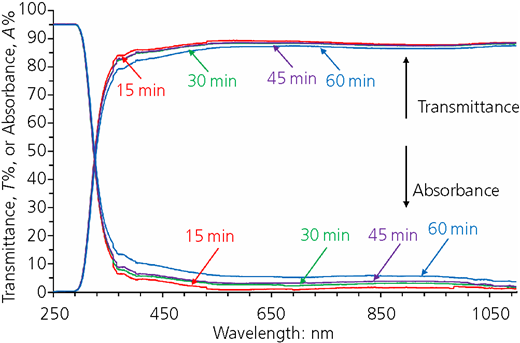
The changes in the optical absorbance of CIGS thin film annealed at ∼200°C for four different annealing times were determined by using optical transmittance and reflectance in the range 190–1100 nm, shown in Figure 6. It was determined that the absorption of the CIGS thin film increased with the decrease in the transmittance, depending on the increase in the annealed time required to reach ∼200°C. In the absorption process, the energy of the incoming photon excites an electron from a lower to a higher energy state.30
The forbidden energy bandgap (E g) was calculated by taking the equation used for direct transition regarding Mott and Davis31 in Figure 7 by Equation 3.
where A is a constant and E g is the bandgap energy. Determining E g involves plotting a graph of (αhν)2 as a function of photon energy hυ; the linear part of the graph is plotted with an intercept on hν axis, given the energy band values of thin films, as shown in Figure 7. This change indicated the increase in the absorption coefficient as the forbidden energy bandgap (E g30 min = 2.16 eV; E g45 min = 2.10 eV; E g60 min = 2 eV) decreased. The energy bandgap has decreased slightly with the increase in annealing time.
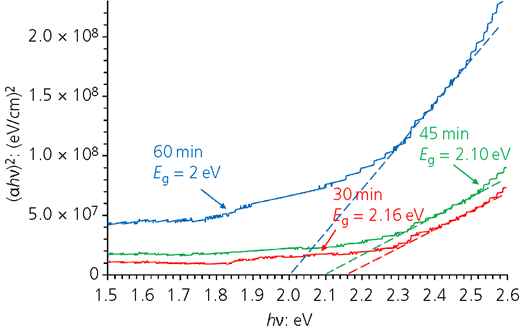
XRD analysis results clearly revealed that chalcopyrite-type CIGS crystals were grown at room temperature through the sol–gel dip-coating technique. Furthermore, the annealing of the films at a temperature of 200°C with various rises in annealing time (from 15 to 60 min) improved the optical absorption as a result of the decrease in optical transmittance. The decrease in the energy bandgap was related to the improvement in crystallinity.
4 Conclusion
The rise in the annealing time supported the increase in the crystallite size. The decrease in the lattice strain is attributed to the decrease in crystallite defects in the CIGS thin-film structure. Moreover, the rise in the annealing time improved the absorption by increasing transmission along with the enhancement of structural characteristics of the CIGS thin film coated by the sol–gel dip-coating method. The optical transmittance decreased slightly with the increase in the annealing time. The increase in the annealing time from 15 to 60 min improved the crystallinity of the thin film with the decrease in the energy bandgap. It was determined that there was a relation between the decrease in the optical bandgap and the rise in the annealing time of the CIGS thin film.

