The authors recently demonstrated that naturalised strains of Escherichia coli exist in municipal waste water, characterised by (a) biomarker patterns in intergenic regions distinct from human and animal E. coli strains and (b) an insertion element (IS30) located in the uspC–flhDC intergenic region of the genome. Remarkably, these strains are naturally adapted to survival and growth in waste water and differentially survive the treatment process. The authors sought to explore the adaptive mechanisms used by these strains for survival. A serial stress experiment (nutrient deprivation and osmotic stress followed by chlorine treatment) was performed and survival was measured using culture. Waste water strains were shown to be approximately 100 times more resistant to chlorine treatment than a wild-type human faecal strain. Naturalised waste water strains were also more robust at producing biofilms – an adaptive strategy for surviving environmental stressors. Since biofilm formation has been linked to increased motility, the authors examined the expression of the flagellar regulator gene, flhDC, under serial stress conditions. Chlorine was a potent inducer of flhDC expression in waste water strains. The results demonstrate that waste water strains possess adaptive genotypic/phenotypic properties related to their survival in waste water and challenge the understanding of treatment reduction based on E. coli as an indicator of treatment performance.
Introduction
Escherichia coli has been one of the most studied microorganisms (Tenaillon et al., 2010) since its discovery in 1885 and has been used as a water quality indicator for faecal contamination for years. It has been generally assumed that this bacterium is restricted to the gastrointestinal system of warm-blooded animals, but several studies have found that E. coli can survive and replicate outside the gastrointestinal tract of animals in a non-host environment (water/sand/sediment) (Anderson et al., 2005; Byappanahalli et al., 2012; Chandrasekaran et al., 2015; Kon et al., 2007; Power et al., 2005; Solo-Gabriele et al., 2000; Tymensen et al., 2015; Winfield and Groisman, 2003). Survival and colonisation in both the animal host and non-host habitats are mediated by adaptations to nutrient availability, temperature, pH, osmolarity and the presence of competitive microflora. In bacteria, survival and adaptation in different environments is necessary for their continued evolutionary success.
Previously, the authors characterised the occurrence of host-specific strains of E. coli in a variety of human and animal isolates by using logic regression analysis of intergenic deoxyribonucleic acid (DNA) sequences (Zhi et al., 2015, 2016a). The authors applied these novel bioinformatic tools to understand E. coli population genetics better in non-host environments, such as waste water, leading to the discovery of naturalised strains of E. coli in municipal waste water (Zhi et al., 2016b). Remarkably, these naturalised populations of E. coli appear adapted to survive in the waste water environment. These strains are characterised by distinct genetic single-nucleotide polymorphism biomarker patterns in intergenic regions (ITGRs) that are different from those seen in human and animal strains of E. coli (Zhi et al., 2016b). Moreover, the majority of these naturalised waste water E. coli strains also possess a distinct genetic signature in which an insertion sequence (IS30) is specifically located in the uspC–flhDC IGR (uspC–IS30–flhDC) of the genome (Zhi et al., 2016b). These strains are easily identified in waste water by using a polymerase chain reaction (PCR) assay targeting this genetic locus (Zhi et al., 2016b). This genetic signature was not observed in (a) E. coli libraries originating from a wide range of animals, including humans; (b) whole-genome sequence databases for E. coli from humans or animals; or (c) in any E. coli DNA sequence data represented in GenBank. To date, these naturalised waste water E. coli strains have been found in all waste water treatment plants (WWTPs) that the authors have tested in Alberta (n = 10), Canada, suggesting that they are widely disseminated and implying that some strains of E. coli appear to have evolved adaptations for survival and growth in a waste water environment. These findings have challenged the understanding of waste water treatment in the context of using faecal indicator bacteria, such as E. coli, as a measure of treatment performance, demonstrating that bacteria in the sewage influent may be genetically different from those in the WWTP effluent.
Given the relative abundance of these naturalised E. coli strains in sewage/waste water and their widespread distribution throughout WWTPs in Alberta, the genetic and phenotypic properties of these strains likely allow for their survival and persistence in a stressful waste water environment. A wide repertoire of genes/pathways are known to regulate the stress response in E. coli, and these include (a) the generalised stress response (RpoS), which facilitates survival against nutrient derivation, and oxidative and osmotic stressors (Battesti et al., 2011; White et al., 2011); (b) the universal stress proteins, known to be important for resistance to oxidative stress, ultraviolet (UV) radiation and antibiotics (Gustavsson et al., 2002; Nachin et al., 2005); and (c) the more recently discovered locus of heat resistance – a genomic island encoding up to 16 different proteins associated with heat shock, cell envelop maintenance and turnover of misfolded proteins (Mercer et al., 2015) – important for repairing cellular damage. Surprisingly, naturalised waste water strains of E. coli possess all these stress-adaptive mechanisms (Zhi et al., 2016b), which in themselves, are reflective of the processes used to treat waste water (i.e. osmotic shock, oxidative stress (hydrogen peroxide (H2O2), chlorine), UV treatment, nutrient deprivation/competition), suggesting an evolutionary adaptation of E. coli to this non-host environment.
A further adaptation appears to be the site-specific insertion of the IS30 element between the uspC and flhDC genes. Insertion elements located in IGRs have been shown to modify expression of certain genes (Barker et al., 2004). As outlined earlier, the uspC gene plays an important role in promoting resistance to oxidative and UV damage through DNA repair (Gustavsson et al., 2002; Kvint et al., 2003; Nachin et al., 2005), suggesting that the IS30 element may play a role in upregulating uspC expression during UV treatment of waste water. The flhDC gene encodes the master regulator for flagellar biosynthesis, acting as an activator for the expression of bacterial flagellar proteins (Anderson et al., 2010). Flagella promote bacterial motility, which, in turn, is positively associated with biofilm formation (Wood et al., 2006). Biofilm formation is an important strategy used by bacteria to survive unfavourable environmental conditions, and the formation of biofilms has been shown to promote resistance to chlorine, UV radiation (UVC), oxidative damage and even predation (Bianco et al., 2006; Elasri and Miller, 1999; Ryu and Beuchat, 2005; Vogeleer et al., 2014) – important microbial reduction strategies used during waste water treatment. Consequently, the uspC–IS30–flhDC polymorphism may play an important adaptive strategy in these naturalised bacterial populations towards colonisation and survival in tertiary treated waste water.
The purpose of this study was to explore the potential correlation between the presence of the uspC–IS30–flhDC ITGR polymorphism observed in naturalised waste water E. coli strains and the adaptive phenotypes of motility, biofilm formation and chlorine resistance as strategies that promote the survival of naturalised E. coli in a waste water environment.
Methods
Serial stress survival experiment
Two naturalised uspC–IS30–flhDC marker-positive waste water E. coli isolates (WW10 and WW63) and two uspC–IS30–flhDC marker-negative wild-type E. coli isolates (H51 and H54) isolated from human faeces were used in the serial stress experiment. The authors’ previous paper describes the isolation and characterisation of these naturalised waste water strains (Zhi et al., 2016b). All E. coli strains were cultured in tryptic soy broth (TSB) for 24 h at 37°C, after which the culture was diluted to 1:10 by using sterile distilled water and incubated for another 24 h at room temperature (nutrient deprivation/osmotic stress). The cultures were then treated with chlorine by adding 0·8% bleach to the culture. The mixture was shaken for 2 min and free chlorine was measured using a ChemMets kit (ChemMetrics, Midland, Virginia). The bleach volume added to the culture was adjusted until the free residual chlorine reached 0·3–0·5 parts per million (ppm). The culture was allowed to incubate for 5 min at room temperature and 10% sodium thiosulfate was added to neutralise the free chlorine. Free chlorine was measured again to ensure that it had been neutralised. The survivability of the E. coli strains was immediately determined based on culture methods (see in the following paragraph). Triplicate samples were used for this experiment.
Bacterial cell counts were performed at three time points: after the initial 24 h culture in TSB; after 24 h incubation of the 1:10 dilution in distilled water under room temperature; and immediately after chlorine treatment. A tenfold serial dilution was made for each culture, and 100 µl of each dilution was plated on LB agar plates and incubated at 35°C overnight and colony counting was performed 24 h later.
flhDC gene expression studies
For measurement of flhDC expression, E. coli cultures were collected for ribonucleic acid (RNA) extraction at the same three time points as described earlier for the serial stress experiment. RNA extraction was performed using RNAprotect Bacteria Reagent (Qiagen, Inc., Valencia, California) and RNeasy Mini Kit (Qiagen, Inc.). Specifically, one volume of bacterial culture was mixed with two volumes of the RNA protection reagent. The mixture was incubated for 5 min at room temperature and centrifuged at 6300g for 10 min to collect the pellet. The pellet was then used for RNA extraction by using the RNeasy Mini Kit according to the manufacturer’s instructions. RNA was treated with Optizyme deoxyribonuclease I (Fisher Scientific, Waltham, Massachusetts) for DNA removal.
Quantitative reverse transcription polymerase chain reaction (RT-qPCR) was performed to measure the expression of the flhDC gene by using the TaqMan RNA-to-Ct 1-Step Kit (Thermo Fisher Scientific, Waltham, Massachusetts). All reactions were carried out in a 20 µl volume which contained 200 ng of RNA template, 10 µl of TaqMan RT-PCR Master Mix, 0·5 µl of TaqMan RT Enzyme Mix, 0·9 µM of each primer, 0·25 µM of TaqMan probe and molecular biology-degree water. The primers used are listed in Table 1.
The RT-qPCR conditions were as follows: a holding stage at 48°C for 15 min for reverse transcription, another holding stage at 95°C for 10 min for the activation of enzymes and 40 cycles of denaturation at 95°C for 15 s and annealing/extension at 60°C for 1 min. The expression of flhDC in two uspC–IS30–flhDC-positive waste water strains (WW10 and WW63) was compared to the expression of the flhDC in wild-type human faecal strain H51. The expression data of flhDC were normalised to endogenous levels of the housekeeping gene rpoA.
Bacterial biofilm formation assay
Eighteen E. coli strains were used in this portion of the study. Ten were naturalised waste water E. coli strains (uspC–IS30–flhDC positive) originating from four different WWTPs in Alberta, Canada. Eight of them were human E. coli strains (uspC–IS30–flhDC negative) isolated from different patient faecal swabs submitted to the Edmonton site of the Alberta Provincial Laboratory for Public Health (ProvLab) for routine microbiological testing. Human faecal sampling adhered to all ethics requirements (file number Pro00005478_CLS3 at the University of Alberta). All strains were confirmed as E. coli by biochemical analysis using a Vitek bacterial identification system (BioMerieux Canada Inc., St Laurent, Canada) according to the manufacturer’s instructions and protocols at ProvLab.
Biofilm formation was evaluated as previously described by O’Toole (2011) with some modifications. Briefly, strains of E. coli were grown in TSB overnight at 35°C. The optical densities of the cultures were adjusted to OD600 nm = 1·0, and 100 µl of the cultures was added into microtitre plates (CoStar 3595, New York, USA) to test for their ability to form biofilms. The lid of the microtitre plate was replaced with a sterile 96-well PCR plate (Greiner Bio-One, Frickenhausen, Germany) by inserting the PCR plate wells into the wells of the culture microtitre plate to help biofilm binding. The plate was incubated at 35°C for 24 h. The culture media was then discarded. For each well, 125 µl of 0·1% crystal violet was added to stain the biofilm and the whole plate was washed with distilled water four times to remove excess cells and dye. Biofilm formation was quantified by adding 125 µl of 30% acetic acid to dissolve the crystal violet adhering to biofilms on the PCR plate and the absorbance at 550 nm was measured using a microplate fluorometer (Fluostar Omega, Thermo Fisher, Whitby, Ontario, Canada).
Statistics
Statistical analysis of the data for the flhDC expression test and the biofilm formation test was performed using R software version 3.0.0. For the biofilm formation test, an unpaired Student’s t-test was performed. For the flhDC gene expression test, a paired Student’s t-test was performed. A significance value of p < 0·1 was deemed relevant.
Results
E. coli survivability under stressed conditions
Four E. coli strains were analysed for survivability against serial stress conditions and included the following: (a) H51 – a human wild-type faecal strain lacking both a generalised stress response (RpoS) and the uspC–IS30–flhDC biomarker; (b) H54 – a human faecal strain possessing a strong RpoS generalised stress response but lacking the uspC–IS30–flhDC biomarker; and (c) WW10 and WW63 – naturalised waste water strains possessing strong RpoS activity and the uspC–IS30–flhDC biomarker. The strains were grown in TSB for 24 h, diluted to 1:10 in distilled water for 24 h at room temperature (mimicking nutrient deprivation and osmotic stressors) and subsequently treated with chlorine bleach. All four E. coli strains displayed similar replicative potential in TSB, reaching levels of ∼109 colony-forming units/ml after 24 h (Table 2). When TSB cultures were diluted to 1:10 in distilled water and incubated for 24 h, no decline in survivability was observed among the four E. coli strains. However, survivability among the strains was significantly affected by treatment with chlorine. A 4·1 log10 mean reduction in bacterial cell counts was observed for the H51 negative control strain, whereas for the human H54 strain and the naturalised waste water E. coli strains (WW10 and WW63), bacterial concentrations were reduced only by ∼2 log10, suggesting differential survival among E. coli strains in response to chlorine treatment (Table 2).
Motility and biofilm formation
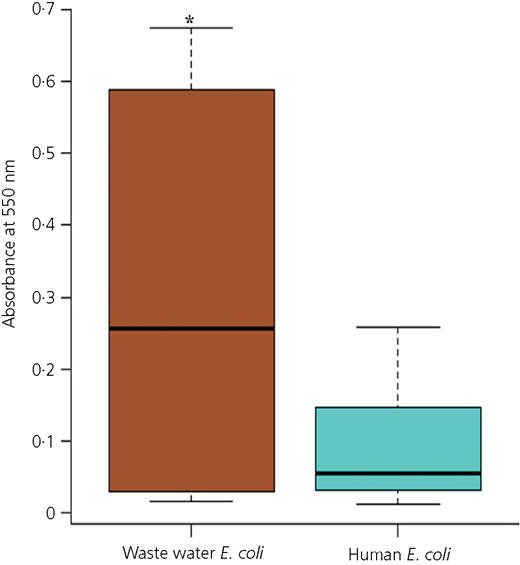
To understand phenotypic alterations associated with differential resistance to chlorine better, phenotypic characteristics such as biofilm formation and motility (as determined by flhDC gene expression assays) were examined as survival phenotypes for E. coli in the non-host environment. Biofilm formation was assessed among eight human faecal strains (not possessing the uspC-uspC–IS30–flhDC marker) and ten naturalised waste water strains possessing the uspC–IS30–flhDC marker. The biofilm-forming capacity of the naturalised waste water strains was significantly greater (p value = 0·04) than that of the human faecal strains, although a large variation was observed within each of the groups (Figure 1). Biofilm formation, as measured by crystal violet absorption to the polysaccharide matrix, was 3·2 times greater in waste water strains than human strains (i.e. mean absorbance values of waste water strains of 0·295 ± 0·27, compared to 0·092 ± 0·09 of human faecal strains). However, not all waste water strains had a high biofilm-forming capacity. For example, the waste water strain WW53, although possessing the uspC–IS30–flhDC marker, had a lower biofilm-forming capacity than those of most of the human strains.
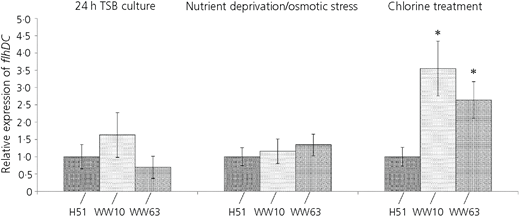
To determine if bacterial motility, and consequently biofilm formation, could be indirectly altered by the IS30 element in naturalised waste water E. coli strains (WW10 and WW63), the expressions of the flagellar regulator gene, flhDC, were compared between the human faecal strain H51 and the two uspC–IS30–flhDC-positive waste water strains (WW10 and WW63) under the serial stress treatments described earlier. Relative expression levels between the housekeeping gene rpoA and flhDC were used as a measure of gene transcription, since relative expression controlled for cell death associated with decreased survivability of H51 to chlorine. The results demonstrate that there was no significant difference in flhDC expression between wild-type strain H51 and uspC–IS30–flhDC-positive strains WW10 or WW63 after 24 h of TSB culture followed by nutrient deprivation/osmotic stress (Figure 2, p value > 0·1). However, a significant difference (p value < 0·1) in flhDC expression between the wild-type human strain H51 and the WW10 (p value = 0·06) and WW63 strains (p value = 0·08) was observed after chlorine treatment. The relative expressions of flhDC of WW10 and WW64 increased 3·6- and 2·6-fold compared to the H51 human strain, respectively, after chlorine exposure.
Discussion
Several studies have demonstrated that although influent sewage is largely composed of human and animal faecal wastes, the waste water matrix itself possesses a very unique microbiome (Wang et al., 2012). Thus, although faecal bacteria, such as E. coli, may comprise a major component of the microbial population entering the WWTP, certain strains of E. coli appear to have evolved to become naturalised populations that survive and replicate in this non-host environment (Zhi et al., 2016b). The fact that the uspC–IS30–flhDC marker is highly specific to waste water (Zhi et al., 2016b) and is geographically distributed throughout WWTPs in Alberta, Canada, suggests that this genetic polymorphism may play a functional role in the survival of these naturalised strains in the waste water environment.
To understand better the potential role of this marker in the adaptive selection and evolution of naturalised E. coli populations in waste water, the survival of uspC–IS30–flhDC-positive and uspC–IS30–flhDC-negative E. coli isolates was examined after serial stress conditions. In addition, other phenotypic outcomes related to stress, including bacterial motility and biofilm formation, were also examined, both of which have been shown to be important for E. coli survival in a non-host environment. Barker et al. (2004) observed that the placement of an insertion sequence known as IS5 upstream of flhDC in E. coli activated transcription of flhDC by potentially releasing transcriptional repression, leading to increased flagellar synthesis and bacterial motility, an effect known to promote biofilm formation in bacteria (O’Toole and Kolter, 1998). Sharma and Bearson (2013) demonstrated that differential regulation of flhDC influenced biofilm formation, and Wood et al. (2006) demonstrated that bacterial motility was positively related to biofilm-forming capacity. Bacterial flagellar expression is highly complex, involving more than 40 genes (McCarter, 2006), but it was hypothesised that naturalised waste water strains may increase levels of flhDC expression in response to environmental stressors (i.e. chlorine), resulting in increased production of biofilms. It has been previously shown that biofilm-producing E. coli strains are more resistant to chlorine (De Beer et al., 1994; Ryu and Beuchat, 2005) and that biofilm formation is important for protecting bacteria in harsh non-host environments (Stewart et al., 2013). Ryu and Beuchat (2005) demonstrated that the viability of an E. coli O157 strain was completely unaffected by chlorine doses as high as 10 mg/l chlorine for 10 min at 12°C, compared to control strains in which an 8 log10 inactivation was observed. Remarkably, when this same strain was allowed to form biofilms on a solid support (i.e. stainless steel coupon), no decline in viability was observed with a chlorine dose of 50 mg/l for 5 min at 22°C, compared to the control strain, where a 6 log10 inactivation was observed under the same treatment conditions.
To examine these potential survival mechanisms, one human strain (uspC–IS30–flhDC negative) and two waste water strains (uspC–IS30–flhDC positive) were subjected to nutrient deprivation/osmotic shock and chlorine treatment and the expression of flhDC was examined. The waste water strains had significantly greater relative expression of flhDC compared to the human strain after chlorine treatment, suggesting that chlorine treatment is a potent inducer of flhDC expression in naturalised strains. In addition, biofilm production across ten naturalised waste water strains (all possessing the uspC–IS30–flhDC marker) was greater than that observed for eight human faecal strains lacking the uspC–IS30–flhDC marker, suggesting that both motility and biofilm formation may be important strategies for survival of these strains in a waste water matrix.
To determine whether these specific alternations were associated with increased survival, culture-based methods were used as means of quantifying the recovery of stressed bacteria. Four E. coli strains were assayed for this portion of the study. One human strain, H51 (also used in the flhDC expression studies), lacked an RpoS stress response, whereas another human strain, H54, possessed a vigorous RpoS stress response – a cellular response shown to be important for environment survival in E. coli (White et al., 2011). Two waste water strains, each possessing the uspC–IS30–flhDC marker and having a strong RpoS response, were also selected for evaluation. Both waste water strains as well as the human H54 wild-type strain were shown to be highly resistant to chlorine, displaying 100 times more resistance to chlorine compared to the human faecal strain H51. Interestingly, there was no difference in survivability between the human wild-type H54 strain and the naturalised waste water strains against chlorine treatment and, consequently, there does not appear to be a direct association between chlorine tolerance and the presence or absence of the uspC–IS30–flhDC marker, even though biofilm production and flhDC expression were enhanced in these strains. Nevertheless, biofilm formation and motility are not the only strategies utilised by bacteria to survive chlorine stress. Several inducible genes/regulators are also produced in response to exposure to reactive chlorine species in E. coli (Gray et al., 2013; Parker et al., 2013), the mechanisms of which can lead to increased intracellular glutathione levels (Chesney et al., 1996; Saby et al., 1999) as well as other antioxidants such as catalases (Dukan and Touati, 1996), methionine sulfoxide reductase (Rosen et al., 2009) and even oxidative repair mechanisms (Gray et al., 2013). All waste water-naturalised strains of E. coli have been previously shown to display a strong RpoS response (Zhi et al., 2016b), but regulation of chlorine resistance mechanisms in these E. coli strains is unknown.
In addition to possessing alternative chlorine stress-adaptive mechanisms, E. coli can also enter into a viable but non-culturable state (VBNC) – a common survival strategy used by E. coli to deal with adverse environmental conditions (Trevors, 2011) such as chlorine treatment (Oliver et al., 2005). During transition into a VBNC state, bacteria condense cellular material, often becoming much smaller, yet their cellular structures remain intact, and they become more resistant to inactivation or treatment (E et al., 2015; Zhang et al., 2015). PCR assays incorporating propidium monoazide (PMA) have been used to evaluate VBNC survival under stress conditions (Nocker et al., 2006; van Frankenhuyzen et al., 2011; Xiao et al., 2013). PMA binds to DNA, preventing PCR amplification of target sequences, but can penetrate only cells in which the cellular membrane of the bacteria has been compromised (Nocker et al., 2006). It is conceivable that although similar survival outcomes were observed between the human H54 strain and the naturalised waste water E. coli strains based on cell culture, that significant differences in overall survival may have existed if VBNC was also are accounted for in the authors’ studies, similar to that observed by Oliver et al. (2005).
The fact that naturalised waste water strains of E. coli displayed chlorine tolerance in the authors’ serial stress experiments corroborates their previous finding that a substantially greater proportion of the culturable E. coli population found in chlorine-treated waste water were shown to carry the uspC–IS30–flhDC marker (59%) compared to the E. coli population in untreated waste water (5%) (Zhi et al., 2016b). This finding also corroborates the authors’ previous findings of differential survival of naturalised waste water E. coli strains across the waste water treatment process (Zhi et al., 2016b), providing further circumstantial evidence of the potential important role that uspC–IS30–flhDC may play in survival in a waste water matrix. However, a definitive understanding of the role of the uspC–IS30–flhDC locus as an adaptive genotype for survival of naturalised E. coli populations in waste water requires the generation of isogenic mutants in which this locus is altered or eliminated using site-directed mutagenesis.
The observation that chlorine treatment selects for the survival of naturalised strains of waste water E. coli has some important implications for the water industry. Firstly, the US Environmental Protection Agency’s microbiological alternate test procedure (US EPA, 2010) – a protocol used for evaluating the suitability of culture media on the recovery of chlorine-stressed faecal microbes such as E. coli – actually appears to select for survival and growth of naturalised E. coli populations in these samples. This suggests that the protocol may bias experimental outcomes towards the culture of naturalised waste water strains of E. coli as opposed to faecal strains of E. coli. Whether this has any impact on interpretation regarding the suitability of approved culture media for public health testing of faecal contamination of water remains to be determined. Also, since these approved culture media are used to evaluate waste water treatment performance, growth bias towards treatment-resistant naturalised strains may underestimate true inactivation efficiency against faecal strains, therefore acting as a conservative estimate of inactivation of bacteria and other pathogens derived from human faeces. As a corollary, the presence of naturalised treatment-resistant E. coli in waste water raises some concerns regarding the use of E. coli as a suitable faecal indicator of water quality. Secondly, the wide variation in the survivability of E. coli strains to chlorine raises some direct concerns for public health. It was observed as early as 1949 that certain populations of bacteria, including E. coli, have developed resistance to chlorine treatment (Allen and Brooks, 1949; Farkas-Himsley, 1964). Since that time, various mechanisms of chlorine resistance have been characterised in E. coli (Gray et al., 2013), and it is plausible that genetic determinants of chlorine tolerance from naturalised strains may act as reservoirs for horizontal transfer to pathogenic strains, or vice versa (i.e. virulence genes may transfer from pathogenic strains to naturalised waste water strains). Chlorine-tolerant E. coli generated from WWTPs located upstream of drinking water treatment plants may cause problems if treatment at the drinking water plant is compromised and virulence maintained in chlorine-tolerant strains. Interestingly, it has been demonstrated that chlorine treatment can promote antibiotic resistance (Murray et al., 1984). Khan et al. (2016) observed that chlorine-tolerant strains of bacteria isolated from chlorinated drinking water systems were more resistant to tetracycline, sulfamethoxozole and amoxicillin, and Jia et al. (2015) observed that chlorine residual was an important parameter is driving antibiotic resistance in bacterial populations found in drinking water distribution systems, including E. coli. Given that antibiotic-resistant E. coli are relatively abundant in treated waste water (Iwane et al., 2001), as are uspC–IS30–flhDC-positive E. coli strains, it would be interesting to evaluate whether uspC–IS30–flhDC-positive E. coli are antibiotic resistant.
All naturalised waste water strains possess the IS30 element in the uspC–flhDC intergenic locus, which the authors hypothesise to be a potentially important regulator of the uspC gene – a genetic element known to confer UV resistance (UVB) in E. coli (Gustavsson et al., 2002). Although nothing is known about how genetic variation at this locus (or its regulatory elements) may specifically alter sensitivity of E. coli to UV treatment, a diverse array of heritable UV resistance mechanisms have been described in E. coli. An understanding of how natural selection may lead to the evolution of UV resistance is important for the water industry. Some of the earliest studies examining the evolution of UV resistance were carried out by Witkin (1946), who exposed a single clone of E. coli to one round of low-pressure UVC radiation (only 0·1 mJ/cm2) and observed that the survivor population had approximately 2·5 log10 greater resistance to UV than the parent strain. Similarly, Harris et al. (2009) examined the evolution of a single laboratory strain of E. coli exposed to over 20 iterative cycles of increasing ionising radiation and found that survivor strains were 2 log10 orders of magnitude more resistant to low-pressure UV inactivation than the parent strain was. They found that doses as high as 15 mJ/cm2 induced a 4 log10 kill in radiation-resistant survivor strains compared to a 6 log10 inactivation of the parent strain. A fascinating study carried out by Alcantara-Diaz et al. (2004) demonstrated an even stronger evolutionary effect. In their study, 80 iterative cycles of increasing doses of low-pressure UVC exposure resulted in the evolution of an E. coli strain that was 4·5 log10 orders of magnitude more resistant to UVC than the parent strain is (1 log10 inactivation of the evolved strain compared to 5·5 log10 inactivation of the parent strain at 15 mJ/cm2). A particularly interesting observation in this study was that the UV-resistant strain developed a mutator phenotype – a phenotype in which the organism dramatically increased its spontaneous mutation rate, leading to a hypermutable strain. Alcantara-Diaz et al. (2004) also found that multiple UV-resistant strains evolved (all of which had >3·5 log10 greater resistance to UVC than the parent strain at a 15 mJ/cm2 dose), each with different genetic mutation events leading to increased resistance. Remarkably, this (2–4·5)log10 difference in evolution of UV resistance described in the studies mentioned earlier reflects the adaptive and vertically transmitted (parent to progeny) mutational properties of a single strain and does not encompass horizontal gene transfer (transformation, transduction, conjugation, cross-species genetic exchange) that may also regulate UV resistance in a population of E. coli undergoing natural selection (i.e. such as the mixed bacterial populations in a WWTP). These studies emphasise an important characteristic of microbial systems – that they are biologically robust and capable of rapidly evolving complex solutions to stressful situations.
In addition to the study of Alcantara-Diaz et al. (2004) and in terms of the development of E. coli resistance to UV doses relevant to water treatment standards, Chen et al. (2015) observed that a genetically modified UVC-resistant E. coli strain possessing the radD/radA genes was relatively unaffected by exposure to 10 mJ/cm2 (i.e. highest dose tested). Gabriel (2015) observed that stress induction (acid treatment followed by desiccation stress) prior to UVC treatment increased the dose required to inactivate 1 log10 of the bacteria from 8·4 to 18·4 mJ/cm2 for a food-borne E. coli O157 strain. Huang et al. (2016) observed that among a small sample of E. coli isolates (n = 5) collected from secondary treated waste water, considerable and variable resistance to low-pressure UV was observed, with doses as high as 40 mJ/cm2, leading to E. coli inactivation levels between 2·9 log10 and 5·7 log10 among these isolates. Similarly, Anastasi et al. (2013) observed the selection of E. coli biotypes in response to UV irradiation in WWTPs in Australia, suggesting that some strains are better at surviving UV treatment than others are in a WWTP. Since naturalised waste water strains of E. coli are commonly found in UV-treated effluents (Zhi et al., 2016b), the authors hypothesise that these strains may also possess UV resistance characteristics important to the water industry.
Conclusion
E. coli is a highly adaptable microbe and a growing body of evidence suggests that this microbe is capable of colonising a variety of animal hosts and non-animal environmental niches, including waste water. The ability to colonise and survive in waste water suggests that natural selection has forced the evolution of certain strains to develop resistance mechanisms against the very water treatment processes typically used to inactivate these organisms. This paper, as well as others, raises concern about the evolution and emergence of treatment-resistant microbes in the water industry and the future impact that these agents may play in water quality, particularly in waste water reclamation, recreational water quality impacted by waste water discharge and potable/non-potable reuse of waste water systems.
Acknowledgements
The authors acknowledge the technical support provided by Candis Scott, a research technologist in their laboratory. Research funding was provided Alberta Innovates, the city of Calgary, the Canadian Foundation for Innovation and the Natural Sciences and Engineering Research Council. The funders had no role in study design, data collection and interpretation or the decision to submit the work for publication.