‘The 16.35 train to London Euston is subject to significant delays due to a vehicle striking a bridge at Stockport….’
A short statement on a railway announcement like this can have significant implications for a Network Railway Bridge Engineer. I have worked in the rail industry for over thirty years and in 2008 I was given the role of Bridge Strike Champion for Network Rail’s London North Western (LNW) Route. It is my role to understand the implications for the rail network in the immediate period after the bridge strike, to understand the technical detail behind such an event and to try and prevent such an incident occurring in the future.
There is an average of 1800 bridge strikes per year on the rail network – typically five per day. Not only is this a safety risk to both road and rail users, it delays trains which results in Network Rail compensating train operators typically £12.6 m per year. The issue also affects other bridge authorities such as London Transport, Canals and Rivers Trust, Highways England and so on, however not to the same extent.
According to a research brief produced by the Rail Safety and Standards Board (RSSB), Reducing the Number and Impact of Vehicle Strikes on Railway Underline Bridges (T854) (RSSB, 2012), bridge strikes occur primarily due to drivers not knowing the height of their vehicle, not noticing or interpreting signs and not considering low bridges when planning their route.
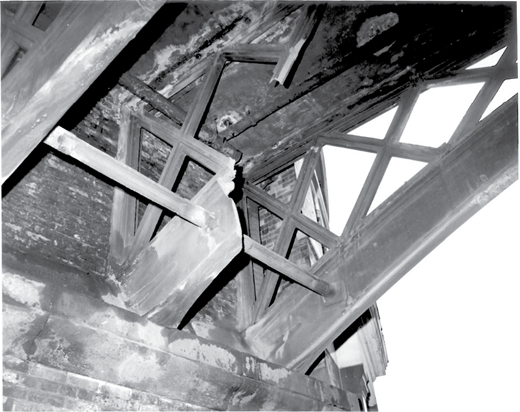
As no doubt you are aware, Britain was the birthplace of railways and the early structures that remain are of international significance. According to an online report produced by RPS Group Ltd. on behalf of Historic England (Kinchin-Smith, 2016), there are 626 listed railway bridges in England. The term ‘bridges’ comprises cast iron arch and beam bridges, wrought iron box and beam bridges, masonry viaducts, arches and footbridges. Not all of these are at risk, but a significant number are in locations that are prone to bridge strikes. The more high-profile bridges are High Level Bridge (Newcastle), Battersea Park Road Bridge (London) and Goole Swing Bridge (Yorkshire). The area that I cover includes Manchester, where there have been three incidents in the past 40 years where historic cast iron arch bridges have been damaged beyond repair and the railway had no option but to replace the structures with a modern equivalent form (Figure 1).
In the past, various bridge owners and heritage organisations have attempted to highlight the issue; for example, Andrew Tegg (British Waterways Heritage Advisor for the North West) in his paper for the Institute of Historic Building Conservation in 2009 (Tegg, 2009). However, getting to grips with the underlying causes and, more importantly, what can be done to lessen the impact of such events remains a real challenge.
In 2006, a joint initiative was trialled between Chiltern Railways and Network Rail. The outcome was a programme known as the National Bridge Strike Initiative. This involves theoretically driving a lorry into a bridge at a certain speed and assessing the bridge’s robustness. The bridge could lift, slide or potentially be damaged so that the capability of the structure is in question. Depending on the outcome a structure is given a dispensation which is recorded in the local signal box. A red signal indicates that trains should be stopped and the bridge should be examined. Amber indicates that the driver of the first train should examine the track at 5 mph; if the track alignment is not affected and there is no debris, trains are permitted to proceed at 20 mph until the bridge is examined. A double amber signal is similar to the procedure for amber, but subsequent trains can proceed at normal speed. A green signal indicates that trains can continue to operate at normal speed. This system ensures a minimum delay without compromising train and passenger safety.
Over the past 6 years there has been three significant court cases regarding bridge strikes involving vehicle insurers and Network Rail. In all three cases, Network Rail won their case. The third case has led to a re-interpretation of the law and now allows Network Rail to claim 100% of all costs incurred, including the cost of train delays, which had previously been the sticking point in the appeal hearings. With some incidents costing the rail industry in the order of £1 million, it is hoped that the impact will filter through to road users and the underwriting industry; this may result in an increased insurance premium for persistent offenders.
The primary bridge strike mitigation is signage indicating the clear available height under the bridge. Network Rail and the British Transport Police are working to raise the profile of bridge strikes with those that cause the incidents through education and enforcement. The education part involves Network Rail engaging directly with as many companies and drivers as possible, informing them of the wealth of material available on both the Government and Network Rail websites (for example, https://www.gov.uk/government/publications/prevention-of-bridge-strikes-good-practice-guide; http://www.networkrail.co.uk/aspx/3563.aspx; http://www.networkrail.co.uk/aspx/12822.aspx), and informing hauliers of their responsibility to ensure that drivers know the vehicle dimensions and the appropriateness of the route. The enforcement element involves Network Rail and the British Transport Police engaging with the Traffic Commissioners, the Driver Vehicle Standards Agency and the Home Office Police to ensure they are aware of the current situation and request their support. It is envisaged that a national advertising campaign will run in parallel. It is worth noting that a skip lorry driver recently received five points on his licence and a £454 fine following a bridge strike in Surrey, UK. Whilst the cost to the driver is minor compared to the rail industry costs, it is hoped that this sends out a clear message that this is a serious issue. It is hoped that this will aid the necessary changes in behaviour that will protect bridges.
Hopefully the future of our historic bridges is looking a little brighter, at least with regard to bridge strikes. Network Rail is keen to work with anyone who has experience they wish to share, possibly from other countries, where bridge strike prevention measures have been successful.