The salvage of the archives of the Ergoliptiki company (which translates directly to ‘contractors’) has been a revelation for the history of the introduction of reinforced concrete in Greece. This excellent hardback presents their most important works in the period 1912–1945 through the contribution of Andreas Drakopoulos (1891–1973), a civil engineer and their Technical Director, showing the widest possible variety such a company could be involved at the time: emblematic private and public buildings, factories, civils contracts (water management, highways, bridges, tunnels), shipyards, and so on.
The book outlines briefly the lives of Drakopoulos and the Ergoliptiki company, a company founded by Moschos Diamantopoulos, another civil engineer, but is dedicated primarily to the projects Drakopoulos directed, as can be seen from the very rich documentation (photos, plans and sections, letters, bills of quantities, sizing calculations). The text is unfortunately only currently available in Greek but it is hoped a further edition could include a summary in English and the outline of some key buildings.
The variety of work presented reveals how well-connected Ergoliptiki was with both private and public clients. The private buildings (mansions, houses, block of flats – polykatoikies) are identified by the names of their owners and the list reads like a contemporary who’s-who of the middle class of Athens, Greece. The photos of the construction sites are often impressive for the insight they provide on the organisation of the work, but also as a confirmation of the concrete skeleton behind purely neoclassical or eclectic designs (1920s), just before the advent of modernism.
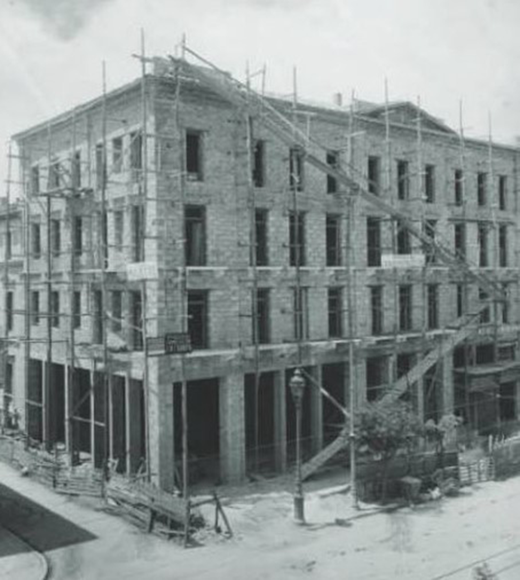
Ergoliptiki’s concrete frames in the 1920s are often very robust and still dictated by the eclectic architectural design scheme (Papaleonardou Residences or the Majestic Hotel (Figure 1) in Athens), showing that concrete technology was moving on slowly from masonry prototypes in smaller buildings. Slab sizes would often be small, but the reinforced-concrete skeleton would be trusted for the large spans of lobbies or shops and was fundamental for multi-storey construction. It is interesting to note these structures seldom followed modernist architectural designs after the 1930s, which would have clearly exhibited the merits of the system, but mostly feature historic patterns that give the impression of masonry construction.
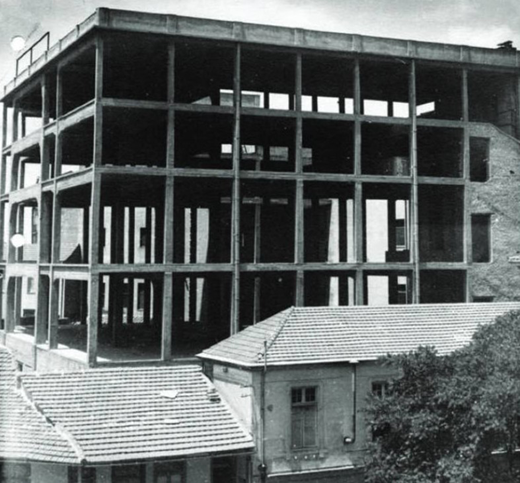
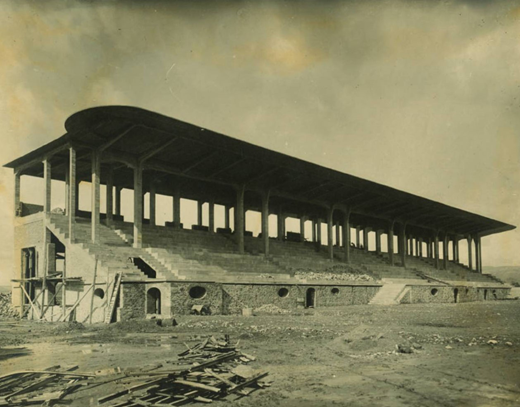
Ergoliptiki would also appear as agents of the Hennebique system, very important through their business life as the first RC regulations in Greece would only be established later in 1954. The less architecturally impressive Polyklinik building (1921–1925) (Figure 2) shows the system’s typical chamfered caps of the columns of the frame. Their most emblematic building, however, was the Hippodrome of Athens in 1924 (Figure 3); a project to regenerate a marshland area in Faliro, which created a cantilevering canopy over the stands, although not a true shell as Torroja’s later Zarzuela Hippodrome in Spain. The site links Drakopoulos with the present; his grandson A. Drakopoulos is the sponsor of the book and co-president of the Stavros Niarchos Foundation, who endowed present-day Greece with a bright new Cultural Centre at this very location.
This is a unique monography of a very influential and active engineer and the Monumenta society should be congratulated for making it happen and supported in producing more books like this. It is hoped that the book will start further studies on the history of reinforced-concrete in Greece, but it could also encourage more similar monographies for other similarly key figures in the UK or elsewhere.