

Papers published in Engineering History and Heritage are eligible for awards from the Institution of Civil Engineers. Papers from any of the ICE journals can be nominated for several awards. In addition, each journal has awards dedicated to their specific subject area.
On Friday 8 October 2010, ICE president Paul Jowitt presented awards to the following papers published in Engineering History and Heritage in 2009. The editorial panel nominated their best papers and an awards committee chaired by Barry Clarke allocated the award.
The Telford Premium, presented for a notable contribution to civil engineering literature, was awarded to: Taylor A, Plant C and Dickerson J (2009) Wellington Street Swing Bridge, Hull, UK. Proceedings of the Institution of Civil Engineers, Engineering History and Heritage, 162(2): 67–79, doi: 10.1680/ehh.2009.162.2.67.
Abstract
The growth of Hull as a British port at the time of William Wilberforce (1759–1833) saw the construction of docks and dock bridges similar to those in London, Plymouth and Liverpool. These structures now form an essential part of Britain's heritage and are rightly protected under listed buildings and conservation regulations. However, they remain at risk, especially if left unused. For several years, Hull City Council has been developing a conservation policy for its nine listed bridges and a comprehensive historical audit was thus required. This paper looks back into the history of Hull Docks and the development of cast-iron swing bridges between 1800 and 1850. The paper describes the design of Hull's cast-iron Wellington Street Swing Bridge as part of a scheme for restoration of the bridge to working order. When the bridge was originally built, it would have been required to carry horse-drawn traffic that would probably have weighed no more than 5 t in total and carried commodities at walking pace, thus minimising the impact factor. Its new role, to stimulate community living and regeneration, is to offer pedestrian and cycle use with occasional use by vehicles weighing up to 7·5 t. The original bridge design may have been based on a three-pinned arch, although this is just speculation. The recent design by consulting engineer Pell Frischmann considered the bridge's articulation; this is described together with other parameters that influenced analysis of the cast-iron structure.
The Overseas Prize, presented for the best paper on works carried out outside the British Isles, was awarded to: Jackson DC (2009) Structural art: John S. Eastwood and the multiple arch dam. Proceedings of the Institution of Civil Engineers, Structures and Buildings, 162(3): 137–146, doi: 10.1680/ehah.2009.162 .3.137.
Abstract
In his landmark book The Tower and the Bridge, engineering professor/historian David Billington proposes the concept of ‘structural art’ and, with a focus on bridges, thin shell roofs and tall buildings, describes its relationship to the ideals of efficiency, economy and elegance. Dams are not discussed in The Tower and the Bridge, apparently because the massive gravity designs commonly built for major projects represent bulky, inefficient designs. Moving beyond gravity dam technology, this paper explores how John S. Eastwood's work designing multiple arch dams accords with Billington's idea of structural art. Eastwood built the world's first reinforced concrete multiple arch dam at Hume Lake, California in 1908 and during the last 15 years of his life became a prominent proponent of the technology. Eastwood's designs, how they correlate to the ideals of efficiency, economy and elegance, and how he integrated mathematical theory into his design methodology comprise the focus of this paper. In addition, issues of visual appearance and their effect upon professional acceptance of Eastwood's design are also considered. By employing the concept of structural art as a prism for studying multiple arch dams, the article elucidates an important aspect of hydraulic engineering history.
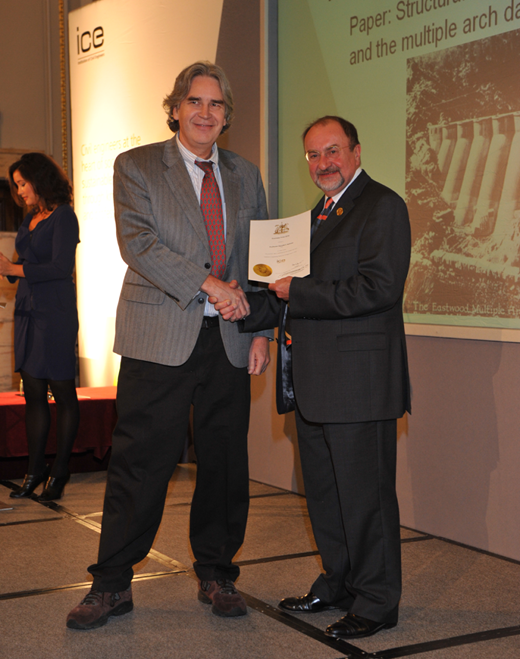
ICE President Paul Jowitt presents the Overseas Prize to Donald Jackson
ICE President Paul Jowitt presents the Overseas Prize to Donald Jackson

