

Papers published in Engineering History and Heritage are eligible for awards from the Institution of Civil Engineers. Papers from any of the ICE journals can be nominated for several awards. In addition, each journal has awards dedicated to their specific subject area.
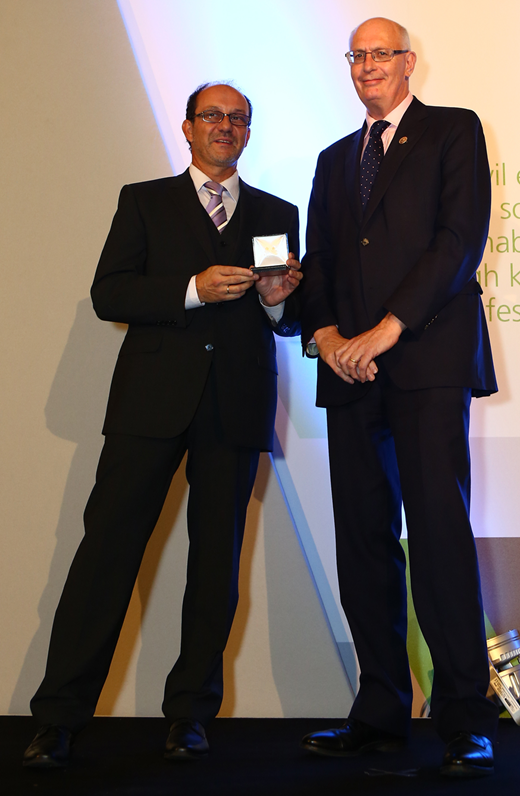
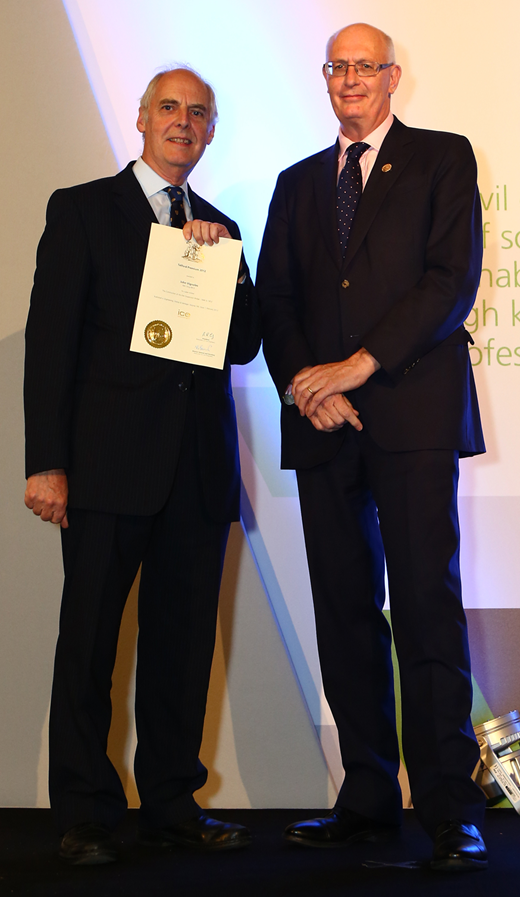
On Friday 18 October 2013, ICE president Barry Clarke presented awards to the following papers published in Engineering History and Heritage in 2012. The editorial panel nominated their best papers and an awards committee chaired by David Balmforth allocated the awards.
Telford Premium Prize
The Telford Premium Prize was awarded to Vignoles (2012).
Abstract
In 1846, the Tsar Nicholas I of Russia commissioned Charles Blacker Vignoles to build a fixed crossing over the River Dnieper at Kiev. Opened in 1853, the resultant suspension bridge, involving the construction of foundations in the fast-flowing river, was the largest multispan suspension bridge in Europe at the time. In the paper, the author, a direct descendant of C.B. Vignoles, describes the design, procurement and construction of the bridge between 1846 and 1853, drawing on information from Vignoles' journals and letters, and also from other contemporary documents. He also makes use of material derived from recently discovered sketches and progress photographs taken by John Cooke Bourne and Roger Fenton – this was one of the first times photography had been used specifically to record construction progress.
Bill Curtin Medal
The Bill Curtin Medal, awarded for the best paper describing innovative design in civil engineering, was awarded to Eisele and Seiler (2012).
Abstract
Construction engineers are increasingly faced with tasks in which a balance must be struck between historic structural designs and modern use requirements. Although they usually master these challenges, a thorough understanding of historic structures and conservation objectives is not widespread. However, such an understanding is key for proper handling of buildings with high conservation significance. In the case of the reconstruction of the Neues Museum in in Berlin, Germany, the most important responsibility of the engineers was to recognise, at an early stage, that purely theoretical approaches would not deliver the intended result and that all parties involved in the project needed to engage in the discussions, which also had to be facilitated. Key services to be provided included the development of verification concepts, planning and designing the required tests in a cross-disciplinary approach and coordinating the activities with the supervising authority.

