This May 2022 issue of Engineering History and Heritage may not have a specific theme, but it presents a modest and charming background contribution to the way we should be considering infrastructure delivery, be it maintaining or adapting what we have, or making new.
The first paper by Giannetti and Casini (2022) on the Tiber retaining walls (Rome, Italy) is an academic paper, assembling facts and chronology, setting out the purpose and construction of the walls and an exploration of the contemporary geotechnical methods. A valuable archive summary for when it comes to current inspection and assessment regimes and any future repairs and alterations.
Next, the paper on the Tai Tam Tuk reservoir dam by Deng et al. (2022) is a charming exploration of how seriously the designers took investigation of the ground conditions, knowing presumably about the local challenges of decomposed rock. It reminds us of the importance of appropriate data gathering – however physically demanding – to inform proper design and construction.
Lastly, the paper by Wohlers (2022) on the Gokteik Viaduct railway bridge in Upper Burma is especially interesting in terms of colonial and Anglo-American history and how the prevailing political landscape shaped decisions and their consequences. The destructive influence of class is sharply focused on the persecution of a site inspector.
In their different ways the papers remind us that:
(i) innovations and sophisticated processes have been practiced for a long time, with varying degrees of success, and the papers provide another valuable link in the chain of information enabling us and the emerging generation of engineers to gain demonstrable confidence about the means of applying innovations for sustainable socio-economic outcomes. Another example of the Mark Twain aphorism, to paraphrase, ‘history might not repeat itself, but it often rhymes.’
(ii) focussing on outcomes is more important than outputs, in the current language of how the Institution of Civil Engineers is currently looking at infrastructure delivery.
On the theme of social value outcomes, plans to create a new urban sky park for Manchester, UK, to bring more green space and nature to the Castlefield area of the city are a step closer to reality, with work on the first Pilot scheme underway. Due to open in July 2022, the National Trust is aiming to turn the imposing 330 m steel viaduct (Figure 1), constructed in 1892, into a temporary park in the sky and create a meeting place to benefit people and nature that celebrates the industrial heritage of Castlefield.
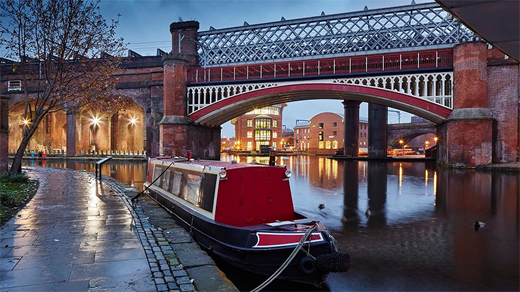
Originally built to carry heavy rail traffic in and out of the Great Northern Warehouse, the station closed in 1969. Since then, it has stood unused with National Highways undertaking essential repairs and regular maintenance to maintain safety. The pilot phase of this project will see a green space created to stretch halfway across the elevation of the viaduct. Trees, flowers and shrubs will be planted to soften the hulking, grey metalwork of the industrial structure to help attract wildlife.
Made possible thanks to working in collaboration with National Highways Historical Railways Estate Team, supported by Manchester City Council, Greater Manchester Combined Authority, Transport for Greater Manchester, the local community, businesses and supporters, the pilot project will be open for 12 months. During this time visitors will have the opportunity to not only explore part of the structure, but to find out more about the viaduct’s heritage (Figure 2), the city’s long relationship with plants and trees, and will have the opportunity to learn some urban gardening tips.
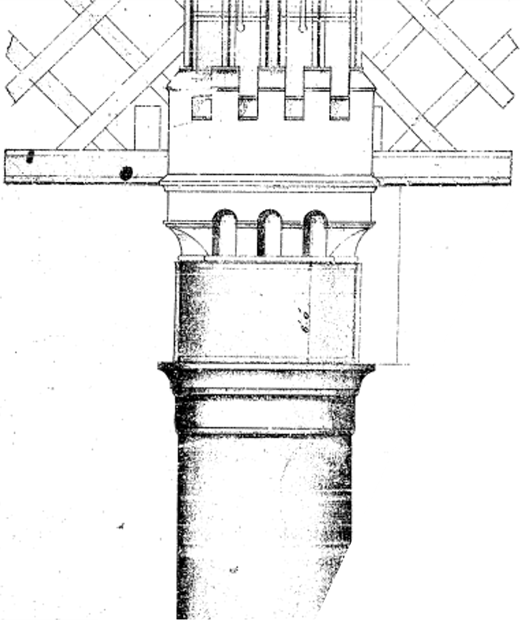
Original 1890 Heenan and Froude original construction drawing point detail (courtesy of Historical Railways Estate, on behalf of the Department for Transport)
Original 1890 Heenan and Froude original construction drawing point detail (courtesy of Historical Railways Estate, on behalf of the Department for Transport)
A section of the viaduct will be left untouched to provide a sense of how nature has reclaimed the space since the site was closed in the late 1960s. It will also have several new features including installations, a community space to hold events and other native planting. The National Trust will also be working to capture visitors’ opinions when they visit to help determine the longer-term future of the Grade II listed structure.
This is a hugely significant moment in the Trust’s plans for creating a unique green space to benefit the surrounding community and to bring more nature to people’s doorsteps. The project is also a fantastic way to celebrate industrial heritage, bringing it to life for the 21st century. The pandemic showed us the importance of our local parks and gardens, but it also highlighted significant inequalities in access to green space in urban areas like Manchester. It is hoped that ‘greening’ the viaduct will become a stepping-stone to other Manchester green spaces and nearby attractions, adding to the city’s vibrant, cultural offer.
Costing approximately £2.0 million, the pilot project has been made possible thanks to funding raised by players of People’s Postcode Lottery, as well as public donations, which will cover two-thirds of the build costs. The plans for Castlefield Viaduct are part of the National Trust’s ‘urban places’ work to increase access to parks and green spaces in, around and near urban areas, so that more people are in easy reach of quiet places with wide open skies.
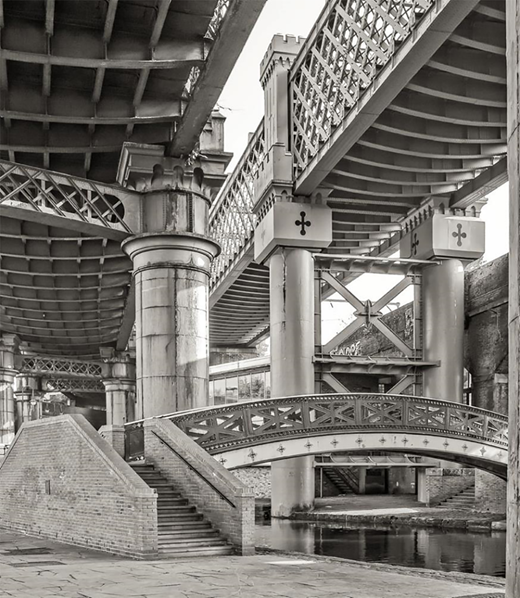
The National Trust want to share the viaduct’s story with the people of Manchester, many of whom may already have walked the cobbles underneath this mighty metal bridge (Figure 3), or spotted it on the Castlefield skyline, without knowing its history. The viaduct has stood in Manchester for over 125 years, and the Trust wants to help the city to protect it, injecting the viaduct with a new lease of life so it becomes a space people can use and be proud of. A positive response has already been received from the communities in the surrounding area and the Trust wants to continue working towards being able to deliver an exciting future for the viaduct and the residents that live close by.
Working with partners, over the next weeks the Trust will be creating an exciting offer for visitors on the viaduct. Various garden areas will be installed, which will include sensory and heritage planting as well as planting for pollinators and information on green gardening techniques. There will also be a covered event space where visitors will be invited out of the elements to discuss their thoughts for the future of the site. Some of the shrubs and plants to be used include the cotton flower, Manchester’s county flower, and local nature-friendly species that will help attract more birds and pollinators.
By testing ideas and finding out what people really need from this unique space during the pilot, the National Trust will take the learning on board and progress a more permanent solution for the viaduct – directly shaped by visitors and the local community. The four partner organisations working with the charity to create areas on the viaduct include Urban Wilderness, the Science and Industry Museum, City of Trees and Castlefield Forum.
Urban Wilderness will be working with Manchester-based charity 42nd Street, who support young people who have suffered mental health challenges, to create something special in the space. The Science and Industry Museum are planning a garden with heritage plants, trees and flowers; interpretation of the industrial heritage that can be seen from the viaduct; and special themed talks and events for all ages during summer and autumn.
The theme of the City of Trees partner plot is ‘trees – past, present and future’. It aims to showcase a variety of trees, shrubs and flowers that have been used throughout the Industrial Revolution, as well as displaying trees that are significant in Manchester today, and those that will play a role in the city’s response to climate change in the future. Castlefield Forum will be using its space to tell visitors all about the essence of Castlefield set within the context of a modern sculptural pocket garden (Figure 4).
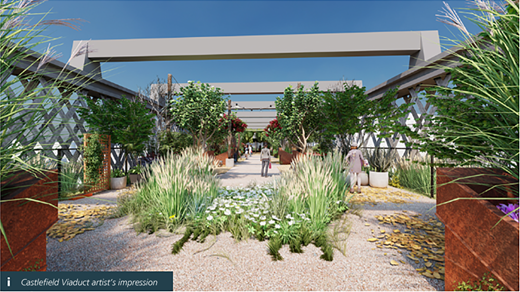
National Trust artist’s impression of what the viaduct could look like (courtesy of National Trust
National Trust artist’s impression of what the viaduct could look like (courtesy of National Trust
When the first phase opens in July 2022, 100 people will be able to visit daily. Entry onto the structure will be free, but there will be a booking system in place to help manage numbers. As part of the experience, visitors will be able to join a guided walk on the viaduct. On behalf of the National Trust, readers of the journal and their extended friends and family network will be warmly welcomed.