Welcome to the third issue of Engineering Sustainability.
Our Institution was founded by engineers who met to share and discuss their experiences. They recognised that there could not be learning or progress unless engineers were prepared to help themselves and benefit others by engaging in dialogue. I am therefore delighted that Messrs Carpenter and Benjafield have submitted discussions on the paper by Parkin et al. in the first issue. I was also interested to note that Griffiths et al. have made reference to the briefing note by Bender published in the first issue in the preparation of their paper on resource use analysis.
1. BRIEFINGS
The first briefing note is an extract from a presentation by the author Max Barry at a CSR (Corporate Social Responsibility) conference held at the London School of Economics in September 2003. The full presentation is available on the Engineering Sustainability website at www.sustainabilityjournal.com. In the presentation, Max presented the disturbing evidence of how recent corporate performance has been shown to lack the ethical standards we should all apply in our working lives. He shows how an individual's ethics can be tested and even changed by the pressures of business, status and society. Do businesses need to behave in a responsible way? Is this an issue for employees? I believe that the answer to both questions is an emphatic ‘yes’. Is the term ‘corporate social responsibility’ understood widely? Certainly not! My understanding is that CSR is essentially the business response to delivering sustainable development1 (Fig. 1).
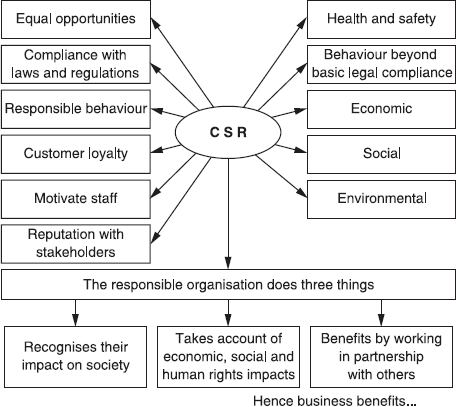
‘Corporate social responsibility’ (CSR) as defined by the DTI Business and Social Report 2002
‘Corporate social responsibility’ (CSR) as defined by the DTI Business and Social Report 2002
If businesses do behave in a responsible way, they will realise real and measurable benefits (Fig. 2). The same principal applies to us as individuals.
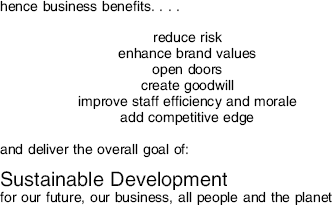
Real and measurable benefits of sustainable development
Real and measurable benefits of sustainable development
In the second briefing Payne describes how a strategic approach and framework is improving the way coastal defences are managed. The briefing note provides a summary of the issues addressed in an ICE Design and Practice Guide on coastal defence published by Thomas Telford in 2002.2
The final briefing by Luckhurst provides an insight into how the water industry is measuring its performance through the use of indicators. The briefing clearly demonstrates the difficulties we all have in identifying indicators that really help in understanding and delivering sustainability in a practical context. Some indicators are readily measured, while others ‘need development’. We all still have a long way to go, so it is encouraging to see an industry sharing experience. Our response should be to identify where we can help! I was particularly interested in the links identified in Fig. 1 of the briefing note.
2. PAPERS
The papers all provide practical guidance on ways in which improvements to resource efficiency and design can be realised.
Nicholson et al. describe how ecological footprinting can provide a measure of the environmental impacts of projects in a way which aids project planning and appraisal. The tool allows designers to derive a simple number which helps to identify the ‘better’ environmental options and which can sit alongside traditional evaluation tools. The paper highlights the significant impact of energy, predominantly through the operation of mechanical and electrical equipment in the wastewater treatment works example quoted. The paper also identifies that the ecological footprinting process was beneficial in raising environmental impact awareness within project teams and provided a mechanism for communicating environmental impacts in a simple and understandable way to the general public.
Griffiths et al. introduce the concept of resource flow analysis as a tool and describe a study adopting this methodology to quantify the resource use of the construction industry. Design is identified as the key area where significant improvements can yield improved resource use and performance. Despite the lack of data on resource use, the authors have demonstrated the significant quantities of waste generated by our industry, identifying that 1·56 tonnes of resources are required for each tonne of material incorporated into the built environment.
The paper also provides details of a number of waste initiatives which are helping to improve resource use through better waste management and environmental performance. The authors’ conclusions are harsh, but valid:
The lack of a coherent approach to improve resource productivity. In other words, our industry has not taken proper ownership of this issue.
… the lack of … robust data on resource use. … Implying that, without data, we cannot identify the scale of the problem or measure any improvements.
In the final paper, Pontee identifies the complexities of artificially creating natural habitats in a dynamic environment. The issues relating to the morphology, hydraulics, hydrology and sedimentology are described and well illustrated with practical examples, including data on the costs of implementing schemes. The author describes a number of predictive tools which can aid design, but notes that these should be used in conjunction with historical data and field studies. The paper implies that a mix of experience, competence and an understanding of potential future impacts on any scheme are essential skills for design. The paper identifies that ‘the engineering of intertidal habitat restoration schemes is still in its infancy …’. and correctly concludes that ‘the growing number of schemes being implemented offers great opportunities to improve our understanding …’. This paper helps to establish the knowledge base and guidance for a very visible way to improve our environment. The author acknowledges those who have taken the design of intertidal habitats through its ‘infancy’. They are to be congratulated for the success of their work to date and their contribution to improving the sensitive and dynamic environment of intertidal habitats.
3. PANEL MEMBERSHIP
I am pleased to welcome a number of new members to our editorial panel:
Mr. George Martin (Forum for the Future)
Professor David Fisk (Imperial College)
Mr. Mike Woolgar (Atkins)
Professor Paul Jowitt (Heriot-Watt University)