


The construction industry, through its activities and supply chains as well as the operation of the assets that it creates, is a major contributor to global greenhouse gas emissions. Embodied carbon dioxide emissions associated with the construction of new assets constitute a growing share of whole-life emissions across all project types and make up nearly a quarter of all annual emissions from the UK built environment. Yet these embodied emissions are still rarely assessed in practice, owing to the perceived difficulty and lack of supporting guidance for practitioners conducting an assessment. This briefing paper retraces recent advances in the field of embodied carbon dioxide assessment and highlights existing and forthcoming practical guidance that could support more widespread assessment. The paper constitutes a where-to rather than a how-to, directing assessors towards appropriate resources, of which there are many. Although the paper does highlight some remaining gaps in the field and identifies corresponding research priorities, recent additions to the body of guidance are generally sufficient to support more widespread assessment. Now, the industry must demonstrate its commitment to tackling climate change by using this guidance to drive deeper carbon dioxide reduction.
1 Introduction
Limiting any increase in global average temperature to ‘well below 2°C’, as outlined in the Paris Agreement (UNFCC, 2015), requires that all nations rapidly reduce greenhouse gas (GHG) emissions to achieve a balance between sources and sinks in the second half of this century. The construction industry has a critical role to play in climate change mitigation, being a significant emitter of GHGs both directly through its activities and supply chains and indirectly through operation of the assets it creates (Giesekam et al., 2016a; Müller et al. 2013). In addition to being one of the largest emitters, the built environment is also one of the largest potential stores of carbon dioxide, through sequestration within biogenic building materials (Giesekam et al., 2014; Lawrence, 2015; Sadler and Robson, 2013). At the global scale, it has been suggested that delivering the Paris Agreement would require all new building construction to be carbon-negative or carbon-neutral after 2030 (Rockström et al., 2017). This will require substantial efforts to mitigate all GHG emissions associated with the construction of new assets and significant growth in the use of biogenic building materials.
In the UK, Construction 2025 sets the more modest target of halving GHG emissions from the built environment by 2025 (HMG, 2013); meanwhile reductions of the order of 80% by 2050 are anticipated in line with the 2008 Climate Change Act (2008). A dedicated sector route map (GCB, 2013), consistent with these targets, was developed in 2013, but a recent update indicated that mitigation efforts to date have been insufficient to deliver the target trajectory (Steele et al., 2015). Insufficient progress in delivering domestic retrofit projects, combined with a growth in embodied emissions from increased construction of new assets, has established a substantial gap between the targets and reality. This gap will widen if construction activity continues to increase, carbon capture and storage technology remains financially unviable for material producers or the rate of electrical grid decarbonisation does not significantly accelerate (Giesekam et al., 2016b). Embodied greenhouse gas emissions (‘embodied carbon’) emissions already make up as much as 90% of whole-life GHG emissions on some projects (Sturgis and Roberts, 2010), constitute a growing share across all project types (Ibn-Mohammed et al., 2013) and are responsible for almost a quarter of annual built environment emissions (see Figure 1). These embodied carbon emissions can be addressed through a wide range of mitigation strategies (Lupíšek et al. 2016; Pomponi and Moncaster, 2016), such as improvement in the efficiency of structural designs (Cullen et al., 2011; Moynihan and Allwood, 2014), the use of alternative building materials (Cabeza et al., 2013; Giesekam et al., 2014; Giesekam et al., 2016c) or the adoption of circular economy approaches that encourage increased reuse and recycling of materials, components and structures (Densley Tingley and Davison, 2011; Pomponi and Moncaster, 2017).
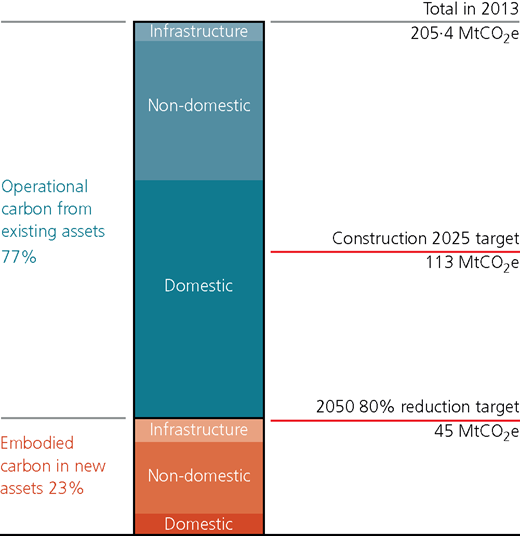
Annual GHG emissions attributable to the UK built environment. MtCO2e represents million tonnes carbon dioxide equivalent
Annual GHG emissions attributable to the UK built environment. MtCO2e represents million tonnes carbon dioxide equivalent
In recognition of this challenge, a growing number of firms are implementing ambitious organisational carbon dioxide reduction targets, through schemes such as the Science Based Targets initiative (Science Based Targets, 2017). Many of these firms are assessing and reporting scope 3 emissions associated with the development of new built assets, and an increasing number are also targeting reductions through the use of embodied carbon or whole-life carbon intensity targets. De Wolf et al. (2017) provided an overview of current carbon dioxide assessment (‘carbon assessment’) practices, and Giesekam et al. (2016a) summarised the various approaches to target setting. This increased interest in embodied carbon has been paralleled by a growth in guidance for practitioners and cross-industry efforts to ensure consistency in assessment procedures. This briefing paper provides a short overview of these new resources.
The briefing paper starts with a summary of current and upcoming guidance that supports embodied carbon assessment in buildings. The subsequent sections highlight gaps in knowledge and guidance and identify priorities for future research. Recognising the differing approaches to carbon assessment and reporting between nations, this paper is primarily aimed at UK practitioners, although many of the resources will doubtless be of use to practitioners elsewhere.
2 Guidance on embodied carbon assessment
2.1 Current guidance
The existing body of guidance includes formal standards, recognised methodologies, recommended practices, case studies and entry-level guidance. The majority of these documents were prepared in the last 5 years and target a broad range of professions and experience. The following is a summary of the most important recent additions.
For those seeking a general introduction to the topic, an extensive range of briefing sheets are available from the UK Green Building Council (UK-GBC, 2015a, 2015b), Waste and Resources Action Programme (Wrap, 2011) and many of the professional institutions (e.g. Institution of Civil Engineers (ICE, 2011) and Institution of Structural Engineers (IStructE, 2011)).
A range of standards (see Figure 2) – largely emerging from the work of the European Standards Technical Committee CEN TC350 – govern embodied carbon assessment and reporting. These include a calculation method for the assessment of environmental performance in buildings, BS EN 15978:2011 (BSI, 2012), and the product category rules for environmental product declarations (EPDs) for construction products, BS EN 15804:2012+A1:2013 (BSI, 2014). These standards provide an overarching framework, define a common set of life cycle stages and provide guidance for practitioners conducting an embodied carbon assessment. However, they do not prescribe certain key parameters, such as system boundaries, that remain at the discretion of the practitioner. This can lead to differences in interpretation and application, which reduce the comparability of results between projects. For a full description of each standard, see UK-GBC (2017a).
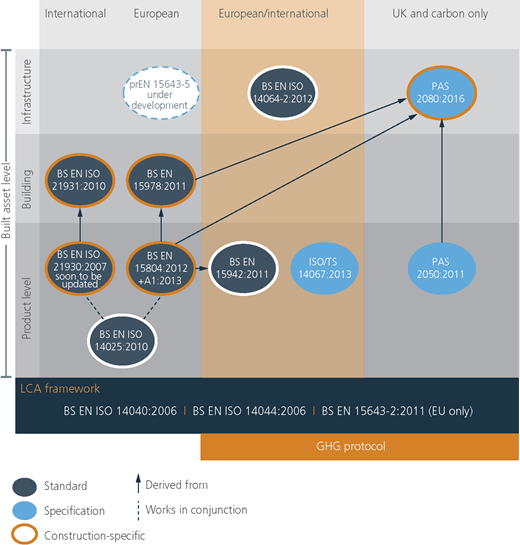
Overview of standards related to embodied carbon assessment (from UK-GBC (2017a))
Overview of standards related to embodied carbon assessment (from UK-GBC (2017a))
A complementary British publicly available specification, PAS 2080:2016 (‘Carbon management in infrastructure’) (BSI, 2016), guides the management of whole-life carbon by each value chain member. Launched in 2016, its principal purpose is to provide a common language and framework for whole-life carbon management with a focus on leadership, culture change and supply chain engagement. Although PAS 2080:2016 is principally a framework for managing rather than measuring carbon dioxide, it does provide guidance on reporting, benchmarking and target setting. The associated guidance document (GCB and CLC, 2016) also contains a wealth of worked examples and practical tips on implementation. Compliance with PAS 2080:2016 can be requested by a client on a project or demonstrated by an individual company across its portfolio. Anglian Water was the first such company to achieve certification (Anglian Water, 2017). Although PAS 2080:2016 is primarily aimed at infrastructure providers, the specified approach can be adapted for buildings.
Given its comprehensive nature, PAS 2080:2016 can appear overly onerous for some clients, in particular those without prior experience in embodied carbon assessment. The UK-GBC recently published extensive guidance to support such clients in the development of briefs that include embodied carbon assessment (UK-GBC, 2017a). The core guidance document explains the key considerations and provides sample wording for clients who wish to insert requirements for assessment within their project documentation. The supporting information also includes guidance on calculation tools, benchmarking and target setting, alongside several example client briefs. Although non-prescriptive, the guidance does list the main methodologies and data sources suitable for UK assessments.
The most commonly used methodology for calculating the embodied carbon of building projects is set out in a 2014 global guidance note published by the Royal Institute of Chartered Surveyors (RICS, 2014). This note succeeded a similar 2012 information paper focusing on assessing the embodied carbon of materials (RICS, 2012). The 2014 methodology has a broader focus and includes emissions during life cycle stages other than cradle-to-gate (which was the temporal limit of the 2012 information paper). It also includes best practices and a guidance framework to help quantity surveyors navigate the field of embodied carbon. The guidance note, together with other standards and guidance, has fed into the forthcoming RICS professional statement, which is discussed in Section 2.2. Numerous practical examples and recent case studies using this approach are publicly available, such as those hosted by the UK-GBC (Cary, 2015; UK-GBC, 2015d). Such case studies not only demonstrate the process, but also highlight the practical challenges involved in conducting an assessment, and can serve as a source for benchmarking.
In addition to internal company reports and isolated case studies, project embodied carbon benchmarks can also be extracted from a number of sources, including the Wrap embodied carbon database (Wrap and UK-GBC, 2014), an extensive global study compiled by the Carbon Leadership Forum (Simonen et al., 2017), the fourth edition of Civil Engineering Standard Method of Measurement (ICE, 2013), the Methodology to Calculate Embodied Carbon (RICS, 2014) and a range of academic studies – for instance, De Wolf et al. (2015) reported findings from a database of over 200 buildings and Cabeza et al. (2014) summarised over 60 life cycle assessments (LCAs) reported in the academic literature.
More general guidance on good practice in LCA can be found in the comprehensive ILCD Handbook (EC JRC IES, 2010), with tailored guidance for products and buildings available from EeBGuide (2012). Extensive guidance on the impacts of construction products can also be obtained from Anderson and Thornback (2012), with a more recent summary of product data published through European EPD programmes available online (Anderson, 2017). Advice and benchmark data of specific relevance to those producing commercial offices can be found in publications by the British Council for Offices (BCO, 2012) and in David Clark’s book What Colour Is Your Building? and online annexes (Clark, 2013). Particular guidance on building services can be found in the Chartered Institution of Building Services Engineers’ (Cibse) 2013 report (Hitchin, 2013) and subsequent technical memorandum (Cibse, 2014). Further general guidance on good practice in reporting can be found in the recommendations of the Embodied Carbon Task Force (Battle, 2014) and the guidance document issued by the Greater London Authority (GLA, 2013). In excess of 100 further online resources on the topic of ‘embodied carbon’ can also be found in the UK-GBC pinpoint directory (UK-GBC, 2017b). These include links to training courses, event presentations, webinars, software tools, sources of life cycle inventory data and so forth.
A variety of industry and academic events on the topic have been hosted over recent years, many of which have been comprehensively documented. For instance, the UK-GBC hosted an Embodied Carbon Week featuring 22 events (UK-GBC, 2014) and a follow-up conference in 2015 (UK-GBC, 2015c). The University of Cambridge hosted a joint industry and academic embodied carbon symposium in 2016 (Moncaster and Pomponi, 2016). Meanwhile cross-industry groups such as CBxchange (Chisholm, 2015), the Alliance for Sustainable Building Products and the Construction Industry Research and Information Association have hosted numerous one-off events. The topic is now a common feature of annual industry events such as Ecobuild and regular conferences such as Mott MacDonald’s Carbon Crunch and Volvo Construction Equipment’s Construction Climate Challenge series. Reports summarising these events contain many more contemporary examples of best practice than those documented in the academic literature and formal guidance. They also provide excellent first-hand testimonies of the challenges and benefits associated with conducting and embedding embodied carbon assessment within an organisation’s procedures.
2.2 Upcoming guidance
A number of projects due for completion in the current year will form the basis of an even more comprehensive set of documents supporting embodied carbon practitioners.
Among these are the main deliverables of a project funded by Innovate UK–Engineering and the Physical Sciences Research Council aimed at implementing whole-life carbon in buildings and produced by a consortium that includes Sturgis Carbon Profiling, Faithful+Gould, Sustainable Business Partnership, Arup, Cambridge University, RICS, Land Securities and Laing O’Rourke (Sturgis Carbon Profiling, 2017). This will take the form of a RICS professional statement – the highest level of guidance offered by RICS – titled ‘Whole life carbon measurement: implementation in the built environment’, which will become mandatory for RICS members who wish to undertake whole-life carbon analyses (RICS, 2017).
The RICS professional statement will complement two books on the topic. One is published by Royal Institute of British Architects and authored by Simon Sturgis (Sturgis, 2017). Targeting Zero: Embodied and Whole Life Carbon Explained is intended to be an accessible read, aimed at introducing concepts on embodied and whole-life carbon based on case studies. A second, academic, book will be published by Springer and is edited by Francesco Pomponi, Catherine De Wolf and Alice Moncaster. The book, titled Embodied Carbon in Buildings: Measurement, Management and Mitigation, will cover the state of the art of embodied carbon research and practice from across the world, with contributions from all continents to highlight what has been done so far and shed some light onto what lies ahead.
The ever-growing interest in and importance of embodied carbon is also confirmed by a forthcoming special issue of the academic journal Energy and Buildings (Elsevier, 2017) on the role of embodied carbon towards achieving zero-impact buildings.
3 Gaps in knowledge and guidance
Although the standard of general practice in embodied carbon assessment has improved over recent years, there are still several specific areas where practitioner knowledge is limited and guidance is lacking.
3.1 Access to product and construction data
Despite recent growth in the publication of EPDs (Anderson, 2017), it continues to be difficult to source appropriate product data (Gavotsis and Moncaster, 2015; Giesekam et al., 2016c) and the use of outdated or geographically inappropriate data remains commonplace (De Wolf et al., 2017; Pomponi and Moncaster, 2016). The shortcomings of some of the most commonly used databases are also well documented (e.g. Hill and Dibdiakova, 2016; Din and Brotas, 2016) and should be urgently addressed. Data on other life cycle stages, such as the emissions associated with initial construction and demolition processes, remain elusive, in part because of the difficulties capturing and organising data on-site (Davies et al., 2014, 2015). Although there is undoubtedly considerable work to be done improving the quality, comparability and accessibility of embodied carbon data at both product and project levels, the data that are currently available can still support approximate assessment, identification of carbon hotspots and mitigation opportunities.
3.2 Lack of standardisation in assessment procedures
Due to the non-prescriptive nature of the current standards, many key parameters remain at the discretion of the practitioner conducting the embodied carbon assessment. This has resulted in the use of various functional units, assumed service lives and no common procedure for selecting appropriate system boundaries (Anand and Amor, 2017). These differences, combined with the influence of site-specific factors, reduce the comparability of results between projects. The upcoming RICS guidance, with its mandatory clause for RICS members, should standardise some aspects, such as spatial and temporal boundaries of the assessment, reference study periods, life cycle stages included and data sources used. Although it is mandatory only for RICS members, RICS maintains a broad global membership and the resources can also be used outside this network. This new professional statement will provide a more structured approach to embodied and whole-life carbon assessment and a robust starting point for those interested in conducting transparent, reliable and verifiable analyses.
3.3 Inconsistent reporting of results
The results of many assessments are not made publicly available, and those that are published are rarely presented in a consistent format. Key parameters and assumptions are frequently not stated, and results are often aggregated to a level that prevents comparison between projects. This limited range of data sources and inconsistent detail has restricted opportunities for firms to normalise and benchmark project performance. The few firms that are benchmarking projects are also limited to conducting a relative comparison between buildings, which does not indicate the adequacy of absolute performance in the context of UK climate mitigation strategies (Giesekam et al., 2016b). Past efforts to aggregate project data, such as the Wrap embodied carbon database (Wrap and UK-GBC, 2014), have often suffered from a lack of consensus around reporting procedures, and selective reporting has generally been seen as the solution to retain the anonymity of sensitive projects. However, more consistent and granular reporting, such as submitting emissions by life cycle stage and building element, would significantly improve comparability.
The new RICS statement will provide a common template for reporting, ensuring greater consistency and the adoption of a modular approach. The move towards confidential reporting to a central body, RICS, should also allow for anonymisation of sensitive projects, while benchmarks by building type, element and life cycle stage could be issued from aggregated data sets.
3.4 Areas requiring additional guidance
Additional plain-language guidance on three topics in particular would be a useful contribution – namely, carbon sequestration in biogenic materials, uncertainty analysis and data quality assessment.
Despite the large body of published work on the topic, carbon sequestration remains a poorly understood topic within the industry, and approaches to calculating the benefits vary widely between projects. The differing methodological choices and assumptions adopted can significantly alter the overall results (De Rosa et al., 2017; Pawelzik et al., 2013; Peñaloza et al., 2016). Accessible advice on best practice for practitioners that are new to the field would be extremely valuable.
Uncertainty analysis is often avoided altogether because it is perceived as too complex or labour intensive (Pomponi et al., 2017). However, recent work has been done to address the complexity of uncertainty analysis for the LCA of buildings, and new methods exist that are light, fast and usable with no previous knowledge required on the underlying probability theory (Pomponi et al., 2017). Data quality is also rarely assessed in industry practice, either qualitatively with reference to set criteria or through more formal data scoring approaches. This happens despite tools for assessing and reporting on the quality of LCA data having long been available (e.g. Weidema et al., 1996, 2013). For those interested in incorporating this into future assessments, comprehensive guidance can be found in annex A of the ILCD Handbook (EC JRC IES, 2010). An assessment of data quality increases the transparency and reliability of LCA findings but does not eliminate errors. These should also be considered and represent a long-known and yet ongoing area of research (e.g. Lenzen, 2000; Heijungs and Lenzen, 2014).
Additional guidance for certain audiences is also required, as the majority has been targeted towards particular professions and practitioners with minimal experience of embodied carbon assessment. Simultaneous efforts should be made to support those at the best end of current practice in further developing the field and to extend knowledge of assessment practices beyond quantity surveyors and sustainability specialists.
Despite the identified gaps, the present body of guidance is sufficient to support basic embodied carbon assessment, and these shortcomings should not serve as grounds for delaying or rejecting more widespread assessment. Indeed, increased uptake will be critical in resolving many of the outstanding issues.
4 Future research priorities
Future research should seek to address the knowledge gaps identified in the preceding section. Overcoming persistent concerns about data, which have undermined industry confidence and uptake, will require a particular focus on getting the right numbers and getting the numbers right. This means ensuring the use of reliable, verified and peer-reviewed data sets that come from trustworthy and independent parties (getting the right numbers) as well as ensuring correct application of standards and methodologies to perform comparisons ceteris paribus (getting the numbers right).
In addition to addressing these concerns, a concerted awareness-raising effort is required to ensure more widespread adoption of embodied carbon assessment. Commercial pressures, alongside the limited resources and organisational capacity available to many organisations within the industry, are likely to continue to limit uptake. Future research should seek to identify ways to reduce the time, cost and difficulty of conducting an assessment while preserving robust outputs that support effective decision-making. The identification of appropriate opportunities to omit non-critical elements from the assessment, when combined with a modular reporting approach, should ensure that comparability between projects is preserved while assessment times are reduced. Public events such as those listed in Section 2.1 also have a key role to play in building confidence, transferring knowledge and extending best practice. Further effort must also be made by the academic community to disseminate research into industry, particularly in areas such as uncertainty analysis, where significant academic work has already been undertaken but has seen little use in practice.
As the industry’s understanding of embodied carbon assessment matures, additional work must be undertaken to ensure alignment of company and sector carbon targets with national and international mitigation commitments. This may require novel methodologies for target development and the introduction of new policy instruments.
5 Conclusions
There is a mounting body of guidance supporting embodied carbon assessment in buildings, reflecting a field that is rapidly expanding in popularity and sophistication. There are still common concerns surrounding data quality and scope for greater standardisation of assessment procedures, but upcoming guidance will address many of these issues. Further research and guidance will be required on certain topics, but the exigent challenge is encouraging uptake of assessment and reporting across the industry. By the end of 2017, there will be sufficient guidance and evidence to support widespread assessment; the industry must now demonstrate its commitment to tackling climate change by using this guidance to drive carbon reduction.
Acknowledgements
The contribution of the first author was supported by the Research Councils UK Energy Programme through the Centre for Industrial Energy, Materials and Products grant number EP/N022645/1. The contribution of the second author was supported by the Vice Chancellor’s Research Fellowship at Edinburgh Napier University.

