

On behalf of the chair and the editorial panel, it is my pleasure to introduce the December issue of Proceedings of the Institution of Civil Engineers – Engineering Sustainability. The issue contains four papers on the topic areas of life-cycle assessment (Arena, 2019), thermal comfort control systems (Moreno et al., 2019), biocementation (Charpe et al., 2019) and the understanding of multi-hazard approaches to evaluate climate resilience (Green and Chmutina, 2019).
The first paper (Arena, 2019) presents the results of an attributional life-cycle assessment of the Thames Tideway tunnel in London. The paper investigates the main processes related to the manufacture of the infrastructure asset and presents the results of a scenario (sensitivity) analysis which concludes (in part) that improvements in the sustainability of the tunnel segmental lining are possible (Arena, 2019).
Moreno et al. (2019) discuss the trial of double-skin façade (DSF) technology (Figure 1) for office buildings. The trial site was located in the School of Engineering at the Universidad Autónoma de Querétaro in Mexico. The paper describes the construction of the system and the monitoring undertaken during the testing. The authors conclude that the DSF system trialled with proportional, integrating and differentiating (PID) control yielded 70% power savings for the office test room (Moreno et al., 2019).
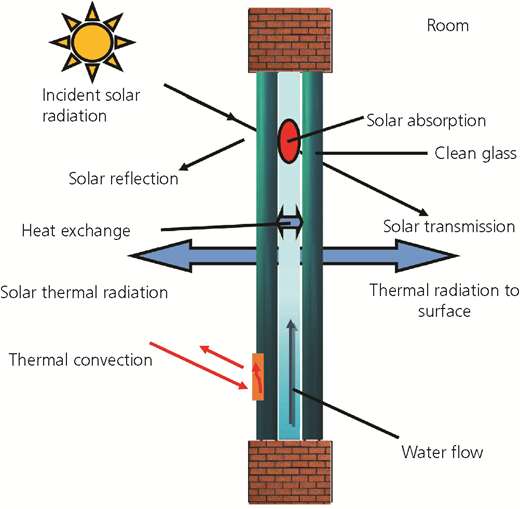
Energy flow paths in a double-glass-pane water flow (reproduced from Moreno et al. (2019))
The third paper (Charpe et al., 2019) presents a study of the effects of urea on concrete mechanical properties. This work deals with the interesting area of biocementation, which aims to replace chemical admixtures with more environmentally friendly and sustainable additives. For the 30–35 MPa 28 d compressive strength concrete used in this paper the optimal urea concentration for microbially induced calcium carbonate precipitation was shown to be 5 g/l with 5 d being the survival time of the bacteria in the material (Charpe et al., 2019).
The final paper in this issue (Green and Chmutina, 2019) starts with the results of a detailed literature review which examines the impacts of various climate-induced hazards on the general London area and London’s rail infrastructure. The paper then presents the results of a thematic assessment of semi-structured interview data to capture the views of key stakeholders on climate-induced threats and multi-hazard approaches with a focus on rail infrastructure. The paper concludes (in part) that a holistic examination of the range of hazards (multi-hazard) is needed in the London rail industry (Green and Chmutina, 2019).
I hope that readers enjoy this final issue of the journal for 2019.

