This study examines the static and dynamic resilience of REITs in Australia, Singapore, France, Italy, Germany, the United Kingdom, Canada and the United States during three major global events – the September 11 attacks in the US, the Global Financial Crisis (GFC) and the COVID-19 pandemic.
Using monthly and quarterly data of REIT returns, real GDP and the world and country-level uncertainty indices from 2000 to 2024, the study applies standard return-risk analysis, an impulse response and a Dynamic Ordinary Least Squares (DOLS) framework to examine the financial resilience of REITs in these countries across these major global shocks.
The analysis reveals that REITs in these countries demonstrated relative resilience, supported by independent economic policies and real GDP growth. The GFC had the most severe impact, but recovery was swift, indicating that financial system-triggered shocks are more harmful to REITs than external factors. Most REITs exhibited dynamic rather than static resilience, particularly during the GFC and COVID-19. Non-passive, short-term investors tended to overreact to local shocks, resulting in underperformance relative to passive, long-term investors.
The findings could inform the decisions of macroeconomic policy and investment analysts during periods of economic uncertainty. Institutional investors could also use the findings to inform their investment decisions during global shocks.
1. Introduction
The concept of resilience has wide-ranging applications, spanning environmental, economic, social, disaster, urban and engineering contexts to institutional settings (Modica and Reggiani, 2015). The earlier work of Pimm (1984) described engineering resilience as the ability of a system to return to a pre-existing situation after a destabilising shock. According to Mayor and Ramos (2020), economic resilience is the capacity of a region’s economy to resist or recover rapidly from external shocks, often at a pace that even outperforms its pre-shock situation. The International Monetary Fund [IMF] (2023), for instance, established the Resilience and Sustainability Trust [RST] in May 2022 as an economic resilience tool to provide affordable long-term financing to support nations undertaking critical macroeconomic reforms. This aims to minimise the risks associated with balance of payments instability and COVID-19 pandemic-related issues. Approaches to resilience may vary, but the common theme is the ability to leap back from a shock or a challenging situation. These disturbances are often due to human behaviour and systemic, regulatory or policy failures (Steenblock et al., 2023). So, an enhanced understanding of resilience is crucial, as it offers lessons that will inform decisions about future actions during disturbances. It will also reveal the system’s capacity to deal with unexpected situations often triggered by factors outside its control.
Despite the importance of studying resilience, the concept has received little attention in the property investment landscape, especially Real Estate Investment Trusts (REITs). REITs, listed on stock markets as indirect investment options, offer exposure to diverse property assets, including offices, retail spaces, shopping malls, industrial buildings, housing, hotels and cinemas (Australian Securities Exchange [ASX], 2024). They are also recognised globally for providing investment diversity, consistent income streams, liquidity and corporate-level tax advantages (Wagner et al., 2022; Hoesli and Oikarinen, 2012). These advantages made REITs a viable investment option for many institutional investors (Lee et al., 2022; Newell and Marzuki, 2023). In Australia, for example, the market capitalisation of REITs increased from $Aus147.48 billion in January 2023 to $Aus175.97 billion in December 2024 (ASX, 2024). Similar gains are also reported in Singapore, Canada, the US, the UK and other European countries (Chong et al., 2017).
However, this growth trajectory does not necessarily reflect a consistent trend of high performance by REITs over time. The occurrence of systemic risk, whether at the national, regional or global level, amongst other factors, has become critical in determining REIT performance. This is supported by Milcheva (2022), who highlighted the role of shocks and their varying impacts on the performance of REITs across regions and countries. In the past two decades, shocks such as the September 11 attacks in the US, the Global Financial Crisis (GFC) and the COVID-19 pandemic have had tremendous impacts on the investment landscape across the globe. It is, therefore, critical to examine the resilience of REIT performance during these shocks to identify success stories and lessons that could inform future investment decisions. Following the definitions proposed by Rose (2004) and Rose et al. (2007), we considered two forms of resilience – static and dynamic. Static resilience is the ability of a system to maintain a high level of performance when shocked. In contrast, dynamic resilience is the ability of a system to recover from shock. We used these two forms of resilience to determine the performance resilience of REITs before, during and after these shocks in selected OECD countries. Also, as the system shocks, the economy often shifts, prompting quick economic responses (Krenz and Živanović, 2024). During such financial turbulence, the trend and structure of real GDP and global market volatility may impact the performance of these REITs.
As such, this is the first comprehensive study on the financial resilience of REITS in a sample of OECD countries drawn from the Asia–Pacific, Europe and the Americas. We discuss how static and dynamic resilient the REITs in Australia, Canada, France, Germany, Italy, Singapore, the United Kingdom (UK) and the United States (US) are during the September 11 terrorist attacks, the GFC and the COVID-19 pandemic. These countries represent a broad geographical scope with a strong financial base and asset portfolio among global REITs. They also provide a rich dataset to evaluate the coping strength and ability of these REITs to bounce back during these crises. The listed property sector offers an ideal setting to explore the resilience of assets. Firstly, real estate is a significant economic segment with securitised assets representing a sizable and relatively homogeneous industry (Lee et al., 2018; Chong et al., 2017). Secondly, securitised real estate constitutes a distinctive sector with unique characteristics. Prior research has highlighted these characteristics, noting that real estate securities are closely intertwined with direct property markets and exhibit greater sensitivity to monetary and real estate fundamental shocks than shares (Ling et al., 2023; Lee et al., 2022). Furthermore, the GFC erupted in connection with the real estate markets (Brunnermeier, 2009), further reflecting the relevance of REITs as a testing ground for investigating the resilience of assets.
This study contributes to the literature in several ways. To the best of our knowledge, this is the first attempt to assess the static and dynamic resilience of leading REIT markets. Until now, there has been a notable absence of comprehensive analysis that delves into the resilience of REITs across different market conditions, timeframes and uncertainties. Our study uncovers actionable insights into how REITs navigate and withstand various economic fluctuations and external shocks. These findings could inform policymakers in the financial system and investment analysts on strengthening performance during periods of uncertainty.
Secondly, since not all REITs are static and resilient but are relatively dynamic, from the perspective of a momentum investment strategy, investing in REITs during global shocks is timely, as performance is expected to improve after the crisis, thereby providing capital gains within a short timeframe. We found that none of the REITs reached their average performance level in the 12 months preceding the event. This performance may likely keep the prices of listed REITs moderate. For investors practising the momentum strategy, which emphasises the timing of investment, it may stimulate a decision to buy since the performance, especially the Australian and US REITs, is expected to bounce back within the first or second year when the shock ceases. This will aid in making decisions about switching capital funds during a global event. The study has offered evidence that could inform the decisions of REIT investors in the event of uncertainty.
Finally, understanding the fundamentals of major REITs’ performance across the Asian-Pacific, European and American regions at various stages of three key global shocks between 2000 and 2024 could help improve financial risk modelling in the market. We further show that the timely implementation of targeted economic interventions will boost economic activities, which could support the recovery of REITs during periods of market volatility. Macroeconomic policy and listed market investment analysts could use these findings to inform them of their actions during periods of economic uncertainty.
The rest of the paper is structured as follows: Section 2 reviews the relevant literature, while Section 3 provides the theoretical framework and conceptualisation of the study. Section 4 discusses the data and methodology, Section 5 discusses the results and Section 6 presents the concluding statements.
2. Literature review
2.1 Investment landscape of REITs
The investment landscape of REITs is evolving. As of June 2023, the global listed real estate firms comprised 2,392 companies with a collective market capitalisation of US$3,045 billion (EPRA, 2023). This highlights the pivotal role of the real estate sector within the broad equity markets, creating a surge in interest among institutional investors in the sector, especially during periods of financial turbulence (Bouattour et al., 2026; Hoesli et al., 2008). The sector’s close integration with the capital market has even led to the introduction of futures markets written on REITs (Lee et al., 2022), further highlighting its importance and interconnection with financial markets.
With the research lens on REITs broadening its scope, geographic location has emerged as a significant factor (Hartzell et al., 2014). Other studies, such as those by Ampountolas (2026), Hartzell et al. (2014) and Lin et al. (2019), focus on the role of property type in REIT performance. The competence and expertise of REIT management have consistently been linked to greater performance outcomes (Chinloy et al., 2013; Beracha et al., 2019). Moreover, Eichholtz and Yönder (2015) found that REITs led by overconfident CEOs tend to engage in more investment activities, acquire more assets and are less inclined to sell assets. While Geltner et al. (2025) emphasise the importance of property development, Hill et al. (2012) highlight the role of liquidity in enhancing REIT performance. Alcock and Steiner (2017) argued that even though investment and financing decisions are connected, they are not made concurrently, further highlighting that investment decisions often influence leverage without reciprocity.
2.2 Performance, risk and other characteristics of REITs
REITs across the globe have been affected in diverse ways by various economic events and pandemics, such as the September 11 terrorist attacks in the US, the GFC and COVID-19. As such, numerous studies have examined the performance and risk management of REITs, providing valuable insights into how these investment vehicles navigate market volatility and economic shifts. For instance, Xie and Milcheva (2026) found that, during COVID-19, the daily returns of REITs with properties within 0.1 miles from the infectious area reduced by 0.23%. However, the findings contradict other REIT studies before COVID-19 (e.g. Lin et al., 2019). Ling and Naranjo (2015) documented increasing sensitivity of equity REITs to underlying real estate performance, attributing it to the participation of sophisticated investors in the REIT market since the early 1990s. Additionally, Bangura and Lee (2024a) found a strong link between residential REITs and direct housing. Although several studies have examined REITs’ investment landscape, return, risk and other characteristics, the focus on their performance resilience during global events is limited. This research intends to address this lacuna in the existing literature.
3. Theoretical framework and the conceptualisation of performance resilience
We conduct a two-stage study by coupling two prominent theories of investment performance – the Modern Portfolio Theory (MPT), pioneered by Harry Markowitz in 1952, and the Arbitrage Pricing Theory (APT) postulated by Stephen Ross in 1926. In stage 1, we examine the performance resilience of REITs across three major global events following the framework of Markowitz’s MPT. As reported in the literature, a raft of global events and shocks occurred between 2000 and 2024. The key events with global financial impacts on investment activities being considered are the September 11 terrorist attacks between September 2001 and July 2002 (Choudhry, 2005), the GFC between July 2007 and March 2009 (Reserve Bank of Australia [RBA], 2010) and the COVID-19 pandemic spanning between January 2020 and May 2023 (UN World Health Organisation [WHO], 2023). These subsamples are adequate to address the research questions. These events and shocks generally have far-reaching implications for investment markets, capital markets and financial systems worldwide (Yudaruddin et al., 2025; Lim and Morris, 2023; Lotz et al., 2023).
However, studies on coping strategies or performance resilience of various investments during these events have been somewhat piecemeal, examining only individual events and their impact on investment activities. Our study comprehensively investigates all three major events using static and dynamic forms of performance resilience. The selected OECD countries are the dominant REIT regimes in terms of market capitalisation and asset portfolios, and most have been in operation consistently since the 2000s or even before. Again, following the definition of Rose (2004) and Rose et al. (2007), in the context of our study, static resilience is the ability of a REIT to maintain its performance during the crisis at least at the level of the average of the12 months before the crisis, while dynamic resilience is the ability of a REIT to bounce back in the 12 months after the crisis to the level of the average performance of the 12 months before the crisis. The reference point of these forms of resilience is the average performance of a given REIT in the 12 months leading up to the crisis, as most stock markets, investors and Fund Managers often use 12 months of data to evaluate their performance and prepare financial reports.
Following Markowitz (1952), the MPT is premised on the maximisation of the expected return and minimisation of the risk of a portfolio. In our study, the expected total return of a given REIT is expressed mathematically as follows:
Where E(RREIT) is the expected return of a given REIT i, Wi is the weight associated with the various assets in the portfolio of REIT and n is the number of asset classes in the REIT. The overall portfolio risk of REIT is expressed as:
where is the standard deviation of the portfolio in a given REIT, Wi is the weight associated with asset class i, σi is the portfolio standard deviation and Corrij is the correlation between a pair of assets i and j. Equations (1) and (2) evaluate static and dynamic resilience in terms of the performance of the chosen REITs across the three crises discussed.
In the second stage, we deployed the APT in an impulse response and a Dynamic Ordinary Least Squares [DOLS] framework to offer some economic explanation of REIT performance using key market fundamentals. By combining the MVP and APT, we systematically analyse the performance of these REITs and provide economic explanations.
4. Data and methodology
4.1 Data
We used monthly data in the return-risk analysis and quarterly data in the regression, covering 2000 to 2024. The REIT return index, a measure of investment performance, was obtained from Eikon. This sector-specific index, as categorised by the Global Industry Classification Standard (GICS), offers an industry analysis framework developed by MSCI and S&P Dow Jones Indices (Bangura and Lee, 2024a). The summary statistics of the monthly returns are reported in Table 1. The country-level uncertainty index is calculated from the quarterly Economist Intelligence Unit country report and obtained from the organisation’s website (Ahir et al., 2022). The quarterly data of the real GDP growth rate were obtained from the International Financial Statistics of the International Monetary Fund [IMF] (IMF, 2024).
4.2 Methodology
Three sets of methods were employed. The first is a computation and statistical description of the average monthly total return and risk-adjusted return at time (t). The total return is the difference in the monthly index as recently employed by Marschner and Ceretta (2026), and the risk-adjusted measure is the monthly total return of a REIT per unit of risk. These two indices are expressed in Equations (3) and (4) as follows:
From Equation (3), REIT/TRt is the equity total return of a REIT in the current month, and REIT/TRt-1 is the equity total return of a REIT in the previous month. From (3), we derive the risk-adjusted return of a REIT at time (t) as follows:
From Equation (4), is the overall portfolio risk of a given REIT defined in Equation (2).
By denoting the average performance of a REIT in the 12 months preceding a given crisis as REITpre-crisis performance and the average performance of a REIT during and the 12 months after the crisis as REITcrisis performance and REITpost-crisis performance, respectively, we represent the static and dynamic forms of resilience as follows:
The second stage of the methodology is an impulse-response framework. Following Bangura and Lee (2024a), we use a two-variable structural vector autoregression (SVAR) to gauge REITs’ response to a world-uncertainty shock. This will highlight their recovery periods and further elucidate the static and dynamic resilience of these REITs. Static resilience occurs when a REIT reverts to its steady state within four-quarters, while the trajectory towards a steady state after four-quarters will reveal the REIT’s dynamic resilience. The SVAR analysis is preceded by stationarity and cointegration tests as well as a determination of the optimal lag criteria. Premised on this, our SVAR model becomes:
We define this two-variable SVAR framework in matrix form as follows:
From Equation (8), rt is a 2×1 vector, π is the 2×1 vector of constants, t is a vector of 2×1 structural disturbance and q is the number of lags. The matrix K0 becomes:
Multiplying to both sides of Equation (9), its reduced form becomes:
Where, p = εt = t = a vector of errors in the reduced form SVAR model. We expressed the relationship between structural disturbances (t) and the reduced form errors (εt) as t = K0εt and T(L) = = In – T1L -T2L2 … … ….TpLp. The impulse response to a shock is expressed as T(L)−1 and we expect at least one restriction to be imposed on this model. We consider REIT performance to be more endogenous, and it is affected by shocks to itself. However, country-level uncertainty is expected to harm REIT performance (Ahir et al., 2022).
The final stage of the methodology is an application of the DOLS to examine the long-run equilibrium effects of key macroeconomic variables on REIT performance. The mechanism of DOLS helps correct serial correlation and endogeneity in the model (Bangura and Lee, 2022). This stage provides an economic explanation of REIT performance and assesses the effect of country-level uncertainty on REIT returns across the selected countries. In this study, real GDP growth is used as a summary indicator of these broader economic policy effects, while the uncertainty index reflects systematic risk over time. The role of these variables in an economy is well documented in McKibbin and Vines (2020). Accordingly, the DOLS framework estimates the influence of real GDP growth and the country-level uncertainty index on REIT performance in each country. The model is specified as follows:
From Equation (11), REITt denotes the performance of REIT in a given country, and V is a vector of explanatory variables – real GDP growth rate and country-level uncertainty index. We expect a positive relationship between real GDP growth rate and REIT performance, as economic expansion is expected to generate more REIT-related activities. In contrast, a negative relation is likely between the country-level uncertainty index and REIT performance, as increasing unpredictability may hinder operations and investment activities in the REIT market. Before DOLS, we also check for cointegration in the model using the Autoregressive Dynamic Lag [ARDL] Bounds cointegration test (Bangura and Lee, 2024b). Diagnostic tests were conducted using the Breusch-Godfrey Serial Correlation LM test and the Breusch–Pagan–Godfrey heteroskedasticity test.
5. Results and discussion
5.1 Performance of REITs across the three events
The analysis of the September 11 attacks covers only Australia and the US due to the availability of REIT performance data. From Table 2, the average monthly performances of these countries in the 12 months preceding the September 11 attacks were 0.58 and 1.13%, respectively. These are the referenced indices for analysing the static and dynamic performance resilience of each REIT.
During the September 11 attacks, REITs’ monthly performance dropped to 0.11% in Australia and −0.58% in the US, indicating that these REITs are not static resilient as they performed below the average of the 12 months before the September 11 attacks. For dynamic resilience, the recovery phase, the performance of the Australian REIT moves closer to the referenced index with an index of 0.51%. In the twenty-four months after the crisis period, this REIT exceeds the referenced index, recording an average monthly performance of 0.71%, while the US REIT maintains a constant index in the twelve- and twenty-four-month post-crisis recovery period. This shows the GFC affects REITs’ recovery path differently. In Australia, the introduction of a suite of monetary and fiscal policies during this crisis plays an important role in the recovery. The ebb and flow of cash rates, targeted infrastructural investment and quantitative easing are the range of instruments used during the September 11 attacks to achieve economic stability in these countries (Keely and Bacon, 2023). Further, portfolio diversification of REITs also supports recovery as they can switch capital to more performing and less risky assets. Mirvac Group, one of the oldest REITs in Australia, for instance, has maintained a diversified asset portfolio in office, industrial and retail, and more recently, this REIT is switching towards residential property using a build-to-rent model (Bangura and Lee, 2024a). In the US, since 2001, the improvement in financial performance of rent-regulated housing in New York City, for instance, has become a motivating factor for investment in this asset by residential REITs (Teresa, 2016). The investment diversification offered by REITs is often a vehicle through which REITs can bounce back from a tumultuous period.
For the GFC, we examined REITs in Australia, Singapore, France, the UK and the US. There was no static resilience in all these REITs, as they recorded a negative average monthly performance during the crisis period. This can be attributed to the dramatic drop in both consumer and investor confidence during this event. In terms of dynamic resilience, in the 12 months after the crisis period, all REITs recovered from the crisis as their performance exceeded the reference index of this event. In fact, most of these REITs significantly outperformed the reference index. The situation during the GFC can be linked to the timeliness of intervention policies and programs in the financial systems of these countries (Kennedy, 2009). According to van Riet (2010), in the EU, between September and October 2008, several euro area countries swiftly announced bank rescue schemes which complemented the exceptional liquidity support provided by the European Central Bank [ECB]. In the USA, both liquidity and non-liquidity support were provided to depository institutions and non-bank financial institutions, as well as lowering short-term policy rates and scaling up quantitative easing (Chen et al., 2015). In Australia, the Reserve Bank also lowered its cash rate target substantially, and the Australian Government implemented an expansionary fiscal policy while also providing guarantees on deposits and bonds issued by Australian banks (RBA, 2010). This array of targeted economic interventions across countries and regional blocs revitalises the economies of these countries, which supports the recovery of REITs during the GFC.
For the COVID-19 pandemic, we examined REITs in all countries. The COVID-19 pandemic presented mixed results. Apart from Australia and the USA, REITs in all other countries recorded negative performances, revealing they were not static resilient. Even though REITs in Australia and the US were also not static resilient, they recorded strong positive performances during the pandemic. As recovery is still unfolding, REITs in Australia, France, the UK and the US are on a positive trajectory. As noted earlier, government intervention, investment diversification and liquidity are key drivers of REIT recovery. The use of portfolio diversification to address investment challenges during global events is supported by the outcome of a survey of the top leaders from 37 global and Asia Pacific investors conducted by Jones Lang LaSalle [JLL] (2022). In Australia, for example, according to CBRE (2024), the growth of e-commerce increased investment in the industrial and logistics asset class, especially during the pandemic.
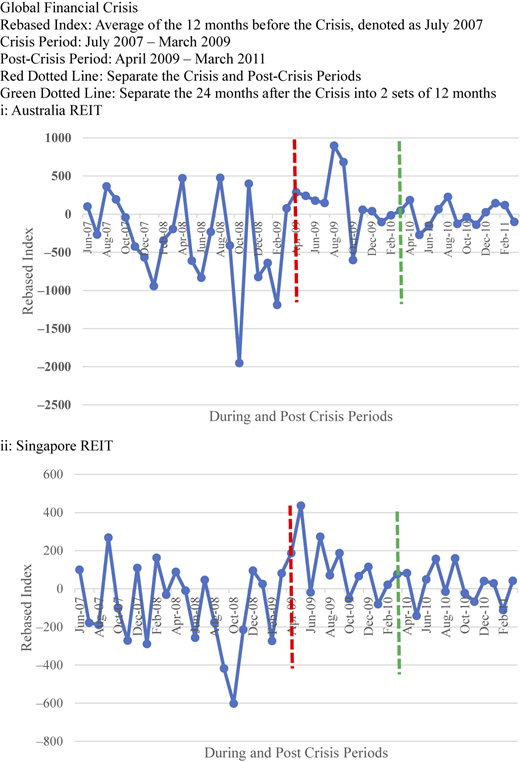
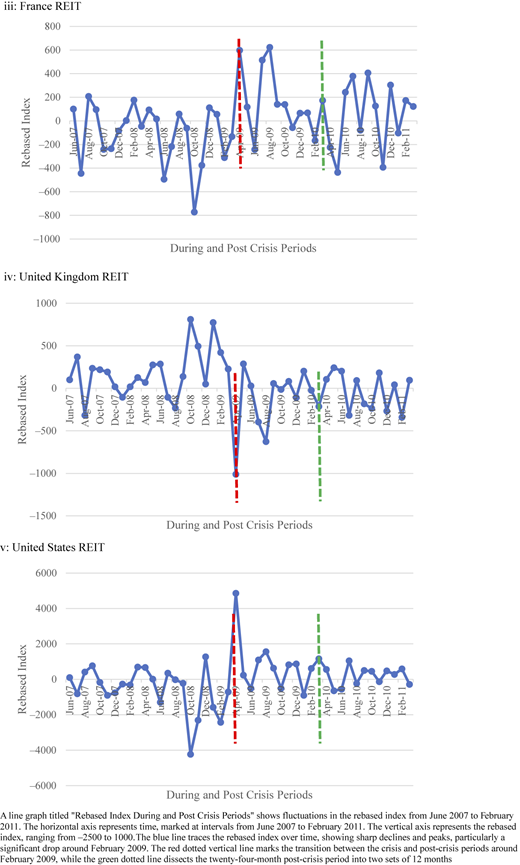
The previous analysis compares the referenced index of each REIT with the average monthly performance during each crisis and the twelve- and twenty-four-month post-crisis periods. For a better representation of the performance of these REITs during and in post-crisis periods, we calculated the rebased index and graphically represented each of these REITs. We rebased the average performance of the twelve months before each crisis at 100. This allows us to compare the performance of REITs during and after the crisis with the rebased index. The red dotted line separates the crisis and the post-crisis periods, while the green dotted line dissects the twenty-four-month post-crisis period into two sets of 12 months. Due to the sufficiency of its dataset, we use the GFC to demonstrate how the performance of REITs in Australia, Singapore, France, the UK and the US during and after the crisis periods compares with the rebased index. The results are reported in Figure 1.
A line graph titled “Rebased Index During and Post Crisis Periods” shows fluctuations in the rebased index from June 2007 to February 2011. The horizontal axis represents time, marked at intervals from June 2007 to February 2011. The vertical axis represents the rebased index, ranging from −2,500 to 1,000. The blue line traces the rebased index over time, showing sharp declines and peaks, particularly a significant drop around February 2009. The red dotted vertical line marks the transition between the crisis and post-crisis periods around February 2009, while the green dotted line dissects the twenty-four-month post-crisis period into two sets of 12 months
Figure 1 shows more volatility and downswings in the monthly performances during the crisis period relative to the rebased index for all REITs. It reveals a bearish trend, indicating that the performance of REITs took a downward trajectory when the GFC hit. This could create investment pessimism, a situation that explains the overall negative performance of all these REITs during the crisis period. However, in the twelve months after the crisis, these REITs recorded more upswings in monthly performances compared to the rebased index. It reveals a bullish trend in the market that injects more investment optimism, which eventually leads to the recovery of REITs from the negative performance during the crisis. The rebased index generally supports our previous discussion on the GFC regarding the poor performance of REITs during the crisis period, but leaps back to the rebased index in the 12 months after the crisis.
5.2 Return-risk performance of REITs across the three events
The preceding analysis examines returns without accounting for risk. This section uses risk-adjusted performance to assess the static and dynamic resilience of these REITs. The results are presented in Table 3. When the risk is factored into the analysis, the results are quite similar to the return index. The overall analysis reveals the following caveats. Firstly, there is variation in the degree of resilience across REITs during global events. Secondly, events triggered within the financial system have greater adverse effects on REITs than those caused by factors outside the financial system. Finally, most REITs do not recover within 12 months after an event but are likely to recover within 12–24 months after the crisis period, depending on the nature and scale of economic interventions in the country.
5.3 Results of impulse response of REITs to structural shock
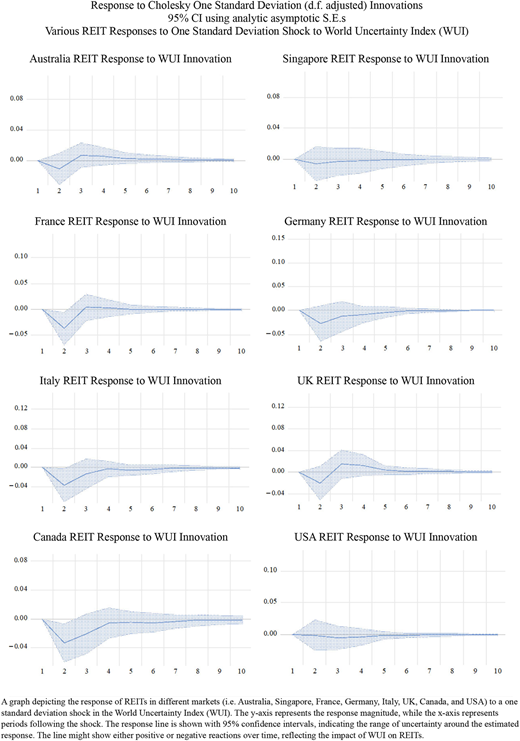
In the second stage of the analysis, we use an impulse response framework to examine REITs’ response to a one-standard-deviation shock of the world uncertainty index. With a ten-quarter display, we consider the first four-quarters to represent static resilience, while the remaining six-quarters depict dynamic resilience. The results are reported in Figure 2.
Figure 2 (i–viii) shows how the various REITs respond to an investment landscape of global uncertainties. As expected, the results show that a one standard deviation shock to the world uncertainty index generally leads to a negative response for at least four-quarters for each of the eight REITs before it returns to a steady state. This shows an inverse relationship between the performance of each of these REITs and this global risk index, providing further explanation of the static resilience of REITs when there are global events. The results further reveal that the US REIT tends to revert to a steady state more quickly than the other REITs. More specifically, the response of the US REIT to shock occurs after the second quarter but returns to a steady state after the fourth quarter. This is followed by France REIT, which tends to hit its steady state value after five-quarters, Australia, Singapore and the UK REITs after almost six-quarters. These findings generally reflect our earlier discussion on the recovery route of these REITs after the COVID-19 pandemic. However, the return to a steady state is much longer for Germany, Italy and Canada. The impulse response results of REITs are largely aligned with our previous discussion, as they portrayed relative dynamic resilience.
5.4 Dynamic Ordinary Least Squares regression results of REITs
As previously discussed, economic policies and systematic risk often play a major role in shaping REIT activities and their returns. This is reiterated in the earlier study of Swanson (2004). In this section, we use DOLS regression analysis to examine the long-run relationship between key macroeconomic factors, such as real GDP growth and country-level economic uncertainty, and REIT performance. This analysis will shed light on the effects of these variables on REIT returns over time. Before presenting the DOLS estimates, we first assess the long-run relationship among the variables using the ARDL Bounds cointegration test and then evaluate the reliability of the model through diagnostic tests. The ARDL Bounds cointegration results are reported in Appendix 1in the Online Appendix, while the DOLS estimates are reported in Table 4.
FromAppendix 1, there is a clear rejection of no cointegration in this model, as the F-statistic exceeds the upper bound for each REIT at the 1% significance level. The diagnostic results in Appendix 2 in the Online Appendix show that the DOLS is well specified. The results from Table 4 reveal that the real GDP growth rate of Australia, Singapore, Canada and the US has a positive and statistically significant effect on the performance of REITs in these countries at the relevant levels. These results imply that the use of economic programs and policies to stimulate economic growth, over time, plays a critical role in determining REITs’ performance, especially in these countries. For the individual country-level uncertainty index, as expected, it is negative and statistically significant for the Australian, Canadian, Singapore and US REITs. These results mean that, apart from the world uncertainty index discussed in the impulse response, uncertainty at the country level also has a strong and significant impact on the REITs of these countries over time. However, the index is insignificant and has the expected sign in the European nations of France, Germany, Italy and the UK. These results reveal the impact of single-nation monetary policies versus Union policies on the performance of these REITs. Individual countries often develop and implement their own set of economic policies, while a holistic policy framework is often undertaken and sometimes foisted in aggregated nations such as the European Union. As such, the sentiment around uncertainty could vary between these countries. As REITs constitute diverse asset sub-classes, we deepen our analysis by conducting a robustness check. The results reported in Tables 5 and 6 in the Online Appendix are consistent with our findings.
6. Conclusion and policy implications
REITs continue to play a significant role in the investment landscape across the globe. It is an investment vehicle for both individual and institutional investors, attracting significant capital inflows. However, the occurrence of global events like the September 11 attacks in the US, the GFC and the COVID-19 pandemic often takes a toll on the performance of REITs. This raises the question of how resilient these REITs are during these global shocks. Existing literature on the performance of REITs, especially during these events, is piecemeal, looking at the performance of REITs separately in each crisis. Besides, none of these studies has examined the response of REITs to shocks and the long-run relationship between real economic growth and systematic risk on the performance of these REITs. Dubbed static and dynamic resilience across these three major events between 2000 and 2024, we comprehensively examined the performance resilience of each REIT in Australia, Singapore, France, Germany, Italy, the UK, Canada and the US. We provided some long-run economic explanations for these performances. We employ standard return-risk analysis, an impulse response and a DOLS framework, which collectively lead to the following findings.
Firstly, by considering all three events, we found the Australian and the US REITs to be relatively resilient compared to the others during these global shocks. Individual economic responses by these countries, over time, including an independent monetary environment, contributed to this performance, as evidenced by the statistical significance of the real GDP growth rate in these countries. Second, relative to other crises, the adverse effect of the GFC on the performance of REITs was the most severe, but the recovery was quicker across all REITs. This shows shocks triggered within the financial system have greater adverse effects on REITs than those caused by factors outside the financial system. Finally, most REITs were generally not static resilient but were relatively dynamic resilient, especially during the GFC and the COVID-19 pandemic. Importantly, we found that non-passive and short-term investors may have reacted too strongly to the local shocks, causing their REIT portfolios to perform worse than passive and long-term investors. These findings have significant policy implications. Boosting real GDP growth is critical in enhancing REITs’ performance. Economists and policymakers in the financial market could use the findings to develop tools to help address the impact of global shocks in the capital market. The findings could also inform the investment decisions of institutional investors during periods of uncertainty. Our findings also highlight the importance of geography in the formation of investors’ expectations during market crises.
Even though our study covers the major REITs around the globe using monthly and quarterly datasets, future research may use daily closing stock prices and perhaps deploy GARCH models to investigate the market volatility and return dynamics of these REITs.
The supplementary material for this article can be found online.