Family businesses (FBs) are considered an essential type of entrepreneurship that impacts economic growth. However, statistics show that after a period of performance they ultimately fail, and comparatively little is known about the reasons for their failing when compared to the amount of research focusing on keys to success.
Through the implementation of an case study technique, which is widely used in research to address the complex phenomenon of failure, this paper aims to analyse the antecedents of failure in the case of four Catalan FBs. In doing so, this article develops propositions based on Institutional Economics Theory and Dynamic Capability Theory, with a focus on innovation and product diversification in family firms.
Using interviews as a means of obtaining a large amount of information, it is observed that problems related to governmental regulations and constantly changing social behaviour can lead to failure for FBs. Additionally, a link between R&D activities and new product development and FB failure is observed. More specifically, this research highlights that a lack of product diversification and innovation can become a hindrance for FB performance when the institutional environment is unstable. It reveals the importance of developing dynamic capabilities that can meet the demands of fast-changing consumer behaviour. From a practical perspective, these findings can be used by governments in developing regulations focused on the dynamic capabilities of FBs, and by managers in order to learn from these experiences and implement appropriate strategies for long-term development and crisis management.
This paper theoretically contributes to both the FB literature, as well as to institutional economics and dynamic capability theories by offering a combined perspective on how FB's dynamic capabilities change based on environmental factors and impact FB failure.
1. Introduction
Business failure has been the subject of research and there is considerable interest in the topic. Firm characteristics, such as the industry (Browne et al., 2021), size (Maharajh et al., 2023) and level of sustainable growth (Jamil et al., 2023) have an impact on a firm’s performance and ultimate failure (Basco et al., 2021). Family businesses (FBs) are considered to be one of the biggest drivers of economic growth, as they provide 70–90% of the world’s GDP, representing approximately one-third of the 500 S&P firms worldwide, 85% of start-ups and 60% of European firms (Araya-Castillo et al., 2022; Patel and Guedes, 2022; About European Family Business, 2020). The unique characteristics of FBs, such as family involvement, the alignment between family and company objectives and the typically low number of stakeholders make FB performance different and create a need for understanding FB failure (Cesaroni et al., 2017). Additionally, FBs have high rates of failure, given that 66% of FBs fail during the second-generation transition and only 15% survive through the third generation, often due to the conflict between family and business interests (Maharajh et al., 2023). Adding reasons for failure to our understanding could help to prevent or mitigate it (Amankwah-Amoah et al., 2022).
Scholars have focused on failure from the perspective of the family and business dimensions (Sharma, 2004). According to Sharma (2004), a difference exists between business and family performance. For example, good performance in the business dimension equates to FB having financial security, whereas the family dimension refers to the level of emotional capital created by social bonds. Also, due to the mixture of family and business ties, family firms can experience additional risks that can impact FBs’ performance both positively and negatively (Patel and Guedes, 2022). For example, the emotional nature of FBs can be at odds with financial business objectives, and therefore FBs’ performance will be hampered (Harrington and Strike, 2018). Furthermore, the emotional nature of family characteristics in the presence of undeveloped governance mechanisms can have a positive impact on firm performance due to the fact that FBs can obtain a cheaper workforce from within the family by using their social ties to lower agency costs, however, this can create a level of risk in the organizational structure and create a need to understand whether in the long-term FBs may either experience improvement in their performance or will fail (Soleimanof et al., 2018). For example, the family effect has the potential to create a certain level of commitment in the management of the business, thus lowering the odds of failure (Patel and Guedes, 2022).
Adding further complexity to this relationship, there are various reasons for failure due to the heterogeneous nature of FBs, including the different objectives, goals and sizes of FBs (Mitter et al., 2021; Razzak et al., 2021). Moreover, it is not clear whether family-specific characteristics and dynamic capabilities help to prevent failure or stimulate it even further (Razzak and Jassem, 2019; Morgan et al., 2021). Research has mainly focused on the analysis of failure at the industry level, but not at the level of individual businesses, leaving FB failure and bankruptcy largely unexplored (Mitter et al., 2021). Ultimately, FBs are facing constant challenges when making decisions as they need to prioritize family values and try to increase financial performance simultaneously (Harrington and Strike, 2018). Family orientation creates certain patterns of management and operations in the firm, so family firm failure has its own antecedents and requires special attention (Amankwah-Amoah et al., 2022). Ultimately, FBs adopt different governance and management strategies based on the institutional environment, however, the relationship between survival and institutions is relatively unexplored (Soleimanof et al., 2018; Urbano et al., 2019).
Therefore, the objective of this article is to fill in this gap in the literature by explaining FB failure. To better understand FB failure, the following research questions are posed:
How and why do formal and informal institutional environments impact FB failure?
How and why do FBs’ dynamic capabilities lead them to avoid failure?
How and why does product diversification and innovation help FBs to avoid failure?
To answer these questions, this article builds on institutional economics theory and dynamic capabilities theory arguing that formal and informal institutions can create an unfavourable environment for FB performance. In addition, the traditional and risk-averse nature of FBs can diminish firms’ dynamic capabilities to overcome economic shocks.
The findings contribute to the emerging literature on the topic of dynamic capabilities in the FB context (Schilke et al., 2018). They are in line with the findings that stress the fact that, to preserve control and management inside the ruling family, FBs are not able to use their social capital efficiently, which harms FBs’ dynamic capabilities (Munoz-Bullon et al., 2018). This article adds knowledge to the field of product diversification, demonstrating the importance of such activities in order to avoid failure. It is argued that large FBs have lower R&D investment levels and lower product diversification when the institutional environment is highly regulated (Skorodziyevskiy et al., 2024). The findings add to those of Delbufalo et al. (2016) which suggest that the result of product diversification is dependent on the environment, such that in a weaker institutional environment, product diversification is considered to be the best strategy to increase FB performance. Lastly, this research sheds light on the stream of literature that analyses the innovation outcomes of FBs (Alonso et al., 2018; Ahmad et al., 2021). Research states that FBs’ agency problems and lack of resources lead to lower innovation outcomes (Nieto et al., 2015; Schäfer et al., 2017). FBs’ risk-averse nature drives them towards more traditional ways of innovation (Schmid et al., 2014), however, in the fast-changing environment, radical innovation is needed to avoid failure (Nieto et al., 2015). Ultimately, this research enriches the literature on crisis management by showing how FB performance can be harmed during institutional transition periods (Cesaroni et al., 2017; Calabrò et al., 2021). From a practical perspective, this finding can be used as a guide for FBs while developing dynamic capabilities, as well as strategic management to overcome crises.
This article is structured as follows: In the Section 2, the literature on family business failure is reviewed using an institutional lens and the perspective of dynamic capabilities theories. Afterwards, the methodology and findings from the case study analysis are presented in Sections 3 and 4, followed by discussion in Section 5. Ultimately, Section 6 of the article offers concluding remarks.
2. Literature review
2.1 Family business failure and the institutional perspective
Overall there is mixed evidence in the literature on the effect on performance of being an FB; a positive impact on performance is observed in terms of family identification, emotional attachment and renewal of bonds, while a negative impact of family influence and control on FB performance is also described. This can be explained due to the fact that in order to maintain control, FBs will frequently prioritize the contracting of family members as workers rather than using qualified external employees (Razzak and Jassem, 2019). There is evidence that FBs’ financial performance is usually hampered in the initial stages, based on the prioritization of other factors, such as the family’s protection of ¨affective endowments¨ and more focus on socioemotional wealth creation, rather than financial considerations. However, how performance changes with the growth of FBs is debatable (Cesaroni et al., 2017). Additionally, traditional financial metrics such as liquidity, profitability, efficiency and capability of facing long-term debt help to predict FB failure. Nevertheless, researchers find contradicting results about FBs’ financial performance and insolvency based on differences in the definition of family firm used in the study, the setting and whether the focus is macro- or micro-economic (Gonzalez et al., 2019). A stream of research defines family firms as those which are ‘governed and/or managed with the intention to shape and pursue the vision of the business held by a dominant coalition controlled by members of the same family or a small number of families in a manner that it is potentially sustainable across generations of the family or families’ (Chua et al., 1999, 25). Another line focuses on the behaviour of family firms, which is mainly focused on business continuity with the aim of transferring to the next generation (Maharajh et al., 2023). To sum up, there is no clear relationship between environmental factors and FB performance, as researchers have found ambiguous results (Razzak and Jassem, 2019).
The Literature has utilized different concepts to explain business failure ranging from bankruptcy to exit decisions. Some scholars equate exit decisions to failure, neglecting the fact that it can be seen as a strategic decision (Nordqvist and Melin, 2010). Others explain it in terms of several unexpected events with a non-desirable outcome (Coad, 2014). On the other hand, the FB literature states that failure can be perceived due to a lack of succession, as only 30% of FBs survive past the first generation (Mitter et al., 2021; Miller et al., 2003). This can be explained by several problems during and after succession, such as the loss of market share, shrinking margins from project results and high expenditure costs (Miller et al., 2003). In this study, failure is understood as a deviation of expected outcomes that can be a result of errors and risk-taking with a sequence of organizational decline (Ucbasaran et al., 2013).
2.2 Family business failure and institutional economics
Formal institutions such as business regulations and government and political structure, as well as informal ones, such as the social norms, values and beliefs of society, create impacts on business performance (North, 1990; Urbano et al., 2019). According to research on institutional economics, the emotional nature of family and a financial business perspective are seen as contradictory characteristics that can conflict with and jeopardize short-term payoffs for FBs, leading to a mere 10% survival rate amongst third-generation FBs (Harrington and Strike, 2018). Therefore, due to emotional attachment, high ownership orientation and the desire to keep strategic decision-making in their own hands, FBs interact differently with institutions (Mitter et al., 2021), and the interaction is not a simple one. Added to this, different levels of institutional protection for FB shareholders result in a dual impact of governmental regulations on FB development (Arregle et al., 2017; Peng et al., 2018). In environments where formal institutions give perks and business development opportunities, FBs have higher possibilities of growth (Soleimanof et al., 2018). On top of this, FBs can benefit more from new policy implementations due to efficient internal coordination (Cai et al., 2023). Informal institutions, such as the culture, values and principles of society can have a positive impact on FB growth by providing certain legitimacy that can be beneficial for FB, such as political, governmental and community support (Berrone et al., 2020; Peng et al., 2018). Out of a need to protect socioemotional wealth, FBs (Harrington and Strike, 2018) are sensitive to institutional pressure and take decisions that are approved of by society (Soleimanof et al., 2018; Chaudhary et al., 2021). The organizational culture of FBs results in collectivist values (Simon et al., 2012), which are transmitted through informal chats about business topics to create management control systems beneficial to these types particular of business (Leiß and Zehrer, 2018; Songini et al., 2018). For example, in rural areas, FBs have higher chances of survival through perks and advantages gained from social connections (Backman and Palmberg, 2015). Hence in societies where the FB formula is highly respected, FBs will have perform better (Mengoli et al., 2020).
2.3 Dynamic capabilities (DC) and FB failure
Institutions create the environment for FB growth or failure. Nevertheless, in order to prosper in the long term, businesses should take opportunities to create new resources or adapt existing ones to achieve the necessary organizational change according to market needs (Chirico and Nordqvist, 2010; Bohorquez-Lopez et al., 2024). According to Teece (2007), this can be referred to as a firm’s ¨dynamic capabilities¨, which cannot be acquired, are hard to imitate and are based on the unique characteristics of a firm.
A fast-changing environment can pressure FBs to implement new strategies in order to overcome a crisis (Soluk et al., 2021). It can be characterized as the need for the development of new products and technologies to meet new market and customer demands (Chirico and Bau, 2014; Sørensen and Stuart, 2000). However, the outcome of these actions can depend on the firms’ desire and willingness to preserve family wealth and to survive (Chrisman et al., 2015). FBs are unique for their dynamic capabilities, as they encompass the interaction of family, individual and business characteristics (Chirico and Nordqvist, 2010; Bohorquez-Lopez et al., 2024). In addition, in the FB context, family resources do not have a direct impact on firm performance, however, they have an impact on firm value creation and the exploitation of dynamic capabilities (Carnes and Ireland, 2013).
In order to meet customers’ needs and lower financial risk, FBs should increase their product diversification strategy (Munoz-Bullon et al., 2018; Stadler et al., 2018). Although this will increase the amount of information that needs to be analysed, it is argued that in doing so FBs will benefit from their social capital to compensate for the lack of professionals in the field (Stadler et al., 2018). On one hand agency theory argues that FBs product diversify more, since it helps to mitigate the financial risk of concentrating family wealth in one business (Anderson and Reeb, 2003; van Essen et al., 2015). However, on the other hand, another stream argues that publicly listed FBs product diversify less or do so only in the markets and industries that they are more familiar with in order to preserve control inside the family and thereby avoid external advisors (van Essen et al., 2015). Furthermore, in large FBs the board can pressure new product development that is not always aligned with the business strategy (Defrancq et al., 2016; Munoz-Bullon et al., 2018). Continuing with a conservative mindset and focusing on protecting family values can be associated with low levels of innovative dynamic capabilities (Bohorquez-Lopez et al., 2024). In the FBs where path dependencies and paternalism are high, less innovative activities will be initiated in order to preserve family traditions (Chirico et al., 2012; Glyptis et al., 2021; Carnes and Ireland, 2013). However, in the FBs where family members share experiences and have high levels of trust and a democratic management style, they will enhance their absorptive capacity, increasing innovation outcomes (Daspit et al., 2019).
3. Methodology
3.1 Data collection
The objective of this article is to understand what role formal and informal institutions play in FB failure, as well as how and why dynamic capabilities, specifically product diversification and innovation, can lead to or help prevent failure. To answer these questions, this article develops a multiple case study and micro-level inductive approach, which is widely used to understand complex social issues as well as to explain historical events and discover opportunities (Jaskiewicz et al., 2015). To select the cases, convenience sampling (Welsh and Raven, 2006) was used, based on the fact of being a FB that has failed and a willingness to participate in the study. Case study analysis is particularly applicable for FB failure analysis as the topic is largely unexplored. Case selection was conducted based on the fact that the FB had closed or was in the process of closing during the study. A business was considered to be a FB and was included in the study if over 50% of the ownership of the company and control of capital belonged to the family. This approach has been used by several researchers in the FB field (Songini et al., 2018).
The primary dataset was obtained from the family business chair at the University of Girona. The dataset contained information regarding family and non-family businesses in Spain obtained from SABI (Bureau van Dijk). In total, there were 624 companies, out of which 31 were selected as failed family businesses. To be considered a failure, according to SABI, the company must have already closed or be in the process of closing. The authors contacted all 31 companies via phone or email and four companies agreed to participate in an interview. Two of the 31 companies were discarded as they had merely changed names, so the businesses were still active but under different names. Semi-structured interviews were conducted with representatives of the four companies which agreed to be interviewed. Interviews are considered an effective method for collecting relevant information to analyse the topic of research (De Massis and Kotlar, 2014). The interviews were conducted over nine months in 2022, with one family member from two cases and two family members from two cases. There were five general managers and one commercial manager, and all participants had been actively involved in governance of the FB, as well as having been the second or third-generation successors of FB founders. The interviews lasted for an average duration of 77 min (120 min, 61 min, 64 min, 102 min, 66 min and 50 min, respectively). A protocol was adopted based on cases as new interests emerged. The first part of the interview started with closed-ended questions regarding the interviewee’s age, the founding date of the firm, the company position of the interviewee and the year in which they joined the company. With the purpose of reducing confirmation bias (Powell et al., 2012), the second part of the interview included open-ended questions focusing on dynamic capabilities, specifically innovation and product diversification activities, as well as the role that formal and informal institutions played during different stages of the FB’ development. Finally, the last segment concentrated on personal and family characteristics and their impact on FB performance. Additionally, to prevent interviewees from memorizing replies, the questions were not shared with them beforehand. As the interviewees were from Catalunya and felt more comfortable speaking in Spanish or Catalan, the initial protocol was developed in English and translated into Spanish. To reduce interviewer bias, two interviewers participated in the five interviews and one of the interviewers was local. Interviews were recorded, and both interviewers actively participated in the questioning process and took notes based on Eisenhardt’s proposals (Eisenhardt, 1989). Secondary data were added from articles and photos provided. For reliability, the data was triangulated with information from websites, reports and publicly available datasets.
3.2 Data analysis
It used an interpretative approach to analyse the data by having investigators personally engage with the case and develop the context and narratives to explain it. This approach helped to understand the unique and complex characteristics of FB failure (Leppäaho et al., 2016). Data were coded by one interviewer using NVIVO 12 software, widely used to analyse heterogenous, qualitative datasets (Miller et al., 2003) through a process of iteration.
For internal and external validity, the interviewers did thematic grouping and coding based on the literature on institutional and dynamic capabilities theory and suggested propositions based on the data (Riege, 2003). Interviewees were asked to offer retrospectives of events and their actions. To reduce bias, interviewees reviewed and validated the initial findings and at times provided supplemental information. Grounded Theory was used to code the data using an inductive approach. In the first stage, code names were given to the subjects and categories mentioned during the interviews to interpret the phenomena of failure with institutional factors and Dynamic Capabilities Theory. Secondly, the initial stage codes were grouped based on inductive and deductive similarities found between the cases. Thirdly, selective coding was done by choosing a category to be the base aggregate dimension and associating other categories with that one (Glaser and Strauss, 2017). Finally, the data was presented in a narrative way. In Table 1 and Table 2, it is showed the overview data of the cases, as well as personal information about the respondents.
4. Findings
4.1 Research context
Catalunya is situated in the north-east of Spain and has autonomous status. Despite occupying only 6.3% of Spanish territory, Catalunya generates more than one-fifth of Spain’s GDP, comprising a large proportion of technological, industrial and agricultural growth. According to the ASCEF 2016 report, 88.3% of private sector companies in Catalunya count as family businesses and their combined value to the economy is 69%. Added to this around 5% of family firms have a legacy of more than 100 years. COVID-19 forced restrictions that created a need for changing the management structure and strategy of family businesses in all sectors, both internally and externally. According to the INE, the percentage of businesses that went bankrupt in Catalunya in 2020 increased by 46% compared to 2018. Spain implemented specific laws, such as the temporary lay-off plan ERTE (Expediente de Regulación Temporal de Empleo or Temporary Employment Regulation file), which was intended to help businesses keep their employees on furlough. Understanding the reasons behind the failure or decision to close family firms in Catalunya is an essential topic and is largely unexplored.
4.2 Case description: Hispanica
Semi-structured interviews were conducted with four family businesses in Catalunya that had decided to close for different reasons. In this section, it is presented a description of the cases together with the analysis using aggregate dimensions.
4.2.1 History of the company
Founded in 1960, Hispanica was one of the traditional FBs in Barcelona. From a background in publishing and distributing magazines, the company saw an opportunity to enter the stationary business. After initial success, the FB decided to expand and add new products, such as toys and gift items to its portfolio. The FB did not have any external shareholders and was 100% family-owned. After successfully completing the second-generation succession, the FB continued to operate until 2017. Based on their good location and the ability of the managing directors to foresee market demand, the FB operated successfully until revenues started to decline and the son of the founder (CEO) decided to close the business. The main reasons for this decision were constantly changing Spanish governmental regulations, increased competition and changes in consumer behaviour.
4.2.2 FB failure, institutions and dynamic capabilities
From the data, it is clear that two aggregate dimensions led to the decision to close the business in 2017, Problems with governmental regulations and Low dynamic capabilities (Table 3).
One of the distinctive characteristics of a wholesaler business is the exclusivity of buying from manufacturers and selling to the retail field. Therefore, this research suggests that it is essential that the supply chain is respected by society and protected by the government. Barcelona, as a major engine of growth in Catalunya, constantly attracts businesses from abroad that have twofold impacts on the economy. On one hand, international companies bring financial wealth and new employment opportunities, and on the other, they create a highly competitive market for local businesses to carry out their business activity. As a result, the wholesaler field, where Hispanica FB operated for more than half a century, was diluted. Having initially started in a more relaxed institutional environment with low levels of governmental regulations and taxes, as well as having a good location and supplier network, Hispanica was turning a profit, however, with the changes in the market and regulatory environment the situation worsened.
In the initial stages, the feasibility of creating an FB in Catalunya was much higher than it is currently due to the regulatory environment and fast-changing market. As mentioned by the CEO of Hispanica, there have always been problems, however, formal institutions were not putting in place obstacles that could have negative impacts on businesses. Nevertheless, different types of governmental regulations created a highly complex environment that led to the failure of Hispanica.
Introduced in 1986, VAT (value-added tax) had a significant impact on businesses in Catalunya. For example, small family businesses such as Hispanica suffered financial difficulties from having to change their price strategy, as well as negotiating new agreements with manufacturers and suppliers. Added to this, as mentioned by the CEO of Hispanica, in the initial years of implementation the law was not properly monitored by the government. As a result, their competitors attempted to delay the payment of the tax if possible.
We had a lot of problems with that. Why? Because many of our competitors did not charge VAT … I remember that the Generalitat de Cataluña came to inspect my toys in case they had liquid in them, in case they had something that was not up to standard, and I said, wait a minute, I buy from importers and national factories. Go to Princesa Street where there are a lot of Chinese stores where you can see things in the window that do not comply with the regulations.
CEO, Hispanica
It is recognized that transition periods always create challenges, and from this case, it is observed that this small FB did not have the required dynamic capabilities to pass through these changes. The problems with governmental regulations increased when the FBs started to be charged different tax rates based on where their business operated and was registered. Furthermore, in order to successfully pass the business to the second generation, FBs in Catalunya must pay an inheritance tax which differs from those in other regions of Spain, and this tax has to be paid by the receiver. According to the CEO of Hispanica, the family had to pay high inheritance taxes, and one of the main shareholders even resigned to avoid high estate taxes afterwards.
The rapid change in user behaviour brought about by the advent of digital platforms impacted the FB’s growth negatively. Due to their limited resources, Hispanica could not quickly adapt to the new market conditions. The new entrants in the wholesaler business changed the rules of the game, the increasing availability of online selling platforms and the decrease in usage of paper printed materials, such as newspapers, impacted the stationary businesses, and Catalan society changed its purchasing behaviour, with a shift to more online shopping, which resulted in decreasing revenues for Hispanica and eventually led to failure.
4.3 Case 2 Cal Rei
4.3.1 History of the company
Cal Rei (CR) is a small FB that was founded in 1929 and operated in the retail sector. In the initial stages, FB sold fabrics and umbrellas which, based on high returns, led to the addition of home textiles to the product list. As a 100% family-owned business, they had enjoyed two family successions until in 2021 it was decided to close the commercial part of the business. Located in the centre of Girona, CR had been challenged by the economic transitions in the past 100 years, however by analysing the behaviour of society and adapting to governmental regulations, CR was able to succeed in the retail sector by constantly focusing on product diversification. Nevertheless, institutional regulations and the fast-changing environment created a pressing need for product innovation. Due in part to the COVID-19 healthcare crisis, changes in consumer behaviour were accelerated, and small family business in the retail sector have seen decreasing sales.
4.3.2 FB failure, institutional economics and dynamic capabilities
After analysing the data, it is observed that firstly CR was harmed by Institutional Transitions. Secondly, the low level of dynamic capabilities had a negative impact on the ability to face environmental change (Table 4).
In the retail sector, a choice location is essential for business growth. However, both interviews showed that the strategically good choice of location had positive, as well as negative impacts on the FB’s development. On one hand, being located in the centre of an important industrial, commercial and service hub such as the Autonomous Community of Catalonia meant that CR benefited from temporary institutional transitions, such as the ¨design fever¨ that occurred after the 1992 Olympic games. On the other hand, for CR there were temporary problems with the change in the rent rates imposed by the government because the FB occupied an important historical building. During the past century, formal institutions throughout Europe suffered from transitions in their economies brought on by important events such as the Second World War and the global financial crisis in 2007. Many European nations could not provide sufficient assistance to small retail FBs, increasing the probability of the failure of CR.
In all these years there has been a war, during which this building was destroyed by the bombings, and I was working there when it was already the store … So, there was a lot of difficulty to finance and to find products to sell. There was a moment when we were about to close this place and my grandfather wanted to leave it, but his children backed him saying: We want to continue.
General Manager, Cal Rei
The COVID-19 pandemic also changed consumer behaviour. Before the pandemic, physical interaction with the product was an important part of the user experience that could increase retail sales. However, the changing environment, coupled with the digitalization of products, altered consumer behaviour drastically and reduced the need to visit physical stores. Businesses further developed their digital platforms and increased the variety of products and services. As a result, the small FB CR was forced to change the production process to remain competitive in the market.
That is to say, I believe that the family business is deeply rooted in Catalonia as a way of doing business, but most probably it will not be in the future.
So, depending on what sector you want to build the business in. I wouldn't advise anyone right now to start a family business in home furnishing.
General Manager, Administrative Manager Cal Rei
I am basically talking about curtains, which has always been our strong side, but which we abandoned as we saw that other things were more important and were working better. Now we are going back to the curtain world, but without the need to have a dedicated showroom and not needing to work in any other way. And if we have an order, we visit the client and show them the possibilities in their home and change the idea a little bit.
General Manager, Cal Rei
Additionally, as observed in the interview, the capability to innovate is an important factor for successful business operation. Small FBs are highly dependent on their networks of suppliers and manufacturers. It is essential to adapt to changes and to develop more connections as the digitalization of the ecosystem results in greater competition. CR experienced drops in sales even though they were selling through digital platforms as well. The changed environment was found to be particularly beneficial for big companies and harmful for local family businesses. The aggregate dimensions with the second-order construct and representative quotes from two interviews are presented in Table 4.
For example, you search for the item that you are looking for on Google and you find it on the manufacturer's website, which will be where the features are best explained, then you can buy it there, they will deliver, so the physical shop no longer makes sense.
General Manager, Cal Rei
4.4 Case 3 Expo Mobi
4.4.1 History of the company
Expo Mobi was a commercial name change from Mobles Tarragona, founded in 1982 by Galerías Tarragona S.A. The family legacy began in 1932 when the grandfather of the last owner moved to Barcelona for his children’s education. The stabilized institutional environment after the civil war in Spain created an opportunity for the family, who had industrial and engineering profiles, to start producing machine elements such as bearings and metal furniture. With a clear understanding of the role of networks, the FB decided to use its own resources to provide all required materials to complete an efficient supply chain for successful business progression in the complex manufacturing field. However, after the financial crisis in 2007 turnover started falling, which led to insolvency.
4.4.2 FB failure and institutions, dynamic capabilities and innovation
Due to its autonomous status, Catalunya’s regulatory system creates an environment where FBs can either grow or fail based on various factors that impact their development. From the interview with the CEO of Expo Mobi, two aggregate dimensions were extracted that have impacted on business failure, such as an unfavourable formal institutional environment and low dynamic capability (Table 5).
As was observed from the data, FBs in Catalunya started losing their tax benefits with changes to the law. The implementation of an inheritance tax is one example. Added to this, during the 2007 financial crisis, a drastic decline in the returns of Expo Mobi was noticed, which coincided with a fall in the number of employees from 502 to 257. As a result of disadvantageous FB regulations, the business was forced to decide between continuity, by deferring its debts or liquidity to be able to maintain the operations of other companies in the family group. With almost a decade of experience in the business, the family decided to cease operations at Expo Mobi and did not present a business continuity plan. One of the reasons for this decision included the administrative and social payments that, according to the law, needed to be made in a short period of time. As a result, the founding family decided not to risk the health of other businesses in the group by attempting the long recovery procedure for Expo Mobi. Additionally, there was an external risk that could have led to failure during the recovery process, such as institutional change and the multiplication of market shares of big international companies operating in the furniture sector in Spain. This, according to the CEO, lowered the success rate of FBs in Catalunya.
Social behaviour changes negatively affected family businesses. The decrease in tourism and the detachment from location created a more universal market where the choice of products was wider. Consequently, the environment was unstable, so FBs were cautious in the prioritization of their investments and the model became less attractive. As a result, Expo Mobi decided to liquidate the company and search for other business opportunities.
The philosophy in Catalonia now is de-escalating. I'm not saying it's right or it’s wrong. It has its reasons and motives, but setting up a business has its disadvantages. For example, we have less and less tourism, less cruises.
CEO, Expo Mobi
The third aggregate dimension refers to firms which experience problems with innovative dynamic capabilities, which can potentially harm the business if incorrectly implemented or not done in time. For example, Expo Mobi implemented the use of SAP software to improve the decision-making process and to increase the efficiency of operations. However, after a short period of time, company management discovered that the software was displaying information that could harm the company. Additionally, a well-structured CRM for a better customer journey did not give the expected results, as the market was not ready for it at the time of integration.
Lastly, one of the core elements for business success is the product that is being sold. Adapting and improving the product in response to market and societal change is essential. The managers of Expo Mobi understood the importance of this and tried a variety of business models to meet customers’ expectations and to continue competing with big international companies. Their efforts, however, did not yield positive results. The CEO said they tried to lower the price of their product offering by rebranding part of it through existing franchises, but it did not yield the expected income.
As an adaptive reaction to structural changes we implemented a franchise system in which capturing clients was easier, because it was not the traditional product, but another type of product … We became franchisees of an operator, which was not traditional in Catalonia, without replacing the mother brand, as we hoped to go back once the situation had stabilized.
CEO, Expo Mobi
Another option for expansion was to sell existing products in international markets. However, analysis of market conditions revealed that the cost-benefit of this action was going to be low. It is concluded that the FB did not invest in the development of new and unique products that would meet customer needs and this eventually led to failure. Table 5 presents the aggregate dimensions of the reasons for Expo Mobi’s failure with quotes from the interview.
4.5 Case 4 Commercial Electrica
4.5.1 History of the company
The company was founded in 1929 during the Barcelona International Exposition, the second world fair, focused on uniting countries from Europe, The East and America. The exposition played an important role in Catalonia’s technological progress. As a result, the great-grandfather of the last member of the family began the production of industrial electric motors. The commercial upscale for the company started in 1954, which matched with the golden age of the economy when drastic expansion in businesses took place. Nevertheless, the financially stable situation did not last for a long period of time as the economic transition and change in demand decreased the level of income, and the company closed in 2014.
4.5.2 FB failure and institutions, dynamic capabilities and innovation
After analysing data two aggregate dimensions emerge: Institutional Transition and Low Dynamic Capabilities (Table 6).
As it was observed above, a drastic change in the economy leads to a new regulatory environment. Many family businesses face the challenge of risking and extending their debts by relying on the banks and other investment companies or deciding to liquidate immediately with the aim of getting some return and paying shareholders. Commercial Electrica experienced such a challenge based on poor market conditions that did not yield the expected results. The business closed in 2014. The FB employed 300 employees and had 15 points of sale, but financial returns plummeted as the construction industry was highly affected by the crisis.
Passing through two successions and an internal crisis resulting from a change in the company structure, Commercial Electrica experienced high cultural resistance to internal reorganization after the main shareholders left the company. Interaction with foreign cultures created a need for modernization and increased the speed of innovation in the internal management of the family business. Two primary family stakeholders incorporated an external member for balanced decision-making.
The external cultural environment also impacted the FB’s decision-making. Barcelona, as an international municipality, always attracted external visitors and entrepreneurs, who brought their business strategies and influenced local businesses with current trends. The interview revealed that international influence led to new branding and product development that was not always successful nor matched existing business strategy.
Nevertheless, on a technical level, Commercial Electrica was active in innovation activities, evidenced by continuous improvement of their relationship with suppliers and the creation of a consolidated customer network. However, the lack of a long-term innovation strategy and the high speed of institutional transitions resulted in demand by customers that the FB could not satisfy. It is concluded that the new environment in Catalunya created a challenge of new product development that Commercial Electrica could not fulfil, forcing it to close the business. In Table 6, aggregate dimensions for the failure reasons of Commercial Electrica are provided.
Yes, I believe that the commercial strategies we used were internal, mainly through the salespeople themselves, trying to channel the sales of the products we were interested in. We used only internal policies, because we could not bear the increased costs of creating commercial policies for externally-generated sales strategies.
Administrative and Accounting Manager, Commercial Electrica
5. Discussion
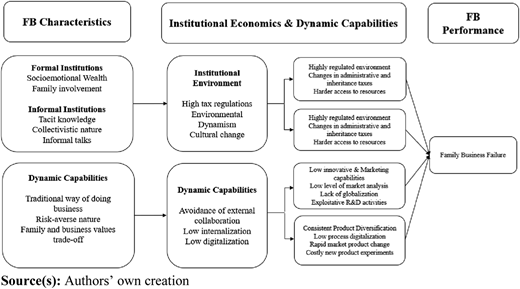
This article shows evidence that institutional economics, as well as firms’ dynamic capabilities, impact family business failure. Firstly, it is found that transition periods in the economy, including new tax measures, such as VAT, or changes in administrative and inheritance taxes, negatively impact family business performance and can even accelerate the decision to close a business. Secondly, it is observed that family firms lack the dynamic capabilities required to overcome the barriers from rapid changes in the market and society.
Institutional development is intended to improve monitoring and information asymmetry inside family firms, acting as an external control tool that has the potential to increase family firm value. In the absence of an efficient legal protection system, formal institutions can have a negative impact on the investments of family firms. The latter may avoid accepting external investments to protect the ownership of the business (Peng et al., 2018). The reduction of inheritance and wealth taxes in Spain in the 1970s created a more beneficial environment for FB growth and survival. The gains, however, were demolished by the implementation of VAT in 1993 (Basco and Bartkevičiūtė, 2016). During economic downturns, FBs were found to have problems of underperformance as family factors, together with their main dependence on internal resources, made it even harder to adapt to changes (Cesaroni et al., 2017). Therefore, the following is proposed:
Family Businesses are more likely to fail in the highly regulated environment, and this can be exacerbated during periods of institutional transition
The attitude of society is an important factor for family business survival. Family firms are especially dependent on informal institutions because social capital is highly valuable as compensation in underdeveloped formal regulations (Soleimanof et al., 2018). The unique characteristics of Catalunya as an autonomous state with high international influence create a special perception of what a business should be like. Although FBs account for 88.3% of private sector businesses in Catalunya and are a highly acceptable way of earning a living, influence from abroad and the elimination of borders through digitalization has created a new environment. Society finds less value in ¨home-made¨ goods, focusing instead on cheaper and more easily obtainable products. This worsens the traditional FB’s performance and leads to failure.
In environments where the creation of social ties is supported by informal institutions, family firms will gain competitive advantages when including family members in business negotiations (Berrone et al., 2020). It is known that family culture can influence the formalization of family firms’ identities to facilitate the relationship between a family firm and its customers, as well as suppliers. The personal approach present in family businesses can create family brands that will impact growth and increase the performance of family businesses by lowering agency costs and increasing family assets (Köhr et al., 2019). Moreover, this trust can create a basis for pro-business relationships with suppliers and other external stakeholders (Arregle et al., 2017). As a result, the following is proposed:
Family Businesses are more likely to fail in an environment where low legitimacy is given by society
Although innovation has a positive impact on firm performance and survival, family firms too often avoid collaboration with external partners involving technological innovation, tending to be very cautious about information sharing (López-Cózar-Navarro et al., 2017). However, the impact of innovation on family firm performance through digitalization is unequivocal. Collected data show that institutional transitions which occurred during crises, including Covid 19, accelerated the intention of FBs to create more innovative product displays and boost sales. It is found that user behaviour has changed and “easy access” when buying a product becomes an important factor in decision-making. Although FBs may enjoy success thanks to family values, including unique tacit knowledge and intuition passed through the generations, they must be open to environmental change and willing to explore a wider range of possibilities. Environmental dynamism creates higher demand to meet ever-changing customer needs, so FBs’ marketing and innovative dynamic capabilities need to increase to meet these expectations (Alonso et al., 2018; Kariv et al., 2022).
As a traditional type of business activity, FBs prefer exploitative R&D activities to maintain the same level of performance, but in a financial downturn, FBs tend to change strategies rapidly to explore options that may decrease the efficiency of innovation, resulting in a lower probability of success (Manzaneque et al., 2020). As a result, the following is proposed:
Family Businesses are more likely to fail due to the lack of innovative and marketing capabilities in the fast-changing environment.
Family business research demonstrates that FBs react sharply to performance decline and expand the original market of a product or even to a completely different line of products to ensure solid continuity and to avoid failure. This step is less likely to be part of a long-term strategy, but it will often occur when FBs face financial constraints (Hafner, 2021). It is observed that actions, such as lowering prices through temporary rebranding or developing unique designs for some products are not enough to avoid failure. This article suggests that product diversification should be implemented, and it should continue as part of an FB’s long-term strategy. This will give them more time to develop competent marketing and financial capabilities to continue FB growth and to deliver a product that meets customer demand. During environmental crises, FBs decision-making will be more risk-oriented and this can lead to higher growth.
Although family boards, networks and approval by the institutional environment have a positive impact on product diversification, the process includes high costs for the company and investments (Stadler et al., 2018). From the findings, it is observed that an FB’s accumulative value is not big enough to manage new opportunities. The literature shows that an FB’s second generation can be more willing to diversify than the first one. A first-generation, however, can often be more risk-oriented, which can lead to faster growth (Arrondo-García R. et al., 2016; Chou and Shih, 2020). As a result, the following is proposed:
Family Businesses are more likely to fail from the lack of consistent product diversification that can be managed by their dynamic capabilities.
After case analysis, a conceptual model is presented which represents a theoretical integration of the reasons leading to failure in FBs (see Figure 1).
6. Conclusion and contribution for future research
The objective of this article is to explore how formal and informal institutional environments, together with companies’ dynamic capabilities, impact FB failure. The research contributes to the FB sector by proposing a theoretical model of the possible antecedents of failure that can help future FBs employ the right strategy to avoid failure. Using Institutional Economics theory, this article explores how and why the formal and informal institutional environments impact FB failure. Additionally, this article uses the Dynamic Capabilities theory to gain more understanding about the reasons for failure from a dynamic capabilities perspective, such as how and why FBs’ product diversification and innovation can either lead to failure or help to prevent it. It is observed that although all four cases had sufficient capabilities to see the change in consumer behaviour and environment, they were unable to seize the opportunity to transform the situation by implementing sufficient product diversification and innovative strategies to avoid failure.
The case study analysis shows that, although governmental regulations are intended to protect and improve business performance, FBs can be hampered by the speed of such changes coupled with poor management. It is observed that rapid changes, such as COVID-19, have accelerated digitalization and increased the importance of innovation for successful business performance. As a result, many FBs are unable to keep pace with changes in consumer behaviour nor to develop new and innovative products. Too often they are pushed out of the market by larger international competitors. Finally, even though FB models in Catalunya are viewed favourably by society and seen as acceptable ways of earning a livelihood, fast environmental change creates disruptive market conditions where the traditional FB formula must change.
The findings have several theoretical and practical contributions. Firstly, they add to the literature on institutions and entrepreneurship (Urbano et al., 2019). As the literature states, the paternalistic nature of management in FBs makes them highly dependent on the external environment, more precisely on the level of societal and governmental support (Berrone et al., 2020). Currently, the institutional environment is changing rapidly and unexpected factors, such as COVID-19, add to this change, creating an unstable environment with resulting lower FB performance. As regulations imposed by the government grow, institutional transitions create a higher risk of underperformance, especially for large FBs (Peng et al., 2018). The literature states that during institutional transitions the regulatory environment is inefficient, and this creates higher transaction costs for FBs, which can impact their performance (Brenes et al., 2019). FBs try to mitigate this risk by relying on social approval to access resources, social capital and networks. However, when this process is aligned with changes in consumer behaviour, the benefits become less evident (Berrone et al., 2020). Secondly, the findings add to the crisis management literature (Cesaroni et al., 2017). The results are in line with those of Soluk et al. (2021), who found that during institutional transitions the relationship between FBs, family influence and dynamic capabilities starts to decline. The literature in general associates low performance with an unstable institutional environment (Cesaroni et al., 2017).
Third, this research contributes to strategic management literature, where the impact of dynamic capabilities on decision-making is in the early stages of development and the perspective of FBs is still emerging (Schilke et al., 2018). Family-specific unique resources do not exclusively have a direct impact on performance; however, they can change the value creation process of the firm (Carnes and Ireland, 2013). In order to preserve and protect family values, FBs will be reluctant to adopt necessary organizational changes. According to Glyptis et al. (2021) transforming existing resources and adapting to new learning is an essential part of increasing firm performance through dynamic capabilities. Although FBs have social capital, it is not used to efficiently enhance FBs’ dynamic capabilities, because losing control of firms places limits on the decision-making process (Munoz-Bullon et al., 2018). The findings are in line with Jones et al. (2013), who, using a single case study approach, demonstrated that speed and adaptation to environmental changes are key for a FB’s long-term survival. As demonstrated by Chirico and Nordqvist (2010), FB culture can play a critical role in the exploitation of dynamic capabilities, such that FBs which are resistant to change can become trapped in old dynamic capabilities (the Hispanica case).
Fourth, the article sheds light on the emerging topic of product diversification in the FB context (Anderson and Reeb, 2003; van Essen et al., 2015; Defrancq et al., 2016). It is demonstrated that innovative capabilities, such as digitalization of products and business processes can become crucial for FB survival. Although previous research states that in order to preserve family wealth and to keep control over the firm in the family, FBs are reluctant to develop new and complex products, it does not demonstrate the relationship between these activities and the ultimate result (Jones et al., 2008). These findings are in line with those of Munoz-Bullon et al. (2018), which found that FBs with greater family involvement will product diversify less. In this vein, the findings of this research demonstrate that this low level of product diversification can lead to failure. Furthermore, they match with Skorodziyevskiy et al. (2024), who demonstrated that in a strongly regulated institutional environment, large FBs have lower R&D investments and lower product diversification. According to Family Report (2021), the turbulency caused by COVID-19 increased the pace of changing consumer behaviour and the need for technological innovation and subsequent development of new products. In this article it is observed that it is essential for product diversification to be part of a long-term strategy, otherwise the constantly changing environment can delay potential benefits that could otherwise have been obtained if the firm entered the market in time (the Expo Mobi, Cal Rei cases). Product diversification strategies can depend on external agreements with other types of corporations, as well as institutions, which, as argued by Pittio and Visintin (2011), will be less pronounced in FBs and highly dependent on the generation in charge.
Lastly, this research adds to the research on innovation outcomes for FBs. As one of the important activities that depend on firms’ dynamic capabilities, lack of innovation can jeopardize firm performance (Alonso et al., 2018). According to De Massis et al. (2018), FBs can be more innovative in times of crisis, however, this can only happen if firm characteristics, such as niche focus, long-term mindset, self-financing and good relationships with employees, customers and the community are present. The findings of this article observe how firms’ innovation activities can help to overcome a crisis followed by institutional transitions (Case of Commercial Electrrica). In addition, it is observed that R&D activities that are not part of long-term strategy, are rather a reaction to a turbulent environment. As demonstrated by Schäfer et al. (2017), FBs have a high propensity to invest in innovation, however, they produce lower innovation productivity, which is explained by insufficient funding compared to other types of firms. We add to the literature that shows that FBs are more inclined towards incremental rather than radical, innovation since they suffer from agency problems, such as insufficient professionals in the field (Nieto et al., 2015). Moreover, their risk-averse nature prevents huge investments in technological innovation because the control and management of the firm will be at risk (Nieto et al., 2015). As demonstrated by De Massis et al. (2016), FBs can benefit from innovation if it is part of the family legacy and long-term tradition transmitted through generations. For example, in the case of Commercial Electrica: innovation was part of their long-term strategy, and they were therefore able to overcome several crises.
From a practical perspective, FBs should reinforce their knowledge exploitation capabilities to enhance innovation and product diversification when the environment is not stable. Although it has been proven that FBs have higher motivation for business survival (Soluk et al., 2021), it is not in itself sufficient to avoid failure. A FB’s social capital should be used efficiently to develop a long-term innovation and product diversification strategy, rather than accumulating unused resources that can be exploited later due to the rapid change of environment. FBs should be able to find ways to manage better innovative activities depending on the institutional environment and then adapt their long-term strategy accordingly.
This case study, however, has limitations that create new areas of research. Firstly, it does not focus on a specific size of company or industry – more polarized cases could be selected. Also, a cross-country analysis could be done to observe differences between institutional factors in developed and emerging economies. Thirdly, it focuses on a specific geographic area that can limit the generalization of the findings. Additionally, future research can analyse FB failure focusing more on socioemotional family characteristics and human resource behaviour. Furthermore, comparisons can be made between family and non-family firms and their dynamic capabilities. This exploratory study adds knowledge to the complex phenomena of failure and opens new paths for research into FB failure.
We would like to acknowledge the help of the Chair of Family Business in the University of Girona for providing the initial dataset.
The authors disclosed receipt of the following financial support for the research, authorship and/or publication of this article: (a) Grant PID 2020-114460GB-C31 funded by MCIN/AEI/ 10.13039/501100011033 and (b) Autonomous Government of Catalonia 2021SGR 00112 Research funding (Alexandra Simon).