Family businesses must continually adapt their strategies to remain competitive. A key challenge is balancing value co-creation, where family members and stakeholders collaborate for positive outcomes, and value co-destruction arises from poor decisions or internal conflicts. Despite extensive research in family business management, limited attention has been given to how these firms generate innovation with high-added value and manage co-creation and co-destruction dynamics. This study examines the long-term strategic decisions that help prevent adverse situations and ensure sustainable growth.
This research uses a longitudinal analysis of 400 family firms in two countries, Colombia and Spain, evaluating how value co-creation and co-destruction strategies evolved. The study applies quantitative methods, focusing on firms’ strategic decision-making, succession planning and alignment between family values and business goals. The data were gathered through structured surveys and analyzed using statistical modeling to evaluate the impact of key variables on business continuity.
Among the main results, it is found that value co-creation fosters long-term sustainability, as long as the strategies designed by the firm are aligned with the company’s objectives. Another result shows that value co-destruction is often linked to ineffective succession planning, internal conflicts and especially resistance to innovation. Thirdly, firms that implement periodic strategy reviews and promote structured succession planning manage to mitigate the risks associated with value co-destruction. Finally, the impact of the dynamics of value co-creation remains constant in both countries, suggesting general strategic implications characteristic of family businesses.
This research focuses on two countries (Colombia and Spain) to conduct a comparative international analysis to provide more information on this type of dynamics. Future research must explore the industry’s specific effects and assess digital transformation’s impacts on value co-creation.
The research results allow us to observe how family businesses can effectively mitigate the risks associated with the co-destruction of value. This is due to the integration of structured succession planning, continuous strategic evaluations and stakeholder participation. The results of this research provide practical suggestions for policymakers, advisors and practitioners, offering them guidance to develop practical and conceptual frameworks that support long-term strategic dynamics in family businesses.
The research’s social implications relate to enhancing sustainability in family businesses. The analysis considers variables such as economic stability, job creation and company intergenerational succession, particularly in emerging economies. The research considers that understanding and implementing the results could contribute to greater social and economic well-being in the way in which they are managed, making a real difference in the processes of family businesses.
This study significantly contributes to the field by examining value co-creation and co-destruction in family businesses over time, emphasizing the crucial role of strategic adaptability. The research provides valuable insights into preventing business barriers, ensuring sustainable development and improving our understanding of family business management, strategic innovation and organizational resilience.
Introduction
Family businesses are the backbone of economies worldwide. In Europe, they represent over 60% of all companies, from small enterprises to large multinational corporations, playing a critical role in job creation and economic stability (European Commission, 2025). In Latin America, family enterprises hold an even more dominant position, accounting for approximately 80% of businesses, contributing over 60% of GDP and employing a significant portion of the workforce (PwC, 2023). In Colombia, family firms comprise around 70% of registered businesses and are crucial in key industries such as manufacturing, retail and agribusiness (Guerrero, 2023). The economic significance of family business is undeniable, yet types of businesses face persistent challenges threatening their long-term sustainability.
Analyzing family businesses in Colombia and Spain allows one to understand how different institutional, cultural and economic environments shape their development and family governance. This prior idea establishes a priority for academic and pragmatic research and the need to create strategies that allow companies to face challenges in diverse contexts. This is how the European economy, as in Spain, offers a legal and financial system that allows family businesses to have institutional resources to manage governance, planning and professionalization. In contrast, at first glance, a country like Colombia, considered an emerging economy on the world stage, presents weaknesses in its institutionality, which affects family businesses to assume responsibilities beyond their operations. In this same aspect, family businesses in Spain reveal different approaches based on the institutional and cultural framework in which they operate.
In Spain, as in other European countries such as Greece and Italy, family businesses often develop a strong emotional attachment to their enterprises, viewing them as economic entities and extensions of their family legacy (Howorth et al., 2010). This deep-rooted connection fosters a preference for generational continuity over financial considerations, making these firms more resistant to selling, even under favorable market conditions. Additionally, for a country like Spain, with a strong institutional framework, family businesses can focus more on their operations, such as governance, succession and relationships with stakeholders, while still assuming social responsibilities according to the context in which they operate (Coda Moscarola and Figari, 2024).
For their part, family businesses in Colombia operate less predictably, considering their institutional framework, which directly affects their behavior and, therefore, the strategies they develop. Due to limitations in state capacity, many Colombian family firms extend their influence beyond business operations, actively providing public goods and social services to employees, their families and surrounding communities (Azizi, 2021; Acosta and Pérezts, 2019). This paternalistic business model, characterized by welfare-oriented initiatives, reflects a historical need to fill institutional gaps (Urrea and Arango, 2000; Vergara, 2013). Although Spanish companies focus on aspects of their operation, family businesses in Colombia must necessarily dedicate resources to balance economic sustainability and social responsibilities directly influenced by their ownership, succession and long-term strategies.
This type of distinction is based on the cultural and institutional role of the context in which they operate and which directly affects the dynamics of family businesses. While Spanish firms emphasize legacy preservation within a structured regulatory system, Colombian firms must navigate the complexities of weaker institutions and social expectations. Research suggests that effective family business management in these different environments requires a flexible approach, integrating family identity with evolving market demands (Gómez-Mejía and Herrero, 2022; Sanchez-Famoso et al., 2025). Understanding how family businesses adapt to their institutional surroundings is essential for developing strategies that ensure longevity and relevance in an increasingly complex global economy.
Family business is generally defined as most decision-making power stays within the family—whether it is the founder, spouse, children or heirs. At least one family member is involved in the company’s management, and even listed companies can count as family businesses if the family still holds at least 25% of the decision-making power (European Commission, 2024). Despite their strengths, family businesses face several challenges that are unique to their structure. Among the primary strengths is preparing different transitions when passing to the next generation in the succession processes, especially in obtaining financing and resolving complex tax issues.
These challenges are fundamental to exploring how family businesses can create value or sometimes face value losses. By examining how they manage their strategies and relationships over time, we can better understand how these companies can either build lasting value or fall into value destruction through conflicts or misaligned goals. In the case of literature on value co-creation and co-destruction, it is possible to find research lines related to the following topics. In the first category of analysis, it is possible to find a topic related to value co-creation vs co-destruction in Hospitality and Tourism (Arica et al., 2023; Apostolidis and Brown, 2022; Pikkemaat et al., 2024; Tasci and Pizam, 2020); value co-creation vs co-destruction in Cultural and Event Management (Azara et al., 2023; Intason et al., 2023; Glyptou, 2023); value co-creation vs co-destruction in Sports and Recreational Activities (Mulcahy and Luck, 2020), value co-creation vs co-destruction in Digital Platforms and Online Consumer Behavior (Liu et al., 2023); value co-creation vs co-destruction in Business and Consumer Experiences (Pera et al., 2021; Jayasimha et al., 2024), Theoretical Approaches to Value Systems and Service Practices (Hsieh and Chen, 2017; Skålén, 2024).
In the field of family businesses, there has been evidence of an evolution in key areas related to the co-creation of value and the co-destruction of value. In this regard, academics have identified trends in the development of the field related to performance, governance, innovation and long-term sustainability. These variables reflect the complexities of managing a company in family structures. One primary focus in the literature examines failure and performance, analyzing how family firms handle risk, resilience and continuity challenges (Hayrapetyan and Simon, 2024; Gunawan and Koentjoro, 2023; Issah and Calabro, 2024). Closely related is research on innovation and transformation, which explores how these businesses adapt to technological changes, competitive pressures and market shifts (Clauss et al., 2024; Costa et al., 2023; Pütz and Werner, 2024; Leute et al., 2023).
On the other hand, an area that is critical to the study of lines such as leadership, governance and ownership structures focusing on succession and managerial control and decision-making and its effect on business stability (Kammerlander et al., 2024; Butticè et al., 2024; Pöll et al., 2024). Given the inherent intergenerational conflicts in family firms, scholars have examined how these tensions affect value preservation and business longevity (Ardyan et al., 2023; Randolph et al., 2024). The role of social capital and entrepreneurship has also gained attention, with research exploring how trust-based networks and family ties influence growth and competitive advantage (Mani and Lakhal, 2023; Al-Dajani et al., 2023; Ivanycheva et al., 2024). Additionally, dynamic capabilities and sustainability studies focus on how family firms respond to uncertainty and market volatility to maintain their long-term strategic position (Bohorquez-Lopez et al., 2024; Hadjielias et al., 2023).
Emerging discussions highlight customer engagement and external stakeholder relationships, examining how family firms build loyalty, manage reputation and foster business ecosystems (Pereira et al., 2024; Griffin and Youm, 2023). Meanwhile, research on mergers, acquisitions and corporate strategies delves into how family businesses expand or restructure while maintaining their core values (Ma et al., 2023). Lastly, growing interest in business model innovation assesses how family firms reinvent their operations through digitalization, new value propositions and shifting market demands (Menter et al., 2023; Leute et al., 2023).
Previous studies show two critical gaps in understanding how family businesses operate. Specifically, there is a need to explore value co-destruction and value co-creation and the critical role dynamic capabilities play in minimizing the effects of value co-destruction. Although much research has focused on the value of co-creation and co-destruction in family businesses, there still needs to be a gap in understanding how these processes evolve. Most studies focus on isolated moments—such as crises, significant events or business transitions—without exploring the long-term dynamics. What is missing is a comprehensive look at how family dynamics, governance structures, intergenerational conflicts and dynamic capabilities influence value creation or destruction throughout the life of a family business. The objective of understanding how these factors change over time becomes an essential element to understand generational and leadership transitions, which allows a process of obtaining valuable information about family businesses and the creation of value over time.
Regarding dynamic capabilities, which consider how family businesses adapt, grow and reorganize considering market dynamics, they are vital to face the possibility of co-destruction of value and, therefore, improve the co-creation of value in the different stages of development of family businesses. While there is plenty of research on value creation in family businesses, the factors leading to value destruction are poorly understood. Many studies focus on the positive aspects of family involvement, such as family ties, social capital and long-term vision, which help drive value creation. However, less attention has been given to the conflicts, governance breakdowns, or intergenerational disputes that can lead to value destruction. Dynamic capabilities are key to overcoming these challenges, as they help family businesses adapt to issues like succession, governance disputes, or shifts in the market. There is a need for more research on how unresolved conflicts, misaligned goals or underdeveloped dynamic capabilities can gradually erode the value of family businesses. Exploring how these destructive processes unfold—especially during times of crisis or transition could provide important insights into how to prevent value loss.
This gap highlights the need to understand the value creation processes and, in turn, the negative impacts of value destruction that affect family businesses. Additionally, it highlights the role of dynamic capabilities in enabling family businesses to balance value creation and destruction over time. In this way, this study aims to answer the following question: how do dynamic capabilities influence the occurrence of value co-destruction in family businesses and how can they ensure long-term value co-creation? We seek to provide a deeper understanding of the mechanisms that help family firms sustain their value, even in the face of governance challenges and market uncertainty. Specifically, this research makes three key contributions: The first is related to shifting the focus from isolated events to long-term value dynamics instead of looking at single moments of crisis or success. This study examines how value creation and destruction unfold over time in family businesses. The second one, bridging governance, family dynamics and adaptability. This study builds a complete picture of how family businesses navigate risks and opportunities by integrating research on governance structures, intergenerational tensions and dynamic capabilities. The third one is exploring how family firms prevent value loss. We go beyond the traditional focus on family business strengths to examine the hidden pitfalls that lead to value erosion, offering insights on how firms can proactively manage these risks.
Considering the gaps mentioned before, the main research objective is to analyze how dynamic capabilities influence the occurrence of value co-destruction in family businesses and how they can ensure sustainable value co-creation in the future. This study is structured as follows: The first part presents the research, mentioning the different studies in co-destruction and co-creation of value in family businesses. The second part presents the theoretical framework on which the study is based. The third section describes the methodology and technique used for data processing, followed by the research results, conclusions and contributions.
Theoretical framework
Family businesses operate at the intersection of tradition and market dynamics, making the balance between value co-creation and value co-destruction particularly complex. While these firms play an important role in economic and cultural sustainability, their deep-rooted ties to local communities and stakeholder relationships expose them to risks of value erosion, especially when market pressures threaten their authenticity (Azara et al., 2023). A key challenge lies in navigating the tension between preserving cultural identity and adapting to market demands, as failing to do so may lead to unintended value destruction.
This theoretical framework review explores the foundations that explain how family firms create or lose value over time, focusing on dynamic capabilities—the ability to adapt, integrate and reconfigure resources in response to external and internal challenges. Specifically, it examines how governance structures, stakeholder relationships and psychological ownership shape strategic decision-making in family businesses. The academic debate focuses exclusively on how the theory of dynamic capabilities, together with the theory of stakeholders and the theory of psychological ownership, offers perspectives that help to understand how companies sustain long-term value over time while mitigating the risks of losing value associated with internal conflicts of family businesses and their external pressures.
Aligned with the research objective—to analyze how dynamic capabilities influence value co-destruction in family businesses and ensure sustainable value co-creation in the future—this review critically assesses the mechanisms that enable family firms to remain resilient. By integrating insights from these theoretical perspectives, this study aims to contribute to a deeper understanding of how family businesses can proactively manage risk, enhance adaptability, and sustain their legacy in evolving market environments.
According to scholars like Azara et al. (2023), the critical relationship between value co-creation and co-destruction, particularly in the context of family firms, emphasizes the importance of businesses understanding these dynamics. Despite the scarcity of studies, it has been found that in the context of cultural events, conflicting perceptions of different stakeholders can be evidenced. These stakeholders play an essential role that becomes commodified by different stakeholders; the event’s significance for some stakeholders could be diminished, leading to value destruction. In this context, the interplay between value co-creation and co-destruction is particularly relevant for family firms, as they often have deep-rooted ties to the local community and cultural identity. The challenge lies in balancing the benefits of market-driven value co-creation with the risk of co-destruction when cultural authenticity is compromised. This calls for family firms to develop and leverage dynamic capabilities—the ability to adapt, integrate, and reconfigure resources—to respond effectively to changing market demands without eroding their core values and cultural heritage.
By recognizing the interconnected nature of value co-creation and co-destruction, family firms can better navigate market pressures and make informed strategic decisions safeguarding cultural significance while embracing market opportunities. Understanding and enhancing dynamic capabilities is crucial for these firms to mitigate the negative impacts of commodification, ensuring sustainable growth while maintaining their cultural identity in the face of market changes. Several theories offer important insights when understanding how family businesses create or lose value. The resource-based view (RBV) and dynamic capabilities theory focus on how a company’s unique strengths and adaptability contribute to its success over time. Agency theory and stewardship theory explore the motivations behind the actions of family members and non-family employees. Social capital theory and family systems theory explain how relationships, both within the family and outside of it, can influence positive or negative outcomes. Organizational identity theory and institutional theory also help us understand how the company’s identity and external pressures shape its strategies.
Although these theories are helpful, stakeholder and psychological ownership theories are particularly relevant for understanding value creation and destruction in family businesses. Stakeholder theory examines how the people involved in a company—family members, employees or customers—impact its success. It shows us that value is created when everyone’s interests are aligned. However, when those interests clash, conflict arises and the business risks losing value. Psychological ownership theory delves into the personal and emotional bonds that people form with business. In family firms, where the company is often deeply tied to the family’s identity, these feelings of ownership can be a powerful force for value creation—but they can also lead to tension and conflict when personal control overshadows the business’s needs.
Before the literature review in each of the indicated perspectives is carried out, the development of the theoretical perspectives and their use in the field of family businesses must be analyzed from a critical perspective to understand not only the development of the field but also the main lines of future development of the themes used in the theoretical field.
A critical perspective on family firms: rethinking strengths and limitations
Family businesses are often regarded as resilient organizations with a long-term vision and strong stakeholder relationships (Su and Dou, 2025). While these attributes contribute to their success, a deeper analysis reveals structural weaknesses, governance complexities and strategic limitations that can undermine their long-term sustainability (Odame and Hinson, 2024; Gutuleac et al., 2025). By examining these firms through the lenses of dynamic capabilities theory, stakeholder theory, and psychological ownership theory, it is possible to develop a more realistic and balanced understanding of their inherent challenges.
Although family firms are effective at developing dynamic capabilities that allow them to navigate market changes effectively, many struggle with strategic rigidity in practice due to their strong emphasis on tradition and legacy (Canjun et al., 2025). This attachment often limits their ability to embrace necessary transformations, making them reactive rather than proactive in responding to industry shifts. Unlike corporations that regularly bring external leadership to drive innovation, family businesses rely on path-dependent decision-making, prioritizing stability over growth (Singh et al., 2024). As a result, they may delay strategic shifts, resist adopting new business models or overlook emerging market opportunities, ultimately reducing their ability to compete in fast-changing environments (Aboelmaged et al., 2024; Gunawan and Koentjoro, 2023).
Regarding stakeholder management, the strengths of family firms can also become sources of internal conflict. According to stakeholder theory, businesses thrive when they successfully balance the interests of multiple stakeholders, including family members, employees, customers and investors (Oware et al., 2022). While family firms emphasize commitment to their stakeholders, decision-making processes often reflect internal power hierarchies rather than broad-based consensus (De Clercq et al., 2022). In many cases, non-family employees or external investors may have limited influence, leading to governance inefficiencies and resistance to organizational change (Fan et al., 2021). Despite their reputation for fostering strong stakeholder relationships, family businesses may struggle to manage competing interests, leading to tensions that can impact performance and long-term stability (Ng et al., 2020).
Psychological ownership is another critical factor shaping family business dynamics, which explains why family members often develop strong emotional ties to their firms (Dey and Fasbender, 2024). While this connection fosters commitment and long-term thinking, it can also lead to overprotectiveness, nepotism and resistance to professionalization. The tendency to prioritize family loyalty and trust over competence can hinder efforts to attract and retain skilled leadership, affecting the firm’s ability to adapt to external challenges (Arslan, 2024; Tajpour et al., 2021). Furthermore, deep emotional attachments to legacy practices may cause reluctance to adopt new governance structures or innovative strategies, reinforcing a cycle of internal resistance that prevents businesses from evolving (Nguyen et al., 2024).
This perspective challenges the idealized narrative of family businesses as inherently resilient and adaptable. While they possess unique strengths, their governance models, stakeholder relationships and psychological ownership patterns can create barriers to long-term competitiveness (Dey and Fasbender, 2024). To thrive in an increasingly complex business environment, family firms must integrate external expertise, embrace adaptive leadership models, and balance tradition and innovation (Arslan, 2024).
Stakeholder theory
Stakeholder theory emphasizes that family businesses must balance the diverse needs of all involved parties, including family members, employees, customers and the broader community. This balance is particularly difficult for family firms because family members tend to be emotionally invested in the business’s legacy and future. At the same time, other stakeholders may focus on short-term goals. Conflicts can emerge when these interests are aligned, leading to better decision-making and value loss.
From a stakeholder perspective, the co-creation value and co-destruction are linked to the factors that impact a company’s performance. These factors include management aspects like strategic alignment and the company’s mission and vision, which help identify its strengths and weaknesses. This insight is essential for driving innovation and promoting the firm’s growth through value co-creation. On the other hand, value destruction can occur when communication fails or when stakeholder goals are at odds, resulting in family disputes, unclear roles or power struggles that can disrupt progress and harm the business.
Mahajan et al. (2023) argue that stakeholder theory integrates ethics and organizational management, emphasizing the need for firms to generate benefits for shareholders and groups that influence or are influenced by the organization. This approach traces back to the Stanford Research Institute, which stressed the importance of organizations delivering satisfaction beyond financial returns. Expanding on this, Donaldson and Preston (1995) introduced the moral obligation of firms to consider the interests of various stakeholder groups and find ways to contribute to long-term profitability while maintaining this balance.
The bases on which the stakeholder theory is built maintain that the firm has a commitment to the different interested parties, both in the management of its financial performance and the prioritization of the objectives of the parties, even over financial earnings. In contrast to more traditional approaches, stakeholder theory views the firm as a collection of entities with their interests, which must be managed based on power, legitimacy and urgency. Donaldson and Preston (1995) also argue that this theory has become so fragmented that it now covers a wide range of disciplines, necessitating a more integrated line of action. Scholars like Mahajan et al. (2023) have proposed a comprehensive theory that unites instrumental, normative and descriptive principles, offering a broader understanding of corporate social responsibility and business ethics.
An ongoing challenge for stakeholder theory is integrating environmental variables and firm capabilities into its framework to ensure that businesses, especially family firms, can manage their relationships and perform effectively in the long term (Donaldson and Preston, 1995). The moral principles guiding stakeholder interactions are crucial for understanding family businesses, which often rely on unique stakeholder relationships (Mahajan et al., 2023).
Psychological ownership theory adds another dimension to this discussion, particularly for family firms. This theory explains how individuals, particularly family members, develop a strong emotional connection and sense of ownership over the business, even if they do not legally own it. In stakeholder theory, psychological ownership can influence how family members interact with other stakeholders. For example, when family members feel a deep sense of ownership, they may prioritize the firm’s legacy and values, potentially leading to tension with non-family stakeholders with different priorities. This emotional investment can fuel value co-creation, as family members work passionately to sustain the business and value co-destruction if conflicts over control and vision arise. Therefore, understanding how psychological ownership intersects with stakeholder interests is vital for family firms to navigate value creation and destruction effectively.
Psychological ownership theory
Psychological ownership theory explains how people can develop a sense of ownership over something, even if they do not legally own it. This feeling is often decisive in family businesses, as family members see the business as an extension of themselves and their family identity (Mao et al., 2024). This sense of ownership can motivate people to ensure the business thrives (Renz and Posthuma, 2022). However, it can also lead to problems, especially when different family members or stakeholders have competing ideas about how the business should be run. In the case of Value Creation, when family members and employees feel a strong sense of ownership, they are more likely to invest extra effort to help the business succeed (Guarana and Avolio, 2022). This personal commitment can lead to collaboration, innovation and long-term growth (Lv et al., 2024). For value co-destruction, however, this sense of ownership can only become problematic if it is robust and distributed. For example, if a family member feels overly entitled to control the business, they might resist necessary changes, which can block innovation and growth (Sieger et al., 2013).
Similarly, if non-family employees feel excluded from important decisions, they might become disengaged or even sabotage the business. These conflicts can lead to a loss of value. Combining stakeholder theory and psychological ownership theory gives us a fuller picture of how family firms can create or destroy value.
Family businesses must ensure that all stakeholders, including family members and employees, feel valued and included (Li and Atkinson, 2020). When people feel they have a role in the business, they are more likely to contribute positively. However, conflict can arise if they feel left out or threatened, leading to value destruction. Family businesses often struggle to balance emotional attachment to the company with the need to make sound business decisions. Stakeholder theory highlights the importance of aligning the interests of family and non-family members, while psychological ownership theory explains the emotional motivations behind their actions. Effectively managing these dynamics is crucial for preventing conflicts that could harm the business (Lee and Suh, 2015).
Family firms need clear governance structures, open communication and decision-making processes considering emotional and business needs to avoid value loss. Regular strategy reviews, succession planning and bringing in outside expertise can help ensure the business’s long-term success (Wilhelm et al., 2024). By using stakeholder theory and psychological ownership theory, this framework provides a deep understanding of how family businesses create or lose value. It emphasizes the need for family firms to carefully manage relationships and emotional investments carefully, ensuring that these personal connections contribute to value creation rather than conflict and loss (Renz and Posthuma, 2022).
An important aspect to highlight is related to the conception of psychological ownership theory as a source of competitive advantage in the understanding that it allows considering the value created by employees as a critical aspect for improving the firm’s performance (Song et al., 2024). In this way, in the future, research should be focused on improving knowledge of the application of not only the legal and financial aspects but also those that have to do with the sense of ownership of employees toward the organization (Renz and Posthuma, 2022). For a firm’s stakeholders to feel psychological ownership, there is no need for a legal link; on the contrary, the perceived rights show that this will depend mainly on other variables such as commitment and territoriality (Peck and Shu, 2009). More recent studies show that in the past, the intention was to investigate the antecedents and consequences of psychological ownership; however, currently, the interest is in an emerging field of a novel nature, such as elements related to culture, regional differences and especially factors that have to do with negative consequences not only at the individual level but also at the group level and especially at the firm level (Renz and Posthuma, 2022).
Dynamic capabilities, family business and the trajectories of value co-creation and co-destruction
The ability of family businesses to sustain competitive advantage is closely tied to their capacity to develop and deploy dynamic capabilities. These capabilities enable firms to adapt, innovate and restructure resources in response to external challenges, ensuring business longevity (Correggi et al., 2023). However, the unique governance structures, deep-rooted traditions and emotional investments that characterize family firms can facilitate value creation or reduce value when mismanaged (Moser et al., 2024). The balance between value co-creation and co-destruction is dynamic, shaped by how effectively a firm can integrate change while preserving its core identity (Hock-Doepgen et al., 2024).
The trajectory of value co-creation in family firms is influenced by their ability to develop and apply dynamic capabilities over time. Companies that recognize and act upon market opportunities strengthen governance and invest in intergenerational knowledge transfer are more likely to sustain an upward trajectory of value co-creation, ensuring continued relevance and competitive strength (Singh et al., 2024). These firms tend to embrace external collaborations, adopt new technologies and maintain flexible management approaches, allowing them to leverage their legacy while adapting to modern challenges.
Conversely, businesses that resist change often experience value co-destruction, with inefficiencies accumulating over time. Firms that fail to innovate, struggle with succession conflicts or resist external influence tend to follow a downward trajectory of value loss (Pemartín et al., 2024). Internal disagreements, rigid decision-making processes, and an unwillingness to reassess traditional business models can cause a steady decline in competitive positioning (Morgan et al., 2021).
Studies suggest that value co-destruction does not occur instantaneously but develops as a gradual accumulation of unresolved conflicts, misaligned strategies and lost market opportunities. However, family businesses that recognize these warning signs and take proactive corrective actions—such as updating governance structures, engaging external expertise or fostering stakeholder collaboration—can stabilize or reverse value erosion (Hayrapetyan and Simon, 2024). Finally, considering the stakeholder theory provides insight into how conflicting interests within a family business can drive value co-destruction. When family members, employees and external investors hold competing priorities without effective governance mechanisms, it can lead to decision-making paralysis, resource misallocation and an erosion of trust. Psychological ownership theory further explains that while substantial emotional investment in a business can enhance commitment, it can also lead to territorial behaviors that resist necessary change, further reinforcing value loss trajectories (Duarte Alonso et al., 2018). According to the above, the following hypotheses are raised:
The trajectory of value co-destruction in family businesses is negatively correlated with the development of dynamic capabilities over time. As dynamic capabilities improve, the rate of value co-destruction decreases.
The trajectory of value co-creation in family businesses is positively influenced by enhancing dynamic capabilities. Firms with more substantial dynamic capabilities exhibit a more consistent and upward trajectory of value co-creation over time.
Methodology
Research design and data collection
This study follows a quantitative research approach to analyze the value co-creation process in family businesses in Colombia and Spain over four years (2021–2024). The decision to conduct a longitudinal study was made for track changes, challenges and trends in family business management, this process offering insights into how value is sustained or diminished over time. Including data from 2024 ensures that the study captures the most recent developments in the sector, making the findings both relevant and applicable.
The choice of a comparative study between Colombia and Spain as the focus countries provides a comparative lens to examine family businesses in two distinct economic and institutional contexts. As an emerging economy, Colombia offers valuable insights into how family firms operate in settings with limited resources and evolving regulatory environments. In contrast to a developed European economy, Spain provides a perspective on structured governance and mature value co-creation strategies within family businesses. This comparative framework enables a deeper understanding of how institutional differences shape business strategies and intergenerational transitions.
Data was collected using a structured survey to ensure consistency and comparability across the sample. A professional polling agency administered survey distribution annually between January and March to control seasonal business variations. The survey included closed-ended questions, allowing for quantitative measurement of key variables related to value co-creation, governance and strategic decision-making.
Sampling and survey administration
The sample comprises 400 family-owned businesses evenly distributed between Colombia and Spain. It was selected through a stratified random sampling method to ensure representation across agriculture, manufacturing and service sectors. Companies must have operated for at least three generations, allowing for a detailed exploration of how management strategies evolve.
Surveys were administered online, by telephone or in person, depending on respondents' geographic location and availability. Each participant completed the survey independently, with an average completion time of 20–30 min per year. To promote continued participation and engagement, businesses received an annual comparative report, benchmarking their responses against industry peers.
Measurement of variables
Key study variables were measured using Likert-scale items, which provided a structured approach for assessing value co-creation, value co-destruction, management strategies and generational dynamics. Respondents were asked to rate their agreement with specific statements using a five-point Likert scale, ranging from 1 (Strongly Disagree) to 5 (Strongly Agree).
The survey instrument incorporated multiple-item Likert scales, adapted from established frameworks in family business research, to ensure validity and reliability. Before full deployment, a pilot test was conducted with a small group of participating firms to evaluate clarity, response consistency and potential biases. Minor adjustments were made to refine the wording and ensure the survey accurately captured the intended constructs.
By employing a structured, survey-based methodology, this study provides a longitudinal perspective on the evolution of value co-creation, value destruction, dynamic capabilities and generational transitions in the family business in diverse institutional settings. Quantitative measures ensure a rigorous approach to analyzing patterns and changes over time, allowing for a data-driven understanding of family business sustainability.
Scales
Value co-creation
This study used a value co-creation scale adapted from Escandon-Barbosa et al. (2021), which evaluates seven characteristics that represent the fundamental elements of value co-creation, such as individual engagement, feedback and the significance of power. This topic was evaluated through a series of Likert-scale answers from 1 (strongly disagree) to 5 (strongly agree). These instruments were created to evaluate the degree of collaboration among the enterprise’s family members and other stakeholders. The survey included questions about factors including the efficacy of communication, the regularity of collaborative decision-making and the degree to which businesses executed cooperative initiatives, such as collectively setting objectives to promote collaborative engagement.
Value co-destruction
This study on family businesses uses the value co-destruction behavior scale, based on Kong et al. (2024), to examine negative actions that limit the efficient use of resources and collaboration in family-owned enterprises. This scale utilizes a two-dimensional framework: resource non-integration behavior and resource misintegration behavior, each emphasizing important components of co-destruction within organizational dynamics. Resource non-integration behavior includes actions that limit resource integration, including the inability to identify available resources, delays in exploring resources or avoiding contributing to shared resources, evaluated by eight items on a 7-point Likert scale from 1 (strongly disagree) to 7 (strongly agree). Resource misintegration behavior refers to actions that misuse resources, including excessive use, intended destruction or inappropriate integration, evaluated through six items on the same scale. These behaviors are particularly important in family enterprises, where intergenerational and stakeholder cooperation is important for value generation. This scale is utilized to examine the impact of these negative behaviors on key outcomes, including collaborative effectiveness, interpersonal relationships and non-financial performance. The scale explains how co-destruction behaviors negatively impact perceived value, satisfaction and the overall efficacy of value co-creation processes in family firms, highlighting potential impediments to sustainable business practices.
Dynamic capabilities
Kump et al. (2019) created the dynamic capacities scale, which measures an organization’s capacity to adapt and respond efficiently to evolving market conditions. This scale evaluates important factors, including an understanding of optimal practices, the systematic collection and integration of market data, and the organization’s ability to utilize external knowledge for innovation. Furthermore, it shows the need for efficient change performance with defined responsibilities and strength in confronting obstacles.
Generational transitions
This element examines challenges and dynamics related to leadership transitions between different generations. The main topics of inquiry will be intergenerational disputes, succession planning and the congruence between family values and company objectives.
The longitudinal data collected over the four years will be analyzed using GMA and implemented using Mplus software. This examination includes various important steps:
Estimation of Trajectories: GMA will be used to determine distinctive value co-creation trends and co-destruction trends within family enterprises. Estimating the starting level of participation by each firm in these processes (intercept) and the rate of change or growth in these areas (slope) will enable the categorization of enterprises into distinct innovation trajectories.
Latent Variable Modeling: The GMA method incorporates latent variables to consider undetected fluctuations in creating value and destruction. This approach allows the study to identify trends in how various family enterprises implement their plans over time and ascertain the impact of these trends on their overall performance.
Model Optimization: To ensure the reliability of the results, the study will produce an extensive collection of 18,000 random initial values for GMA. Through repeated procedures (up to 1,000 iterations), the study will optimize these values to determine the most suitable models for the observed data, ensuring the reliability and validity of the results.
A comprehensive evaluation of the models will be conducted using several statistical criteria, such as Akaike Information Criterion (AIC), Bayesian Information Criterion (BIC) and Adjusted BIC (ABIC), to assess their fit. A lower numerical value in these indices signifies a superior fit of the model, thereby facilitating the identification of the most suitable paths for concurrent generation and destruction of value. Furthermore, the Bootstrap Likelihood Ratio Test (BLRT) will be performed to verify the disparities among models with different attributes.
Validity and reliability
A preliminary pilot study will be conducted with a smaller sample of family companies to demonstrate the reliability and validity of the measurement tools utilized. The objective of this phase is to evaluate the clarity of questions and the efficacy of the scales utilized by using Cronbach’s alpha to measure internal consistency.
Results
The initial descriptive analysis highlighted the critical role of family involvement in the value creation and retention. A significant 75% of respondents expressed a strong emotional attachment to their family business, reflecting a high level of psychological ownership among stakeholders. However, this deep connection is not without challenges. 60% of firms reported struggles with intergenerational conflicts and governance issues, this result suggests that while a strong sense of ownership can enhance commitment and performance, it can intensify tensions if is not adequately managed (see Table 1). This finding underscores the dual impact of family business dynamics, which drive success and are a potential source of internal friction.
A GMA analysis revealed three main ways of value co-creation and two paths of value co-destruction in the family firms analyzed.
Trajectories of value co-creation
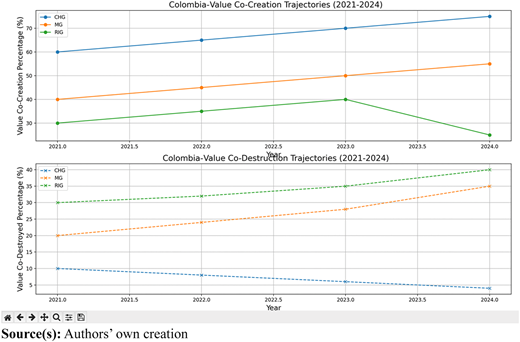
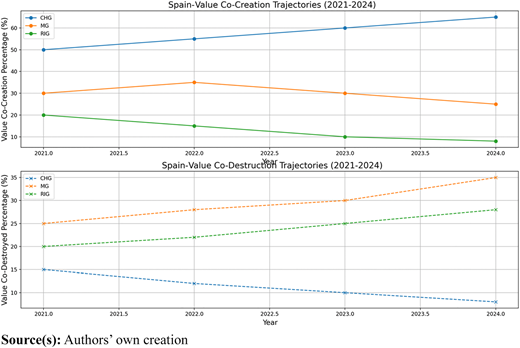
Consistent High Growth (CHG): Including 40% of the sample, businesses in this trajectory exhibited a strong and consistent increase in value co-creation, supported by efficient collaboration and innovation, supported by strong dynamic capabilities. Approximately 35% of those who participated were classified as having Moderate Growth (MG), which indicates that their co-creation activities had fluctuations. These variations were impacted by different degrees of stakeholder involvement and management methods. Rapid Initial Growth then Decline (RIGD) refers to the phenomenon where around 25% of enterprises achieved a first high in co-creation activities, which decreased. Frequently, this decline was linked to persistent internal disputes and resistance to accept change.
The picture for Colombia shows the trajectory of value co-creation and value co-destruction between 2021 and 2024. The CHG trajectory shows the most substantial results regarding value co-creation. It shows a consistent rise from 60% to 75%, indicating that an important percentage of family businesses in Colombia are successfully creating value through engagement and innovation. The trajectory identified as MG shows a more variable pattern than others, which implies a certain level of stability in generating value. However, the trajectory labeled “Rapid Initial Growth” (RIG) decreases significantly after reaching its highest point, this implies difficulties in maintaining growth because of internal conflicts or resistance to change (see Picture 1).
By contrast, in the case of value co-destruction indicates that the trajectory labeled “CHG” shows a consistent decrease in co-destruction rates, indicating a better governance. On the other hand, the trajectory labeled as “RIG” shows ongoing difficulties in effectively managing internal dynamics, as seen by the rising degrees of value destroyed. The contrasting trends in co-creation and co-destruction show effective stakeholder management in family-owned businesses.
The second picture shows Spain’s value co-creation and co-destruction patterns throughout the same period. Spain’s family-owned businesses demonstrate a significant growth tendency in the “CHG” trajectory for co-creation, with a steady increase from 50% to 65%. This previous idea indicates a good momentum generated by effective family participation and strategic leadership. The trajectory identified as “MG” continues to show lower values and indicates variability, indicating potential deficiencies in sustaining performance levels (see Picture 2).
Significantly, the “RIG” exhibits a significant decrease, highlighting certain firms' challenges in maintaining substantial initial progress. Concerning to value co-destruction, the “CHG” trajectory shows favorable changes in governance, resulting in a decline in value co-destruction over the time. However, the “MG” and “RIG” trajectories indicate increasing worries about internal conflicts for family firms, as evidenced by progressively higher value co-destruction rates. The presented image emphasizes a complex balance that family enterprises must maintain to use familial connections to generate value while efficiently managing internal obstacles to mitigate negative influences.
Statistical hypothesis testing
The first hypothesis proposed a negative relationship between the growth of dynamic capabilities over time and the trajectory of value co-destruction in family enterprises. The results confirmed this theory by indicating a statistically significant negative relationship (p < 0.05) between the development of dynamic capacities and degrees of value co-destruction. Organizations that intentionally developed dynamic capabilities, achieved through training, stakeholder engagement and responsive governance, reported a much-reduced rate of value destruction.
Hypothesis 2 proposed that the value co-creation process in family firms is improved by increasing dynamic capacities. This hypothesis was significantly validated, as a statistically significant positive association (p < 0.01) was found between improved dynamic capabilities and continuous increase in value co-creation. Family enterprises that emphasized adaptability, creativity and engagement of stakeholders experienced a continuous expansion in their efforts to provide value through collaborative creation.
Conclusions
This paper expands the theoretical framework of family businesses by integrating theoretical perspectives from stakeholder theory and psychological ownership theory with empirical findings obtained from a study of 400 family enterprises in Colombia and Spain. The research findings show the dual role of family dynamics that influence both the creation and devalorization of value. As defined by Mahajan et al. (2023), Stakeholder Theory emphasizes the need to balance the interests of many stakeholders, including family members, employees and consumers, to allow efficient decision-making and coordinated value generation. The findings indicate that family businesses with strong psychological ownership and commitment are more inclined to adopt sustainable practices that promote positive stakeholder interactions in the long term, as emphasized by Li and Atkinson (2020).
However, the findings also indicate the possibility of value co-destruction when conflicts happen because of incorrect alignment objectives or governance difficulties. The data analysis results demonstrate a negative correlation between dynamic capabilities development and value co-destruction trajectory. These previous results confirm Hypothesis 1, which supports the findings of Hock-Doepgen et al. (2024) that increasing dynamic capabilities reduces the negative impacts of internal conflicts, facilitating more productive intergenerational transitions and ownership practices. Moreover, the strong growth identified in the value co-creation ways highlights the need for continuous strategic evaluations and flexibility in maintaining long-term organizational success, in line with the perspectives of Pemartín et al. (2024) on the need for adaptability and innovation in family enterprises as they confront market shifts.
The relationship between psychological ownership and stakeholder theory demonstrates that significant emotional connections might strengthen dedication. They can also give a possible rise to the conflicts that require diligent controls. In the other side, the psychological ownership theory, as outlined by Mao et al. (2024), argues that the perception of ownership might motivate family members to prioritize the legacy and values of the firm that may occasionally contradict other stakeholders' objectives. This research emphasizes the need for family business to develop an operational structure that supports dynamic capacities, which promotes adaptability and innovation while maintaining confidence in the firm’s fundamental principles and tradition.
Additionally, the research could identify three patterns of value co-creation and two forms of value co-destruction among family businesses in Colombia and Spain between 2021 and 2024. In the case of value co-creation patterns, it shows a sustained growth located in (40%). Firms in this category consistently increase value creation, benefiting from diverse factor as strong governance, stakeholder collaboration and a culture of innovation. The second one shows fluctuating growth (35%) – businesses in this group experienced periods of growth followed by stagnation, mainly due to varying levels of stakeholder engagement and management effectiveness. The third one shows initial growth followed by a decline (25%). Companies in this trajectory showed early success in co-creation, but over time, internal conflicts and resistance to change led to setbacks.
In the case of value co-destruction trends, family business with sustained growth saw a decline in value destruction, suggesting in the best of the cases that strong governance structures helped mitigate internal risks. Firms experiencing early growth, but later decline faced increased value destruction, often due to unresolved governance issues and leadership conflicts. For comparative insights: In the case of Colombia and Spain: Colombian family firms showed strong momentum, with value creation rising from 60% to 75%. In the other hand, governance and leadership challenges remained representing a key risk factor for declining firms. For Spanish family businesses is possible to find similar trend, with value creation increasing from 50% to 65%, though stakeholder misalignment and governance inefficiencies led to difficulties in maintaining consistent performance.
Finally, the research could establish three key takeaways: strong governance and strategic leadership are important in maintaining long-term value creation. In the case of dynamic capabilities, its help to businesses adapt and prevents the decline seen in companies that initially grow but later struggle. Intergenerational conflicts and governance breakdowns remain significant challenges, highlighting the importance of structured leadership transitions and adaptability. The findings underscore the need for proactive governance, innovation and adaptability to sustain value creation while minimizing risks that lead to value erosion in family businesses.
By adopting this approach, individuals will be more effectively qualified to negotiate the dynamics inside of family relationships, guaranteeing the protection of their legacy and the continued development of values via successive generations. This study contributes to understanding how family firms can effectively harmonize their distinctive attributes to improve adaptability and competitiveness in an increasingly complex business landscape. It further supports Hsieh Chen’s insights (2017) on balancing emotional and rational strategies in family businesses through an integrative approach.
Research limitations
This study provides valuable insights into value co-creation and co-destruction in family businesses across Colombia and Spain; several limitations must be acknowledged. The geographical and cultural scope: Although Colombia and Spain were selected to provide a comparative analysis of family businesses in different economic and institutional contexts, the findings may not be generalizable to family firms in other regions with distinct governance structures, regulatory frameworks or socio-cultural influences. Another limitation is related to the sectoral representation: the study includes three primary industries—agriculture, manufacturing and services—but does not cover other significant sectors where family businesses play a crucial role, such as technology, retail, or finance. This limitation may affect the applicability of findings to firms operating in industries with different market dynamics and competitive pressures. The time Frame Constraints: While the four-year longitudinal design (2021–2024) enables analysis of trends and generational shifts, it remains a relatively short period to capture the long-term evolution of value co-creation and co-destruction especially in family firms. In the case of intergenerational transitions often considered over decades, these results suggest that longer-term studies could provide deeper insights into governance transformations and strategic adaptations.
Implications for academia
This research offers new theoretical and applied insights into how dynamic capabilities operate within family firms, especially regarding the balance between value creation and destruction over time. Future studies could build on these findings by further exploring how these dynamic capabilities grow and evolve across diverse industries and cultural contexts. According to the above, looking for the opportunity to provide a more complete understanding of their long-term impact on family firms. This study highlights trajectory analysis as an essential method for tracking the evolution of business dynamics over time. This approach can be applied in future research to understand better how strategy, governance and stakeholder engagement changes shape long-term business performance. Academics can use this tool to explore how different factors affect the growth or decline of value in family businesses over the years.
Furthermore, the conclusion of the research defines the importance of considering the relationship between stakeholders and psychological ownership, showing how these concepts manage to interact with the dynamic capabilities' theory. This combination of theories offers a much deeper look into how family businesses can thrive or face challenges depending on how well they involve the firm’s stakeholders and how the firm’s internal dynamics are managed. Future research can further explore these complex interactions to enrich our understanding of what drives family business success or failure.
Implications for family firms
This research focuses on how firm investments in developing dynamic capabilities enable it to avoid value destruction in family firms. This can be based on the idea that by fostering adaptability, innovation and flexibility, family firms can adequately manage internal disputes and keep up with market changes, which ultimately allows them to protect their created value and long-term success. Thus, the findings of this research show that value destruction often begins with minor unresolved conflicts or mismatches that persist over time. Family businesses should tackle these issues early through improved communication, stakeholder engagement and governance reforms.
Considering this approach, it is necessary to consider a permanent strategic adaptation process that considers the adoption of new technologies and especially the participation of stakeholders to guarantee long-term growth and competitiveness. This research also allows us to observe the need to reinforce the importance of family businesses adapting to changing market dynamics and internal changes, which are related to generational succession processes. Likewise, family businesses must seek to develop the capacity to respond appropriately to challenges through the active development of their dynamic capabilities, guaranteeing the protection of the legacy and continuing to create value for future generations.
Future research directions
An important aspect to highlight is that studies are needed that allow us to examine over time how the dynamic capabilities of family firms behave over longer periods of time. This type of research directly provides information on how dynamic capabilities influence the trajectories of value creation and destruction, especially in stages of the firm that generate transition processes such as mergers and expansions into new markets. While this research provides a general view of dynamic capabilities in family businesses, future studies could explore how these capabilities manifest in different sectors such as manufacturing, technology or retail—understanding how industry-specific factors impact value creation and destruction will offer a more nuanced perspective on the role of dynamic capabilities in family firms. Future lines of research could focus on how cultural and regional factors affect the development of dynamic capabilities in the context of family firms. Additionally, another line of research could focus on how cultural values, local economic conditions and regional business practices can influence how family firms' capabilities can be directed toward innovation, adaptation and management strategies that enable value co-creation and the reduction of value co-destruction.
We are glad of what we achieved. Thanks everyone who inspired us by giving advice and providing the equipment that was needed. It would be harder if anyone gather their knowledge and abilities.