This study aims to explore how Botswana’s tax authorities address sophisticated money laundering through churches, examining their detection and intervention strategies.
This paper opted for a qualitative research framework, specifically utilising purposive interviews with a sample of eight officials of the Botswana Unified Revenue Service (BURS). The methodological choice was strategically made to elicit in-depth insights into the tax authorities’ methodologies and the complexities encountered in addressing money laundering.
Research demonstrates that money launderers often exploit Pentecostal churches to conceal illicit funds, leveraging their perceived legitimacy and lax financial oversight. It also finds that current anti-money laundering (AML) strategies are insufficient, emphasising the critical need for integrating digital transformation tools to enhance detection and intervention.
The study highlights the need for advanced digital tools and stricter oversight in AML frameworks to better detect and prevent financial crimes involving religious organisations.
This paper offers pioneering insights into money laundering within religious organisations, with a focus on Pentecostal churches in Botswana. It critically analyses the BURS strategies, establishes a historical record and lays the foundation for future research in corporate governance and AML practices. By addressing a significant gap in the discourse, it advocates for enhanced AML measures and a deeper understanding of the role of religious institutions in financial crime.
1. Introduction
In contemporary financial systems, combating money laundering remains a formidable challenge, with illicit financial flows estimated to constitute approximately 3.6% of global GDP, equating to around $1.6 trillion annually (Akinbowale et al., 2024; Latif, 2022; Mirenda et al., 2019; O’Donovan et al., 2019; Levi and Soudijn, 2020). Despite significant advances in regulatory frameworks and enforcement mechanisms, the nexus between financial misconduct and religious institutions, particularly in developing countries, has emerged as a particularly insidious problem. In recent years, the world has witnessed a surge of Pentecostal churches in developing countries and more common in developing countries, especially in Africa. The level of poverty propels the proliferation and burgeoning of the Pentecostal movement with its gospel of prosperity, unlike the conventional or traditional churches that stress on “the second coming of Christ” and “life after death” (Munjeyi and Schutte, 2025). For example, there are more than 2,000 Pentecostal churches in Botswana, a country with a population of not more than 2.1 million people, while, in South Africa, Zimbabwe and Nigeria, the number could be estimated to 5,000 churches in each country. These institutions, often cloaked in the sanctity of their charitable missions, can serve as both a sanctuary and a conduit for laundering illicit funds, thus complicating efforts by tax authorities and financial regulators to detect and prevent financial crimes. This paradox is encapsulated in the phrase “the devil in the church,” which underscores the exploitation of ostensibly benevolent organisations for illicit purposes, thereby challenging traditional approaches to financial oversight and governance (Levi, 2002, 2013; Tax Justice Network, 2020).
Contemporary studies primarily focus on conventional financial institutions and sectors such as banking, with limited exploration of the participation of religious entities in money laundering schemes [Landini and Spears, 2024; Organisation for Economic Co-Operation and Development (OECD), 2021]. This literature gap is particularly evident in developing countries, where the interplay of financial secrecy, charitable status and the opulent lifestyles of religious leaders fosters an environment susceptible to exploitation. Existing studies do not adequately address the integration of religious organisations into larger financial crime networks and the efficacy of regulatory measures designed to mitigate these risks. However, there is a dearth of studies that explore sophisticated money laundering practices and countermeasures to combat it within religious institutions. To understand the occurrence of money laundering schemes within church institutions, this study uses the Botswana case as an entry point for churches in developing countries. This study aims to fill this gap by investigating how the Botswana Unified Revenue Service (BURS) identifies and dismantles sophisticated money laundering schemes associated with Pentecostal churches in Botswana. Using a qualitative approach, the research uses semi-structured interviews with BURS officials to uncover challenges and strategies in regulating and investigating financial misconduct within these religious entities.
Botswana is an illustrative case due to its strategic efforts to avoid re-inclusion on the Financial Action Task Force grey list, from which it was delisted in October 2021, following an initial designation in 2018. The country’s vulnerability to money laundering is compounded by high-risk sectors such as the second-hand automobile industry, which facilitates illicit financial flows. The emergence of wealthy Pentecostal churches, known for their ostentatious displays of wealth (Lumumba, 2019), further complicates Botswana’s financial regulatory and anti-money laundering (AML) landscape. This study seeks to elucidate the methods used by money launderers within these religious organisations and to evaluate the effectiveness of BURS’s countermeasures. By revealing patterns of abuse and detailing the specific challenges faced by tax authorities, this research improves our understanding of the intersection between money laundering, tax administration and religious institutions. The results of this study may promote the fight against money laundering in the religious institutions of Botswana. Furthermore, it may also help Botswana’s AML institutions anticipated revenue loss due to money laundering perpetrated through church institutions. The comprehensive understanding of the prevalence of money laundering within church institutions can help policymakers makes significant changes to disclosure requirements and laws regarding religious institutions in the process of devising appropriate countermeasures. Furthermore, it may aid in the extensive understanding of the root cause of money laundering within “once trusted” institutions to identify critical factors (or triggers) and eradicate them before they escalate to a national disaster. This study addresses the still under researched question: “Can tax authorities be able to unravel sophisticated money laundering schemes in developing countries?”
The article is structured as follows: an initial review of the literature on money laundering, followed by a discussion of research methods, presentation of findings and conclusion with recommendations and limitations. This investigation not only fills a significant gap in existing literature but also provides actionable insights for enhancing AML strategies within the context of religious organisations.
2. Theoretical perspectives on money laundering
Money laundering is defined as the deliberate act of concealing or disguising the origins of illicitly obtained financial proceeds, thereby rendering them ostensibly legitimate (FFIEC, 2025; Financial Crimes Enforcement Network (FinCEN), 2012; World Bank, 2009). Definitions from key institutions and jurisdictions reveal nuanced perspectives on money laundering. The Organisation for Economic Co-operation and Development (OECD) describes it as a process through which unlawfully obtained assets are made to appear legally acquired through various transactions (Organisation for Economic Co-Operation and Development (OECD), 2021, 2014; Commonwealth Secretariat, 2005). The United Nations (UN) characterises it as the conversion of illegal gains into legitimate assets to evade legal scrutiny [United Nations Office on Drugs and Crime (UNODC), 1988, 2000, 2011]. According to the Proceeds and Instruments of Crime Act (2008), Section 47(1), money laundering is defined as engaging in transactions or handling property that represents the proceeds of crime, with knowledge or reasonable suspicion of its illicit origins.
The Financial Action Task Force (FATF) defines money laundering as the concealment of the origins of illegally obtained funds through intricate financial transactions [Financial Action Task Force (FATF), 2012a, 2012b, 2013a, 2013b, 2015, 2018, 2019; FATF–Egmont Group, 2018; Financial Crimes Enforcement Network (FinCEN), 2018]. Despite variations in the precise wording of these definitions, they converge on two fundamental elements: the illicit source of the funds and the subsequent process of making them appear legitimate (Tiwari et al., 2020; Villányi, 2021; van Duyne et al., 2018; EU, 2015; Gilmour, 2023).
2.1 The money laundering cycle
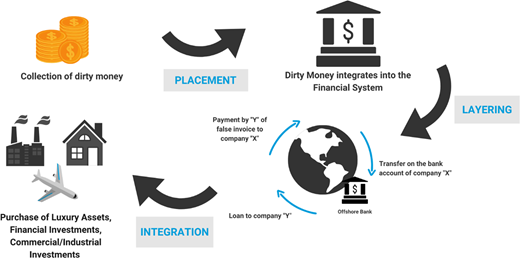
Money laundering, often described as the “cleaning” or “sanitising” of illicit funds, refers to financial transactions that conceal the origin or destination of illegally obtained money (Madzima, 2009; Soudijn and Reuter, 2016). Money laundering traditionally unfolds in three phases: placement, layering and integration (Mironov, 2013; UNODC, 2011), as shown in Figure 1. Placement introduces illicit funds into the financial system, separating them from their criminal source (Schoenherr, 2019). Layering involves complex transactions that obscure fund origins (Reuter, 2013), while integration reintroduces laundered money into the legitimate economy (Organisation for Economic Co-Operation and Development (OECD), 2019). However, some schemes bypass these stages by directly investing illicit funds (Kruisbergen et al., 2019).
2.2 Mechanisms and the challenges to combating money laundering
Money laundering presents a significant threat to financial integrity and economic stability, particularly in developing countries with weaker regulatory systems (Levi and Reuter, 2006). The FATF has established international standards to counter money laundering and terrorist financing, promoting risk-based approaches, national coordination and legal reforms (Financial Action Task Force (FATF), 2012, 2020). Although these standards are theoretically robust and supported by empirical research (Fyfe, 2023), their practical effectiveness, especially within religious institutions, remains contested.
Emerging technologies, such as cryptocurrencies and blockchain, along with the widespread use of cash in informal economies, complicate money laundering detection (Guidara, 2022). Corrupt professionals, politically exposed persons and financial opacity in freeport zones further hinder enforcement efforts (van Driel, 2018). Developing nations often lack the expertise to uncover ML in trusted sectors like churches, which are increasingly affluent and opaque.
Although the FATF proposes 10 guiding principles, including inter-agency collaboration and strategic enforcement (FATF, 2021), implementation gaps persist. This study seeks to address these gaps by examining how tax authorities and religious institutions in developing countries interact in the context of money laundering schemes.
3. Research method
This study adopts a qualitative and interpretive research methodology to explore how tax authorities can decipher complex money laundering schemes, particularly those involving religious institutions in developing countries. Given the intricate nature of money laundering and its intersection with tax regulations, a qualitative approach is ideal to capture nuanced interactions between tax authorities, religious entities and illicit financial activities (Yin, 2018; Denzin and Lincoln, 2018). Data were collected using in-depth interviews and documentary analysis. Document analysis or review involves analysing and evaluating policy documents, peer-reviewed money laundering articles and ministerial circular(s). The study is limited to Pentecostal churches, as opposed to traditional churches. Pentecostal churches are contemporary churches that follow and preach prosperity gospels. These churches are commonly known as ministries, owned and controlled by their founders as opposed to the traditional churches such as Anglican, Methodist, Roman Catholic and Lutheran in to name a few. The choice of Pentecostal churches as case study stems from the belief that some common money laundering in Botswana can be linked to Pentecostal church institutions (Africa Press, 2024), as also evidenced in the case of the self-proclaimed prophet, Bushiri money laundering in South Africa and the South Africa government is seeking extradition. The review of documents provides valuable information on the effects of limited financial disclosure requirements for religious institutions in Botswana.
Semi-structured interviews were conducted with purposively selected experts from tax authorities. The interview protocol, developed from a comprehensive review of peer-reviewed literature and theoretical frameworks accessed through Scopus, IBSS and Web of Science (Hennink et al., 2020; Creswell and Poth, 2018), aimed to gather detailed information on investigative practices, money laundering schemes involving churches and the challenges faced in tracking financial misconduct. The protocol was validated by two field experts to ensure its completeness (O’Reilly and Parker, 2013), with revisions made prior to data collection (Bloor et al., 2001).
The study targeted officials of the BURS, the Botswana Police Service, and the Directorate of Corruption and Economic Crime (DCEC) [Eastern and Southern Africa Anti-Money Laundering Group (ESAAMLG), 2017]. However, due to the sensitive nature of the topic and logistical constraints, the final sample consisted of eight BURS employees who specialise in tax compliance, investigation, audit, risk management and intelligence (see Table 1 for details). This sample size was intentionally limited to ensure in-depth analysis and data saturation, consistent with recent literature on qualitative research (Guest et al., 2006; Marshall, 1996).
The interviews were conducted in English at the BURS headquarters in Gaborone. Ethical approval was obtained from North-West University on 13 July 2024 and from BURS on 18 July 2024. Due to the sensitive nature of the discussions, verbal consent for audio recording was obtained from all participants, documented and deemed appropriate, as per Miller (2008). This method ensured ethical compliance and addressed potential concerns.
All interviews were transcribed verbatim, and thematic analysis was used to interpret the data. This approach involved iterative readings of transcripts to identify recurring themes and patterns (Braun and Clarke, 2006). Initial inductive coding led to the development of key themes related to AML practices, with comments categorised according to the literature review themes.
Triangulation was used to ensure validity and reliability by integrating data from diverse sources, including policy documents and international reports (Flick, 2018). Member checking was also conducted to verify the accuracy of the data (Lincoln and Guba, 1985). Ethical considerations were meticulously addressed throughout the research process (Creswell and Baez, 2021).
4. Research findings and discussion
This section presents and discusses the results of the interviews conducted. It will reveal church money laundering schemes, challenges faced by BURS to combat money laundering, and various deterrent mechanisms adopted and implemented by BURS to counteract money laundering in Botswana.
4.1 Church money laundering sophisticated schemes
The exploitation of Christian churches, particularly Pentecostal congregations, as instruments for laundering illicit funds, is a growing concern in developing countries. Historically, these religious institutions have been covertly utilised as channels for cleansing illegal cash, a practice increasingly recognised as “ecclesiastical crime” or sophisticated financial concealment. This study elucidates the mechanisms by which churches, benefiting from their social trust and the lack of stringent regulatory oversight, facilitate money laundering.
Participants in this study consistently identified that money laundering within churches involves blending illicit funds, often referred to as “dirty” or “dark money” with legitimate financial resources. The interviews revealed that pastors and church leaders use advanced laundering techniques to sanitise ill-gotten wealth. Several participants provided tangible examples of this phenomenon in Botswana. For example, Participant AA highlighted instances where pastors, despite modest salaries, own multiple high-end vehicles. This discrepancy raises questions about the sources of wealth. Participant CC noted that some pastors invest in media outlets, real estate and other businesses, indicating a strategy to diversify and clean up their unexplained wealth. Furthermore, Participant EE observed lifestyles that were incongruent with their professed income, suggesting that their financial disclosures do not accurately reflect their true economic status.
Furthermore, Participant FF remarked on pastors’ frequent overseas travel to destinations such as Dubai and the UK, purportedly for leisure. This behaviour raises suspicions about the sources of their wealth, especially when coupled with the evidence provided by other participants. This opulence is often flaunted, as evidenced by Participant BB, who noted that some pastors boast about their wealth to their followers. This creates a veneer of legitimacy for their financial activities, obscuring the true nature of their income. Participant HH questioned the source of this wealth, suggesting that it could be derived from illicit activities. Given their salaries of P25,000 to P30,000 and their full-time pastoral roles without other business ventures, it seems improbable that they could afford such lavish trips, further fuelling suspicions that they may be enjoying funds of questionable legitimacy.
Previous research corroborates these findings, documenting global instances where corrupt pastors accumulate significant property empires through dubious means (Shingange, 2020; SABC News, 2020; Mokoena, 2020; Mashaba, 2015). Participant CC indicated that some pastors attribute their wealth to “miracle money” from divine sources, which is then used to acquire luxury assets. This notion of miracle wealth is used to obscure the true origins of their funds, as highlighted by Participant HH. The study also revealed various unethical schemes used by money thieves and corrupt church leaders. For instance, Participant GG described a scenario where launderers donate substantial amounts to a church, which later awards lucrative contracts to these donors, thereby converting illicit funds into clean money. A specific incident was reported in one church (name withheld), where a contractor (name withheld) was awarded a tender to build a 5,000-seat church building. Preliminary investigations revealed that the contractor was paid a staggering P357 million, which was previously donated. The total construction cost was found to be five times too high, and it was further discovered that the construction company was linked to the donor, indicating a clear conflict of interest.
Participants AA and EE illustrated other schemes in which money is laundered through “fake miracle sessions” or the donation and subsequent sale of properties and assets. The government of Botswana upon witnessing the multiplicity of “miracle money,” banned Bushiri’s Enlightened Christian Gathering (ECG) church for breaking the country’s laws with its “miracle money” mechanism and BURS is still investigating such cases. However, the government did not investigate whether the “miracle money” had official serial numbers, raising questions about the effectiveness of regulatory oversight. The participants also revealed that there were no reports of fake money in circulation, indicating that “miracle money” was likely a fiction, a scheme to clean dirty money.
In addition, the participants exposed more elaborate laundering strategies. For example, Participant BB described how pastors might receive donations intended for distribution to the underprivileged. However, these donations were never directed to the targeted beneficiaries; instead, they were used to purchase real assets that were later sold, effectively removing the money. Participants FF and EE identified instances where large donations to political entities and fake charitable contribution schemes serve as channels for laundering money. Furthermore, Participant CC highlighted the use of fictitious financial records to deceive tax authorities. An incident involving a certain church (name withheld) was reported that invited journalists for publicity to announce a donation of P101 million to poor congregants, but evidence shows that such money was never delivered.
These findings align with those of De Sanctis (2015a, 2015b, 2015c, 2015d) and Chirisa (2020), who reported that churches are increasingly being used as sanctuaries for dark money. This exploitation is exacerbated by the lack of rigorous regulatory oversight and the sophisticated methods used by larceny to evade detection. The study underscores the urgent need for enhanced scrutiny of church financial activities by regulatory bodies such as the BURS and the Botswana Council of Churches. Given the evidence of intricate laundering schemes and the significant financial assets controlled by some churches, there is a pressing need for comprehensive audits and investigations. As noted by Zalebs (2022), the evolving sophistication of money laundering tactics requires a proactive approach from regulators to mitigate the misuse of religious institutions for financial crime.
This research highlights the alarming trend of churches being utilised as vehicles to launder illicit funds. The findings call for a more robust regulatory framework and vigilant monitoring of church finances to curb the exploitation of these institutions. Enhanced due diligence and transparency are essential to address sophisticated laundering schemes that continue to undermine financial integrity and regulatory efforts.
4.2 The challenges to identifying and preventing money laundering involving churches
Mironga (2022) and Banda (2019) highlight the challenges inherent in combating money laundering, noting that the clandestine nature of these activities, often conducted in “dark,” “secretive” or isolated settings, complicates efforts to detect and address illicit financial flows. As Lioy (2007) underscores, the fact that illicit funds typically bypass the banking system further exacerbates the difficulty for tax authorities and money laundering investigators to trace and expose these transactions.
In Botswana, the reliance on cash transactions and the absence of electronic payment mechanisms in many churches increase their susceptibility to money laundering. As Participant BB remarked, The discontinuation of the cheque system has created fertile ground for launderers who can now make anonymous donations as offerings or tithes without leaving an audit trail. This concern is echoed by Participant GG, who argues that, while theoretical solutions to money laundering are sound, practical implementation remains unfeasible. Participant FF contends, Eliminating money laundering in Botswana would require an impractical increase in BURS’s revenue officers to monitor every transaction closely.
An underexplored issue in the existing literature is the role of church tax exemptions in facilitating money laundering. Kuruvilla (2019) and Lee (2007) point out that the Income Tax Act of Botswana, which exempts churches from filing tax returns, inadvertently aids money launderers. This perspective is supported by three interviewees:
Churches are not legally required to file tax returns, rendering their financial transactions opaque and reducing BURS's ability to scrutinise or investigate money laundering allegations (Participant AA).
The lack of financial disclosure requirements allows churches to potentially launder money, (Participant HH).
Launderers exploit tax law loopholes by utilising churches’ tax-exempt status. (Participant FF).
Compounding these issues is the difficulty of distinguishing between legitimate funds and illicit ones within church finances. Dark money is frequently commingled with legitimate donations, which can then be laundered through real estate or transferred to affiliated churches (Zimeye.net, 2023). Participant EE described the use of “brown envelopes” for depositing large sums of cash, suggesting possible collusion between launderers and church leaders.
The absence of rigorous due diligence and “Know Your Customer” (KYC) practices within churches further exacerbates the problem. As highlighted by several participants, churches do not typically vet their donors or understand their business activities before accepting substantial donations. This oversight significantly increases the risk of illicit funds entering the system (Maphosa, 2020; The Business and Financial Times, 2018):
Churches have traditionally been seen as symbols of transparency but fail to investigate the sources of large cash donations, thereby accepting potentially illicit funds. (Participant HH).
Additionally, the study reveals a critical gap in both previous research and practical approaches: the perceived capacity of BURS to address money laundering within churches. Although some interviewees stress the need for enhanced financial and human resources to combat this issue, others note that the proliferation of money laundering has been facilitated by technological advancements, such as cryptocurrency, which adds a layer of complexity (Magadla, 2017; Mokoena, 2020; Murwira, 2021; News 24, 24, 2023; Shingange, 2020). Participant GG remarked, The rise of digital financial systems and cryptocurrencies has further complicated the fight against money laundering, with churches inadvertently becoming part of this network.
Despite these challenges, BURS is reportedly considering the establishment of a dedicated unit to monitor church finances and address money laundering. However, the specifics of this initiative remain unconfirmed as it awaits approval. In general, the study reveals that both systemic and cultural factors hinder effective enforcement of money laundering in Botswana’s religious institutions. The reluctance of congregants to report illicit activities, due to their deference to church leaders, further complicates the issue (Magezi and Banda, 2017; Maphosa, 2020; Mashaba, 2015).
4.3 Current measures to combat money laundering
This section examines the challenges and effectiveness of the current AML measures implemented by the BURS, particularly in addressing issues within church institutions. The Government of Botswana has instituted several policies aimed at combating money laundering and terrorism financing. Although these measures are broadly applicable, they include a range of national and international legal frameworks designed to tackle money laundering, including conventions such as the United Nations Convention against Transnational Organised Crime, the United Nations Convention on the Suppression of the Financing of Terrorism and various protocols from the Southern African Development Community (SADC) (Madzima, 2009).
In addition to international agreements, Botswana has enacted numerous domestic statutes to combat money laundering, including the Financial Intelligence Act 2007, the Proceeds of Serious Crime Act 1990 and the Prevention of Corruption and Economic Offences Act. These laws empower BURS and other agencies to investigate and prosecute money laundering activities. For example, Participant CC noted that “BURS is empowered by the Proceeds of Serious Crime Act, which criminalises money laundering, and it plays a critical role in investigating suspicious financial activities,” while Participant AA highlighted the role of the Customs and Excise Duty Act in monitoring cross-border currency transportation. While several institutions and government agencies, including the Financial Intelligence Agency (FIA), the Bank of Botswana, law enforcement agencies (such as the Botswana Police Service and the Directorate of Corruption and Economic Crime (DCEC), the Ministry of Finance and the Botswana Council of Churches, collaboratively monitor, detect and prevent money laundering activities in Botswana, the BURS has a specific responsibility. BURS is tasked with enforcing tax laws and overseeing financial transactions to prevent money laundering. This includes conducting audits, investigating suspicious activities and ensuring compliance with relevant legislation, thus playing a pivotal role in safeguarding the financial system against illicit activities.
Despite these legislative measures, Botswana’s AML framework is reported to fall short of international standards set by the FATF (Resane, 2020; Ramantswana, 2019). This shortfall is particularly evident in relation to churches, which, due to their exemption from filing financial reports with BURS, pose significant challenges in identifying and investigating suspicious transactions (Kgatle, 2017; Kenneth Copeland Ministries, 2023; Gambakwe Media, 2020).
Several participants expressed concerns about the limitations of existing measures. For example, Participant EE acknowledged that “Upon receiving tips from whistleblowers, BURS has conducted investigations, which are ongoing,” while Participant AA mentioned that investigations are initiated upon detecting unusual cash deposits. Furthermore, Participant EE stated “Please be aware that we are investigating cases of money laundering involving church leaders. However, I cannot disclose the details or amounts involved at this time, as several reports are still pending investigation. The law mandates that we conduct thorough inquiries and gather evidence before we can proceed with any convictions.” Despite these efforts, the efficacy of BURS’s actions is constrained by legislative barriers, the lack of mandatory financial disclosures by churches and collaboration and coordination among key entities responsible for fighting money laundering.
Efforts to address money laundering risks within church institutions in Botswana include promoting compliance with AML regulations and enhancing transparency. Participants highlighted initiatives such as encouraging due diligence, collecting detailed donor information and implementing stricter KYC practices to deter illicit financial flows. The government’s commitment is reflected in the establishment of the FIA and the National Coordinating Committee for Financial Intelligence, which coordinate efforts between key institutions, including the Bank of Botswana, the Ministry of Finance and the police (Madzima, 2009).
Despite these efforts, the growing misuse of churches as money laundering conduits requires stronger regulatory measures. The vice president’s call for greater adherence to AML frameworks highlights the urgency to prevent grey listing, as seen in October 2021 (Africa Press, 2024). International parallels, including cases from the USA, Brazil and Japan, demonstrate that church exemptions from financial reporting contribute to challenges in detecting illicit activities. Scholars such as Onyekachi (2022), Olivé (2022) and Nonyane (2022) confirm that the complexity of money laundering processes and regulatory gaps hinder enforcement. High-profile cases involving religious leaders further underscore the critical need for robust AML regulations and investigative capacity (Phaladi and Malatji, 2019; Matshobane, 2023).
4.4 The legal and regulatory framework for money laundering in Botswana
4.4.1 The disclosure requirements of church institutions.
Analysis of relevant legal and regulatory documents reveals significant deficiencies in the Botswana framework for addressing money laundering within church institutions. While Section 21 of the Financial Intelligence Act (FIA), 2022, mandates disclosure of international wire transfers exceeding P10,000, there is no legal obligation requiring churches to report such transactions. Furthermore, financial institutions are not consistently mandated to analyse or evaluate these transfers to ensure compliance. Religious institutions are not required to disclose financial information to AML authorities, nor is there a legal provision mandating the disclosure of either financial or non-financial information by churches. As non-profit entities, churches are exempt from tax filing requirements, further enabling opacity. This lack of regulatory oversight has created loopholes that facilitate potential money laundering activities.
Although various acts empower FIA, BURS, BPS and DCEC to investigate and prevent money laundering, their efforts are hindered by limitations under Section 43(1) of the Banking Act, which restricts asset seizure and investigation. In addition, these bodies lack specialised AML units. The study highlights other weaknesses, including the absence of clear thresholds and penalties for offence. Overall, the findings emphasise the urgent need for a comprehensive legal framework mandating financial disclosure and oversight of church institutions in Botswana.
5. Conclusion, recommendation and limitations
This study investigates the challenges facing the BURS in combating money laundering within church and faith-based institutions. Although aligned with broader research, the issue in Botswana is exacerbated by high institutional trust, legislative gaps and frequent use of cash. Interview data indicate that some religious leaders maintain lavish lifestyles and operate businesses such as car dealerships and private schools, potentially masking illicit financial flows.
Research finds that the primary enabler of money laundering within churches is the absence of rigorous regulatory and monitoring mechanisms. Although Botswana has extensive anti-ML legislation, churches are increasingly perceived as vulnerable to exploitation for laundering illicit funds. BURS has responded by engaging church leaders, collaborating with the Botswana Council of Churches (BCC), and promoting financial transparency. A proposed framework would require more than 2,300 churches to report financial transactions, especially large or suspicious ones, thus improving BURS’s investigative capacity and promoting the use of formal banking channels.
Life audits of pastors and key congregants are recommended to detect discrepancies between reported income and observed wealth. The study advocates the establishment of a dedicated anti-ML unit within BURS and the introduction of policy reforms mandating the disclosure of significant donations. Research contributes to the literature by addressing an underexplored domain of ML in religious institutions and identifies the need for greater stakeholder involvement, including policymakers, law enforcement (Botswana Police Service) and the Directorate on Corruption and Economic Crime (DCEC), to deepen understanding and strengthen enforcement.
However, limitations include a small sample of eight BURS participants and exclusion of church representatives and other key actors. The reliance on a qualitative approach and preidentified themes may have constrained the emergence of novel insights. Future research should adopt mixed-method designs, involve larger participant groups and explore the impact of limited financial disclosure requirements on money laundering. It should also evaluate the capacity and infrastructure of BURS to conduct comprehensive investigations into financial crimes. Such research could inform reforms in disclosure policies and institutional capabilities, enhancing AML efforts in Botswana’s religious sector.